
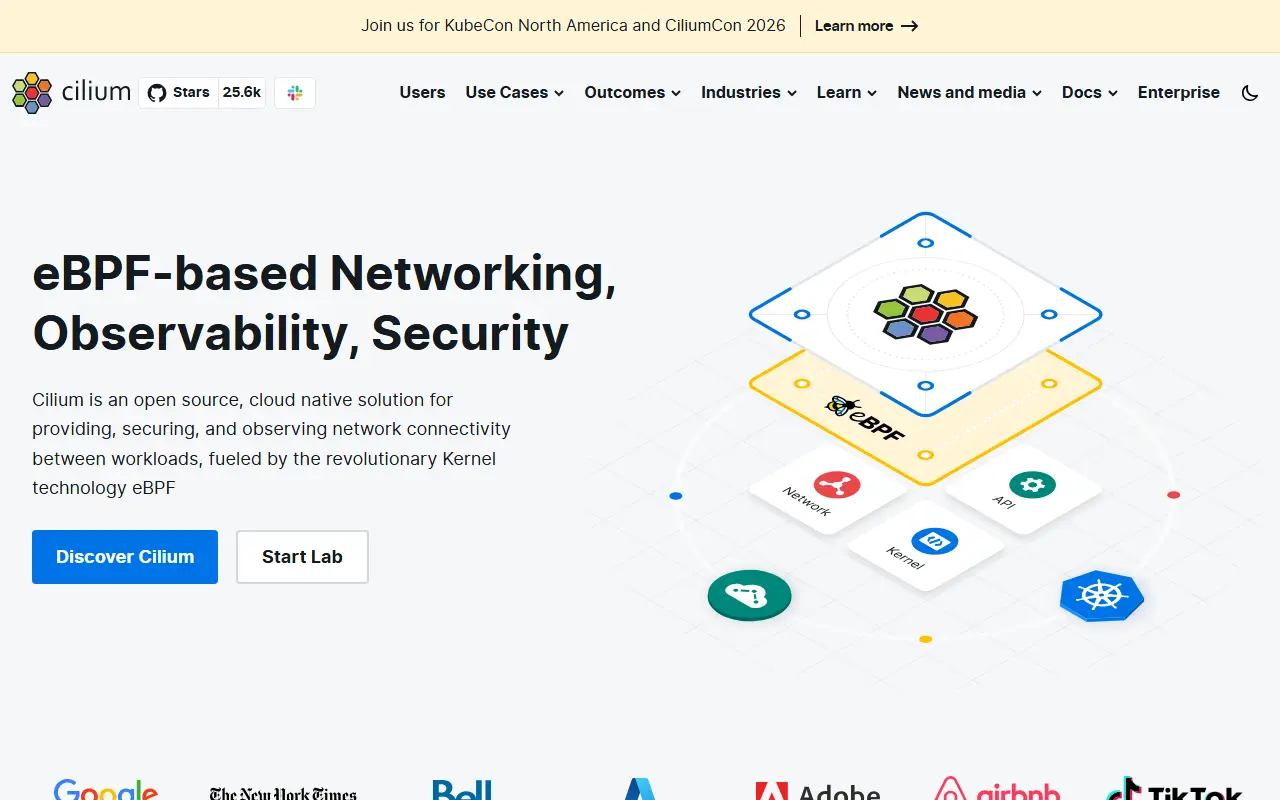
About Cilium
Cilium is a cloud native project that uses eBPF, a technology that runs sandboxed programs inside the Linux kernel, to provide networking, security and observability for containerized workloads. It is most often deployed in Kubernetes clusters as the container network interface, replacing traditional iptables-based approaches.
Its topics show the breadth of the project: Kubernetes networking and CNI, load balancing, XDP, security, kernel-level monitoring and troubleshooting. Because policies and visibility are implemented in the kernel, it can enforce network rules and observe traffic between services with relatively low overhead. The project website describes it simply as cloud native, eBPF-based networking, observability and security.
Cilium is written in Go and Apache-2.0 licensed, and it runs on your own clusters rather than as a hosted service, though several cloud providers integrate it into managed Kubernetes. It suits platform and security teams that operate Kubernetes at scale and need fine-grained network policy plus insight into service-to-service traffic.
Key features
- eBPF-powered Kubernetes networking
- Network security policies
- Kernel-level load balancing
- Traffic observability and troubleshooting
- XDP acceleration support
- Container network interface plugin
Good fit for
- →Kubernetes cluster networking
- →Enforcing network policy between services
- →Observing traffic in container platforms
- Tags
- ebpf
- kubernetes
- networking
- cni
- security
- observability
- service-mesh
- go
- cloud-native
Cilium: questions and answers
- What is Cilium used for?
- Cilium is an eBPF-based networking, security and observability layer for cloud native and Kubernetes environments, covering container networking, policies and load balancing. It is a good fit for Kubernetes cluster networking, enforcing network policy between services and observing traffic in container platforms.
- Is Cilium open source?
- Yes. Cilium is open source under the Apache-2.0 licence. Its source code is on GitHub at cilium/cilium and is written mainly in Go.
- Is Cilium free?
- Yes. Cilium is open source, so the software itself is free to use.
- Can I self-host Cilium?
- Yes. Cilium can be self-hosted on your own server or infrastructure; there is no official hosted version.
- What is Cilium an alternative to?
- Cilium is an open-source alternative to Illumio.
- Is Cilium actively maintained?
- Yes. The most recent commit to Cilium was on 2 October 2026, and the latest release is v1.20.2, published on 16 September 2026. The project has 26k stars on GitHub.
Open-source alternatives to Cilium
See all
OpenZiti
Networking & VPN
The parent project for OpenZiti. Here you will find the executables for a fully zero-trust
Apache-2.0vs Twingate★ 4.4k
Traefik
Networking & VPN
The Cloud Native Application Proxy
MIT★ 65k
Nebula
Networking & VPN
A scalable overlay networking tool with a focus on performance, simplicity and security
MITvs Tailscale★ 18k
OpenVPN
Networking & VPN
OpenVPN is an open source VPN daemon
OSSvs NordLayer★ 15k
Netmaker
Networking & VPN
Securely connect your devices, clouds, and sites with Netmaker's Zero Trust platform.
OSSvs Tailscale★ 12k
Zoraxy
Networking & VPN
A general purpose HTTP reverse proxy and forwarding tool. Now written in Go!
AGPL-3.0★ 5.5k
SaaS alternatives to Cilium
See all
Illumio
Security
Zero-trust segmentation platform that limits lateral movement in data centers and cloud
SaaS
Cloudflare
Networking & VPN
CDN, DNS, DDoS protection and edge computing platform
SaaS
Fastly
Networking & VPN
Edge cloud platform for CDN, security and serverless compute
SaaS
NordVPN
Networking & VPN
Consumer VPN service with threat protection, double VPN and meshnet
SaaS
Private Internet Access
Networking & VPN
Consumer VPN service with a large server network and configurable privacy settings
SaaS
Proton VPN
Networking & VPN
VPN service from Proton with a no-logs policy and a free tier
SaaS