7,363 open-source and SaaS tools, with GitHub stats refreshed every day.

4 alternatives ranked by real activity

Open-source Groundcover alternatives

A curated, ranked list of the 4 best open-source alternatives to Groundcover.

The best open-source alternative to Groundcover is SigNoz. If that doesn't suit you, other good options are Coroot, Pixie and Odigos.

Groundcover alternatives are mainly monitoring & observability tools. 4 of them shipped code in the last 30 days, 4 can be self-hosted, and 3 use a permissive licence.

Last updated October 2, 2026 · ranked by GitHub stars, growth and recent commits

SigNoz

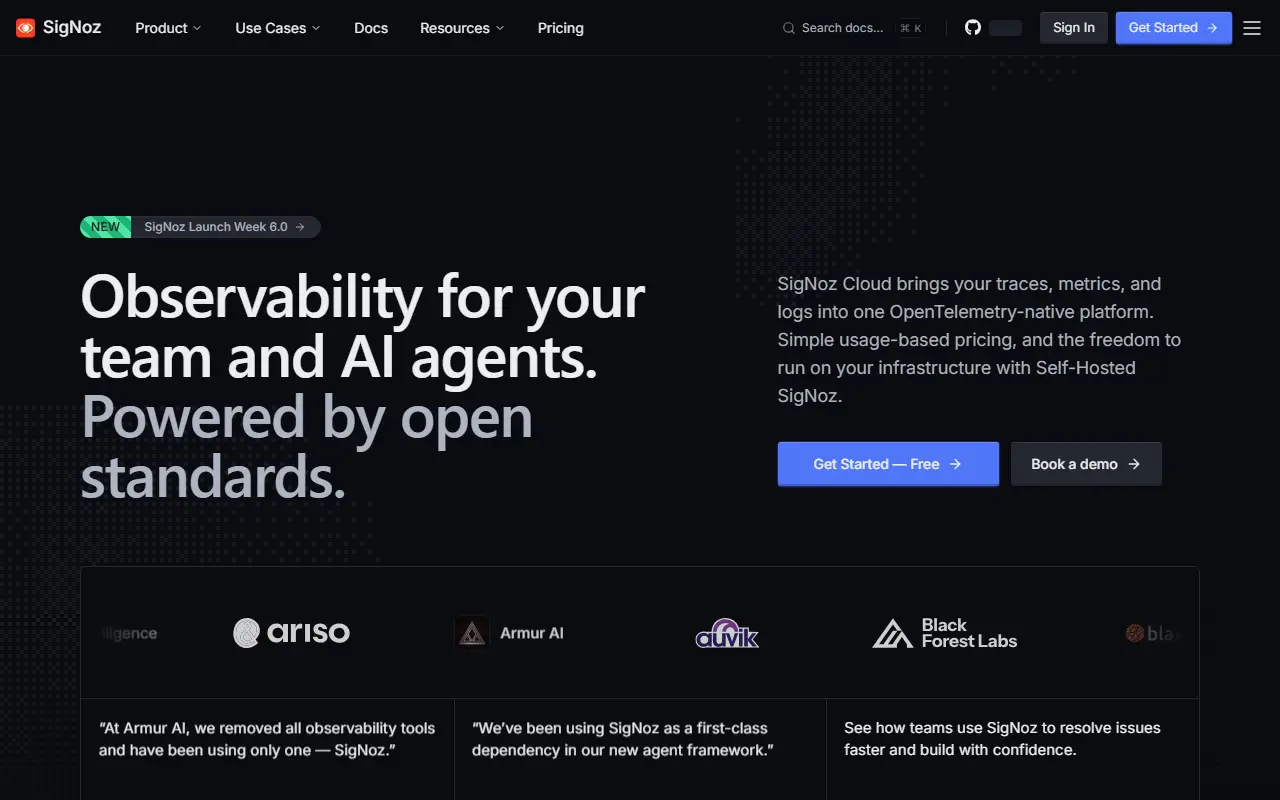
An open-source observability platform built on OpenTelemetry that unifies APM, logs, metrics, traces, alerts and dashboards in one tool, self-hosted or in the cloud.

GitHub stars
32k
Last commit
yesterday
Latest release
v0.144.0
Self-hosted
Yes
Hosted version
Available
signoz.ioSigNoz homepage screenshot

SigNoz is an observability platform, open source and built on OpenTelemetry. It aims to replace a fragmented monitoring stack with a single place for logs, metrics, traces, alerts, exceptions and dashboards, and it presents itself as useful for both engineering teams and their AI agents.

The APM view follows how each service performs, covering latency, error rate, throughput, Apdex, the busiest endpoints, and calls to databases and external services. Log management supports ingesting, searching and correlating logs with traces and metrics through a visual query builder. Dashboards can be built with a query builder, PromQL or ClickHouse SQL, infrastructure monitoring covers Kubernetes clusters, pods, nodes and host resources, and LLM and AI observability traces prompts, tool calls, tokens, latency and cost.

You can choose how to run it. SigNoz Cloud is fully managed, with a 30-day free trial and usage-based pricing that starts at $49. Enterprise options cover cloud, bring-your-own-cloud and self-hosted deployments with extra support and controls. The free Community edition runs in your own infrastructure via Docker, Kubernetes or Linux. The repository license is listed as 'Other' on GitHub.

Key features

  • OpenTelemetry-native logs, metrics and traces
  • APM with latency, error rate and Apdex
  • Log management with a visual query builder
  • Dashboards via query builder, PromQL or SQL
  • Kubernetes infrastructure monitoring
  • LLM and AI application observability
  • Alerts and exception tracking

Pricing: Self-hosted Community is free. SigNoz Cloud Teams starts at $49 per month including $49 of usage, then usage-based per GB; Enterprise is custom and starts at $4000 per month.

Read more about SigNozWebsite GitHub

Coroot

An open-source observability and APM tool that uses eBPF to collect metrics, logs, traces and profiles automatically, with SLO alerting and AI-assisted root cause analysis.

GitHub stars
7.9k
Last commit
2 days ago
Latest release
v1.27.0
Licence
Apache-2.0
Self-hosted
Yes
coroot.comCoroot homepage screenshot

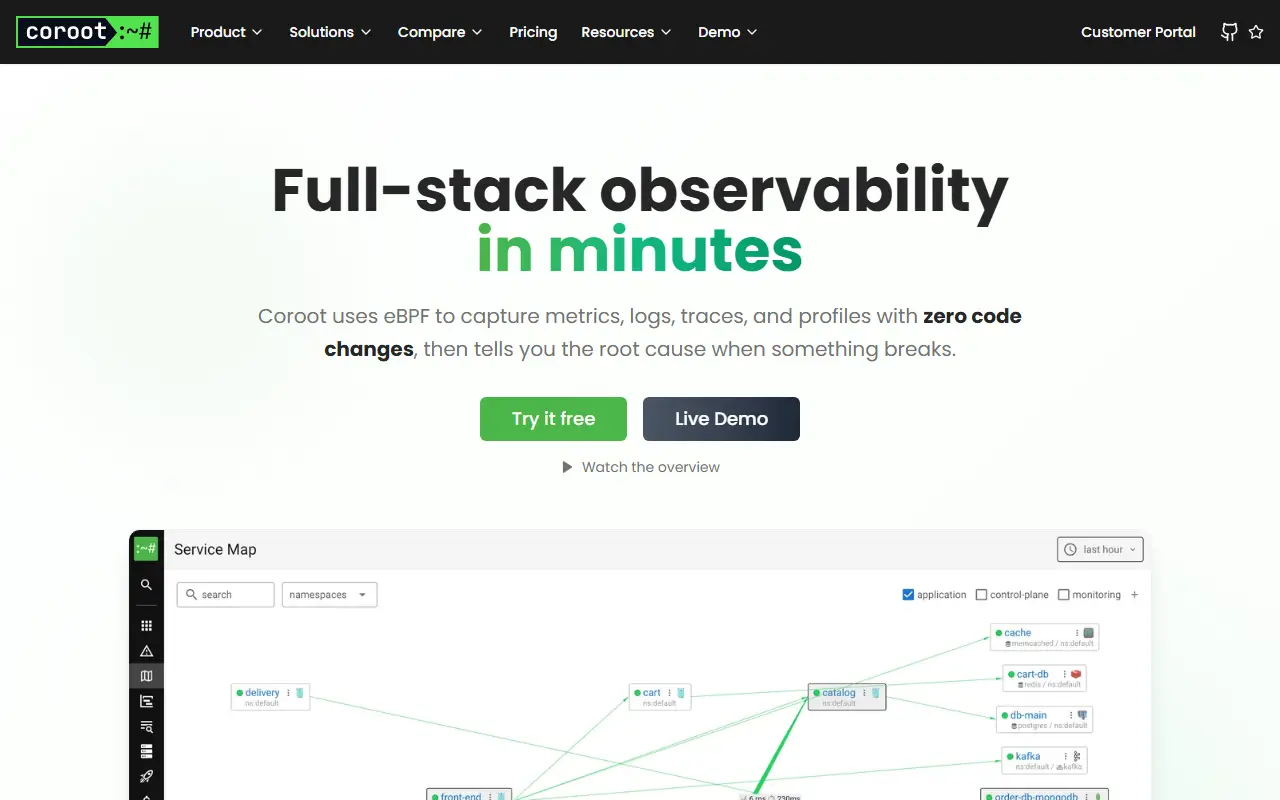
Coroot is an open-source observability and application performance monitoring tool. Its pitch is that collecting metrics, logs and traces is not enough on its own, so it turns the data into actionable insights, including AI-powered root cause analysis, predefined inspections and a service map.

It gathers metrics, logs, traces and continuous profiles automatically with eBPF, so legacy and third-party services can be observed without code changes, and it is also vendor-neutral through OpenTelemetry instrumentation. Features include a service map, application health summaries, SLO tracking and alerting, distributed tracing, log pattern clustering with logs-to-traces correlation using ClickHouse, and one-click profiling that drills down to the line of code. Predefined inspections audit each application without configuration.

Coroot is written in Go and licensed under Apache-2.0, with a live demo, documentation and a separate Coroot Enterprise edition. Topics include database monitoring, microservices and Prometheus. It suits SRE and platform teams that want observability for Kubernetes and Linux workloads without manually instrumenting every service.

Key features

  • eBPF-based zero-instrumentation data collection
  • Service map of the whole system
  • SLO tracking and alerting
  • Distributed tracing with OpenTelemetry
  • Continuous profiling to the code line
  • Log pattern clustering
  • AI-powered root cause analysis

Pricing: Open-source Community Edition is free. Standard is $1 per monitored CPU core per month with a 14-day trial; Premium with 24x7 support is quoted by sales.

Read more about CorootWebsite GitHub

Pixie

Pixie is an open-source Kubernetes observability tool that uses eBPF to gather telemetry automatically and stores the data inside your cluster.

GitHub stars
6.5k
Last commit
9 days ago
Latest release
release/cloud/v0.1.9
Licence
Apache-2.0
Self-hosted
Yes
px.devPixie homepage screenshot

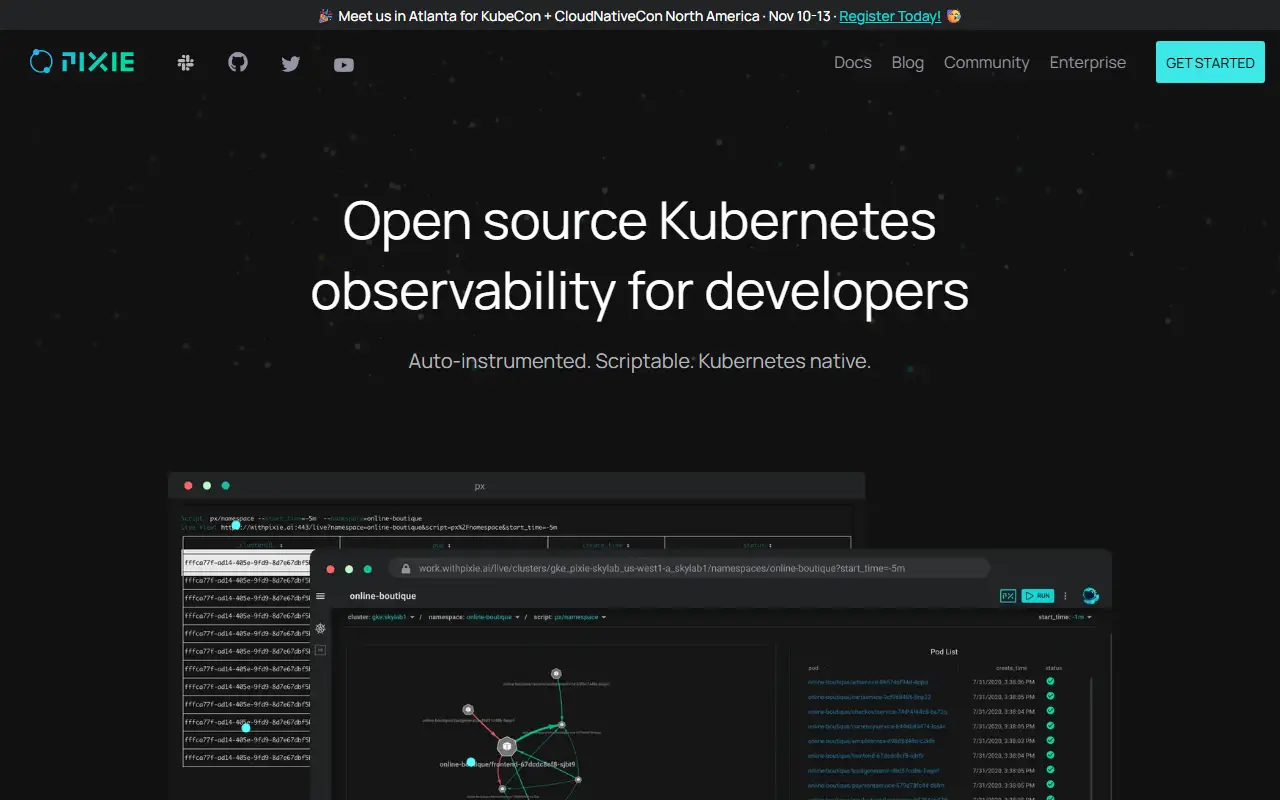
Pixie is an open-source observability platform made for applications running on Kubernetes. It gives a high-level view of a cluster, including service maps, resource usage and application traffic, and lets you drill into individual pods, flame graphs and full request bodies without adding instrumentation code to your services.

It relies on eBPF to gather telemetry automatically, covering requests, resource and network metrics and application profiles. Data is collected, stored and queried on the cluster itself, an approach the project calls in-cluster edge compute, which keeps raw telemetry local and limits overhead. Scripts written in a Python-based, dataframe-style language let you build custom views, and the project is hosted by the Cloud Native Computing Foundation.

Pixie is licensed under Apache-2.0 and is installed into your own Kubernetes cluster, whether a local one such as minikube or a managed cluster on GKE, EKS or AKS. It suits platform and application teams that want fast insight into service behavior without a separate agent-heavy monitoring stack.

Key features

  • Automatic eBPF-based telemetry collection
  • Service maps and cluster resource views
  • Flame graphs and application profiling
  • Full-body request inspection per pod
  • In-cluster data storage and querying
  • Scriptable custom views with Pixie scripts

Pricing: Free and open source under the Apache-2.0 license.

Read more about PixieWebsite GitHub

Odigos

Odigos generates distributed traces for applications on Kubernetes and VMs without code changes, using OpenTelemetry and eBPF.

GitHub stars
3.7k
Last commit
yesterday
Latest release
v1.37.1
Licence
Apache-2.0
Self-hosted
Yes
odigos.ioOdigos homepage screenshot

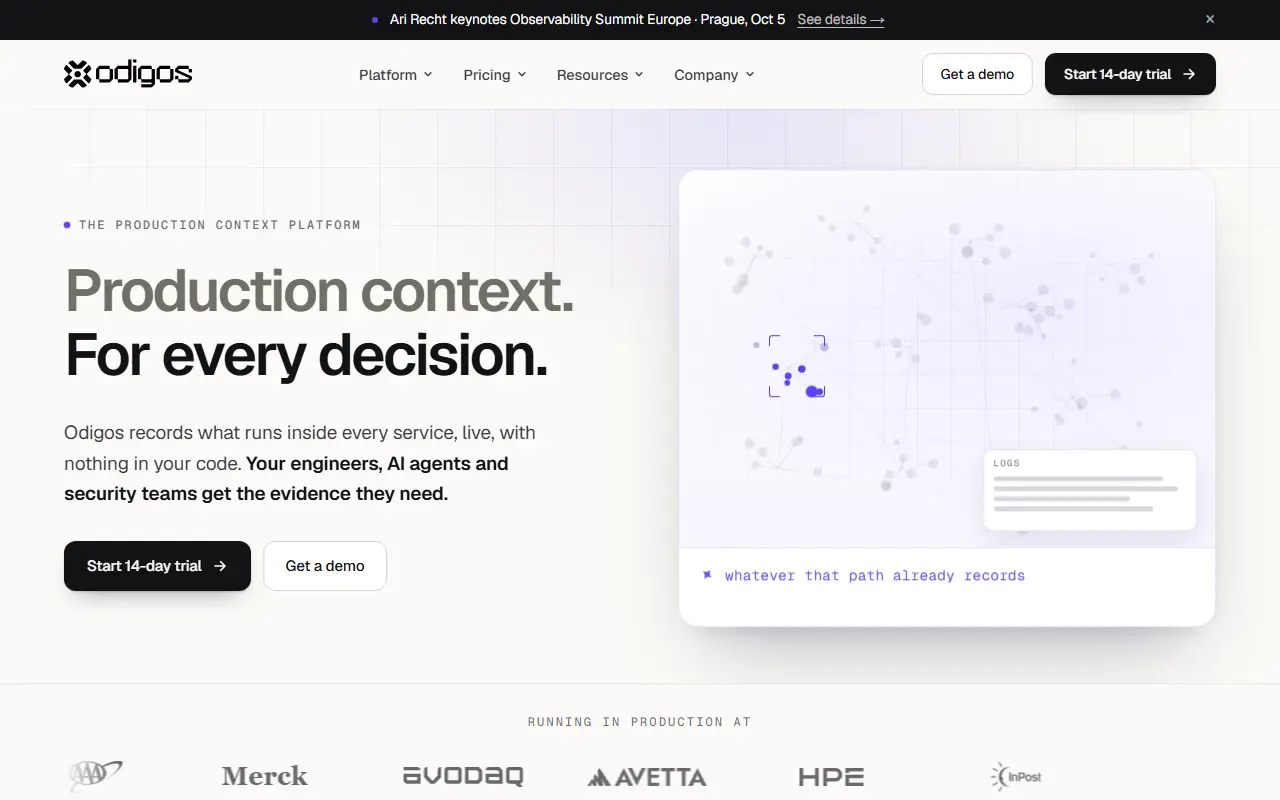
Odigos is an open-source distributed tracing solution aimed at Kubernetes environments and virtual machines. Its core promise is instant tracing without changing application code, which helps platform engineers, DevOps professionals and SREs improve observability quickly.

It builds on OpenTelemetry and eBPF to instrument applications automatically, covering languages such as Go, Java, .NET, Node.js and Python according to the repository topics, and it can emit traces, metrics and logs. The data can be sent to many observability back ends, so it fits into existing monitoring stacks. Documentation, a demo video and a Slack community are linked from the README. It is written in Go.

Odigos is licensed under Apache-2.0 and installed into your own cluster. It suits teams that want OpenTelemetry coverage across many services without rolling out SDKs and code changes service by service.

Key features

  • Automatic instrumentation without code changes
  • Distributed tracing on Kubernetes and VMs
  • OpenTelemetry and eBPF based
  • Support for Go, Java, .NET, Node.js and Python
  • Metrics and logs alongside traces
  • Works with existing observability back ends

Pricing: The open-source edition is free under Apache 2.0. Enterprise is custom-priced through sales and starts with a 14-day trial, no credit card needed.

Read more about OdigosWebsite GitHub

Groundcover alternatives: questions

What is the best open-source alternative to Groundcover?
SigNoz is the top-ranked open-source alternative to Groundcover on Enlisted: An open-source observability platform built on OpenTelemetry that unifies APM, logs, metrics, traces, alerts and dashboards in one tool, self-hosted or in the cloud. Other strong options are Coroot, Pixie and Odigos.
Are these Groundcover alternatives free?
All 4 are open source, so the code is free to use under its licence, and all of them can be self-hosted on your own server or computer. 1 also offers a paid or managed cloud version if you'd rather not host it yourself.
How is this list of Groundcover alternatives ranked?
By a score built from GitHub stars, star growth over the last 30 days and how recently the code changed. 4 of these projects shipped code in the last 30 days. Data is refreshed daily, and nobody can pay to move up.

People also look for alternatives to…

View all