
About Pixie
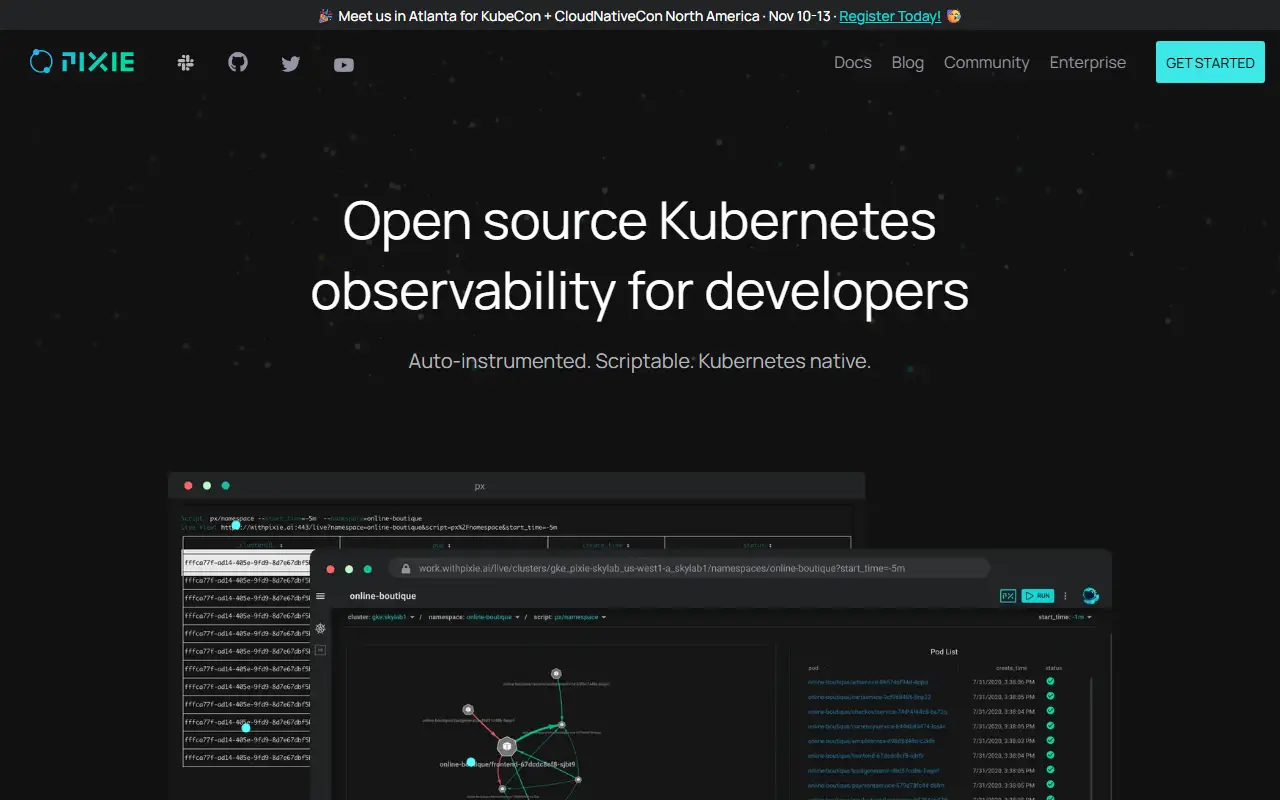
Pixie is an open-source observability platform made for applications running on Kubernetes. It gives a high-level view of a cluster, including service maps, resource usage and application traffic, and lets you drill into individual pods, flame graphs and full request bodies without adding instrumentation code to your services.
It relies on eBPF to gather telemetry automatically, covering requests, resource and network metrics and application profiles. Data is collected, stored and queried on the cluster itself, an approach the project calls in-cluster edge compute, which keeps raw telemetry local and limits overhead. Scripts written in a Python-based, dataframe-style language let you build custom views, and the project is hosted by the Cloud Native Computing Foundation.
Pixie is licensed under Apache-2.0 and is installed into your own Kubernetes cluster, whether a local one such as minikube or a managed cluster on GKE, EKS or AKS. It suits platform and application teams that want fast insight into service behavior without a separate agent-heavy monitoring stack.
Key features
- Automatic eBPF-based telemetry collection
- Service maps and cluster resource views
- Flame graphs and application profiling
- Full-body request inspection per pod
- In-cluster data storage and querying
- Scriptable custom views with Pixie scripts
Good fit for
- →Debugging microservices on Kubernetes
- →Profiling application performance in a cluster
- →Observability with no code instrumentation
- Tags
- kubernetes
- observability
- ebpf
- monitoring
- cncf
- profiling
- self-hosted
Pixie: questions and answers
- What is Pixie used for?
- Pixie is an open-source Kubernetes observability tool that uses eBPF to gather telemetry automatically and stores the data inside your cluster. It is a good fit for debugging microservices on Kubernetes, profiling application performance in a cluster and observability with no code instrumentation.
- Is Pixie open source?
- Yes. Pixie is open source under the Apache-2.0 licence. Its source code is on GitHub at pixie-io/pixie and is written mainly in C++.
- Is Pixie free?
- Yes. Pixie is open source, so the software itself is free to use.
- Can I self-host Pixie?
- Yes. Pixie can be self-hosted on your own server or infrastructure.
- What is Pixie an alternative to?
- Pixie is an open-source alternative to Datadog, IBM Instana and Groundcover. Other open-source alternatives to Datadog include Coroot, Odigos and SigNoz.
- Is Pixie actively maintained?
- Yes. The most recent commit to Pixie was on 24 September 2026. The project has 6.5k stars on GitHub.
Open-source alternatives to Pixie
See all
Coroot
Monitoring & Observability
Coroot is an open-source observability and APM tool with AI-powered Root Cause Analysis. I
Apache-2.0vs Datadog★ 7.9k
Odigos
Monitoring & Observability
Distributed tracing without code changes. 🚀 Instantly monitor any application using OpenT
Apache-2.0vs Datadog★ 3.7k
SigNoz
Monitoring & Observability
SigNoz Cloud is a one-stop observability tool built on top of OpenTelemetry. Get APM, logs
OSSvs Datadog★ 32k
Netdata
Monitoring & Observability
The fastest path to AI-powered full stack observability, even for lean teams.
GPL-3.0vs Datadog★ 81k
HyperDX
Monitoring & Observability
Resolve production issues, fast. An open source observability platform unifying session re
MITvs Datadog★ 9.9k
Uptrace
Monitoring & Observability
Open source APM: OpenTelemetry traces, metrics, and logs
AGPL-3.0vs Datadog★ 4.3k
SaaS alternatives to Pixie
See all
Datadog
Monitoring & Observability
Datadog is a cloud monitoring and observability platform that brings metrics, logs and traces from applications, tools and services into one place.
SaaS
IBM Instana
Monitoring & Observability
Automated application performance monitoring for microservices and containers
SaaS
Groundcover
Monitoring & Observability
eBPF-based observability that keeps collected data inside the customer's cloud
SaaS
AppDynamics
Monitoring & Observability
Cisco application performance monitoring that maps technical metrics to business impact
SaaS
Dynatrace
Monitoring & Observability
Full-stack observability with automatic instrumentation and AI-based root-cause analysis
SaaS
Honeycomb
Monitoring & Observability
Observability service for querying high-cardinality traces and events
SaaS