
About Odigos
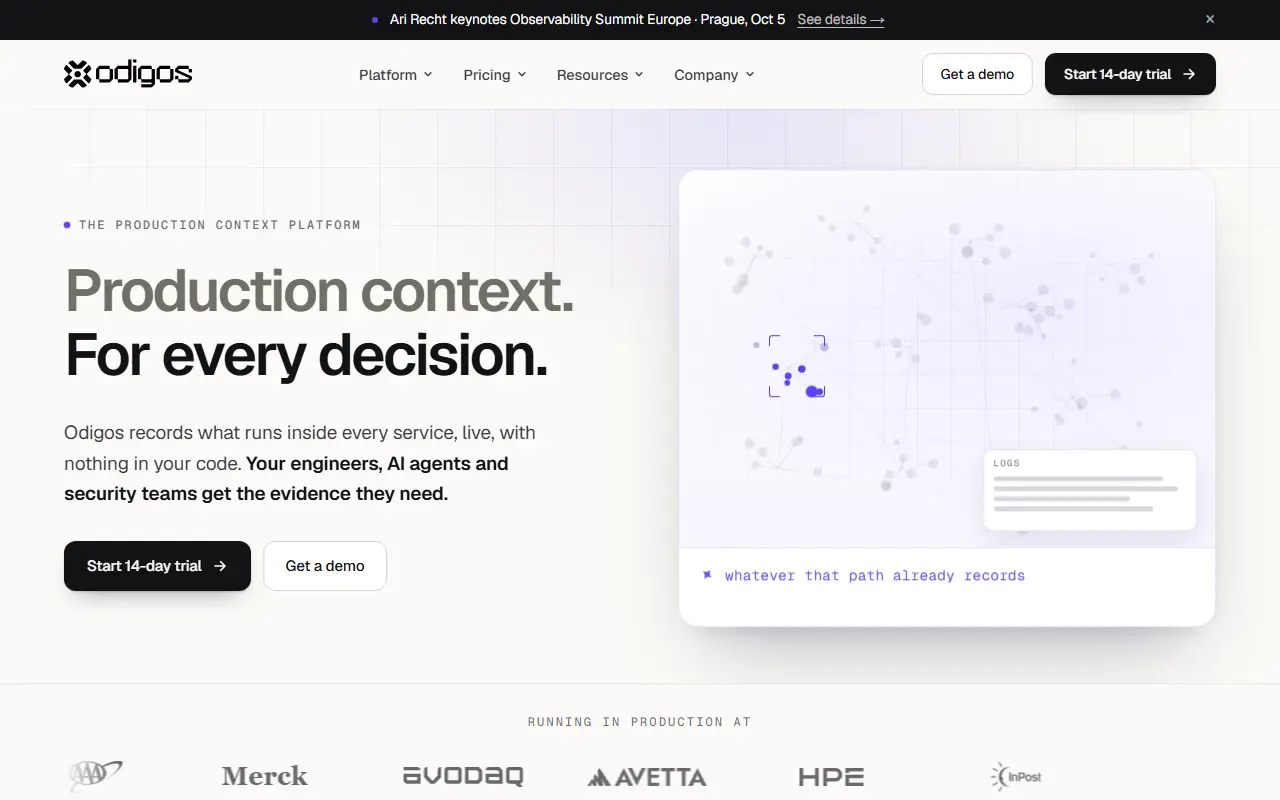
Odigos is an open-source distributed tracing solution aimed at Kubernetes environments and virtual machines. Its core promise is instant tracing without changing application code, which helps platform engineers, DevOps professionals and SREs improve observability quickly.
It builds on OpenTelemetry and eBPF to instrument applications automatically, covering languages such as Go, Java, .NET, Node.js and Python according to the repository topics, and it can emit traces, metrics and logs. The data can be sent to many observability back ends, so it fits into existing monitoring stacks. Documentation, a demo video and a Slack community are linked from the README. It is written in Go.
Odigos is licensed under Apache-2.0 and installed into your own cluster. It suits teams that want OpenTelemetry coverage across many services without rolling out SDKs and code changes service by service.
Key features
- Automatic instrumentation without code changes
- Distributed tracing on Kubernetes and VMs
- OpenTelemetry and eBPF based
- Support for Go, Java, .NET, Node.js and Python
- Metrics and logs alongside traces
- Works with existing observability back ends
Good fit for
- →Adding tracing to legacy services quickly
- →Rolling out OpenTelemetry across a cluster
- Tags
- opentelemetry
- tracing
- ebpf
- kubernetes
- observability
- golang
- monitoring
- auto-instrumentation
Odigos: questions and answers
- What is Odigos used for?
- Odigos generates distributed traces for applications on Kubernetes and VMs without code changes, using OpenTelemetry and eBPF. It is a good fit for adding tracing to legacy services quickly and rolling out OpenTelemetry across a cluster.
- Is Odigos open source?
- Yes. Odigos is open source under the Apache-2.0 licence. Its source code is on GitHub at odigos-io/odigos and is written mainly in Go.
- Is Odigos free?
- Yes. Odigos is open source, so the software itself is free to use.
- Can I self-host Odigos?
- Yes. Odigos can be self-hosted on your own server or infrastructure.
- What is Odigos an alternative to?
- Odigos is an open-source alternative to Datadog, Dynatrace, IBM Instana and Groundcover. Other open-source alternatives to Datadog include Coroot, SigNoz and Pixie.
- Is Odigos actively maintained?
- Yes. The most recent commit to Odigos was on 2 October 2026, and the latest release is v1.37.1, published on 18 September 2026. The project has 3.7k stars on GitHub.
Open-source alternatives to Odigos
See all
Coroot
Monitoring & Observability
Coroot is an open-source observability and APM tool with AI-powered Root Cause Analysis. I
Apache-2.0vs Datadog★ 7.9k
SigNoz
Monitoring & Observability
SigNoz Cloud is a one-stop observability tool built on top of OpenTelemetry. Get APM, logs
OSSvs Datadog★ 32k
Pixie
Monitoring & Observability
Instant Kubernetes-Native Application Observability
Apache-2.0vs Datadog★ 6.5k
Uptrace
Monitoring & Observability
Open source APM: OpenTelemetry traces, metrics, and logs
AGPL-3.0vs Datadog★ 4.3k
Netdata
Monitoring & Observability
The fastest path to AI-powered full stack observability, even for lean teams.
GPL-3.0vs Datadog★ 81k
Pinpoint
Monitoring & Observability
APM, (Application Performance Management) tool for large-scale distributed systems.
Apache-2.0vs Dynatrace★ 14k
SaaS alternatives to Odigos
See all
Datadog
Monitoring & Observability
Datadog is a cloud monitoring and observability platform that brings metrics, logs and traces from applications, tools and services into one place.
SaaS
Dynatrace
Monitoring & Observability
Full-stack observability with automatic instrumentation and AI-based root-cause analysis
SaaS
IBM Instana
Monitoring & Observability
Automated application performance monitoring for microservices and containers
SaaS
Groundcover
Monitoring & Observability
eBPF-based observability that keeps collected data inside the customer's cloud
SaaS
Honeycomb
Monitoring & Observability
Observability service for querying high-cardinality traces and events
SaaS
AppDynamics
Monitoring & Observability
Cisco application performance monitoring that maps technical metrics to business impact
SaaS