 TrackMedia
 TrackRev

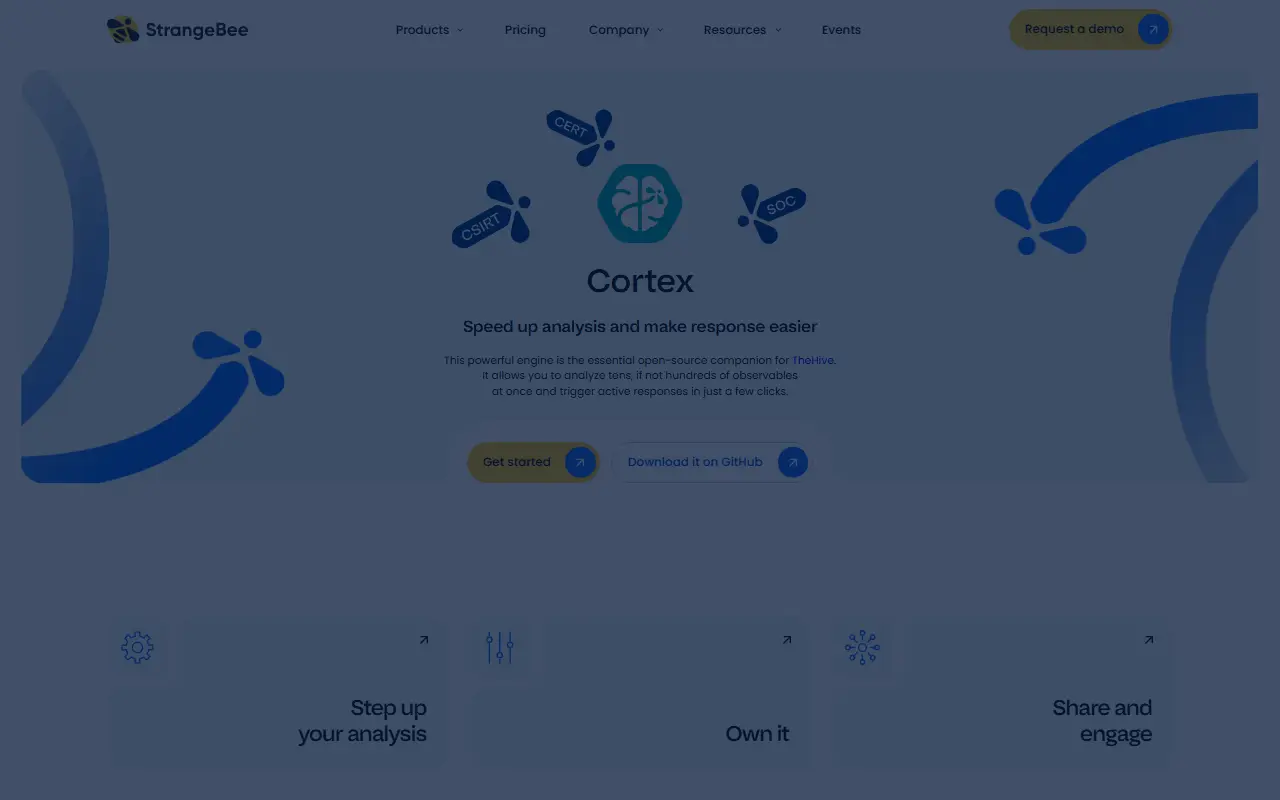
About Cortex
Cortex was created by TheHive Project for SOCs, CSIRTs and security researchers who need to analyze collected observables at scale from one tool instead of several. Observables such as IP and email addresses, URLs, domain names, files or hashes can be analyzed one by one or in bulk, through a web interface or the REST API.
Analysis is done by analyzers, which are programs written in Python or any other language supported by Linux. The project site lists more than a hundred for services such as VirusTotal, Joe Sandbox, Shodan and Onyphe, and responders can be written for active response workflows. The back end is written in Scala with an AngularJS front end.
Cortex is the companion engine for TheHive and also works with MISP in both directions. It is free software released under the AGPL. Organisations can be created with their own users and analyzer settings, and a stateless REST API lets it scale horizontally.
Key features
- Observables analyzed singly or in bulk from a web interface
- REST API for automating analysis
- More than a hundred analyzers for popular services
- Custom responders for active response workflows
- Analyzers can be written in any Linux-supported language
- Organizations with their own users and analyzer settings
- Two-way integration with MISP
Good fit for
- Checking file hashes against VirusTotal
- Enriching MISP events
- Automating incident response actions
Cortex: questions and answers
- What is Cortex used for?
- Cortex is an open source observable analysis and active response engine that runs analyzers and responders on IPs, URLs, files and hashes. It is a good fit for checking file hashes against VirusTotal, enriching MISP events and automating incident response actions.
- Is Cortex open source?
- Yes. Cortex is open source under the AGPL-3.0 licence. Its source code is on GitHub at TheHive-Project/Cortex and is written mainly in Scala.
- Is Cortex free?
- Yes. Cortex is open source, so the software itself is free to use.
- Can I self-host Cortex?
- Yes. Cortex can be self-hosted on your own server or infrastructure.
- What is Cortex an alternative to?
- Cortex is an open-source alternative to Swimlane, Groundcover, Atlassian Compass and xMatters. Other open-source alternatives to Swimlane include Wazuh and Tracecat.
- Is Cortex actively maintained?
- Yes. The most recent commit to Cortex was on 20 October 2026, and the latest release is 4.2.0, published on 20 October 2026. The project has 1.6k stars on GitHub, with 16 added in the last 30 days.
Open-source alternatives to Cortex
See all
k6
Testing & QA
A modern load testing tool, using Go and JavaScript
AGPL-3.0vs OpenText LoadRunner★ 32k
Wazuh
Security
Wazuh - The Open Source Security Platform. Unified XDR and SIEM protection for endpoints a
OSSvs Splunk★ 18k
Cilium
Networking & VPN
eBPF-based Networking, Security, and Observability
Apache-2.0vs Illumio★ 26k
Tracecat
Security
Open-source security automation platform for teams and AI agents
AGPL-3.0vs Tines★ 3.9k
Prometheus
Monitoring & Observability
The Prometheus monitoring system and time series database.
Apache-2.0vs Datadog★ 68k
Backstage
CI/CD & DevOps
Backstage is an open framework for building developer portals
Apache-2.0vs Port★ 35k
SaaS alternatives to Cortex
See all
Swimlane
Security
Low-code security automation platform for case management and incident response
SaaS
Groundcover
Monitoring & Observability
eBPF-based observability that keeps collected data inside the customer's cloud
SaaS
Atlassian Compass
CI/CD & DevOps
Developer portal that catalogs services and tracks software component health
SaaS
xMatters
Monitoring & Observability
Incident response and service reliability platform for alerting and workflow automation
SaaS