
About Backstage
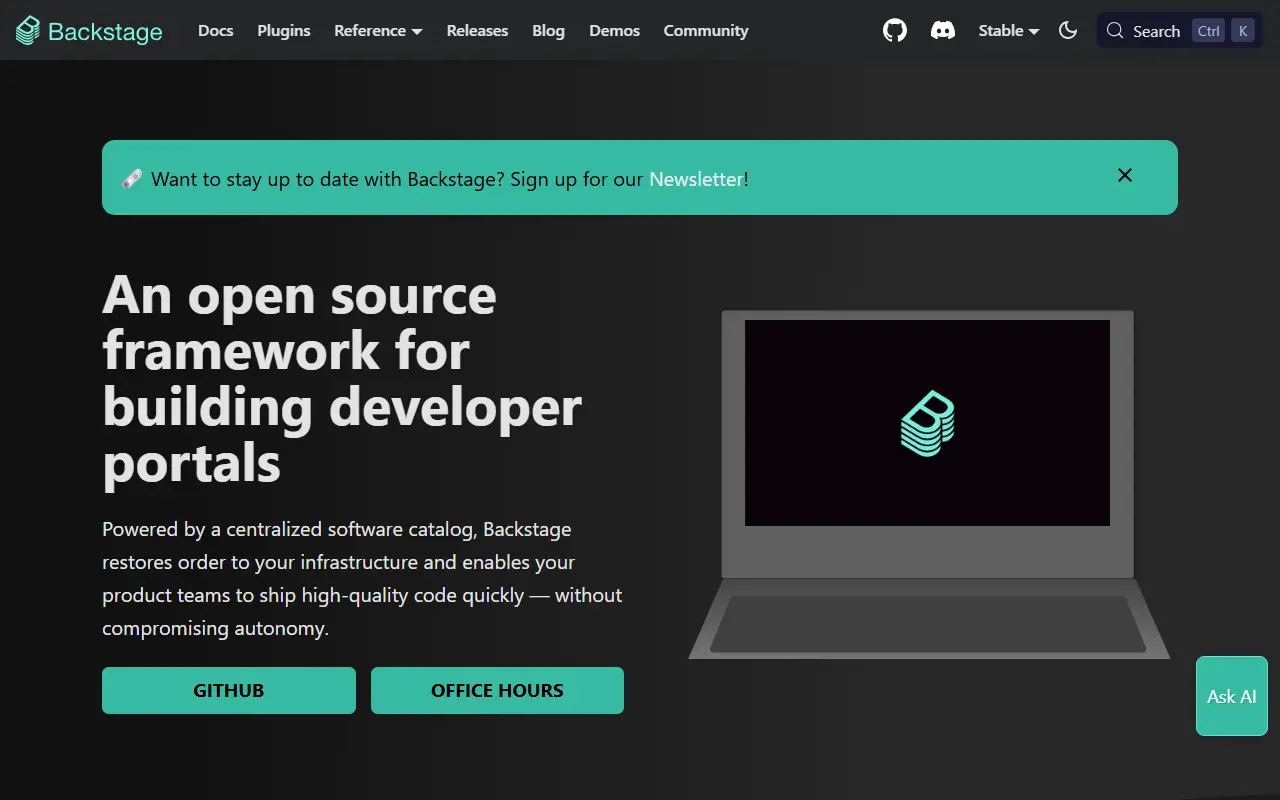
Backstage is a framework, published openly, for creating developer portals. It was created at Spotify and is now a Cloud Native Computing Foundation project at the incubation level. Centered on a software catalog, it brings order to microservices and infrastructure so product teams can ship code quickly while keeping their autonomy. It is written in TypeScript and released under the Apache-2.0 license.
Out of the box it includes a Software Catalog for tracking services, libraries, data pipelines, websites and machine learning models, Software Templates for starting new projects with organization-approved defaults, and TechDocs for a docs-like-code approach to documentation. A growing ecosystem of open-source plugins extends what the portal can show and do. Because it is a framework rather than a finished product, organizations build and host their own Backstage instance, guided by the getting started documentation and roadmap.
Key features
- Software Catalog for services and libraries
- Software Templates for new project scaffolding
- TechDocs with docs-like-code workflow
- Plugin ecosystem to extend the portal
- CNCF incubation project
- TypeScript framework you host yourself
Good fit for
- →Internal developer portal for a platform team
- →Standardizing how new services are created
- →Central catalog of microservices and owners
- Built with
- TypeScript
- Tags
- developer-portal
- platform-engineering
- software-catalog
- cncf
- microservices
- typescript
- plugins
- documentation
Backstage: questions and answers
- What is Backstage used for?
- Backstage is an open-source framework for building internal developer portals around a software catalog, templates and technical docs. It is a good fit for internal developer portal for a platform team, standardizing how new services are created, and central catalog of microservices and owners.
- Is Backstage open source?
- Yes. Backstage is open source under the Apache-2.0 licence. Its source code is on GitHub at backstage/backstage and is written mainly in TypeScript.
- Is Backstage free?
- Yes. Backstage is open source, so the software itself is free to use.
- Can I self-host Backstage?
- Yes. Backstage can be self-hosted on your own server or infrastructure.
- What is Backstage an alternative to?
- Backstage is an open-source alternative to Port, OpsLevel, Humanitec and Atlassian Compass. Other open-source alternatives to Humanitec include KubeVela.
- Is Backstage actively maintained?
- Yes. The most recent commit to Backstage was on 2 October 2026, and the latest release is v1.55.3, published on 29 September 2026. The project has 35k stars on GitHub.
Open-source alternatives to Backstage
See all
KubeVela
Infrastructure & Containers
The Modern Application Platform.
Apache-2.0vs Humanitec★ 7.9k
Harbor
CI/CD & DevOps
An open source trusted cloud native registry project that stores, signs, and scans content
Apache-2.0vs JFrog★ 29k
Jenkins
CI/CD & DevOps
Jenkins automation server
MITvs CircleCI★ 27k
Argo Workflows
CI/CD & DevOps
Workflow Engine for Kubernetes
Apache-2.0vs AWS Step Functions★ 17k
Flux
CI/CD & DevOps
Open and extensible continuous delivery solution for Kubernetes. Powered by GitOps Toolkit
Apache-2.0vs Octopus Deploy★ 8.4k
SuperPlane
CI/CD & DevOps
SuperPlane lets AI agents fully automate routine development work, with the rules, verific
Apache-2.0★ 7.7k
SaaS alternatives to Backstage
See all
Port
CI/CD & DevOps
Internal developer portal builder with a software catalog and self-service actions
SaaS
OpsLevel
CI/CD & DevOps
Internal developer portal with a service catalog and maturity scorecards
SaaS
Humanitec
CI/CD & DevOps
Platform orchestrator that provisions infrastructure for each deployment on request
SaaS
Atlassian Compass
CI/CD & DevOps
Developer portal that catalogs services and tracks software component health
SaaS
Faros AI
CI/CD & DevOps
Engineering intelligence platform that analyzes delivery metrics and developer productivity
SaaS
Qovery
Hosting & PaaS
Platform that deploys and manages applications on a team's own cloud accounts
SaaS