4 open-source alternatives ranked by real activity

Open-source OpsLevel alternatives

A curated, ranked list of the 4 best open-source alternatives to OpsLevel.

The best open-source alternative to OpsLevel is Grafana. If that doesn't suit you, other good options are Harness, Backstage and Cortex.

Commercial alternatives to OpsLevel include Humanitec, Port, Atlassian Compass and GitLab. See all 20.

OpsLevel alternatives are mainly monitoring & observability tools, but some are also CI/CD & DevOps tools. 4 of them shipped code in the last 30 days, 4 can be self-hosted, and 3 use a permissive licence.

Last updated November 13, 2026 · ranked by GitHub stars, growth and recent commits

Grafana

An open-source platform for visualizing metrics, logs and traces from many data sources, with dashboards, alerting and ad-hoc exploration.

GitHub stars
78k
Last commit
today
Latest release
v13.3.1
Licence
AGPL-3.0
Self-hosted
Yes
Hosted version
Available
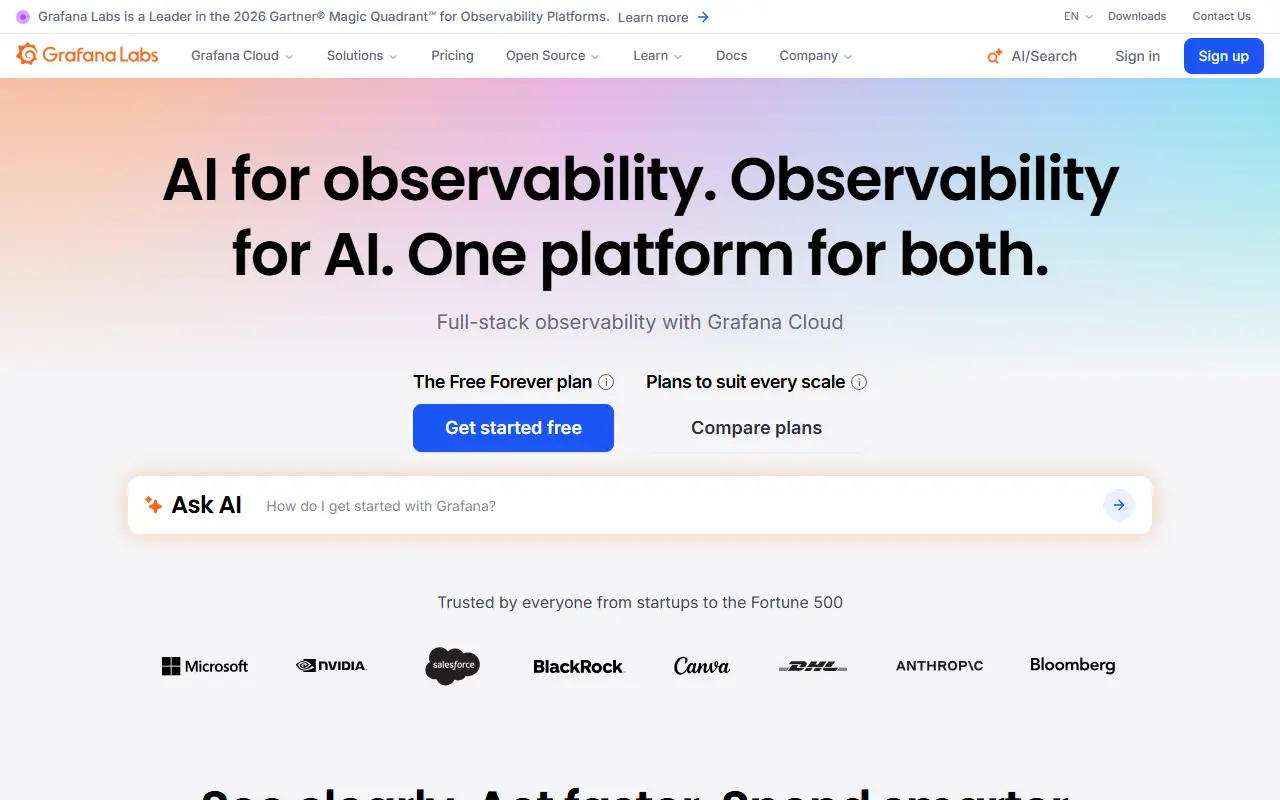
grafana.comGrafana homepage screenshot

Grafana is a visualization and observability platform that lets you query, chart and alert on data wherever it is stored. It does not hold your data itself; it connects to sources such as Prometheus, Loki, Elasticsearch, InfluxDB, MySQL and PostgreSQL and brings their results together in shared dashboards.

Dashboards can be made reusable with template variables that appear as dropdowns, and a single graph may mix queries against different data sources. Explore views support ad-hoc queries, side-by-side comparison of time ranges and a jump from metrics to logs while keeping label filters. Alert rules are defined visually, and notifications go to systems like Slack, PagerDuty, VictorOps and OpsGenie. Panel plugins add further visualization types.

Grafana is AGPL-3.0 licensed, written in Go and TypeScript, and can be installed on your own servers; Grafana Labs also runs a hosted offering. It is common in DevOps and SRE teams as the dashboard layer on top of Prometheus-style monitoring, and a public demo site lets you try it first.

Key features

  • Dashboards with template variables
  • Mixed data sources in a single graph
  • Visual alert rules with Slack and PagerDuty
  • Explore view for ad-hoc metric and log queries
  • Panel plugins for extra visualizations
  • Connects to Prometheus, Loki and SQL databases

Pricing: Grafana Cloud has an always-free tier with usage limits. Pro starts at $19 per month plus usage; Enterprise starts at a $25,000 annual spend commit and is sold through sales.

Harness

An open-source developer platform combining Git hosting, CI/CD pipelines, cloud development environments called Gitspaces and artifact registries, the successor to Drone.

GitHub stars
39k
Last commit
yesterday
Latest release
v2.28.2
Licence
Apache-2.0
Self-hosted
Yes
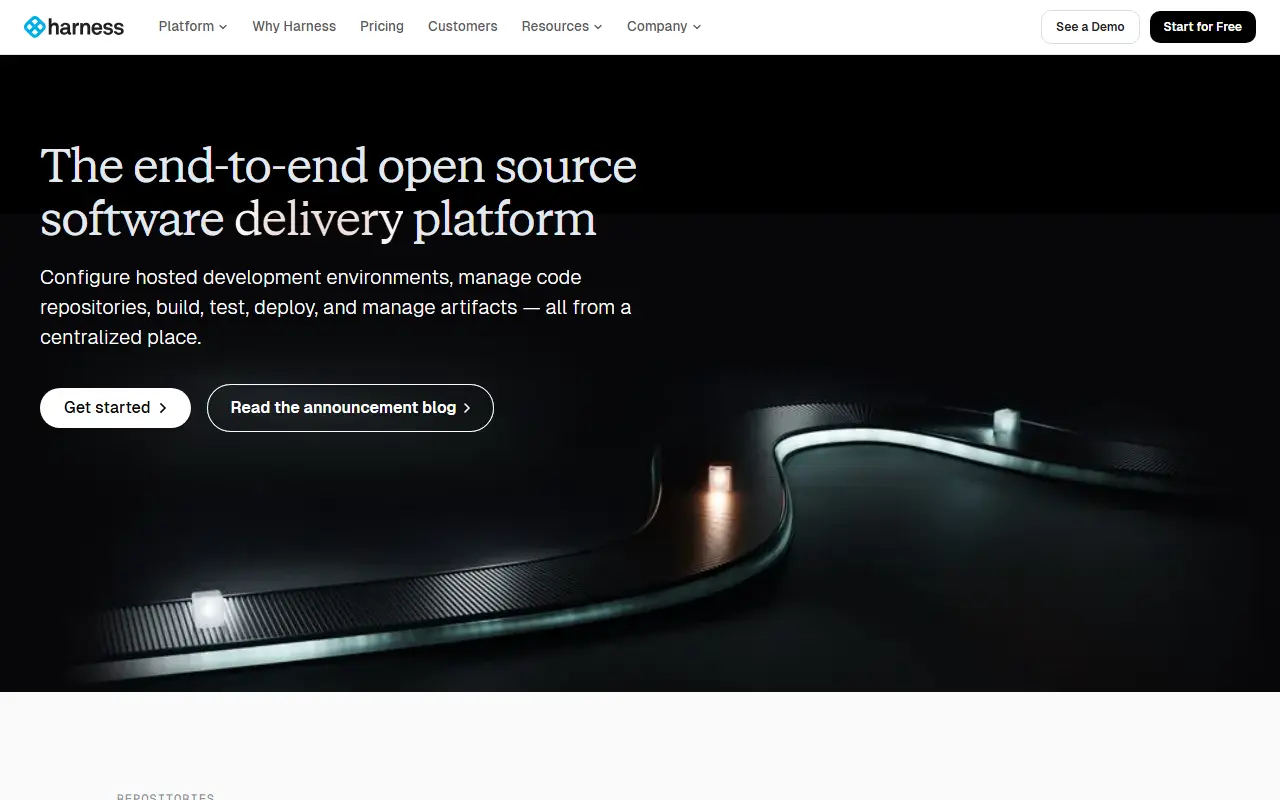
harness.ioHarness homepage screenshot

Harness Open Source is a developer platform written in Go that bundles source code hosting, automated pipelines, hosted development environments and artifact registries in one product. The idea is to give a team a complete, self-run DevOps toolchain rather than separate services for repositories, builds and package storage.

Its hosted development environments are called Gitspaces, and the platform also includes registries for build artifacts. Harness is presented as the next generation of Drone: Drone focused only on continuous integration, whereas Harness adds code hosting and developer environments. The maintainers say the goal is eventual parity with Drone's pipeline capabilities so users can migrate, and a snapshot of Drone lives on a separate branch so it can keep developing.

You can run Harness locally from the published Docker image and open it on port 3000. The image stores its database and repositories in a volume, so a bind mount or named volume is strongly recommended to avoid losing data when the container stops. The project is Apache-2.0 licensed, with documentation at developer.harness.io.

Key features

  • Git repository hosting
  • CI/CD pipelines for build automation
  • Gitspaces hosted development environments
  • Artifact registries for build outputs
  • Docker image for quick local setup
  • Migration path from Drone

Pricing: A free plan covers individual developers and small teams. The Essentials bundle and the modular Enterprise plan have no published prices and are quoted through sales.

Backstage

Backstage is an open-source framework for building internal developer portals around a software catalog, templates and technical docs.

GitHub stars
35k
Last commit
yesterday
Latest release
v1.56.4
Licence
Apache-2.0
Self-hosted
Yes
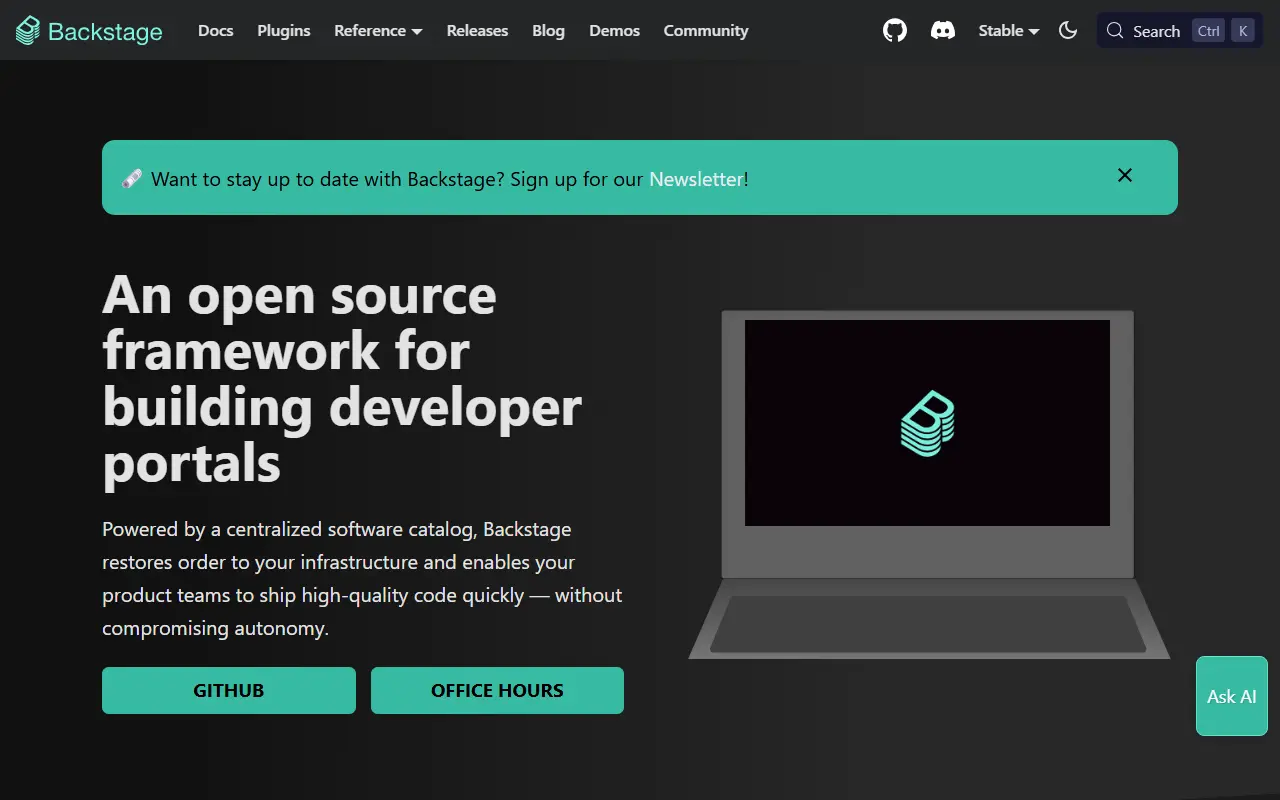
backstage.ioBackstage homepage screenshot

Backstage is a framework, published openly, for creating developer portals. It was created at Spotify and is now a Cloud Native Computing Foundation project at the incubation level. Centered on a software catalog, it brings order to microservices and infrastructure so product teams can ship code quickly while keeping their autonomy. It is written in TypeScript and released under the Apache-2.0 license.

Out of the box it includes a Software Catalog for tracking services, libraries, data pipelines, websites and machine learning models, Software Templates for starting new projects with organization-approved defaults, and TechDocs for a docs-like-code approach to documentation. A growing ecosystem of open-source plugins extends what the portal can show and do. Because it is a framework rather than a finished product, organizations build and host their own Backstage instance, guided by the getting started documentation and roadmap.

Key features

  • Software Catalog for services and libraries
  • Software Templates for new project scaffolding
  • TechDocs with docs-like-code workflow
  • Plugin ecosystem to extend the portal
  • CNCF incubation project
  • TypeScript framework you host yourself

Pricing: Free and open source under the Apache-2.0 license; you build and host your own instance.

Cortex

Cortex is a horizontally scalable, multi-tenant, long-term storage backend for Prometheus and OpenTelemetry metrics, written in Go.

GitHub stars
5.9k
Last commit
today
Latest release
v1.21.1
Licence
Apache-2.0
Self-hosted
Yes
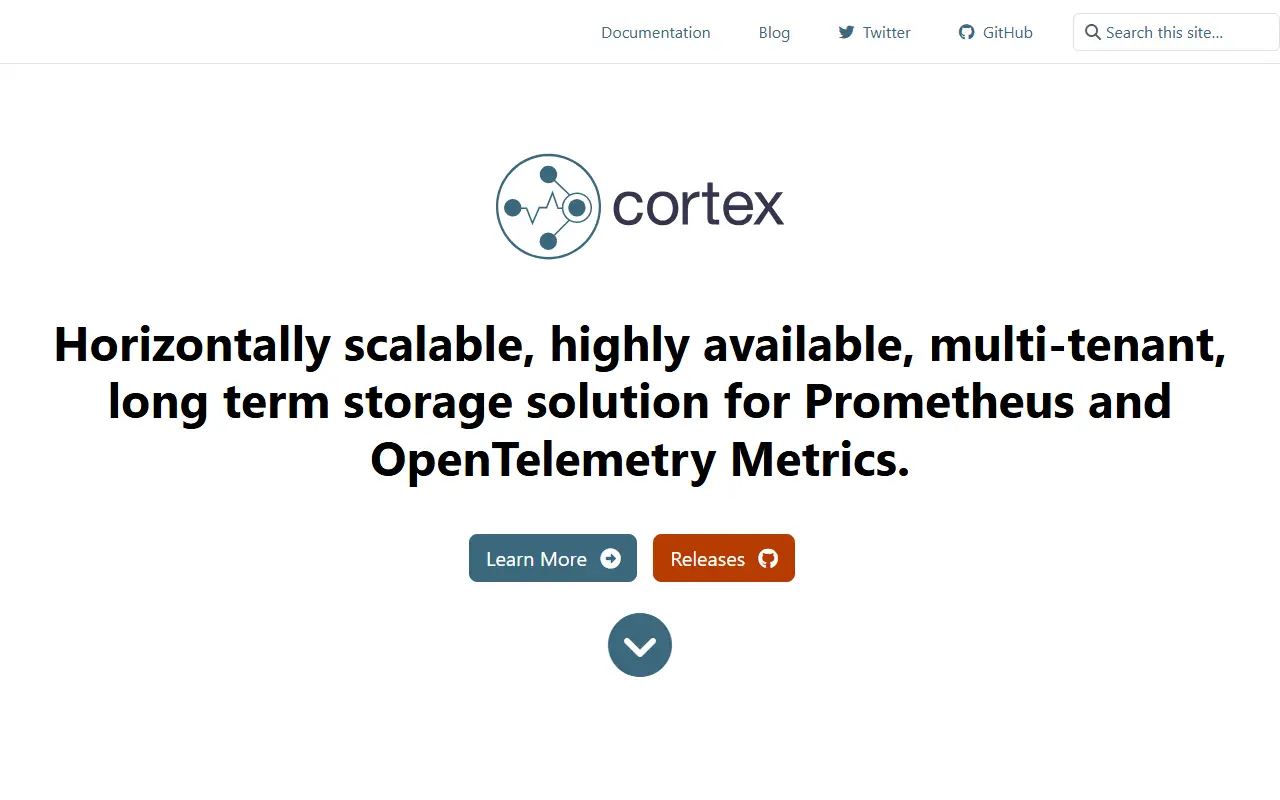
cortexmetrics.ioCortex homepage screenshot

Cortex is a storage and query layer for metrics that extends Prometheus beyond what a single server can handle. It runs as a cluster spread over several machines, which lets it go past the throughput and storage limits of a single node, and it replicates data between machines when run as a cluster so metrics remain available if a node fails.

A key feature is multi-tenancy: Cortex isolates data and queries from several independent Prometheus sources within a single cluster. It supports long-term storage of metric data on S3, GCS, Swift and Microsoft Azure object storage, and handles both Prometheus and OpenTelemetry metrics. The project is a CNCF project, and its documentation covers architecture, configuration, guides and security.

Cortex is licensed under Apache-2.0 and is run by you, typically on Kubernetes. It suits platform teams and service providers that need shared, durable, scalable metrics storage for many teams or customers.

Key features

  • Horizontally scalable metrics storage
  • Replication for high availability
  • Multi-tenant data and query isolation
  • Long-term storage on S3, GCS, Swift and Azure
  • Prometheus and OpenTelemetry metrics support
  • Runs on Kubernetes clusters

Pricing: Free and open source under the Apache-2.0 license.

Commercial OpsLevel alternatives

Hosted, closed-source products that compete with OpsLevel. Showing 12 of 20.

See every OpsLevel alternative on its tool page

OpsLevel alternatives: questions

What is the best open-source alternative to OpsLevel?
Grafana is the top-ranked open-source alternative to OpsLevel on Enlisted: An open-source platform for visualizing metrics, logs and traces from many data sources, with dashboards, alerting and ad-hoc exploration. Other strong options are Harness, Backstage and Cortex.
What are the best commercial alternatives to OpsLevel?
Humanitec, Port, Atlassian Compass, GitLab and Coda are among the hosted, closed-source alternatives to OpsLevel listed on Enlisted, which lists 20 in total. Compare their pricing and features on each tool page.
Are these OpsLevel alternatives free?
All 4 are open source, so the code is free to use under its licence, and all of them can be self-hosted on your own server or computer. 1 also offers a paid or managed cloud version if you'd rather not host it yourself.
How is this list of OpsLevel alternatives ranked?
By a score built from GitHub stars, star growth over the last 30 days and how recently the code changed. 4 of these projects shipped code in the last 30 days. Data is refreshed daily, and nobody can pay to move up.

People also look for alternatives to…

View all