 TrackMedia
 TrackRev

About Port
Port is a commercial platform for building an internal developer portal. Platform teams model their own software catalog, connecting services, infrastructure and tools, and then expose self-service actions so developers can provision resources and run workflows without waiting on tickets.
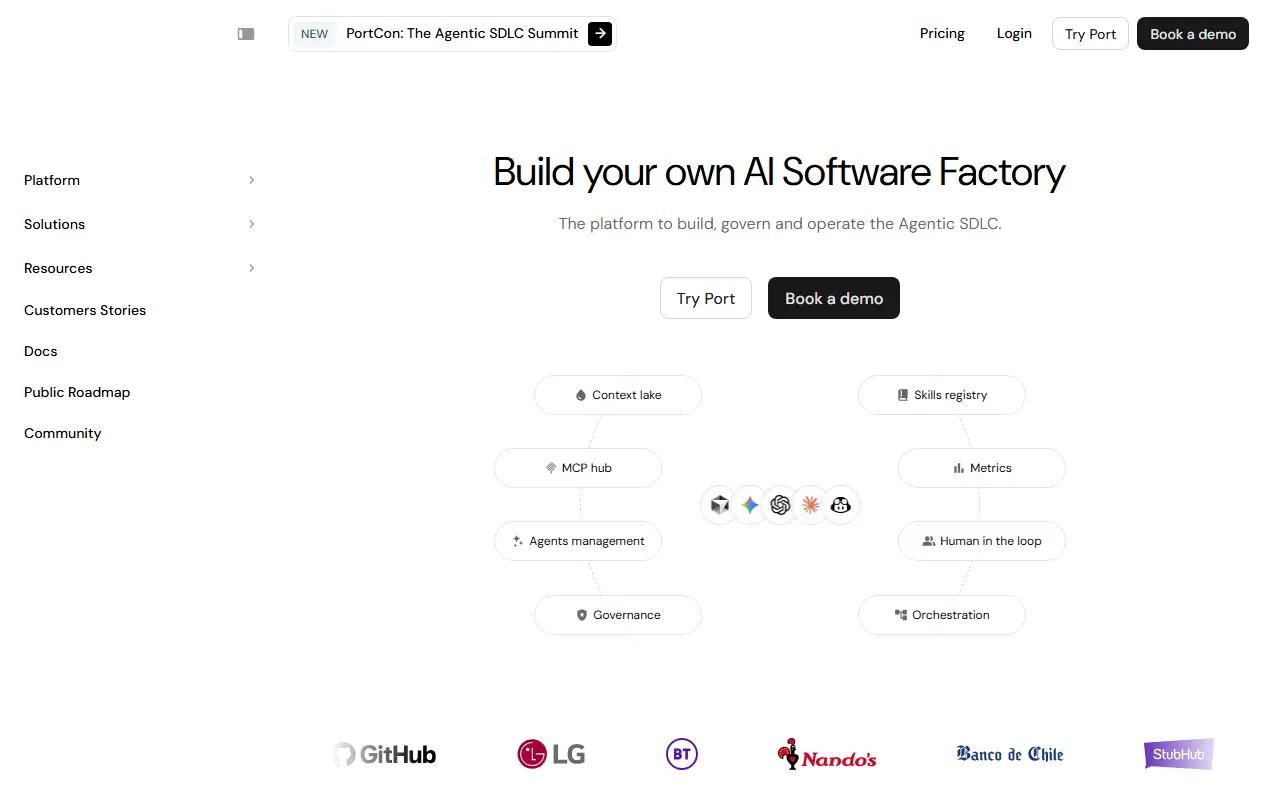
The vendor now positions Port as an agentic software delivery platform. It describes mapping an engineering environment into a live context layer, orchestrating agent-driven workflows across the software lifecycle with governance built in, automatically discovering agents, MCP servers and skills so standards can be enforced, and measuring the return on AI in engineering.
Port is a hosted proprietary product with a published pricing page, a login for existing customers and a request-a-demo flow for new ones. It is aimed at platform engineering teams that want a configurable portal rather than a fixed, opinionated interface.
Key features
- Customizable software catalog data model
- Self-service actions for developers
- Live context layer across the engineering environment
- Agentic workflow orchestration with governance
- Auto-discovery of agents, MCPs and skills
- ROI measurement for AI in engineering
Good fit for
- Building an internal developer portal
- Governing AI agents across engineering teams
- Offering developer self-service for infrastructure
Port: questions and answers
- What is Port used for?
- Port is an internal developer portal builder with a software catalog, self-service actions and, more recently, context and governance features for AI agents in the SDLC. It is a good fit for building an internal developer portal, governing AI agents across engineering teams and offering developer self-service for infrastructure.
- Is Port free?
- Yes. Port has a free plan, and paid plans start at $30 per seat per month. A free trial is also available.
- Is Port open source?
- No. Port is proprietary (closed-source) software and can't be self-hosted. Open-source alternatives to Port include Backstage and Cortex.
- What are some alternatives to Port?
- Port competes with OpsLevel, Humanitec and Swimlane. For open-source options, see Enlisted's ranked list of open-source Port alternatives.
Open-source alternatives to Port
See all
Backstage
CI/CD & DevOps
Backstage is an open framework for building developer portals
Apache-2.0vs Port★ 35k
Cortex
Monitoring & Observability
A horizontally scalable, highly available, multi-tenant, long term Prometheus.
Apache-2.0vs Arize AI★ 5.9k
SuperPlane
CI/CD & DevOps
SuperPlane lets AI agents fully automate routine development work, with the rules, verific
Apache-2.0★ 10k
Gitea
CI/CD & DevOps
Gitea - Git with a cup of tea! Painless self-hosted all-in-one software development servic
MITvs Bitbucket★ 59k
Harness
CI/CD & DevOps
Harness Open Source is an end-to-end developer platform with Source Control Management, CI
Apache-2.0vs GitHub Actions★ 39k
Jenkins
CI/CD & DevOps
Jenkins automation server
MITvs CircleCI★ 27k
SaaS alternatives to Port
See all
OpsLevel
CI/CD & DevOps
Internal developer portal with a service catalog and maturity scorecards
SaaS
Humanitec
CI/CD & DevOps
Platform orchestrator that provisions infrastructure for each deployment on request
SaaS
Swimlane
Security
Low-code security automation platform for case management and incident response
SaaS
Atlassian Compass
CI/CD & DevOps
Developer portal that catalogs services and tracks software component health
SaaS
Faros AI
CI/CD & DevOps
Engineering intelligence platform that analyzes delivery metrics and developer productivity
SaaSStackGen
CI/CD & DevOps
AI infrastructure automation that analyses an app and generates its cloud setup instead of hand-written Terraform
SaaS