#1
A static site generator written in Go that builds websites from Markdown and templates, with themes, modules and Sass support, for blogs and documentation.
- GitHub stars
- 90k
- Last commit
- yesterday
- Latest release
- v0.169.0
- Licence
- Apache-2.0
- Self-hosted
- Yes
gohugo.io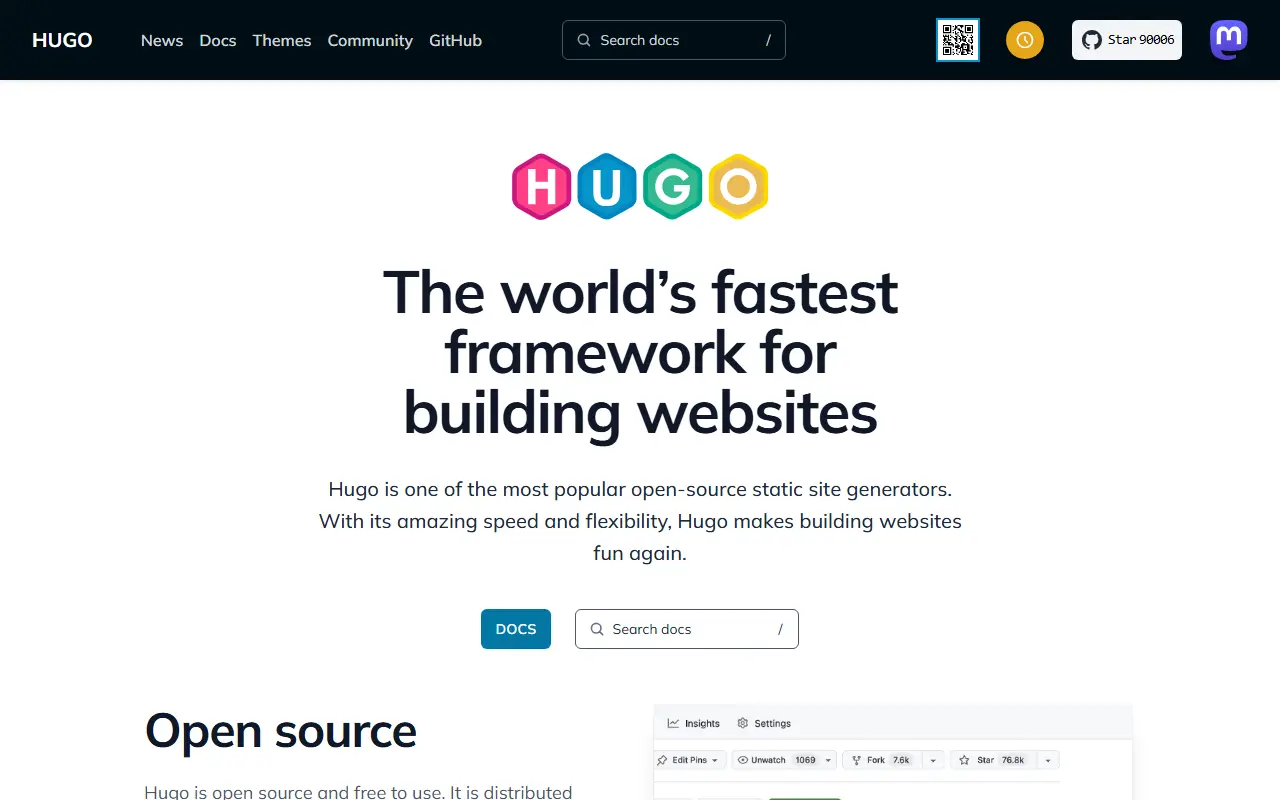
Hugo is a static site generator written in Go. You write content in Markdown, combine it with templates and a theme, and Hugo renders a folder of plain HTML, CSS and JavaScript that can be hosted almost anywhere without a server-side runtime or database. It is widely used for blogs, documentation sites and marketing pages.
It ships as a single prebuilt binary for Linux, macOS, Windows and the BSDs, and can also be built from source with Go and a C compiler. Hugo Modules let a site pull in themes and shared content as versioned components, a theme gallery gives starting points, and built-in functions transpile Sass to CSS. A deploy command and hosting guides cover publishing to common platforms.
The project is Apache-2.0 licensed and built by a community of contributors. Unlike a hosted CMS, there is no admin interface by default: editing happens in files, often tracked in Git, which suits developers and technical writers who prefer a plain-text workflow.
Key features
- Builds sites from Markdown content and templates
- Hugo Modules for themes and shared components
- Built-in Sass transpilation
- Single prebuilt binary for major platforms
- Large theme gallery
- Deploy command for common hosting targets
Pricing: Free and open source under the Apache-2.0 license.
#2
Jekyll is a static site generator that turns Markdown, Liquid templates, HTML and CSS into blogs and websites.
- GitHub stars
- 52k
- Last commit
- 1 mo ago
- Latest release
- v4.4.1
- Licence
- MIT
jekyllrb.com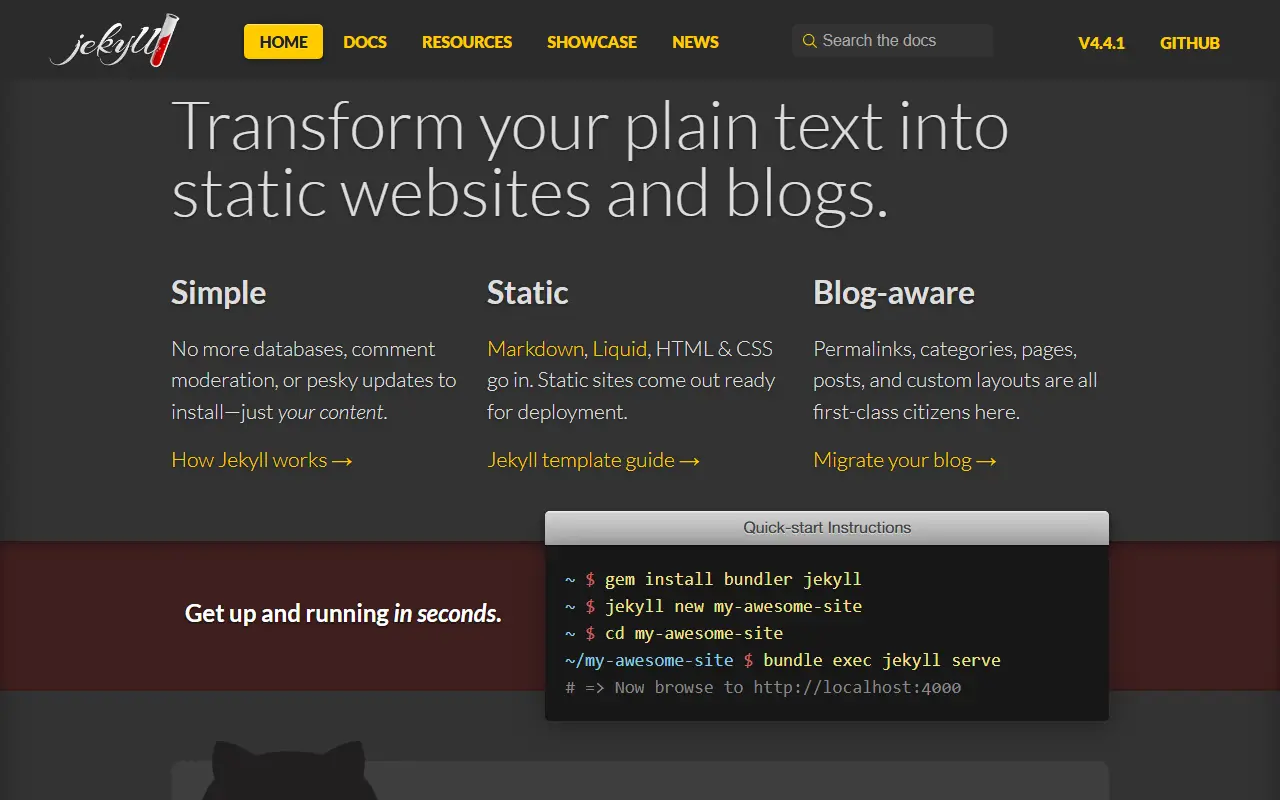
Jekyll takes plain text and builds static websites and blogs from it. Markdown, Liquid, HTML and CSS go in, and a static site comes out ready for deployment, so there is no database or comment moderation to run. It treats permalinks, categories, pages, posts and custom layouts as built-in concepts, which is why it calls itself blog-aware.
Getting started is a few shell commands: install bundler and jekyll as gems, create a new site, then serve it locally on port 4000. GitHub Pages is powered by Jekyll, so a site can be deployed through GitHub for free, including a custom domain. The current release shown is 4.4.1, the project is maintained by volunteers and funded by sponsors, and the site content is under the MIT License.
Key features
- Builds static sites from plain text
- No database or comment moderation to maintain
- Markdown, Liquid, HTML and CSS as inputs
- Permalinks, categories, pages, posts and layouts built in
- Local preview server
- Free deployment through GitHub Pages

Backstage is an open-source framework for building internal developer portals around a software catalog, templates and technical docs.
- GitHub stars
- 35k
- Last commit
- yesterday
- Latest release
- v1.56.4
- Licence
- Apache-2.0
- Self-hosted
- Yes
backstage.io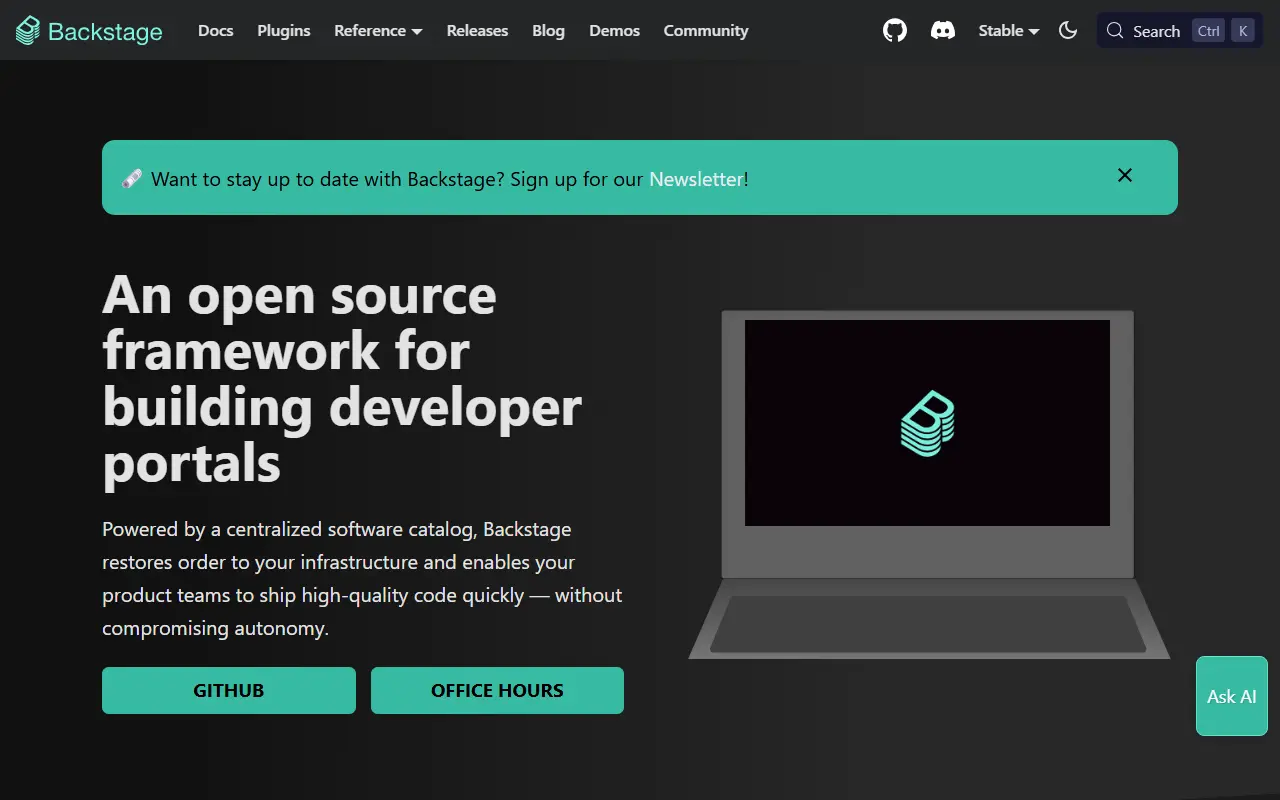
Backstage is a framework, published openly, for creating developer portals. It was created at Spotify and is now a Cloud Native Computing Foundation project at the incubation level. Centered on a software catalog, it brings order to microservices and infrastructure so product teams can ship code quickly while keeping their autonomy. It is written in TypeScript and released under the Apache-2.0 license.
Out of the box it includes a Software Catalog for tracking services, libraries, data pipelines, websites and machine learning models, Software Templates for starting new projects with organization-approved defaults, and TechDocs for a docs-like-code approach to documentation. A growing ecosystem of open-source plugins extends what the portal can show and do. Because it is a framework rather than a finished product, organizations build and host their own Backstage instance, guided by the getting started documentation and roadmap.
Key features
- Software Catalog for services and libraries
- Software Templates for new project scaffolding
- TechDocs with docs-like-code workflow
- Plugin ecosystem to extend the portal
- CNCF incubation project
- TypeScript framework you host yourself
Pricing: Free and open source under the Apache-2.0 license; you build and host your own instance.
#4
An open-source tool that generates interactive wikis for GitHub, GitLab and Bitbucket repositories by analyzing code, writing documentation and drawing diagrams.
- GitHub stars
- 18k
- Last commit
- yesterday
- Licence
- MIT
- Self-hosted
- Yes
grok-wiki.com
DeepWiki-Open, now branded Grok-Wiki, is an open-source implementation of the DeepWiki idea: you enter a repository from GitHub, GitLab or Bitbucket, and it automatically builds an interactive wiki about that codebase. The author describes it as their own attempt at the concept.
The process analyzes the code structure, generates comprehensive documentation, creates visual diagrams that explain how parts fit together, organizes everything into a navigable wiki and produces a codemap for guided tours of the code. Topics list support for Gemini, Ollama, OpenAI and OpenRouter models, so you can choose cloud or local models, and the project can be self-hosted. Version 2.0 is released as Grok Wiki, a local-first desktop workspace for repository wikis and question-and-answer sessions, downloadable from grok-wiki.com.
The code is written in Python and licensed under MIT, with translated READMEs and a Discord community. Contributions through issues and pull requests are welcome. It is useful for developers onboarding to unfamiliar repositories and maintainers who want generated documentation as a starting point.
Key features
- Generates wikis from repository code
- Auto-generated architecture diagrams
- Codemap for guided code tours
- Supports GitHub, GitLab and Bitbucket
- Works with Gemini, OpenAI, OpenRouter and Ollama
- Local-first desktop workspace in version 2.0
Pricing: Free and open source under the MIT license; model usage costs depend on the provider you choose.
#5
GitBook is a knowledge platform that connects docs, product and users, answers user questions, and identifies knowledge gaps.
- GitHub stars
- 29k
- Last commit
- yesterday
- Latest release
- @gitbook/react-contentkit@0.7.7
- Licence
- GPL-3.0
- Hosted version
- Available
gitbook.com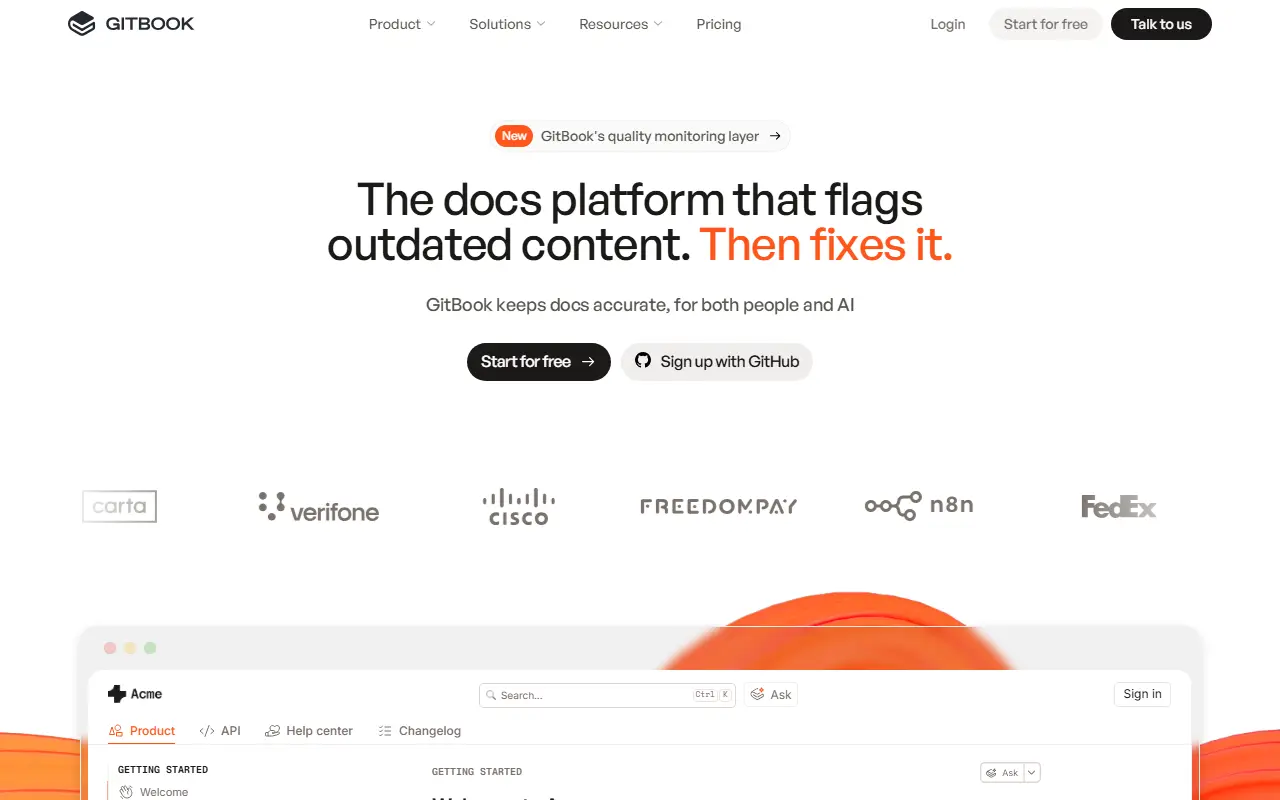
GitBook is a knowledge platform that connects your docs, product and users. It answers user questions and identifies knowledge gaps. The platform includes docs-as-code support and AI insights.
Key features
- AI insights
- Quality monitoring layer that flags outdated content
- Proactive updates
- Embed and connect
- Ask your docs
- Agent traffic tracker

mdBook is a command line tool written in Rust that builds books and documentation sites from Markdown, with search and themes.
- GitHub stars
- 22k
- Last commit
- yesterday
- Latest release
- v0.5.4
- Licence
- MPL-2.0
rust-lang.github.io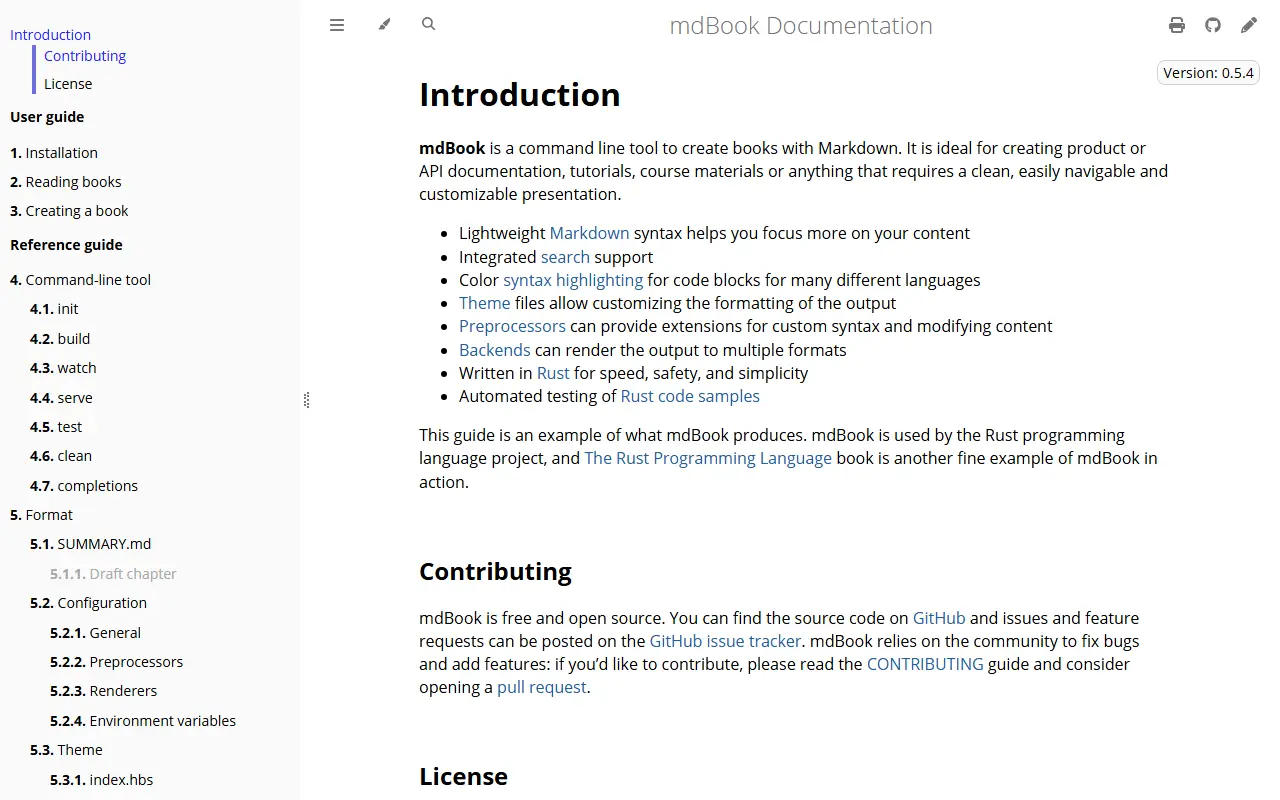
mdBook is a command line tool that creates books from Markdown. It is aimed at product or API documentation, tutorials, course materials and anything else that needs a clean, navigable presentation.
The output has integrated search and color syntax highlighting for code blocks in many languages. Theme files let you customize the formatting, preprocessors can add custom syntax or modify content, and backends can render the book to multiple formats. Rust code samples can be tested automatically.
It is written in Rust and used by the Rust programming language project for its own book. The source and documentation are released under the Mozilla Public License v2.0, and the documentation site shows version 0.5.4.
Key features
- Books written in lightweight Markdown
- Integrated search and syntax highlighting
- Customizable theme files
- Preprocessors for custom syntax
- Multiple output formats through backends
- Automated testing of Rust code samples

Sphinx is a documentation generator that supports reStructuredText and MyST Markdown, with features like cross-referencing, multiple output formats, themes, extensions, and internationalization.
- GitHub stars
- 8.1k
- Last commit
- 4 days ago
- Latest release
- v9.2.0
sphinx-doc.org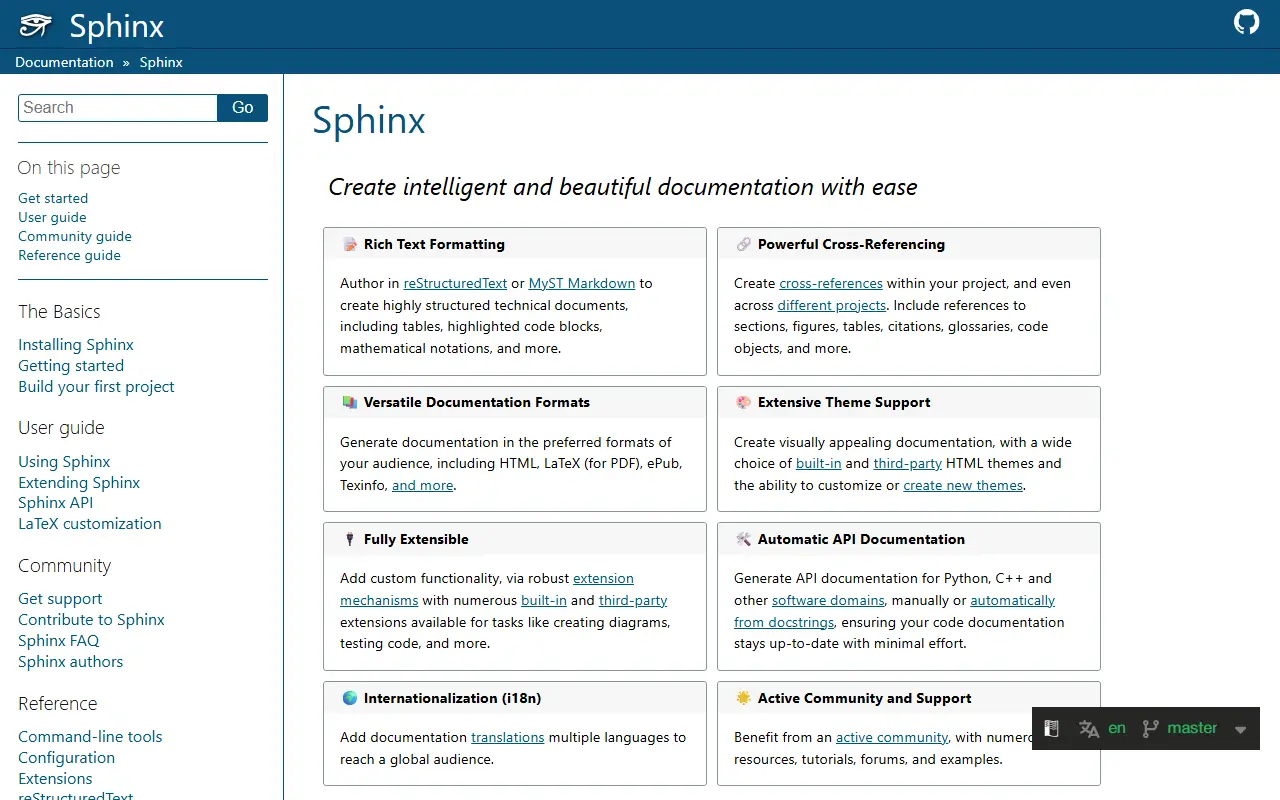
Sphinx is a documentation generator that allows authors to write in reStructuredText or MyST Markdown to create structured technical documents. It supports tables, highlighted code blocks, mathematical notations, and cross-references within and across projects.
The tool can generate documentation in formats such as HTML, LaTeX (for PDF), ePub, and Texinfo. It offers built-in and third-party HTML themes, extension mechanisms for custom functionality, and automatic API documentation for Python, C++, and other software domains.
Key features
- Rich text formatting with reStructuredText or MyST Markdown
- Cross-referencing within and across projects
- Multiple output formats: HTML, LaTeX, ePub, Texinfo
- Extensive theme support with built-in and third-party themes
- Extensible via built-in and third-party extensions
- Automatic API documentation for Python, C++, and other domains

Docfx converts .NET assembly, XML code comment, REST API Swagger files and markdown into rendered HTML pages, JSON model or PDF files.
- GitHub stars
- 4.5k
- Last commit
- 4 days ago
- Latest release
- v2.81.0
- Licence
- MIT
dotnet.github.io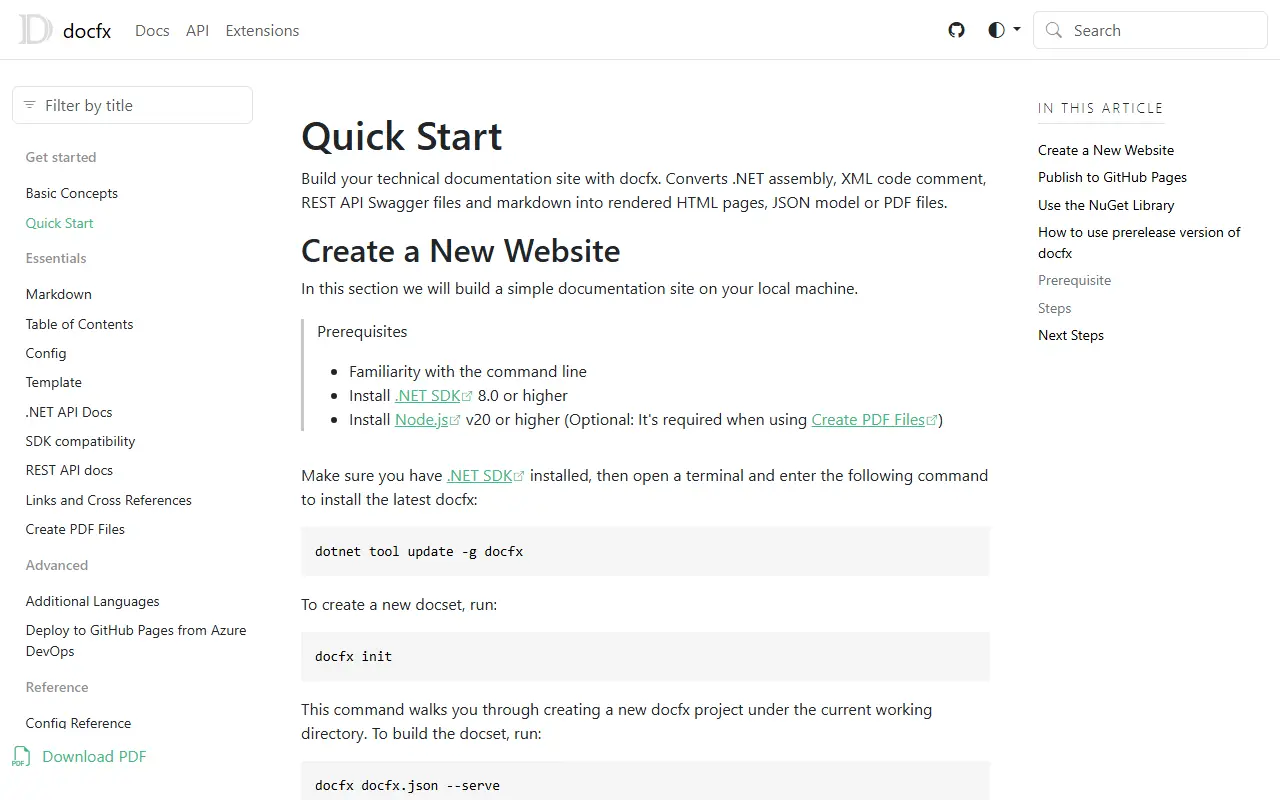
Docfx is a static site generator that builds technical documentation sites. It converts .NET assembly, XML code comment, REST API Swagger files and markdown into rendered HTML pages, JSON model or PDF files.
It is designed for developers who need to generate documentation for .NET projects. The tool can be installed as a .NET tool and used from the command line to create and build documentation projects.
Key features
- Converts .NET assembly, XML code comment, REST API Swagger files and markdown into rendered HTML pages, JSON model or PDF files.
- Provides a command-line interface to initialize and build documentation projects.
- Produces static HTML files under the _site folder for publishing to static site hosting servers.
- Supports publishing to GitHub Pages via GitHub Actions.

Command-line tool that keeps a markdown wiki of a codebase's decisions, flows and gotchas, maintained by AI coding agents such as Codex and Claude Code.
- GitHub stars
- 962
- Last commit
- 3 mo ago
- Latest release
- v0.4.4
- Licence
- Apache-2.0
- Self-hosted
- Yes
codealmanac.com
CodeAlmanac is a living wiki for a codebase, written and kept up to date by AI coding agents. It aims to capture what code alone cannot say, such as why a system is shaped as it is, what broke before, which invariants matter and how workflows cross files and services. The pages are plain markdown stored in your repository, indexed locally and reviewed in Git like any other change.
Setup installs instructions for the agent tools you choose and three local macOS launchd jobs. One syncs recent Codex and Claude conversations into the relevant wiki every five hours, one reviews the wiki daily for stale or duplicated knowledge, and one installs CLI updates daily. The README says the jobs and all wiki work run locally. Today it supports macOS with Codex or Claude Code.
Setup asks about anonymous telemetry, which can be refused in setup, through a flag, a config option or the DO NOT TRACK variable, and the README says it never sends code, paths, prompts or credentials. The project is written in TypeScript and licensed under Apache-2.0.
Key features
- Markdown codebase wiki stored in your repo
- Maintained by AI coding agents
- Local indexing and Git-based review
- Scheduled sync, garden and update jobs
- Support for Codex and Claude Code
- Opt-out anonymous telemetry
Pricing: Free and open source under the Apache-2.0 licence.
Commercial Swimm alternatives
Hosted, closed-source products that compete with Swimm. Showing 12 of 13.
- View tool
Documentation platform for product and API docs with a block editor
SaaS
- View tool
GitBook is a documentation and knowledge platform that keeps product docs accurate for people and AI, with docs-as-code support and an MCP server.
SaaS
- View tool
Developer documentation platform with API reference pages and AI search
SaaS
- View tool
Hosted API documentation and developer hub with usage analytics
SaaS
- View tool
API documentation and changelog hosting from OpenAPI and AsyncAPI files
SaaS
- View tool
API documentation, linting and governance tooling built on OpenAPI
SaaS
- View tool
Connect a repo or upload a zip to get generated docs, AI chat and architecture diagrams
SaaS
- View tool
API design, documentation and governance platform now owned by SmartBear
SaaS
- View tool
Confluence is Atlassian's team workspace for writing, organizing and sharing documentation and knowledge, with AI help for drafting, summarizing and finding answers.
SaaS
- View tool
Internal developer portal with a service catalog and maturity scorecards
SaaS
- View tool
Internal wiki with unified search across connected company tools
SaaS
- View tool
Notion is an AI-enabled workspace for notes, docs, wikis and projects, with agents, meeting notes and search across connected apps.
SaaS
See every Swimm alternative on its tool page
Swimm alternatives: questions
- What is the best open-source alternative to Swimm?
- Hugo is the top-ranked open-source alternative to Swimm on Enlisted: A static site generator written in Go that builds websites from Markdown and templates, with themes, modules and Sass support, for blogs and documentation. Other strong options are Jekyllrb, Backstage, DeepWiki-Open and GitBook.
- What are the best commercial alternatives to Swimm?
- Archbee, GitBook, Mintlify, ReadMe and Bump.sh are among the hosted, closed-source alternatives to Swimm listed on Enlisted, which lists 13 in total. Compare their pricing and features on each tool page.
- Are these Swimm alternatives free?
- All 9 are open source, so the code is free to use under its licence, and all of them can be self-hosted on your own server or computer. 1 also offers a paid or managed cloud version if you'd rather not host it yourself.
- How is this list of Swimm alternatives ranked?
- By a score built from GitHub stars, star growth over the last 30 days and how recently the code changed. 7 of these projects shipped code in the last 30 days. Data is refreshed daily, and nobody can pay to move up.
 TrackMedia
 TrackRev