
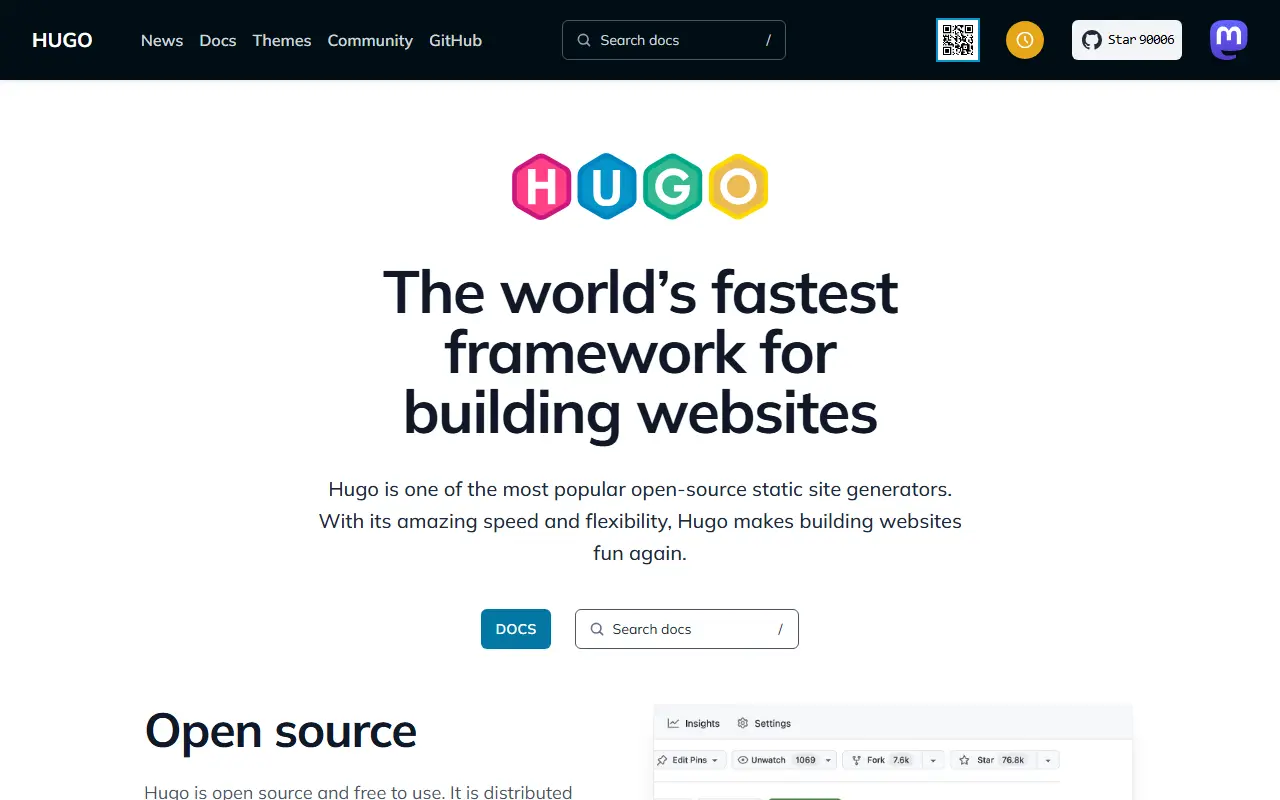
About Hugo
Hugo is a static site generator written in Go. You write content in Markdown, combine it with templates and a theme, and Hugo renders a folder of plain HTML, CSS and JavaScript that can be hosted almost anywhere without a server-side runtime or database. It is widely used for blogs, documentation sites and marketing pages.
It ships as a single prebuilt binary for Linux, macOS, Windows and the BSDs, and can also be built from source with Go and a C compiler. Hugo Modules let a site pull in themes and shared content as versioned components, a theme gallery gives starting points, and built-in functions transpile Sass to CSS. A deploy command and hosting guides cover publishing to common platforms.
The project is Apache-2.0 licensed and built by a community of contributors. Unlike a hosted CMS, there is no admin interface by default: editing happens in files, often tracked in Git, which suits developers and technical writers who prefer a plain-text workflow.
Key features
- Builds sites from Markdown content and templates
- Hugo Modules for themes and shared components
- Built-in Sass transpilation
- Single prebuilt binary for major platforms
- Large theme gallery
- Deploy command for common hosting targets
Good fit for
- →Developer blogs and personal sites
- →Documentation sites kept in Git
- →Static marketing pages
- Built with
- Go
- Tags
- static-site-generator
- go
- markdown
- blog
- documentation
- jamstack
- themes
- cms
Hugo: questions and answers
- What is Hugo used for?
- Hugo is a static site generator written in Go that builds websites from Markdown and templates, with themes, modules and Sass support, for blogs and documentation. It is a good fit for developer blogs and personal sites, documentation sites kept in Git, and static marketing pages.
- Is Hugo open source?
- Yes. Hugo is open source under the Apache-2.0 licence. Its source code is on GitHub at gohugoio/hugo and is written mainly in Go.
- Is Hugo free?
- Yes. Hugo is open source, so the software itself is free to use.
- What are some alternatives to Hugo?
- Similar open-source tools in the CMS category include Zola, Marmite and Bludit. SaaS products in the same category include BlogBowl, Blogsitefy and CloudCannon.
- Is Hugo actively maintained?
- Yes. The most recent commit to Hugo was on 1 October 2026, and the latest release is v0.167.0, published on 28 September 2026. The project has 90k stars on GitHub.
Open-source alternatives to Hugo
See all
Zola
CMS
A fast static site generator in a single binary with everything built-in. https://www.getz
EUPL-1.2★ 17k
Marmite
CMS
Markdown makes sites - A Static Site Generator for Blogs
AGPL-3.0★ 878
Bludit
CMS
Simple, Fast, Secure, Flat-File CMS
MITvs Blogger★ 1.5kNesta CMS
CMS
File Based CMS and Static Site Generator
MIT★ 899
Lektor
CMS
The lektor static file content management system
BSD-3-Clause★ 3.9k
Notablog
CMS
Tell stories of your work with Notion
MIT★ 682
SaaS alternatives to Hugo
See all
BlogBowl
CMS
Open-source blog and newsletter management platform
SaaS
Blogsitefy
CMS
Create SEO-optimized blogs on your own domain without relying on a third-party platform
SaaS
CloudCannon
CMS
Git-based visual CMS for static sites with editing tools for content teams
SaaS
Storyblok
CMS
Headless CMS with a visual editor for component-based pages
SaaS
Voog
CMS
Website builder with online store and multilingual site features from Estonia
SaaS
1FoodMenu
CMS
One-page website builder for restaurants and food trucks with menu, hours and contact info
SaaS