7,363 open-source and SaaS tools, with GitHub stats refreshed every day.

7 alternatives ranked by real activity

Open-source CloudCannon alternatives

A curated, ranked list of the 7 best open-source alternatives to CloudCannon.

The best open-source alternative to CloudCannon is Decap CMS. If that doesn't suit you, other good options are TinaCMS, Pages CMS, Sveltia CMS and Keystatic.

CloudCannon alternatives are mainly CMS tools. 7 of them shipped code in the last 30 days, 7 can be self-hosted, and 7 use a permissive licence.

Last updated October 3, 2026 · ranked by GitHub stars, growth and recent commits

Decap CMS

A Git-based content management interface for static site generators, formerly Netlify CMS, that gives editors a clean UI over content stored in your repository.

GitHub stars
19k
Last commit
today
Latest release
decap-cms@3.16.3
Licence
MIT
Self-hosted
Yes
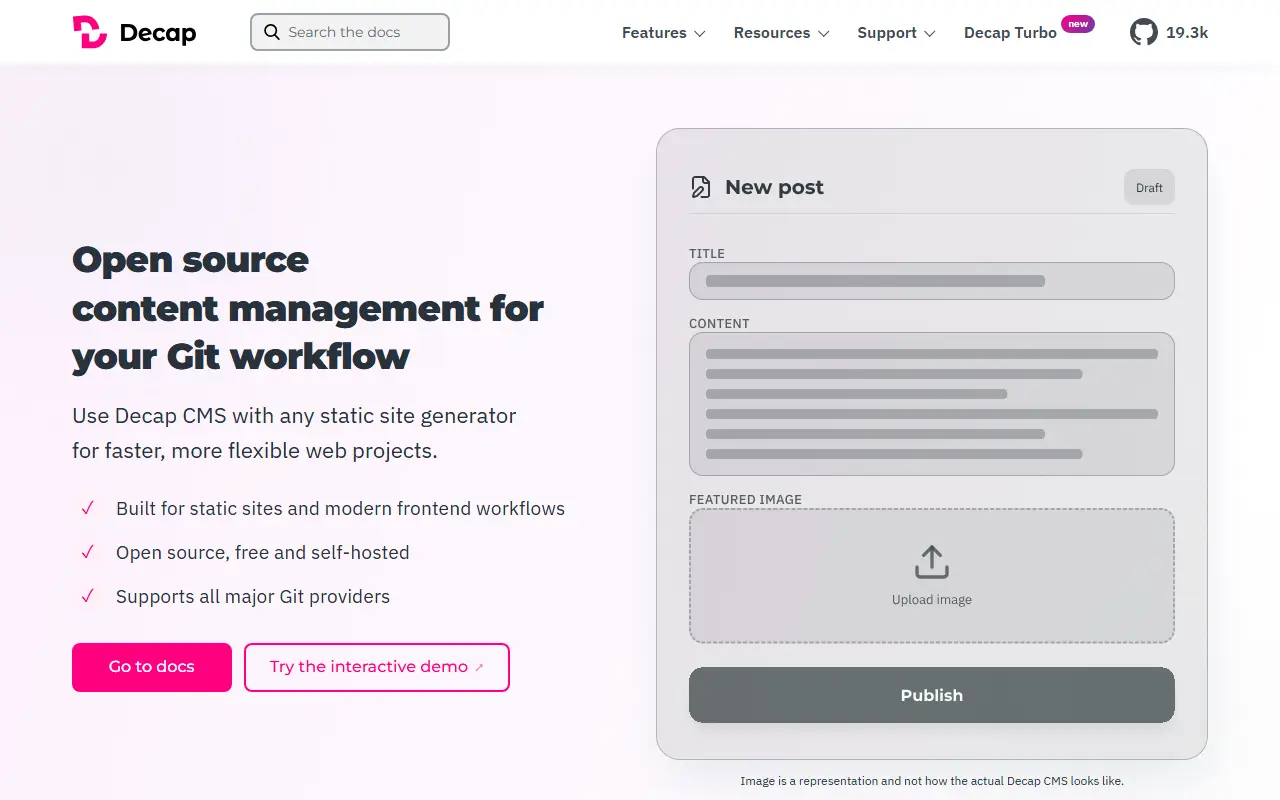
decapcms.orgDecap CMS homepage screenshot

Decap CMS, previously known as Netlify CMS until early 2023, is an open-source content editor designed for sites built with static site generators. It gives non-developers a simple interface for adding and editing content, while the content itself is stored as files in a Git repository.

It works as a single-page React app that you include under the /admin path of your site. A YAML configuration file describes your content model, and you can adjust the CMS layout to match the site. When someone visits /admin they log in and can then create or edit entries, with changes committed to Git. There are two ways to set it up: a quick install with a single HTML file plus a config file that loads scripts from a CDN, or a fuller installation integrated into your static site build for more flexibility.

Decap CMS is licensed under MIT and is a client-side app, so there is no database server to run. It is a popular choice for Jamstack sites on generators like Hugo, Jekyll and Eleventy, where teams want editors to manage content without touching code.

Key features

  • Editing UI for content stored in Git
  • YAML-defined content models
  • Single-page app mounted at /admin
  • Quick CDN install or full build integration
  • Works with any static site generator
  • Login-protected editing interface

Pricing: Free and open source under the MIT license.

TinaCMS

An open-source headless CMS that keeps Markdown, MDX, JSON and YAML content in your Git repository, with a GraphQL API and optional live visual editing.

GitHub stars
14k
Last commit
today
Latest release
tinacms@3.14.2
Licence
Apache-2.0
Self-hosted
Yes
Hosted version
Available
tina.ioTinaCMS homepage screenshot

TinaCMS is an open-source headless content management system built around files in Git. Content in Markdown, MDX, JSON, YAML and other formats lives in your own GitHub repository, and editors work on it through an admin interface instead of editing raw files.

Content is exposed through a GraphQL API that supports queries on fields such as an author's first name, references between documents, and both statically generated and server-side rendered pages. An optional, opt-in live preview lets less technical editors see changes to Markdown content as they edit. It is commonly paired with Next.js and React sites.

Tina is written in TypeScript and licensed under Apache-2.0. You can test a starter site locally or try a demo on TinaCloud, the hosted service from the same team. Documentation, a public roadmap, GitHub Discussions and a community Discord are available for support.

Key features

  • Git-backed content in your own repository
  • Markdown, MDX, JSON and YAML support
  • GraphQL API for querying content
  • Opt-in live visual editing
  • References between documents
  • Static and server-rendered page support
  • Hosted TinaCloud option

Pricing: Free plan for 2 users. Per project, Team is $24, Team Plus $41 and Business $249 a month on annual billing; Enterprise is custom.

Read more about TinaCMSWebsite GitHub

Pages CMS

Pages CMS is an open-source content manager for GitHub repositories, built for static sites made with Jekyll, Hugo, Astro, Next.js and similar tools.

GitHub stars
4.1k
Last commit
2 days ago
Latest release
2.1.8
Licence
MIT
Self-hosted
Yes
Hosted version
Available
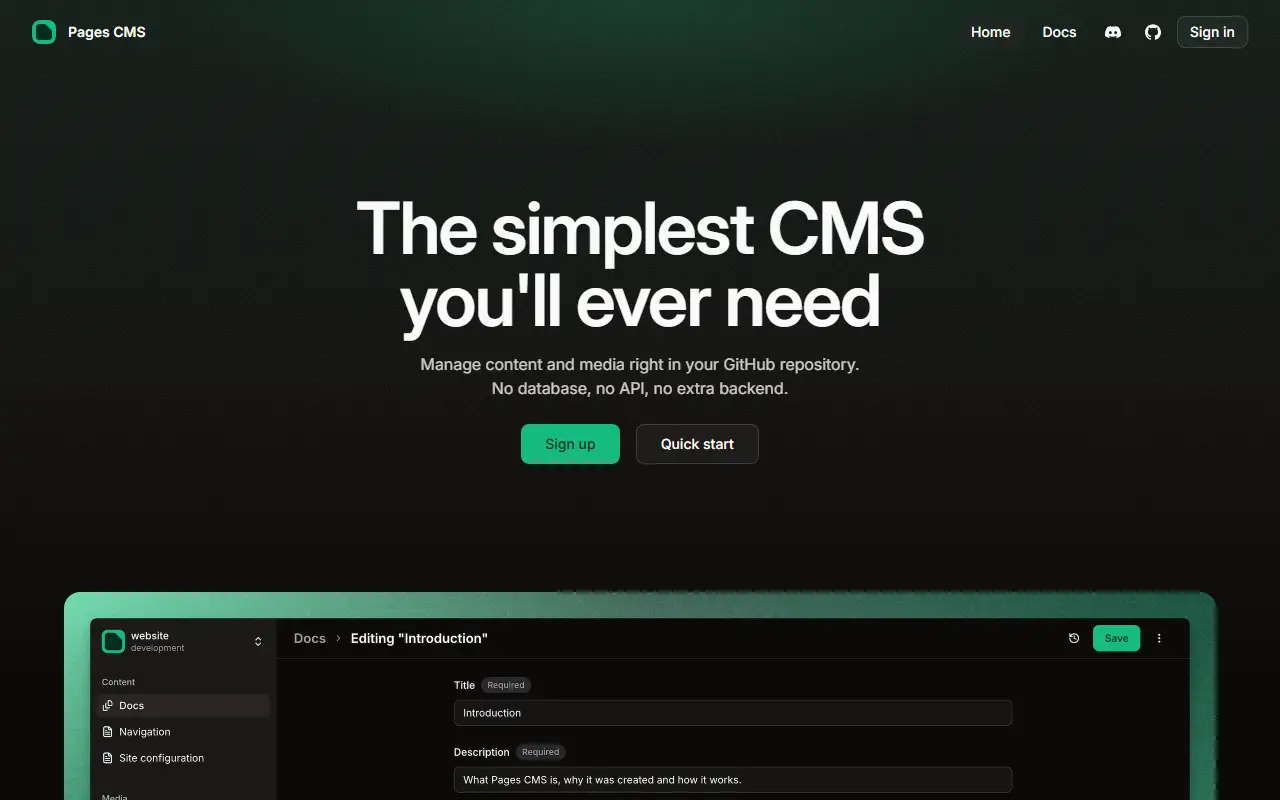
pagescms.orgPages CMS homepage screenshot

Pages CMS is an open-source CMS that edits content and media directly in a GitHub repository. It works especially well for static websites and content-led apps made with Jekyll, Hugo, Next.js or Astro, and the topic list also mentions Eleventy, Gatsby, Docusaurus, VitePress and VuePress.

Because content lives as files in your repo, editors get a friendly interface while developers keep the Git workflow and ownership of the content. You can either use the hosted app at app.pagescms.org or run a development copy yourself from the repository, which involves creating a GitHub App and setting environment variables. Documentation covers installing locally and upgrading to version 2.

Pages CMS is written in TypeScript with Next.js and is licensed under MIT. It suits developers who build sites for clients or teams and want non-technical editors to update content without touching Git.

Key features

  • Edit content and media in GitHub repos
  • Works with Jekyll, Hugo, Astro and Next.js
  • Hosted version at app.pagescms.org
  • Self-hostable via a GitHub App
  • Git-based content ownership
  • Documentation for configuration options

Pricing: Free and open source under the MIT license; a hosted version is available.

Sveltia CMS

Git-based headless CMS for Jamstack sites, built as a modern replacement for Netlify and Decap CMS with strong multilingual support and mobile editing.

GitHub stars
2.9k
Last commit
yesterday
Latest release
v0.227.2
Licence
MIT
Self-hosted
Yes
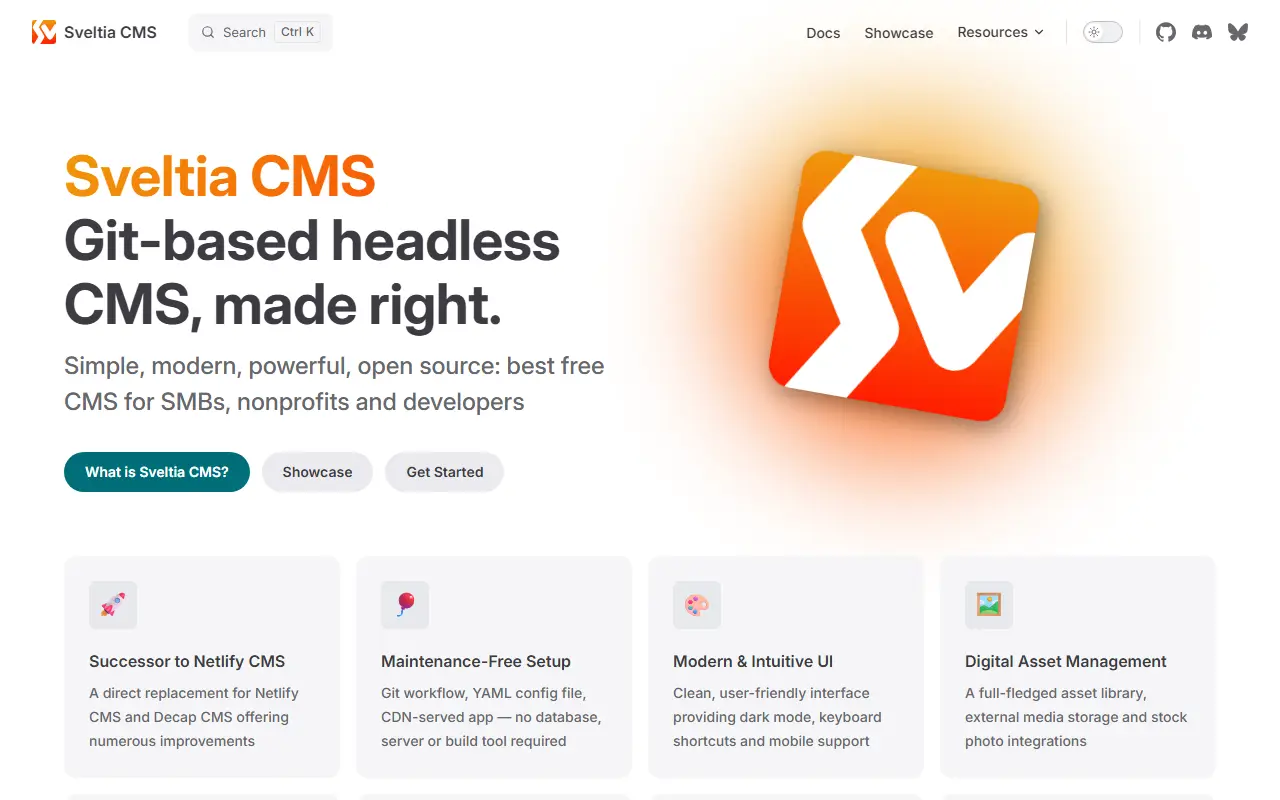
sveltiacms.appSveltia CMS homepage screenshot

Sveltia CMS is a Git-based headless content management system for static and Jamstack websites. It is a full rewrite of Netlify CMS, now known as Decap CMS, and keeps high compatibility with existing configurations while improving performance, security, and user experience. It is open source under the MIT license and runs as a small single-page web app served from a CDN.

It is designed for both content editors and developers, with first-class internationalization, dark mode, and mobile support. The topics mention integrations with GitHub and stock-photo providers such as Pexels, Pixabay, and Unsplash, plus digital asset management features. The maintainers say hundreds of issues from the Decap repository have been resolved, and the project shows migrated sites from Decap and WordPress in its showcase.

Sveltia CMS is framework-agnostic and works with static site generators like Astro, Eleventy, and Hugo, from personal blogs and portfolios to marketing sites and knowledge bases. It suits teams that want to keep content in Git while giving non-developers a friendly editing interface.

Key features

  • Git-based content editing for static sites
  • Compatible with Netlify and Decap CMS configs
  • First-class multilingual content support
  • Mobile-friendly editing interface
  • Stock photo search from Pexels, Pixabay, and Unsplash
  • Works with Astro, Eleventy, and Hugo
  • Dark mode

Pricing: Free and open source under the MIT license.

Keystatic

Git-based CMS from Thinkmill that stores content as Markdown, YAML, or JSON files with a TypeScript API and no database, built for Next.js, Remix, and Astro.

GitHub stars
2.4k
Last commit
yesterday
Licence
MIT
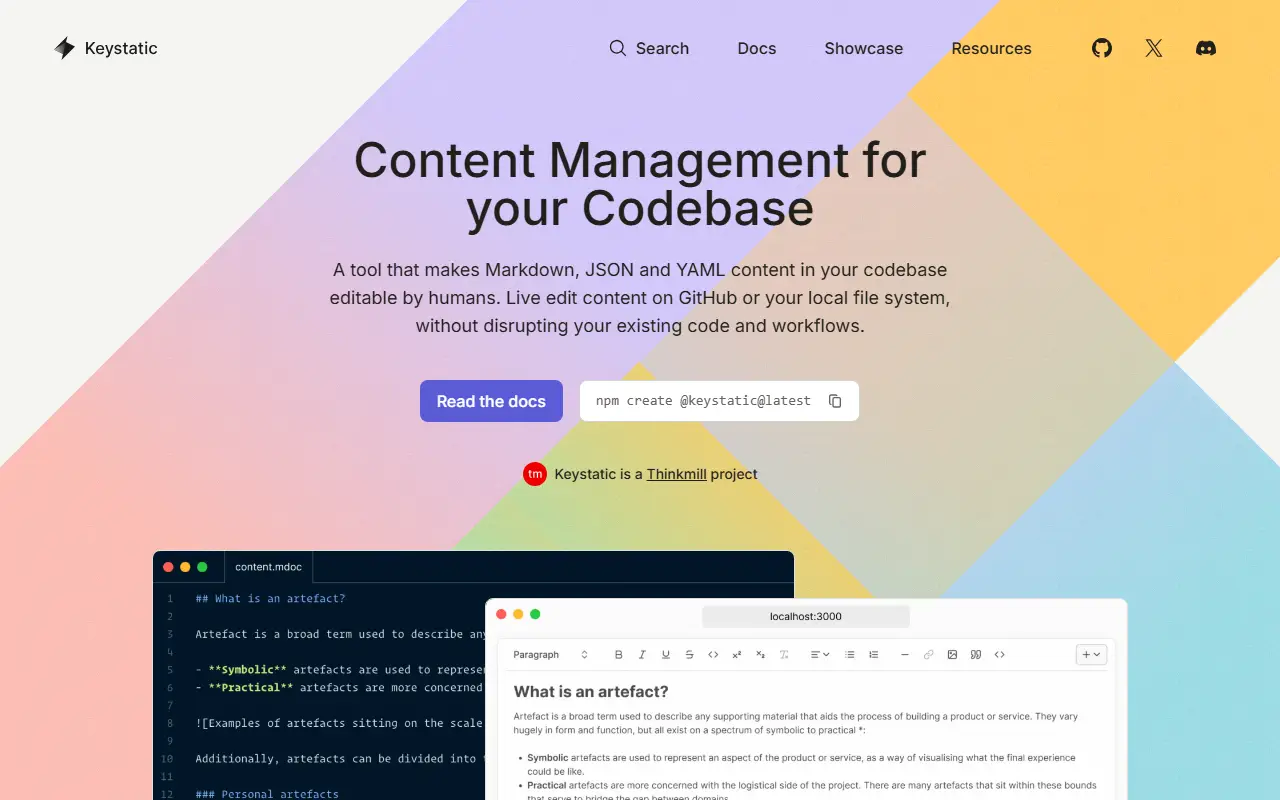
keystatic.comKeystatic homepage screenshot

Keystatic is a content management system that keeps content as Markdown, YAML, or JSON files in your own repository instead of in a database. It offers a TypeScript API and a visual editing interface, connects directly to GitHub, and does not alter your source code. It carries over ideas from Keystone, a previous project from the same team, Thinkmill. It is released under the MIT license.

It is designed for modern front-end frameworks such as Next.js, Remix, and Astro, and is meant to fit into existing developer workflows. Because content is plain files, it can be versioned, reviewed, and deployed along with the rest of a site, and editors who are not developers get a friendly interface to change it.

The README describes the project as experimental while it is being developed and points readers to keystatic.com, guides, templates, and the CLI to try it. Development of the monorepo requires Node.js 18 and pnpm. Keystatic suits developers building content-driven sites who want a lightweight CMS without running a separate backend.

Key features

  • Content stored as Markdown, YAML, or JSON files
  • TypeScript API for defining content
  • Visual editing interface for non-developers
  • Direct GitHub connection
  • No database required
  • Designed for Next.js, Remix, and Astro

Pricing: Free and open source under the MIT license.

Alinea

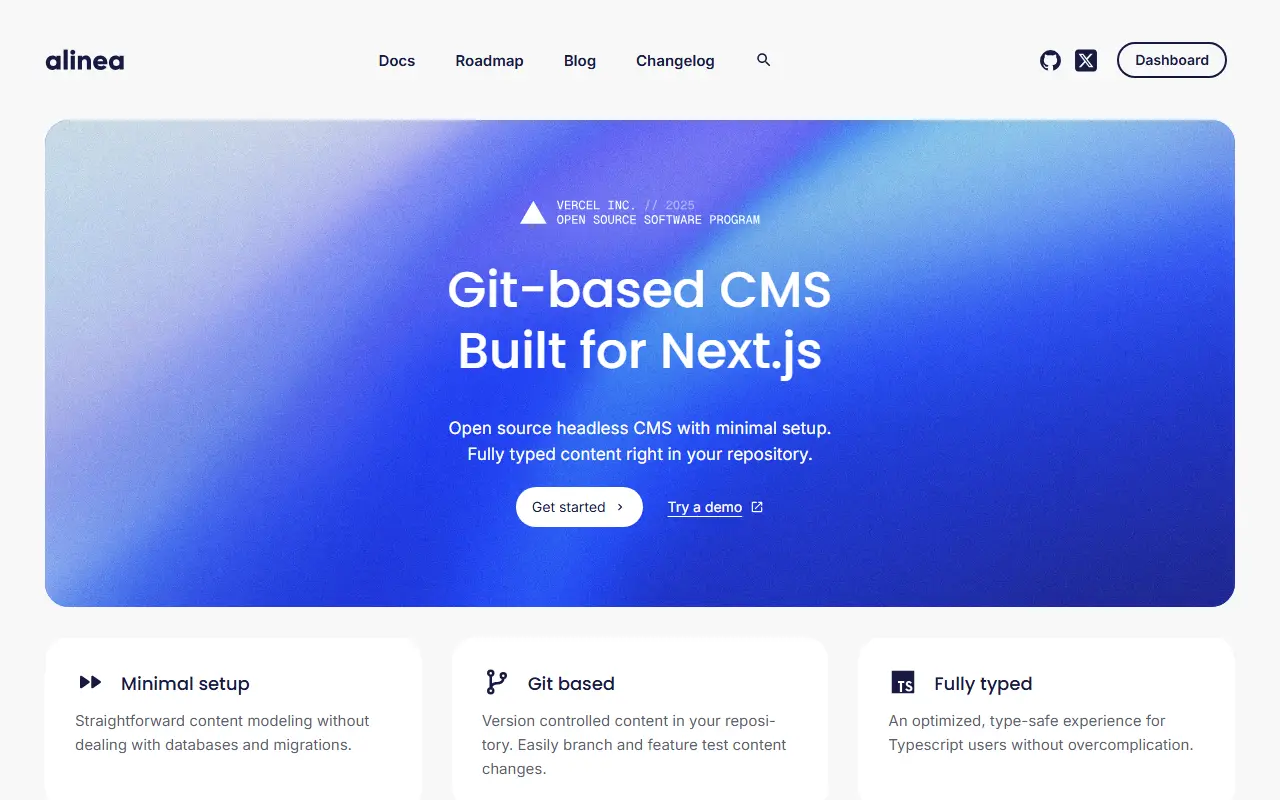
Alinea is an open-source, Git-based headless CMS for Next.js where content is typed in TypeScript and stored as JSON files in your repository.

GitHub stars
855
Last commit
today
Latest release
v1.7.0
Licence
MIT
Self-hosted
Yes
Hosted version
Available
alineacms.comAlinea homepage screenshot

Alinea is an open-source headless CMS built for Next.js. You describe your content model in TypeScript, editors work in a dashboard that ships inside your own app, and every entry is saved as a JSON file in your Git repository, so content can be reviewed, branched and rolled back like code.

Queries are typed directly from your schema without code generation. Content is indexed in SQLite and bundled with the site, so no separate content database server is needed, and the dashboard offers full-text search. Live previews render drafts through your server components while editors type, and each publish is a Git commit that deployed sites pick up without a rebuild. The dashboard is built on React Aria Components with dark mode, entry history, roles and permissions, and per-field translations.

You can self-host the backend on your own database or let Alinea Cloud handle sign-in and publishing. Alinea needs Node.js 24 or higher, React 19 and the Next.js App Router, installs with an alinea init command, and is licensed under MIT.

Key features

  • Content model defined in TypeScript
  • Entries stored as JSON in Git
  • Typed queries without codegen
  • Live draft previews
  • Dashboard with roles and translations
  • Self-host or Alinea Cloud

Pricing: Open source under the MIT license; a managed Alinea Cloud option is also available.

Read more about AlineaWebsite GitHub

Deco

Deco is a Git-based visual CMS for TypeScript sites on Deno, HTMX and Tailwind, with a content editor UI generated from component props.

GitHub stars
849
Last commit
2 days ago
Latest release
1.211.2
Licence
Apache-2.0
Self-hosted
Yes
Hosted version
Available
deco.cxDeco homepage screenshot

Deco is a Git-based visual CMS for TypeScript projects built on Deno, with server-side JSX templates and client-side interactivity through HTMX. Changes made in the visual editor are saved to Git, and developers can edit on the web while committing locally through an HTTPS tunnel to their development machine.

Business users and editors get a content editor UI generated automatically from TypeScript props, an asset manager with multimedia support, a publishing workflow with staging, immutable releases and instant rollbacks, and roles and permissions for content-only editors. It has native Tailwind theme support with component libraries such as DaisyUI, Preline, FloatUI and Shadcn UI.

Sites deploy with one click to Deno-compatible hosts, with Deno Deploy the preferred partner and other providers listed as coming. The README also lists deco.cx PRO managed hosting at 99 USD per month. Starting from a template at deco.new creates a GitHub repository and a free deco.site domain. The framework is licensed under Apache-2.0.

Key features

  • Git-based visual content editing
  • Editor UI generated from TypeScript props
  • Server-side JSX with HTMX interactivity
  • Tailwind themes and component libraries
  • Staging, immutable releases and rollbacks
  • One-click Deno Deploy hosting

Pricing: The open source core is free to self-host. Managed Studio costs R$100 per user per month; Enterprise starts from R$50 mil per month, and a results-based plan combines a fixed fee with a share of growth.

Read more about DecoWebsite GitHub

CloudCannon alternatives: questions

What is the best open-source alternative to CloudCannon?
Decap CMS is the top-ranked open-source alternative to CloudCannon on Enlisted: A Git-based content management interface for static site generators, formerly Netlify CMS, that gives editors a clean UI over content stored in your repository. Other strong options are TinaCMS, Pages CMS, Sveltia CMS and Keystatic.
Are these CloudCannon alternatives free?
All 7 are open source, so the code is free to use under its licence, and all of them can be self-hosted on your own server or computer. 4 also offer a paid or managed cloud version if you'd rather not host it yourself.
How is this list of CloudCannon alternatives ranked?
By a score built from GitHub stars, star growth over the last 30 days and how recently the code changed. 7 of these projects shipped code in the last 30 days. Data is refreshed daily, and nobody can pay to move up.

People also look for alternatives to…

View all