 TrackMedia
 TrackRev

About Kirby
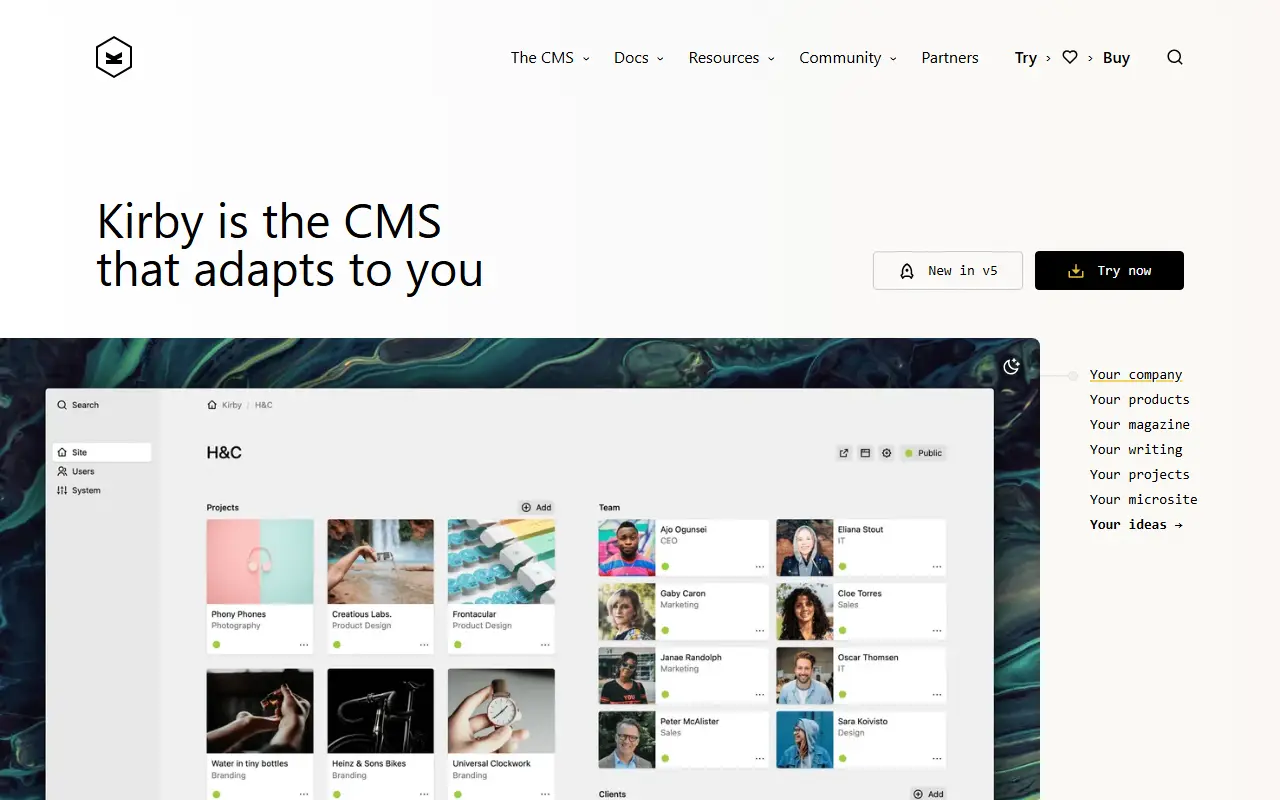
Kirby is a content management system built on PHP that stores content in files rather than a traditional database. Developers design their own editing interface by combining forms, galleries, articles, spreadsheets and other building blocks, which makes it adaptable to very different sites while remaining approachable for editors.
This repository holds Kirby's core application folder, and the project recommends starting from the Starterkit or Plainkit repositories instead. Topics also mention headless CMS use, so content can be consumed through an API as well as templates. The project provides documentation, a forum, an issue tracker, a feedback platform, an online demo and a community Discord.
The README states plainly that Kirby is not free software: you can try it on a local machine or a test server for as long as you need, and you buy a license when you are ready to launch. The source can be read on GitHub under a custom license agreement. It suits web developers and agencies who prefer a paid, flat-file CMS with a customizable panel.
Key features
- File-based content without a required database
- Customizable editing panel
- Flexible content fields and blueprints
- Headless CMS capability
- Starterkit and Plainkit starting points
- Free to try before buying a license
Good fit for
- Building client websites with a custom editing interface
- Running a flat-file site without database administration
- Using a headless CMS for a front-end project
Kirby: questions and answers
- What is Kirby used for?
- Kirby is a file-based PHP CMS that lets developers design custom editing panels, sold under a paid license rather than as free software. It is a good fit for building client websites with a custom editing interface, running a flat-file site without database administration and using a headless CMS for a front-end project.
- Is Kirby open source?
- Yes. Kirby is open source under a custom licence. Its source code is on GitHub at getkirby/kirby and is written mainly in PHP.
- Is Kirby free?
- Yes. Kirby is open source, so the software itself is free to use under the terms of its own licence.
- Can I self-host Kirby?
- Yes. Kirby can be self-hosted on your own server or infrastructure; there is no official hosted version.
- What is Kirby an alternative to?
- Kirby is an open-source alternative to Webflow and CloudCannon. Other open-source alternatives to Webflow include Craft CMS.
- Is Kirby actively maintained?
- Yes. The most recent commit to Kirby was on 13 November 2026, and the latest release is 5.6.3, published on 5 November 2026. The project has 1.5k stars on GitHub, with 4 added in the last 30 days.
Open-source alternatives to Kirby
See all
Craft CMS
CMS
Build bespoke content experiences with Craft.
OSSvs Contentstack★ 3.6k
Strapi
CMS
🚀 Strapi is the leading open-source headless CMS. It’s 100% JavaScript/TypeScript, fully
OSSvs Contentstack★ 73k
Sanity
CMS
Sanity Studio – Rapidly configure content workspaces powered by structured content
MITvs Contentstack★ 6.4k
Statamic
CMS
Statamic: The New Site/App Package
OSSvs Storyblok★ 840
Decap CMS
CMS
A Git-based CMS for Static Site Generators
MITvs Prismic★ 19k
Keystatic
CMS
First class CMS experience, TypeScript API, Markdown & YAML/JSON based, no DB
MITvs Prismic★ 2.5k
SaaS alternatives to Kirby
See all
Webflow
CMS
Webflow is a visual web design and hosting platform that combines a designer, CMS, hosting and SEO tools so teams can build and run websites without coding.
SaaS
CloudCannon
CMS
Git-based visual CMS for static sites with editing tools for content teams
SaaS
OverflowCMS
CMS
External headless CMS for Webflow that stores unlimited items in your own database and renders them on your site
SaaS
Contza
CMS
Developer-first CMS that adds visual content editing to a website
SaaSABHUB
CMS
No-code website builder and content management system for small and mid-size wineries
SaaS
Dorik
CMS
AI-assisted website builder with drag-and-drop editing and CMS features
SaaS