 TrackMedia
 TrackRev

 CloudCannon
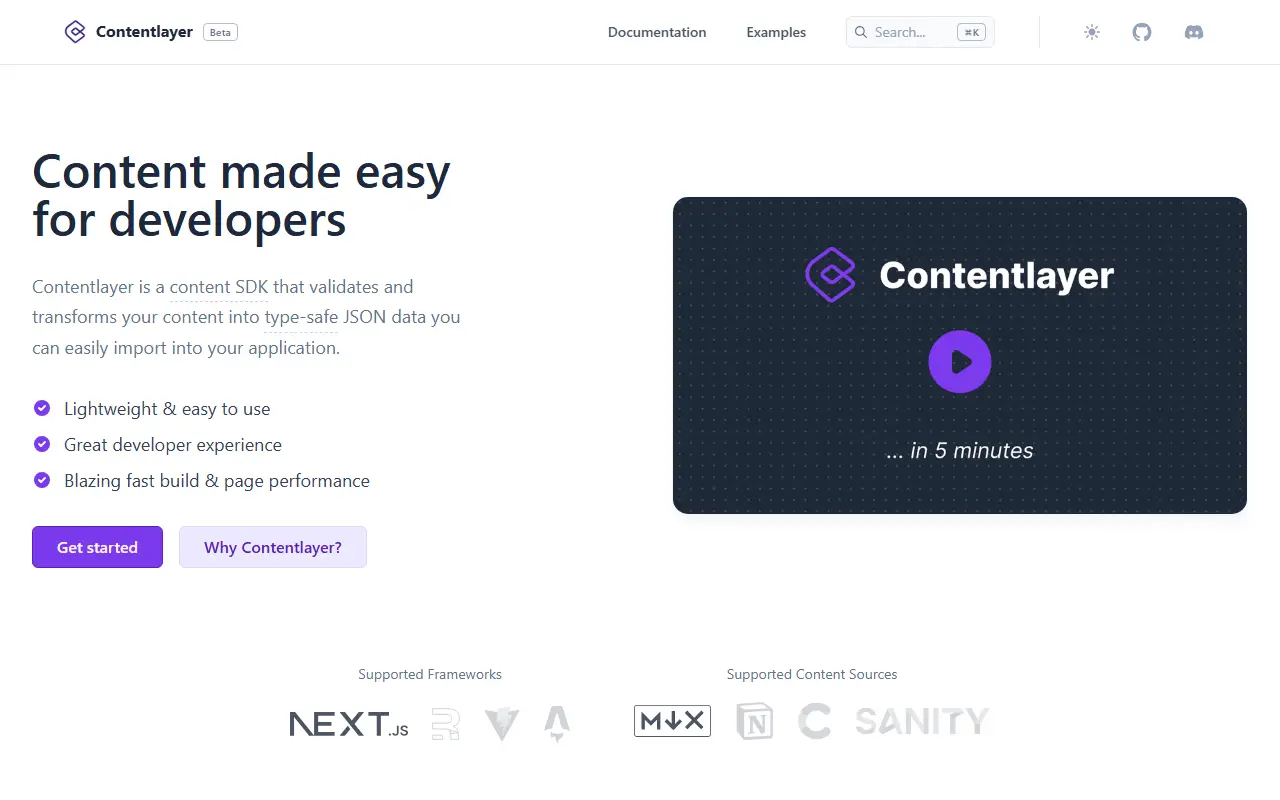
About Contentlayer
Contentlayer sits between your content and your application. You describe the shape of each document type in a config file, and it validates the content, generates TypeScript types, and writes data objects you import as an ES module.
It works with local Markdown and MDX files as well as Notion, and runs either as part of the Next.js dev server or through its own command-line tool. Because content arrives as plain data, you use ordinary JavaScript methods rather than learning a query language.
The site labels the project as beta. It claims incremental and parallel builds, instant live reload and scaling to 100k of documents, and shows a counter of 20933 projects using it.
A short setup walks through three steps: configure the content source, let Contentlayer transform the content into data, and import that data into the application. The generated output lands in a .contentlayer/generated folder as JSON files with type definitions, and tree-shaking is mentioned as a way to keep the development bundle small.
Key features
- Validates content and frontmatter
- Generates TypeScript types automatically
- Incremental and parallel builds with live reload
- Document types defined for local Markdown files
- Runs inside Next.js dev server or via CLI
Good fit for
- Blogs from Markdown
- Documentation sites
- Typed content for Next.js
Contentlayer: questions and answers
- What is Contentlayer used for?
- Contentlayer is a content SDK that validates Markdown, MDX or CMS content and turns it into type-safe JSON you can import into an app. It is a good fit for blogs from Markdown, documentation sites and typed content for Next.js.
- Is Contentlayer open source?
- Yes. Contentlayer is open source under the MIT licence. Its source code is on GitHub at contentlayerdev/contentlayer and is written mainly in TypeScript.
- Is Contentlayer free?
- Yes. Contentlayer is open source, so the software itself is free to use.
- Can I self-host Contentlayer?
- Yes. Contentlayer can be self-hosted on your own server or infrastructure.
- What is Contentlayer an alternative to?
- Contentlayer is an open-source alternative to CloudCannon. Other open-source alternatives to CloudCannon include TinaCMS, Keystatic and Payload.
- Is Contentlayer actively maintained?
- The most recent commit to Contentlayer was on 7 November 2024, and the latest release is v0.3.4, published on 29 June 2023. The project has 3.5k stars on GitHub.
Open-source alternatives to Contentlayer
See all
TinaCMS
CMS
TinaCMS is the leading open-source headless CMS that supports Markdown and Visual Editing.
Apache-2.0vs Storyblok★ 14k
Keystatic
CMS
First class CMS experience, TypeScript API, Markdown & YAML/JSON based, no DB
MITvs Prismic★ 2.5k
Payload
CMS
Payload is the open-source, fullstack Next.js framework, giving you instant backend superp
MITvs Contentstack★ 46k
Alinea
CMS
Content management, streamlined
MITvs Storyblok★ 856
Hugo
CMS
The world’s fastest framework for building websites.
Apache-2.0vs Squarespace★ 90k
Strapi
CMS
🚀 Strapi is the leading open-source headless CMS. It’s 100% JavaScript/TypeScript, fully
OSSvs Contentstack★ 73k