#1
A static site generator written in Go that builds websites from Markdown and templates, with themes, modules and Sass support, for blogs and documentation.
- GitHub stars
- 90k
- Last commit
- yesterday
- Latest release
- v0.169.0
- Licence
- Apache-2.0
- Self-hosted
- Yes
gohugo.io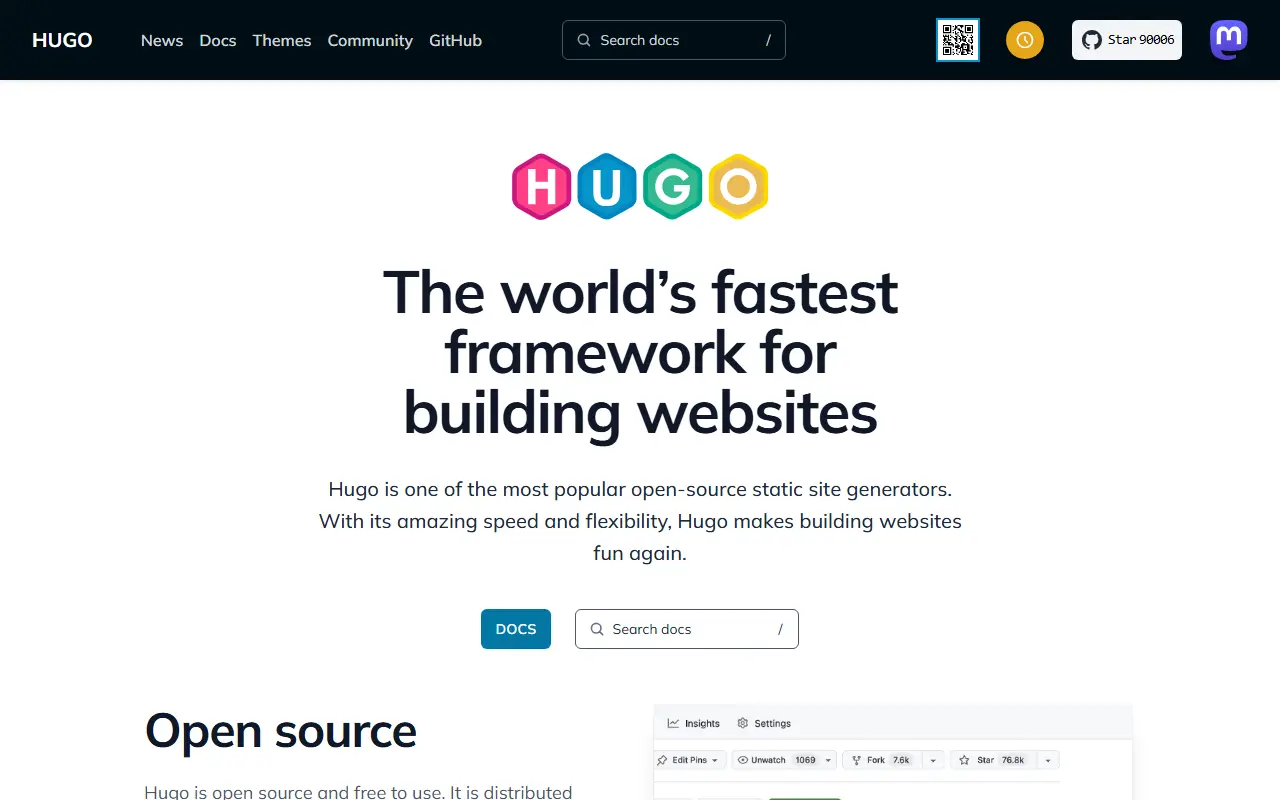
Hugo is a static site generator written in Go. You write content in Markdown, combine it with templates and a theme, and Hugo renders a folder of plain HTML, CSS and JavaScript that can be hosted almost anywhere without a server-side runtime or database. It is widely used for blogs, documentation sites and marketing pages.
It ships as a single prebuilt binary for Linux, macOS, Windows and the BSDs, and can also be built from source with Go and a C compiler. Hugo Modules let a site pull in themes and shared content as versioned components, a theme gallery gives starting points, and built-in functions transpile Sass to CSS. A deploy command and hosting guides cover publishing to common platforms.
The project is Apache-2.0 licensed and built by a community of contributors. Unlike a hosted CMS, there is no admin interface by default: editing happens in files, often tracked in Git, which suits developers and technical writers who prefer a plain-text workflow.
Key features
- Builds sites from Markdown content and templates
- Hugo Modules for themes and shared components
- Built-in Sass transpilation
- Single prebuilt binary for major platforms
- Large theme gallery
- Deploy command for common hosting targets
Pricing: Free and open source under the Apache-2.0 license.
#2
A collaborative team knowledge base and wiki with realtime editing and Markdown compatibility, built with React and Node.js and available hosted or self-run.
- GitHub stars
- 41k
- Last commit
- today
- Latest release
- v1.12.0
- Self-hosted
- Yes
- Hosted version
- Available
getoutline.com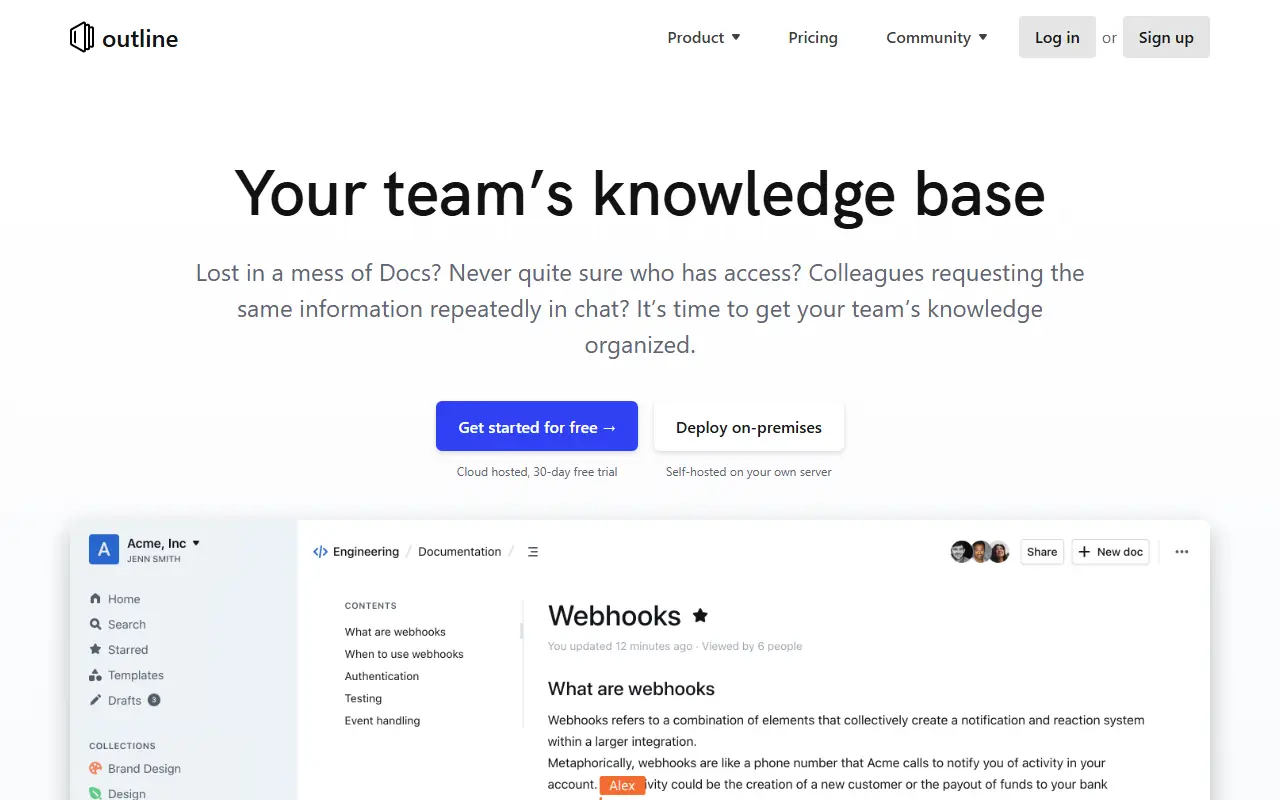
Outline is a knowledge base for teams, built with React and Node.js. It focuses on fast, collaborative writing: documents are edited together in realtime, stay compatible with Markdown, and are organized into collections so a growing team can find what it has written down.
The maintainers offer a hosted version at getoutline.com, and the repository contains the source that runs Outline and its associated services. If you only want to use Outline you do not need to run the code yourself, while teams that want their own copy can follow the documentation for a production configuration and use the published container images. Topics also mention a Slack integration.
The repository license is listed as 'Other', so review it before commercial redistribution. Outline suits teams looking for a wiki or internal documentation tool with a clean editor, as an alternative to products such as Confluence or Notion for company knowledge. The project does not accept AI-generated pull requests.
Key features
- Realtime collaborative editing
- Markdown-compatible document editing
- Collections for organizing a wiki
- Integration with Slack workspaces
- Hosted service at getoutline.com
- Container images for self-running
Pricing: Cloud pricing is by team size: $10 per month for 1-10 members, $79 for 11-100 and $249 for 101-200. The first 30 days are free; larger teams are quoted.
#3
Jekyll is a static site generator that turns Markdown, Liquid templates, HTML and CSS into blogs and websites.
- GitHub stars
- 52k
- Last commit
- 1 mo ago
- Latest release
- v4.4.1
- Licence
- MIT
jekyllrb.com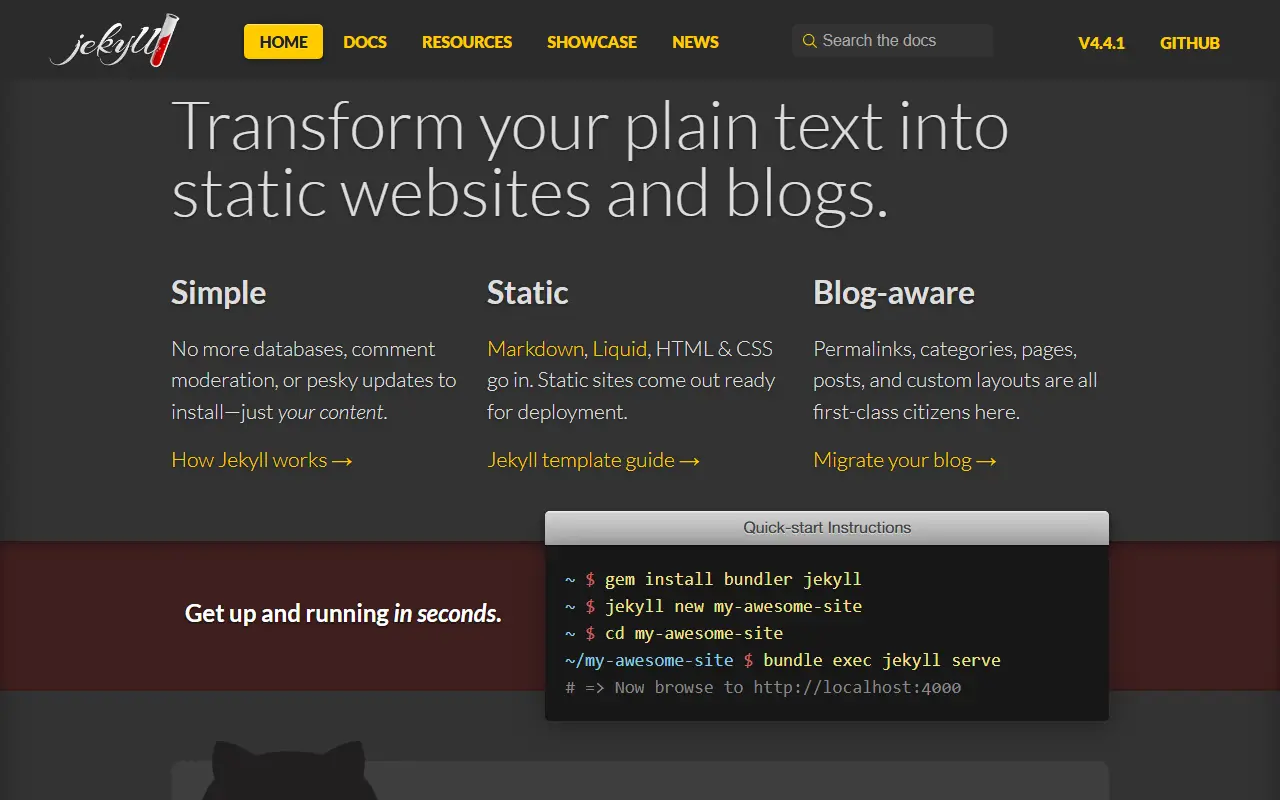
Jekyll takes plain text and builds static websites and blogs from it. Markdown, Liquid, HTML and CSS go in, and a static site comes out ready for deployment, so there is no database or comment moderation to run. It treats permalinks, categories, pages, posts and custom layouts as built-in concepts, which is why it calls itself blog-aware.
Getting started is a few shell commands: install bundler and jekyll as gems, create a new site, then serve it locally on port 4000. GitHub Pages is powered by Jekyll, so a site can be deployed through GitHub for free, including a custom domain. The current release shown is 4.4.1, the project is maintained by volunteers and funded by sponsors, and the site content is under the MIT License.
Key features
- Builds static sites from plain text
- No database or comment moderation to maintain
- Markdown, Liquid, HTML and CSS as inputs
- Permalinks, categories, pages, posts and layouts built in
- Local preview server
- Free deployment through GitHub Pages

An open-source collaborative wiki and documentation tool, positioned as an alternative to Confluence and Notion, with real-time editing, diagrams and permissions.
- GitHub stars
- 22k
- Last commit
- today
- Latest release
- v0.97.0
- Licence
- AGPL-3.0
- Self-hosted
- Yes
- Hosted version
- Available
docmost.com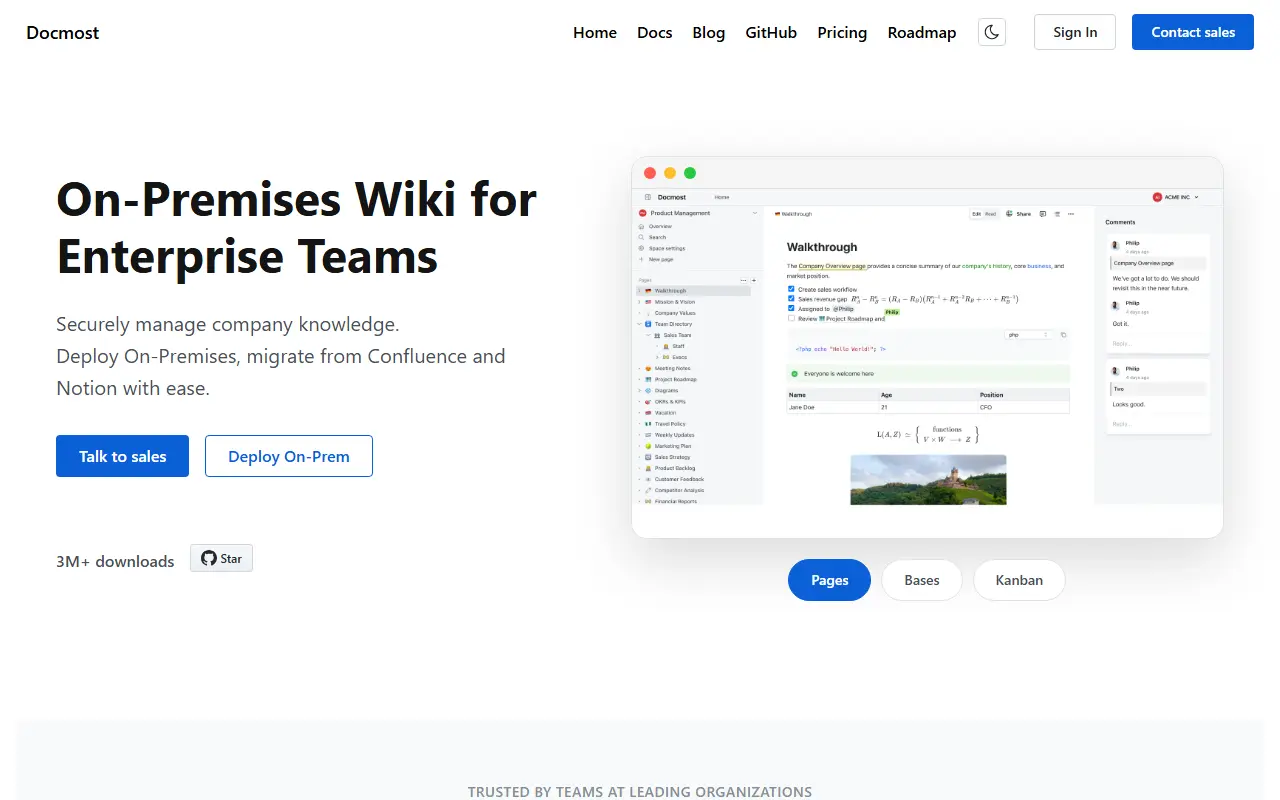
Docmost is a collaborative wiki and documentation tool, open source and presented as an alternative to Confluence and Notion with a focus on secure, on-premise use. Teams write and organize knowledge together in real time, and the project emphasizes that its self-hosted deployment fits organizations with strict compliance requirements.
Its feature list covers real-time collaboration, diagrams through Draw.io, Excalidraw and Mermaid, spaces for organizing content, permission management with groups, comments, page history, search, file attachments and embeds for tools such as Airtable, Loom and Miro. The interface is translated into more than ten languages. Topics mention an AI feature, real-time collaboration and drop-in migration from other wikis.
The Docmost core is licensed under AGPL-3.0, while enterprise features sit in specific directories under a separate enterprise license. You can follow the documentation to self-host it or try the cloud version. It suits teams looking for an internal knowledge base or documentation hub with a lighter footprint than Confluence.
Key features
- Real-time collaborative editing
- Diagrams with Draw.io, Excalidraw and Mermaid
- Spaces, groups and permission management
- Comments and page history
- Full-text search and file attachments
- Embeds for Airtable, Loom and Miro
Pricing: The self-managed Community edition is free. Business costs $6 per seat per month billed annually with a 10-seat minimum; Enterprise is custom and trial licenses are available.
#5
Wiki.js is a Node.js-based open-source wiki; this repository holds the 3.0 beta, which is not intended for production use, while the stable 2.x line lives elsewhere.
- GitHub stars
- 29k
- Last commit
- yesterday
- Latest release
- 3.3.1
- Licence
- AGPL-3.0
- Self-hosted
- Yes
beta.js.wiki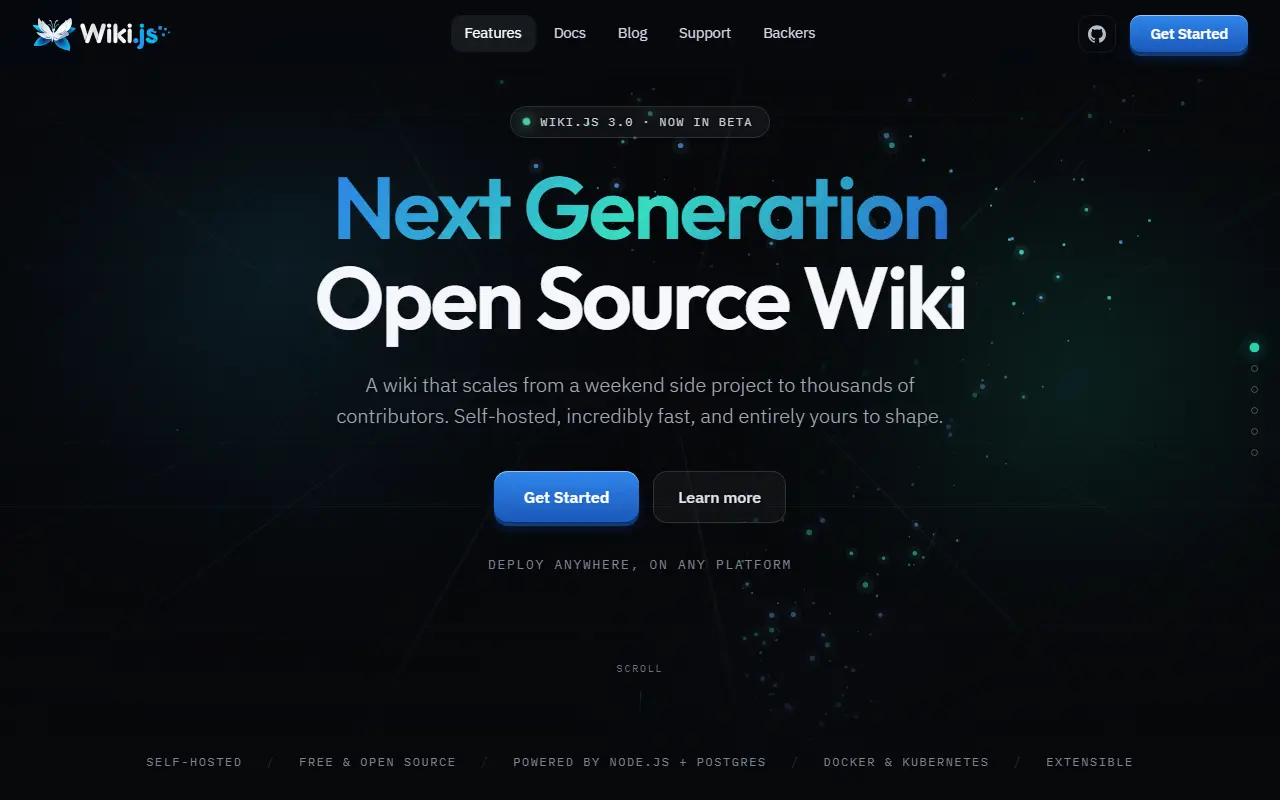
Wiki.js is a next-generation open-source wiki platform built on Node.js with a Vue front end. This repository contains the upcoming 3.0 release in beta, and the README is explicit that it is not for production use. The current stable 2.x release is published at js.wiki and in a separate repository.
The project is aimed at documentation and knowledge sharing for teams. Topics list Markdown editing, Git, cross-platform operation and documentation, and the beta is accompanied by installation requirements, a changelog and a feature request channel. Contributors can help with translations, and the project is supported by sponsors, patrons and donations from the community.
Wiki.js is AGPL-3.0 licensed. It is software you run on your own server, so it suits teams that want a self-hosted wiki they control. Anyone who needs a dependable wiki today should look at the 2.x stable version rather than this beta, and treat the 3.0 code as a preview of what is coming.
Key features
- Node.js wiki with a Vue front end
- Markdown content editing
- Git-friendly documentation workflow
- Installs on multiple platforms
- Community-driven translation effort
- 3.0 beta preview with changelog
Pricing: Free and open source under the AGPL-3.0 license.
#6
An AI-powered open-source knowledge base builder for product docs, technical docs, FAQs and blogs, with AI writing, Q&A and search, from the Chaitin team.
- GitHub stars
- 11k
- Last commit
- 8 days ago
- Latest release
- v3.87.4
- Licence
- AGPL-3.0
- Self-hosted
- Yes
- Hosted version
- Available
pandawiki.docs.baizhi.cloud
PandaWiki is an open-source system for building knowledge bases, powered by large language models. It helps teams quickly set up product documentation, technical documentation, FAQs and blog sites, and uses AI to assist with writing, answering questions and searching the content.
The editor supports Markdown and HTML and can export to Word, PDF and Markdown. Sites can be embedded in other websites as a widget or turned into chatbots for DingTalk, Feishu and WeCom. Content can be imported from web page URLs, website sitemaps, RSS feeds and offline files. A knowledge base is a collection of documents from which PandaWiki builds a separate wiki website, and AI features need an LLM to be configured at first login.
To self-host it you need a Linux server with Docker 20.x or newer and run the installer as root. A SaaS version also exists for those who prefer not to deploy it. PandaWiki is licensed under AGPL-3.0, so modifications and network services built on it must also be open source, and the project documentation is mainly written in Chinese.
Key features
- AI-assisted writing, Q&A and search
- Markdown and HTML rich text editing
- Export to Word, PDF and Markdown
- Embeddable web widget
- Chatbots for DingTalk, Feishu and WeCom
- Import from URLs, sitemaps, RSS and files
- Installation with Docker on Linux
Pricing: Free and open source under AGPL-3.0; a SaaS version is also available.
#7
A simple, self-hosted wiki and documentation platform built with PHP and Laravel that organizes content into books, chapters and pages.
- GitHub stars
- 19k
- Last commit
- yesterday
- Latest release
- v26.09.3
- Licence
- MIT
- Self-hosted
- Yes
codeberg.org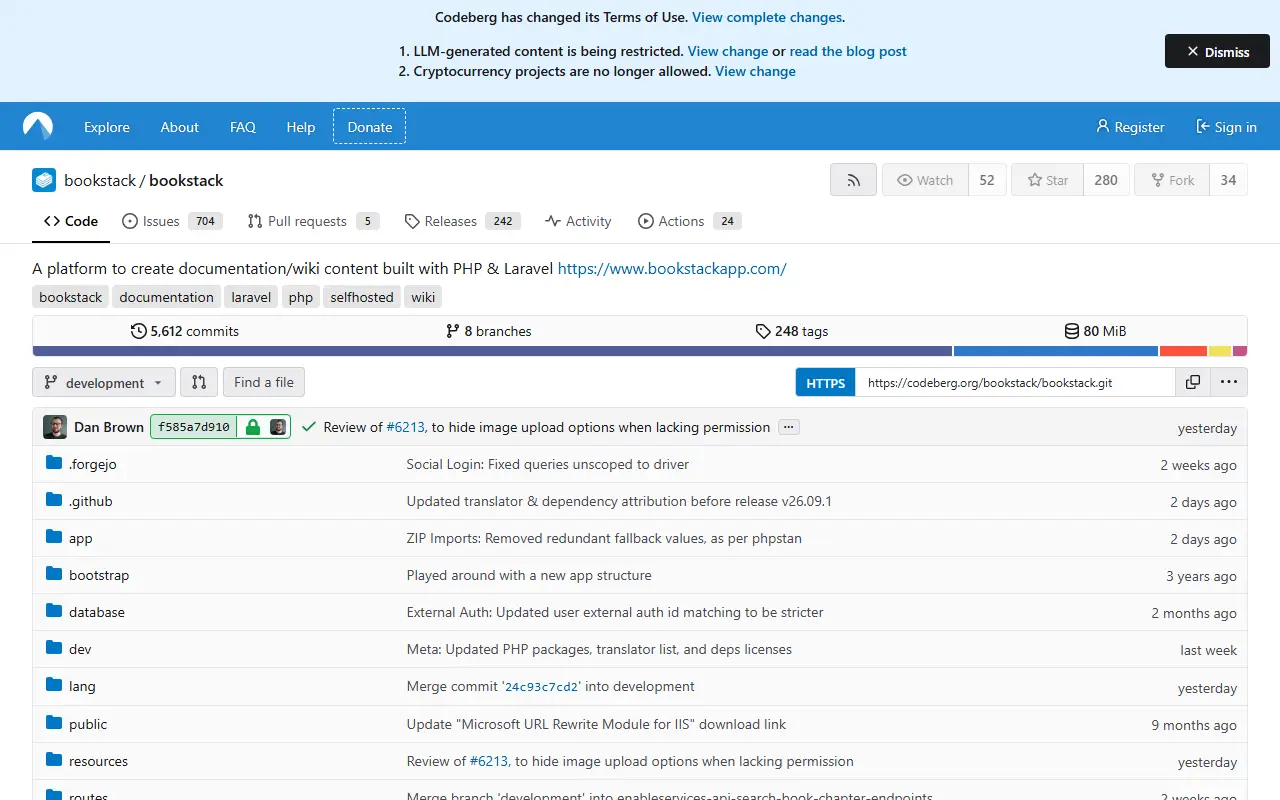
BookStack is a platform for storing and organizing information and documentation, built with PHP and the Laravel framework. It is deliberately opinionated: the aim is a pleasant, intuitive experience out of the box where only basic word-processing skills are needed to create content, so non-technical colleagues can contribute.
Content is organized in a book metaphor, with shelves, books, chapters and pages. Advanced capabilities are available for those who want them, but the project says they should never get in the way of the simple core experience, and it is not intended as a general extensible platform for unrelated purposes. Development is relaxed and positive, evolving slowly while keeping upgrades stable and easy. There is a demo instance, installation instructions, documentation and a blog.
BookStack is licensed under MIT and is now managed on Codeberg, which is where the primary repository and issue list live. You host it on your own server with PHP and a database. It suits teams, schools and small organizations that want an approachable internal wiki rather than a highly configurable knowledge system.
Key features
- Shelves, books, chapters and pages structure
- Simple editor for non-technical users
- Self-hosted PHP and Laravel application
- Stable and easy upgrade path
- Demo instance and documentation
- Advanced options that stay out of the way
Pricing: Free and open source under the MIT license.
#8
Sphinx is a documentation generator that supports reStructuredText and MyST Markdown, with features like cross-referencing, multiple output formats, themes, extensions, and internationalization.
- GitHub stars
- 8.1k
- Last commit
- 4 days ago
- Latest release
- v9.2.0
sphinx-doc.org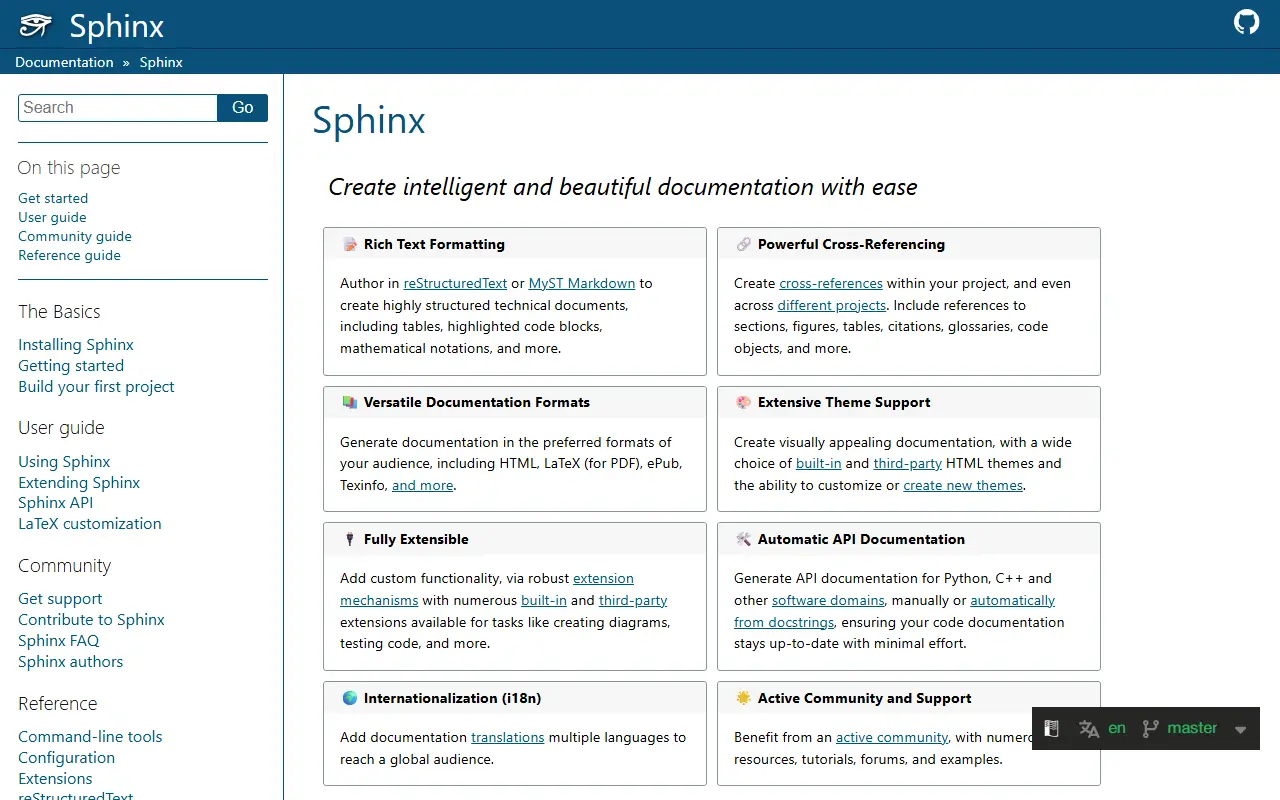
Sphinx is a documentation generator that allows authors to write in reStructuredText or MyST Markdown to create structured technical documents. It supports tables, highlighted code blocks, mathematical notations, and cross-references within and across projects.
The tool can generate documentation in formats such as HTML, LaTeX (for PDF), ePub, and Texinfo. It offers built-in and third-party HTML themes, extension mechanisms for custom functionality, and automatic API documentation for Python, C++, and other software domains.
Key features
- Rich text formatting with reStructuredText or MyST Markdown
- Cross-referencing within and across projects
- Multiple output formats: HTML, LaTeX, ePub, Texinfo
- Extensive theme support with built-in and third-party themes
- Extensible via built-in and third-party extensions
- Automatic API documentation for Python, C++, and other domains

An open source wiki engine written in PHP that stores pages as plain text files, so it needs no database.
- GitHub stars
- 4.7k
- Last commit
- 2 days ago
- Latest release
- release-2026-07-14c
- Licence
- GPL-2.0
- Self-hosted
- Yes
DokuWiki is an open source wiki application written in PHP and licensed under GPLv2. It works on plain text files, which means it does not need a database. Its syntax is similar to the one used by MediaWiki, and it is often recommended as a lighter, easier to customize alternative.
Because it only needs files, it can be installed on local PCs, flash drives, and folders synced with file hosting services or file synchronization programs such as Dropbox or Syncthing. The name comes from the German word for documentation, Dokumentation.
Andreas Gohr created DokuWiki in June 2004. A parser and renderer redesign in January 2005 and a cache mechanism brought performance gains that made it usable for larger projects. Installation instructions and all documentation are published on dokuwiki.org.
Key features
- Stores content in plain text files
- Written in PHP and licensed under GPLv2
- Syntax similar to MediaWiki
- Can run from local PCs, flash drives or synced folders
- Cache mechanism for larger projects

Self-hosted document and knowledge base system built with Python and Django, for individuals and small teams writing notes, wikis, and product docs.
- GitHub stars
- 3.2k
- Last commit
- 2 days ago
- Latest release
- v1.1.1
- Licence
- GPL-3.0
- Self-hosted
- Yes
mrdoc.io
MrDoc is an online document and knowledge management system you host yourself. It covers capturing and storing content, organizing it into collections, AI-assisted question answering, writing, and sharing, so individuals and small teams can keep personal notes, internal wikis, product documentation, and tutorials in one place. Its own description compares it to a self-hosted Yuque or an online-editable GitBook.
Content is written in Markdown, and the project provides several ways in: the web application, browser extensions for web clipping and quick notes, desktop clients for Windows, macOS, and Linux, a mobile client for Android, and an Obsidian plugin for two-way sync. The web app comes in an open-source edition and a professional edition, so some features are reserved for the paid tier.
MrDoc is written in Python with the Django framework and released under the GPL-3.0 license, with documentation in both Chinese and English and a demo site. It suits teams that want full ownership of their knowledge base data and a simple self-hosted alternative to cloud documentation tools.
Key features
- Markdown document editing and organization
- Wiki and knowledge base structure
- AI knowledge base question answering
- Browser extension for web clipping
- Desktop and mobile clients
- Two-way sync with Obsidian
Pricing: The open-source edition is free under the GPL-3.0 license; a separate Professional Edition exists.
6 more Document360 alternatives
Document360 alternatives: questions
- What is the best open-source alternative to Document360?
- Hugo is the top-ranked open-source alternative to Document360 on Enlisted: A static site generator written in Go that builds websites from Markdown and templates, with themes, modules and Sass support, for blogs and documentation. Other strong options are Outline, Jekyllrb, Docmost and Wiki.js.
- What are the best commercial alternatives to Document360?
- HelpDocs, KnowledgeOwl, Helpjuice, GitBook and Confluence are among the hosted, closed-source alternatives to Document360 listed on Enlisted, which lists 34 in total. Compare their pricing and features on each tool page.
- Are these Document360 alternatives free?
- All 16 are open source, so the code is free to use under its licence, and all of them can be self-hosted on your own server or computer. 4 also offer a paid or managed cloud version if you'd rather not host it yourself.
- How is this list of Document360 alternatives ranked?
- By a score built from GitHub stars, star growth over the last 30 days and how recently the code changed. 11 of these projects shipped code in the last 30 days. Data is refreshed daily, and nobody can pay to move up.
 TrackMedia
 TrackRev