8 open-source alternatives ranked by real activity

Open-source Readymag alternatives

A curated, ranked list of the 8 best open-source alternatives to Readymag.

The best open-source alternative to Readymag is Astro. If that doesn't suit you, other good options are Hugo, Jekyllrb, Instatic and Grav.

Commercial alternatives to Readymag include Cargo, Pixpa, Tilda and Webflow. See all 15.

Readymag alternatives are mainly CMS tools. 7 of them shipped code in the last 30 days, 8 can be self-hosted, and 4 use a permissive licence.

Last updated November 13, 2026 · ranked by GitHub stars, growth and recent commits

Astro

Astro is a JavaScript web framework for content-driven websites that renders on the server and ships little client-side JavaScript.

GitHub stars
64k
Last commit
yesterday
Latest release
@astrojs/vue@7.1.5
astro.buildAstro homepage screenshot

Astro describes itself as a JavaScript web framework optimized for building fast, content-driven websites. Components render on the server, and the browser receives lightweight HTML instead of a large JavaScript bundle. Data can come from the file system, an external API or a CMS, so content is not tied to one source.

Projects start with the npm create astro@latest command. Built-in pieces include content collections for Markdown and MDX, view transitions and image optimisation, and integrations extend it further. Astro works with the major UI frameworks, including React, Vue, Preact, Svelte and Solid, so existing components can be reused inside Astro pages.

Key features

  • Server-side rendering of components to light HTML
  • Content collections for Markdown and MDX
  • Only needed JavaScript is shipped
  • Page transitions through browser View Transition APIs
  • Works with major UI frameworks
  • Loads data from files, APIs or a CMS

Read more about AstroWebsiteGitHub#1 Readymag alternative

Hugo

A static site generator written in Go that builds websites from Markdown and templates, with themes, modules and Sass support, for blogs and documentation.

GitHub stars
90k
Last commit
yesterday
Latest release
v0.169.0
Licence
Apache-2.0
Self-hosted
Yes
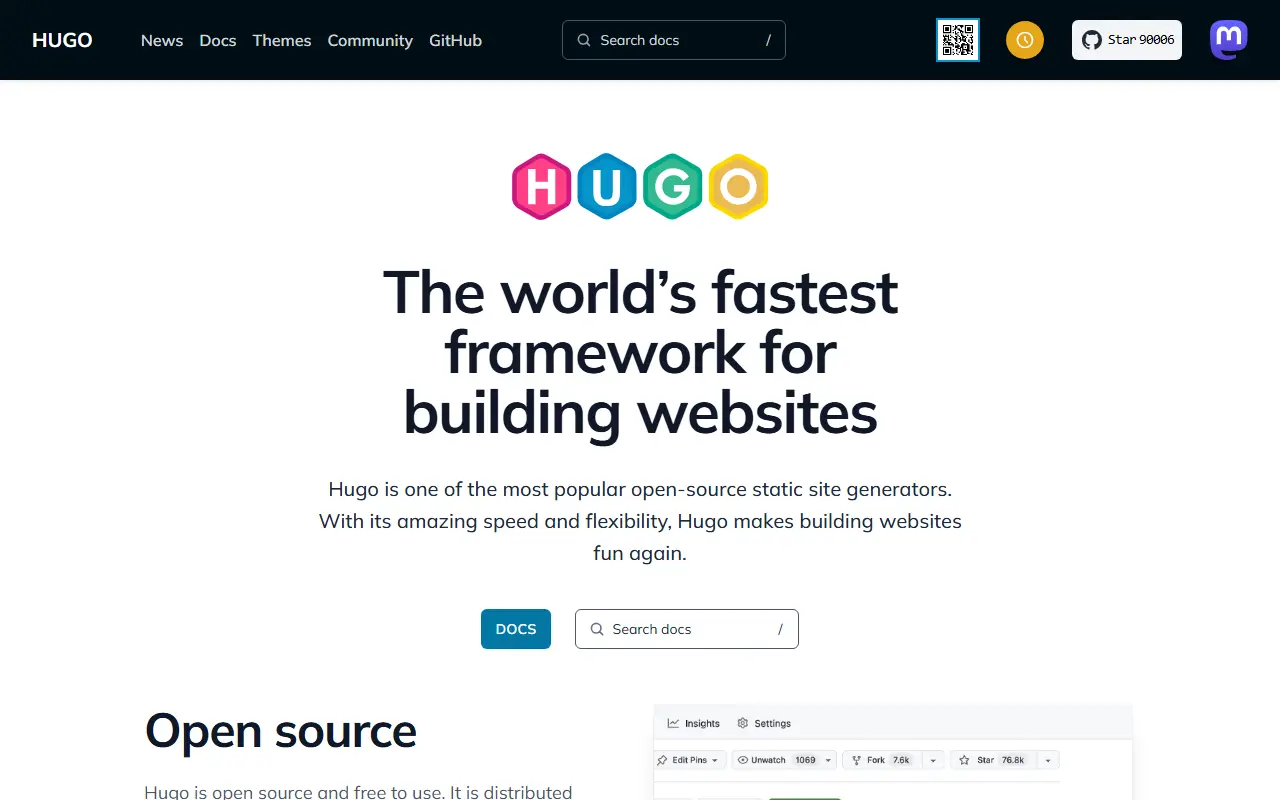
gohugo.ioHugo homepage screenshot

Hugo is a static site generator written in Go. You write content in Markdown, combine it with templates and a theme, and Hugo renders a folder of plain HTML, CSS and JavaScript that can be hosted almost anywhere without a server-side runtime or database. It is widely used for blogs, documentation sites and marketing pages.

It ships as a single prebuilt binary for Linux, macOS, Windows and the BSDs, and can also be built from source with Go and a C compiler. Hugo Modules let a site pull in themes and shared content as versioned components, a theme gallery gives starting points, and built-in functions transpile Sass to CSS. A deploy command and hosting guides cover publishing to common platforms.

The project is Apache-2.0 licensed and built by a community of contributors. Unlike a hosted CMS, there is no admin interface by default: editing happens in files, often tracked in Git, which suits developers and technical writers who prefer a plain-text workflow.

Key features

  • Builds sites from Markdown content and templates
  • Hugo Modules for themes and shared components
  • Built-in Sass transpilation
  • Single prebuilt binary for major platforms
  • Large theme gallery
  • Deploy command for common hosting targets

Pricing: Free and open source under the Apache-2.0 license.

Read more about HugoWebsiteGitHub#2 Readymag alternative

Jekyllrb

Jekyll is a static site generator that turns Markdown, Liquid templates, HTML and CSS into blogs and websites.

GitHub stars
52k
Last commit
1 mo ago
Latest release
v4.4.1
Licence
MIT
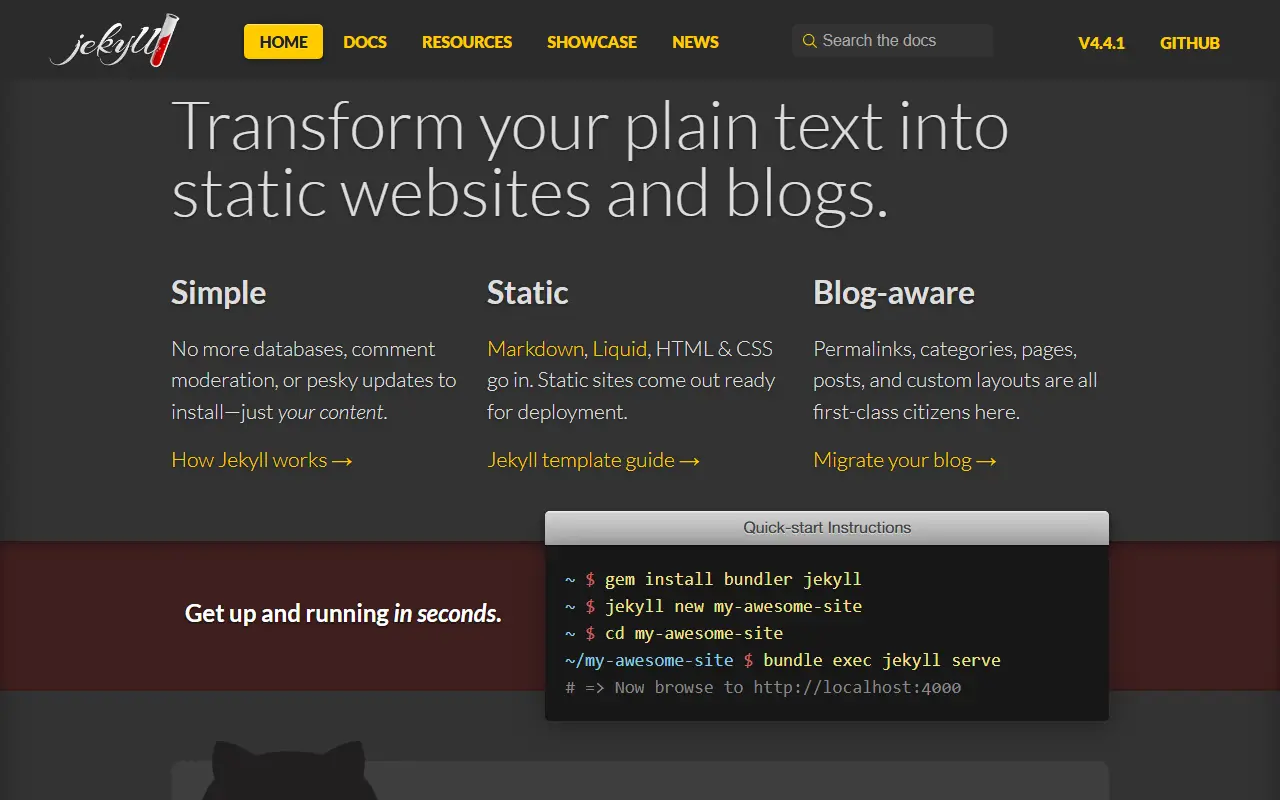
jekyllrb.comJekyllrb homepage screenshot

Jekyll takes plain text and builds static websites and blogs from it. Markdown, Liquid, HTML and CSS go in, and a static site comes out ready for deployment, so there is no database or comment moderation to run. It treats permalinks, categories, pages, posts and custom layouts as built-in concepts, which is why it calls itself blog-aware.

Getting started is a few shell commands: install bundler and jekyll as gems, create a new site, then serve it locally on port 4000. GitHub Pages is powered by Jekyll, so a site can be deployed through GitHub for free, including a custom domain. The current release shown is 4.4.1, the project is maintained by volunteers and funded by sponsors, and the site content is under the MIT License.

Key features

  • Builds static sites from plain text
  • No database or comment moderation to maintain
  • Markdown, Liquid, HTML and CSS as inputs
  • Permalinks, categories, pages, posts and layouts built in
  • Local preview server
  • Free deployment through GitHub Pages

Instatic

A self-hosted visual CMS and site builder that runs in one Bun server and outputs clean static HTML and CSS, positioned as an open alternative to Webflow, Framer and WordPress.

GitHub stars
9.1k
Last commit
10 days ago
Latest release
v0.0.21
Licence
MIT
Self-hosted
Yes
instatic.comInstatic homepage screenshot

Instatic is a self-hosted content management system with a visual editor, content engine and publisher all running in a single Bun server. It is presented as an open-source alternative to Webflow, Framer and WordPress, and aims to replace the usual pile of separate services for CMS, framework, hosting, forms and analytics.

One server holds the canvas editor, content engine, media, authentication, forms, plugins and the publisher, with users, roles and a database included, backed by SQLite or Postgres. Pages it generates are plain semantic HTML with compact CSS, without framework runtime or builder attributes, so they behave like static files. The README suggests one-click deployment on Railway, with options for Render and Docker or a VPS with Caddy TLS.

Instatic is MIT licensed and very new: the repository was created in April 2026 and the latest release is v0.0.20, so expect rapid change. It targets developers, designers and small businesses who want to own their site stack and keep the published output lean.

Key features

  • Visual canvas editor for pages
  • Clean static HTML and CSS output
  • Single Bun server for everything
  • Users, roles and plugins built in
  • SQLite or Postgres storage
  • Forms and media management
  • One-click Railway deployment

Pricing: Free and open source under the MIT licence.

Grav

A flat-file CMS written in PHP that needs no database, using Markdown content, Twig templates and YAML configuration, with a package manager for plugins and themes.

GitHub stars
16k
Last commit
2 days ago
Latest release
2.2.29
Licence
MIT
Self-hosted
Yes
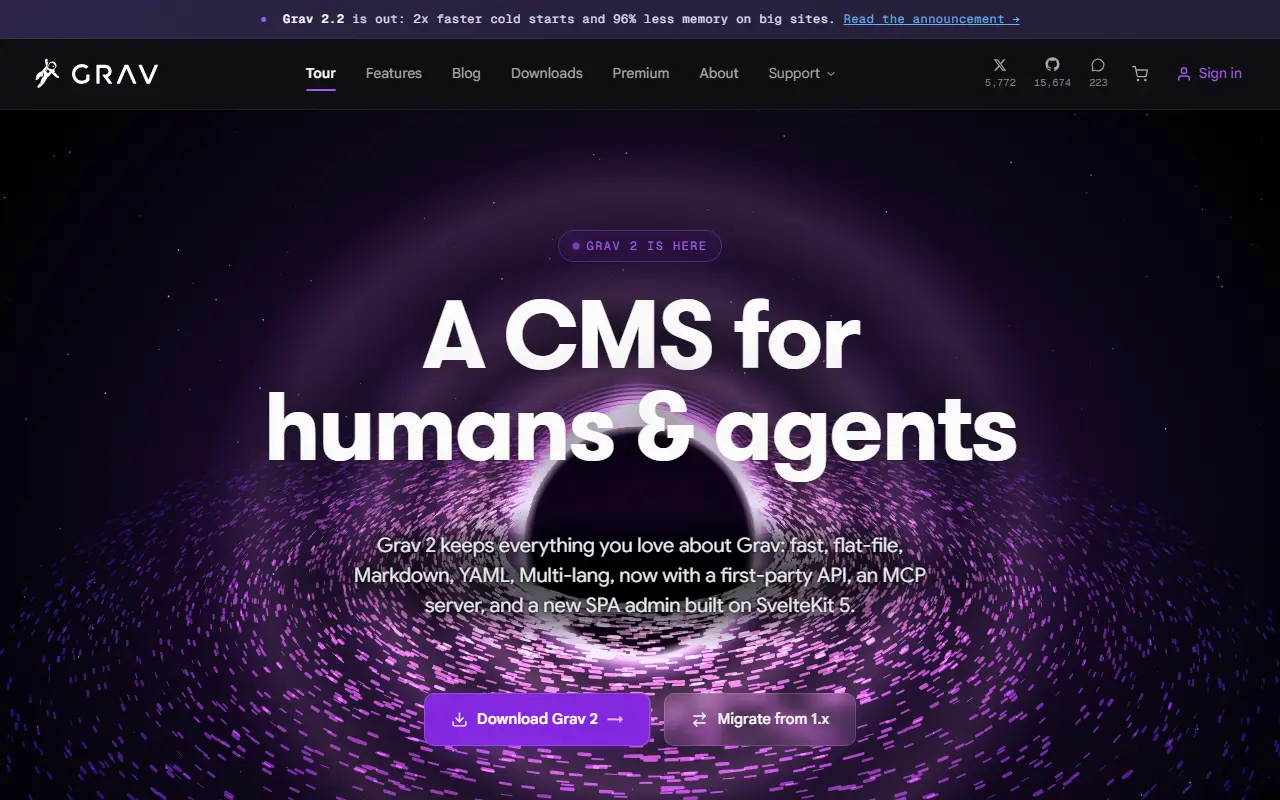
getgrav.orgGrav homepage screenshot

Grav is a file-based web platform written in PHP. There is nothing to install in the traditional sense: you extract the archive and the site is running, and content lives in plain files rather than a database. It follows the flat-file CMS approach but with its own design philosophy.

Content is written in Markdown, templates use Twig, and configuration is in YAML. Under the hood it relies on established components, including Parsedown for Markdown, Symfony Cache, the Pimple dependency injection container, the Symfony Event Dispatcher for plugin events, Symfony Console for the command line and the Gregwar image library for dynamic image handling. A built-in package management system makes installing and upgrading plugins and themes straightforward, and it can update Grav itself.

Grav is MIT licensed and aimed at developers and small organizations that want a fast, simple CMS they can version in Git and host on cheap PHP hosting. Its topics cover website building and generation, and an admin plugin offers a web interface for those who prefer one.

Key features

  • Flat-file CMS with no database
  • Markdown content and Twig templates
  • Configuration written in YAML
  • Package manager for plugins and themes
  • Architecture built on Symfony components
  • Dynamic image manipulation

Pricing: Free and open source under the MIT license.

Read more about GravWebsiteGitHub#5 Readymag alternative

Webstudio

An open-source visual website builder positioned as a Webflow alternative, connecting to any headless CMS and supporting all CSS properties, hosted by Webstudio or yourself.

GitHub stars
9.2k
Last commit
today
Latest release
0.312.0
Licence
AGPL-3.0
Self-hosted
Yes
Hosted version
Available
webstudio.isWebstudio homepage screenshot

Webstudio is a visual development platform, released as open source, for developers, designers and cross-functional teams, and is presented as an alternative to Webflow. It is a visual builder that connects to any headless CMS and supports all CSS properties, and you own the data, components and infrastructure.

You can choose the hosted version or deploy your own instance, and the topics mention Cloudflare Workers, React, Remix and accessibility via Radix UI. The project provides a blog, documentation, a roadmap and an issue tracker for the builder, and a community on Discord.

Licensing is split. The Webstudio core, meaning all functionality in the repository, is free and open source under AGPL-3.0-or-later, while the optional sdk-components-animation package is proprietary and requires accepting the Webstudio, Inc. EULA. It is written in TypeScript. It suits designers and developers who want Webflow-style visual building with the option to self-host.

Key features

  • Visual builder for websites
  • Support for all CSS properties
  • Connects to any headless CMS
  • Host on Webstudio or self-host
  • React and Remix based codebase
  • Optional proprietary animation package

Pricing: Core is open source under AGPL-3.0-or-later; an optional animation package is proprietary. A hosted version is offered.

Publii

A desktop static site CMS for Windows, macOS and Linux that lets you build and edit sites offline, then publish them to a server or a hosting service.

GitHub stars
7.4k
Last commit
5 days ago
Latest release
v.0.48.3-build-17587
Licence
GPL-3.0
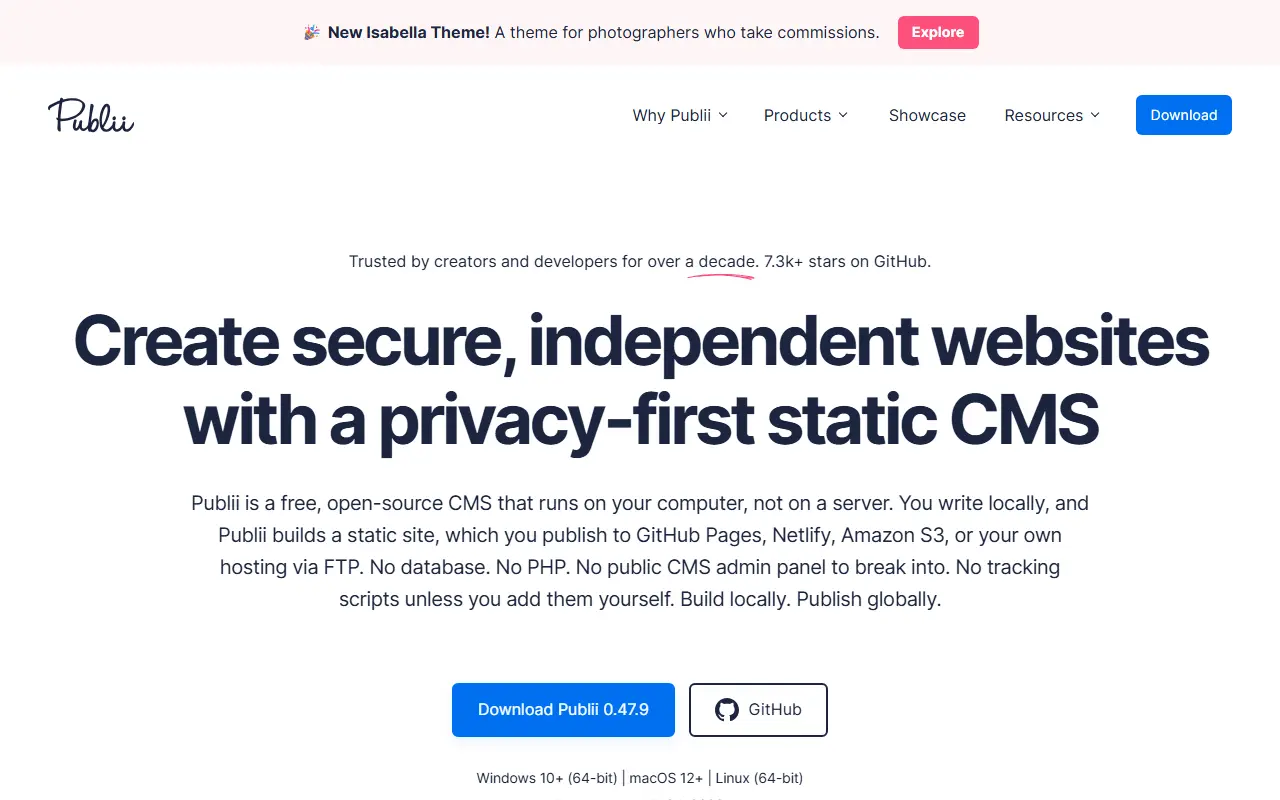
getpublii.comPublii homepage screenshot

Publii is a desktop-based content management system for static websites, available for Windows, macOS and Linux. It offers an interface comparable to server-based CMSs such as WordPress or Joomla, with posts, pages, themes and options, but produces a fast static site instead of running on your web server. It is written with Electron and Vue.

Because the app runs locally, you can create, update and change a site without an internet connection and then upload the changes in one click. It supports multiple upload targets, including standard HTTP or HTTPS servers, Netlify, Amazon S3, GitHub Pages, Google Cloud and SFTP. It is presented as a privacy-focused, SEO-friendly option that avoids the security and performance burden of a dynamic CMS, and is meant to be usable even for beginners.

Publii is licensed under GPL-3.0 and downloads are offered for exe, dmg, deb, rpm and AppImage. User and developer documentation, a community hub and a wiki are available, and instructions explain how to build the app yourself. It suits bloggers, small businesses and developers who want static output with a friendly editor.

Key features

  • Desktop CMS for Windows, macOS and Linux
  • Offline site editing
  • Static site output for speed and security
  • Built-in themes and options
  • One-click upload to Netlify, S3 or SFTP
  • GitHub Pages and Google Cloud publishing

Pricing: Free and open source under the GPL-3.0 licence.

Silex

Free, open-source visual website builder that exports clean static HTML and CSS, positioned as a libre alternative to Webflow.

GitHub stars
3k
Last commit
today
Latest release
v3.10.0
Licence
AGPL-3.0
Self-hosted
Yes
Hosted version
Available
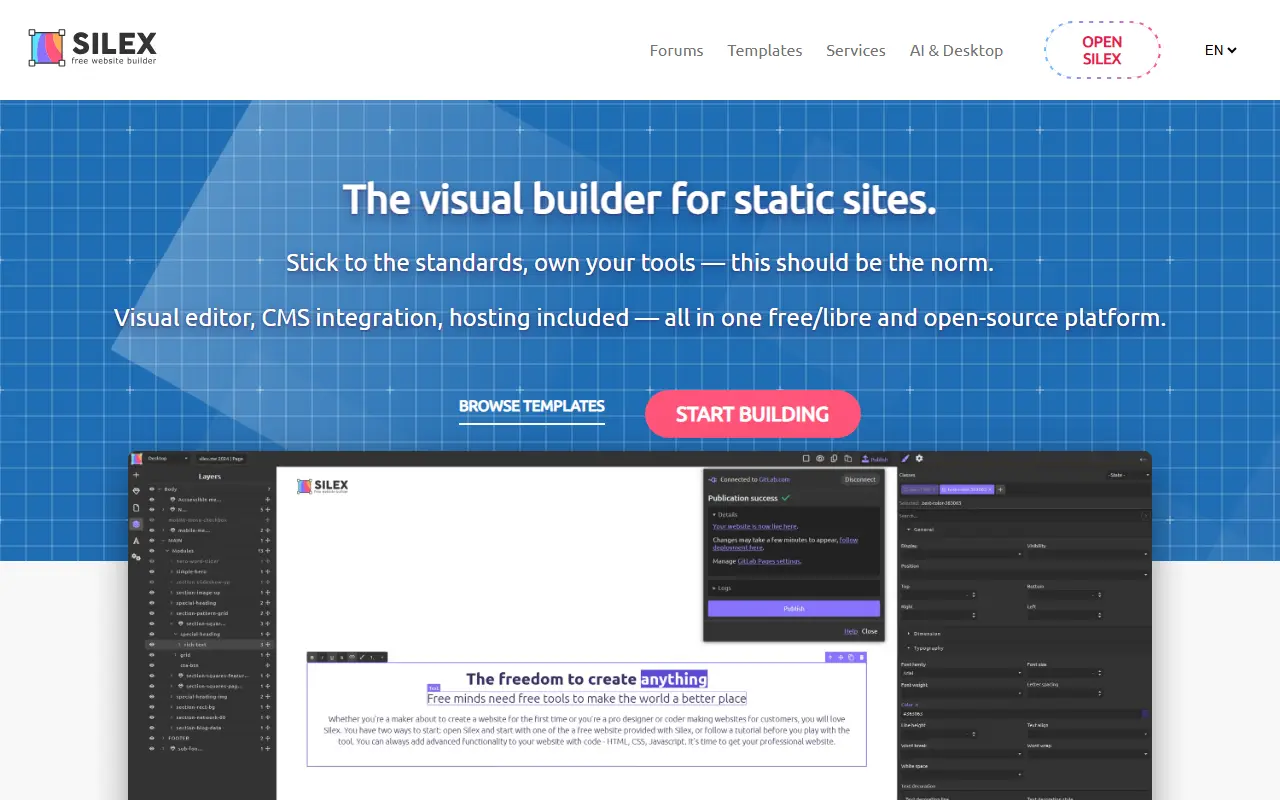
silex.meSilex homepage screenshot

Silex is a visual builder for static websites that can also pull in dynamic data. You design pages visually and export standard HTML and CSS that can be hosted anywhere, so there is no proprietary format, forced hosting, or subscription. It is released under the AGPL-3.0 license and presented as an open alternative to Webflow.

It is maintained by Silex Labs, a non-profit organization, and describes itself as free forever with all features included and no premium tier. It follows JAMstack practices, uses the GrapesJS editor according to its topics, and can pull content from WordPress through GraphQL. An MCP server is also mentioned among the project topics, and a desktop app can be downloaded alongside the online version.

You can try Silex online or run it yourself with Node.js. It suits web agencies, WordPress developers, freelance designers, and no-code builders who want a visual workflow with output they fully own. Because the output is standard web files, learning it also builds transferable HTML, CSS, and JAMstack skills.

Key features

  • Visual page design with clean HTML and CSS export
  • Host the exported site anywhere
  • Dynamic data for static sites
  • WordPress content through GraphQL
  • Desktop app and online editor
  • Built on the GrapesJS editor

Pricing: Silex is free to use hosted through a free GitLab account, as a desktop app, or self-hosted. Training, development and managed hosting are optional services quoted separately.

Read more about SilexWebsiteGitHub#8 Readymag alternative

Commercial Readymag alternatives

Hosted, closed-source products that compete with Readymag. Showing 12 of 15.

See every Readymag alternative on its tool page

Readymag alternatives: questions

What is the best open-source alternative to Readymag?
Astro is the top-ranked open-source alternative to Readymag on Enlisted: Astro is a JavaScript web framework for content-driven websites that renders on the server and ships little client-side JavaScript. Other strong options are Hugo, Jekyllrb, Instatic and Grav.
What are the best commercial alternatives to Readymag?
Cargo, Pixpa, Tilda, Webflow and Semplice are among the hosted, closed-source alternatives to Readymag listed on Enlisted, which lists 15 in total. Compare their pricing and features on each tool page.
Are these Readymag alternatives free?
All 8 are open source, so the code is free to use under its licence, and all of them can be self-hosted on your own server or computer. 2 also offer a paid or managed cloud version if you'd rather not host it yourself.
How is this list of Readymag alternatives ranked?
By a score built from GitHub stars, star growth over the last 30 days and how recently the code changed. 7 of these projects shipped code in the last 30 days. Data is refreshed daily, and nobody can pay to move up.

People also look for alternatives to…

View all