#1
An open-source system for deploying, scaling and managing containerized applications across clusters of hosts, hosted by the CNCF.
- GitHub stars
- 129k
- Last commit
- yesterday
- Latest release
- v1.37.2
- Licence
- Apache-2.0
- Self-hosted
- Yes
- Hosted version
- Available
kubernetes.io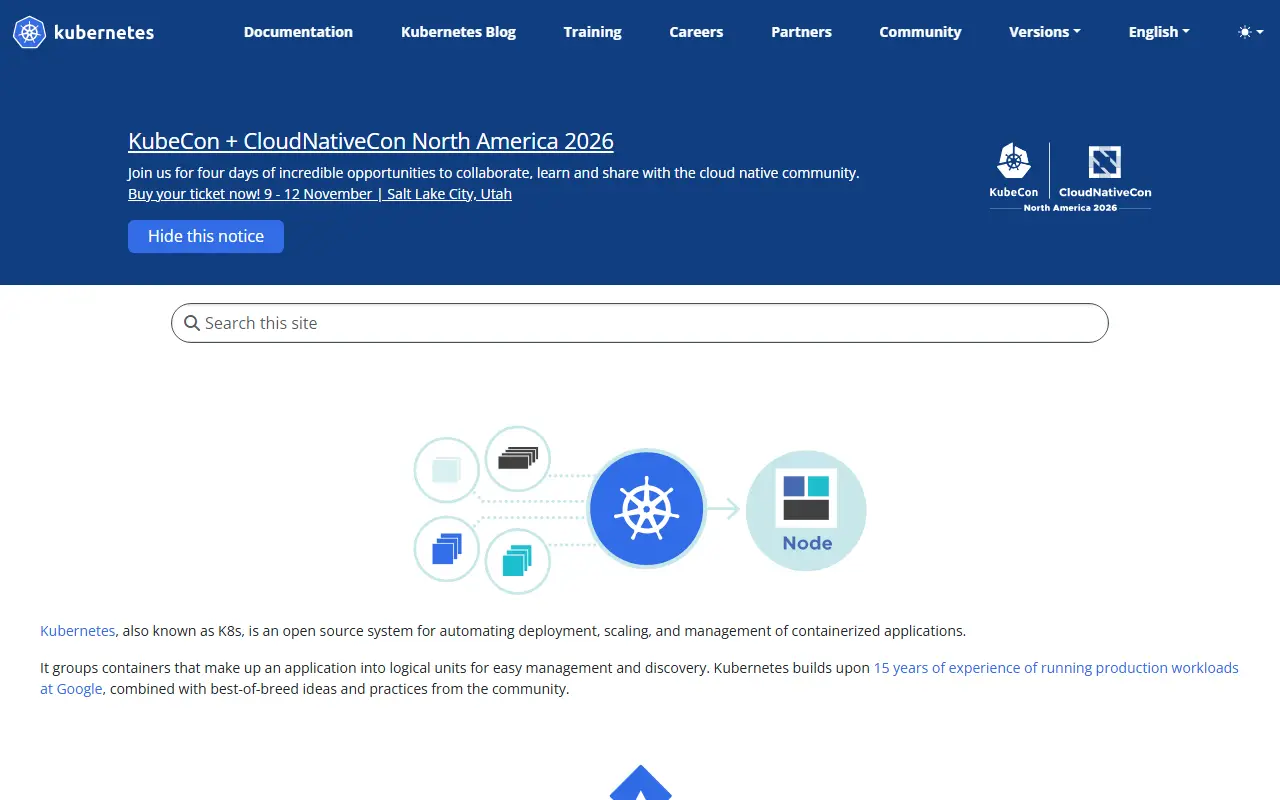
Kubernetes, also written K8s, is an open-source system that manages containerized applications across multiple hosts. It provides the basic mechanisms for deploying, maintaining and scaling applications, so teams can run containers reliably without scheduling each one by hand. It is written in Go and released under the Apache-2.0 license.
The project builds on years of experience running production workloads at Google with an internal system called Borg, combined with practices from the wider community. The Cloud Native Computing Foundation hosts the project. Users interact with it through declarative configuration and the documentation on kubernetes.io, which includes tutorials and a free course on scalable microservices.
Kubernetes can be run on your own infrastructure, and major cloud providers also offer managed Kubernetes services. The README adds that the k8s.io/kubernetes module is not supported for use as a library. It suits platform and DevOps teams running microservices that need scheduling, scaling and automatic recovery.
Key features
- Container scheduling across multiple hosts
- Automated application deployment and rollouts
- Scaling of containerized workloads
- Maintenance and self-healing of applications
- Declarative configuration of desired state
- CNCF-hosted with extensive documentation
Pricing: Free and open source under the Apache-2.0 license; cloud providers sell managed services built on it.
#2
Coder is a self-hosted platform for cloud development environments and AI coding agents, with workspaces defined in Terraform.
- GitHub stars
- 17k
- Last commit
- yesterday
- Latest release
- v2.38.7
- Licence
- AGPL-3.0
- Self-hosted
- Yes
coder.com
Coder is a self-hosted platform for running cloud development environments and AI coding agents on infrastructure you control. Workspaces are defined with Terraform and can be backed by EC2 VMs, Kubernetes pods, Docker containers and similar resources, so developers can start from a prepared environment instead of configuring a local machine.
Workspaces connect through a secure WireGuard tunnel and shut down automatically when idle to save on costs. Developers can use IDEs such as VS Code and JetBrains. Coder Agents runs an AI coding agent whose loop executes in the control plane on your infrastructure, works with models from Anthropic, OpenAI, Google, Bedrock or self-hosted options, and keeps LLM credentials out of workspaces while providing audit logging and cost tracking.
The server can be installed with a script on Linux and macOS or from a Windows binary, and it starts with a built-in database for evaluation. Production use calls for a PostgreSQL database and an external access URL. Coder is written in Go and released under AGPL-3.0, with a paid Premium tier referenced in its documentation.
Key features
- Terraform-defined cloud development workspaces
- Secure WireGuard connections
- Automatic shutdown of idle workspaces
- Works with VS Code and JetBrains
- AI coding agents running on your infrastructure
- Audit logging and model governance
Pricing: The Community edition is free and self-hosted. Premium is billed annually per user and AI Premium is custom; neither price is published.
#3
Backstage is an open-source framework for building internal developer portals around a software catalog, templates and technical docs.
- GitHub stars
- 35k
- Last commit
- yesterday
- Latest release
- v1.56.4
- Licence
- Apache-2.0
- Self-hosted
- Yes
backstage.io
Backstage is a framework, published openly, for creating developer portals. It was created at Spotify and is now a Cloud Native Computing Foundation project at the incubation level. Centered on a software catalog, it brings order to microservices and infrastructure so product teams can ship code quickly while keeping their autonomy. It is written in TypeScript and released under the Apache-2.0 license.
Out of the box it includes a Software Catalog for tracking services, libraries, data pipelines, websites and machine learning models, Software Templates for starting new projects with organization-approved defaults, and TechDocs for a docs-like-code approach to documentation. A growing ecosystem of open-source plugins extends what the portal can show and do. Because it is a framework rather than a finished product, organizations build and host their own Backstage instance, guided by the getting started documentation and roadmap.
Key features
- Software Catalog for services and libraries
- Software Templates for new project scaffolding
- TechDocs with docs-like-code workflow
- Plugin ecosystem to extend the portal
- CNCF incubation project
- TypeScript framework you host yourself
Pricing: Free and open source under the Apache-2.0 license; you build and host your own instance.
#4
Argo CD is a Kubernetes continuous delivery tool built on GitOps, syncing applications from Git to clusters declaratively.
- GitHub stars
- 25k
- Last commit
- yesterday
- Latest release
- v3.6.1
- Licence
- Apache-2.0
- Self-hosted
- Yes
argo-cd.readthedocs.io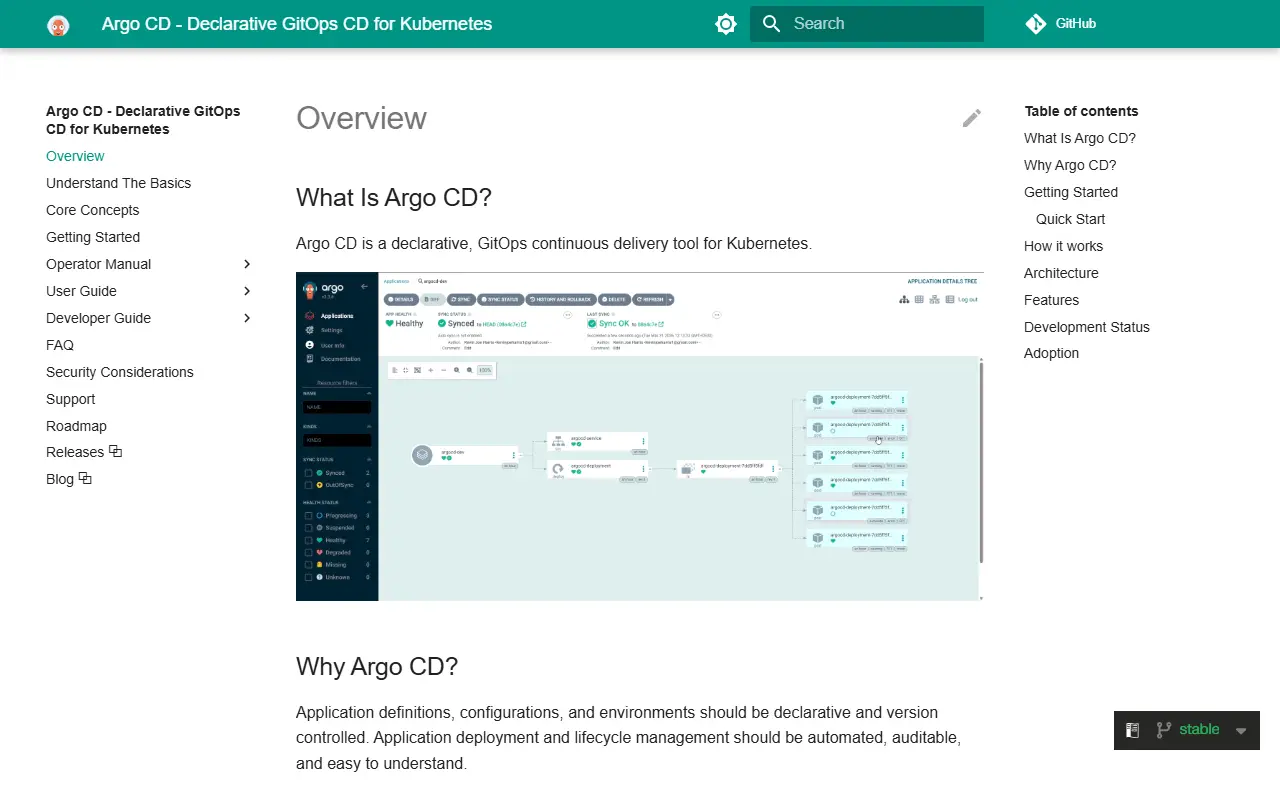
Argo CD applies GitOps principles to continuous delivery on Kubernetes, in a declarative way. Its premise is that application definitions, configuration and environments should be declarative and version controlled, and that rolling out and managing applications should be automated, traceable and straightforward. It is written in Go, is part of the Argo project under the CNCF, and is released under the Apache-2.0 license.
Repository topics show support for Helm, Kustomize and Jsonnet as ways to describe applications, alongside a focus on continuous deployment pipelines. The project offers complete documentation and a live demo, and the community can be reached through GitHub Discussions, a Slack channel, contributor office hours and monthly user community meetings. Its README links to many blog posts and talks on combining Argo CD with tools such as Crossplane, Argo Workflows and preview environments for pull requests.
Key features
- GitOps-based continuous delivery for Kubernetes
- Declarative, version-controlled application definitions
- Helm, Kustomize and Jsonnet support
- Automated and auditable deployments
- Live demo and complete documentation
- CNCF-governed open community
Pricing: Free and open source under the Apache-2.0 license.
#5
Pulumi is an infrastructure as code platform that lets teams define cloud infrastructure in Node.js, Python, Go, .NET, Java or YAML.
- GitHub stars
- 26k
- Last commit
- yesterday
- Latest release
- v3.275.0
- Licence
- Apache-2.0
- Self-hosted
- Yes
- Hosted version
- Available
pulumi.com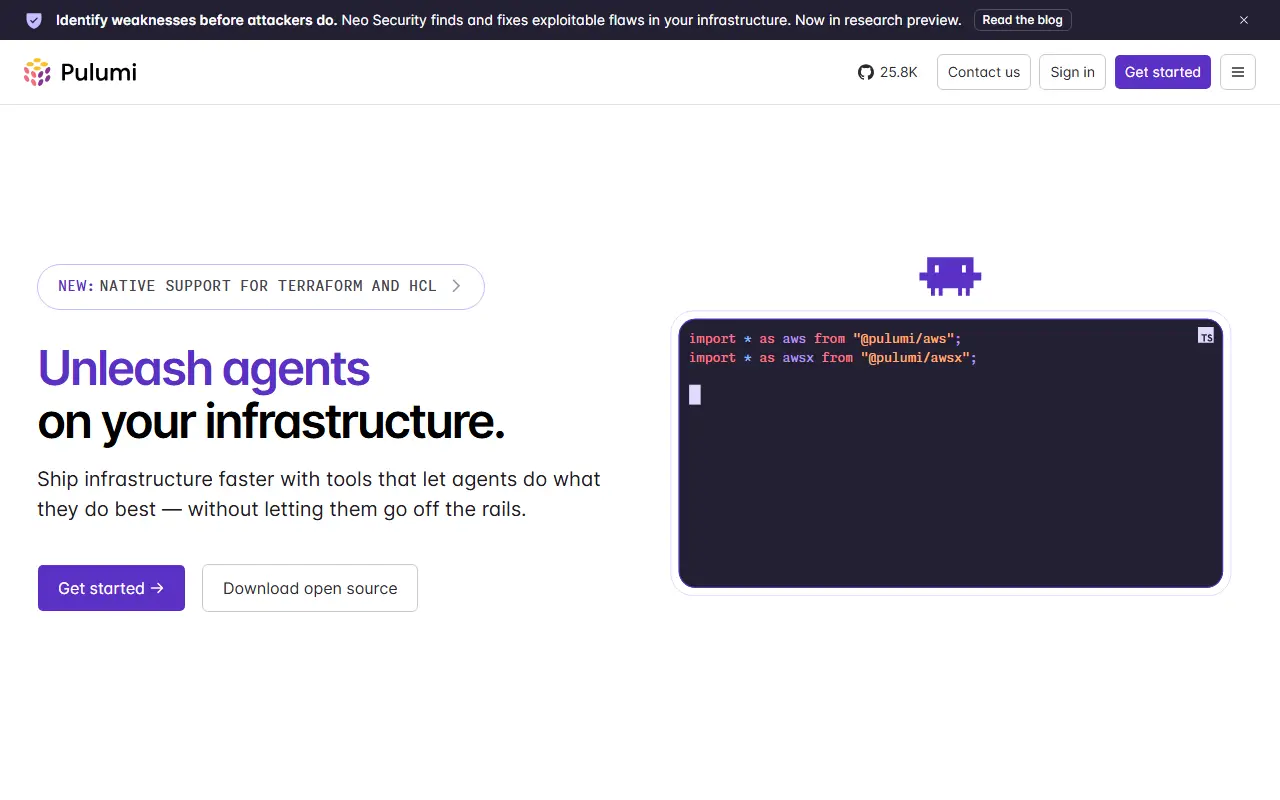
Pulumi is an infrastructure as code platform. Teams describe infrastructure for any cloud in a general-purpose language: Node.js, Python, Go, .NET, Java, or YAML. A registry lists hundreds of cloud providers and packages.
Around the core tool sit services for secrets and configuration, discovery and governance, an internal developer platform, and an AI agent named Neo. The Free plan covers one user with state management and Pulumi Deployments; Essentials, Pro and Enterprise add users, policy, SSO, audit logs and more.
The licence listed for the project is Apache-2.0. The pricing page says Pulumi stays free for open source and individuals, and the Enterprise plan lists self-hosting as available.
Key features
- Infrastructure as code in several languages
- AI infrastructure agent called Neo
- Environments, secrets and configuration management
- Asset management and compliance remediation
- Registry of cloud providers and packages
- Unlimited projects, stacks and environments on Free
- SSO, RBAC and policy enforcement on Pro
Pricing: Free is $0 for 1 user. Essentials is $40/month (up to 500 managed resources), Pro $400/month (up to 2,000), Enterprise $2,000/month (up to 4,750). Credits: 40, 400 and 2,000.
#6
Rancher is an open-source container management platform for deploying and operating Kubernetes clusters across environments.
- GitHub stars
- 26k
- Last commit
- yesterday
- Latest release
- v2.15.3
- Licence
- Apache-2.0
- Self-hosted
- Yes
rancher.com
Rancher is an open-source container management platform for organizations that run containers in production. It aims to make Kubernetes easy to run in many places, to meet IT requirements and to support DevOps teams. It is written in Go, released under the Apache-2.0 license, and distributed as a container image that you can start with a single docker run command and then open in a browser.
The main repository is a meta-repository used for packaging that contains most of the Rancher codebase, with other projects and modules listed in go.mod. Stable releases are published as versioned images and a stable tag, and release announcements are posted on the SUSE forums. The README points to the installation guides, a support matrix of operating systems, hardware and software requirements, product documentation, and community help through forums and Slack.
Key features
- Container management platform for Kubernetes
- Quick start with a single Docker command
- Versioned stable release images
- Support matrix for operating systems
- Build documentation for custom packaging
- Community forums and Slack support
Pricing: Rancher does not publish prices. Visitors fill out a form to get detailed pricing from the regional sales team.
#7
Nix is a purely functional package manager that builds packages in isolation for reproducibility and reliability.
- GitHub stars
- 18k
- Last commit
- yesterday
- Licence
- LGPL-2.1
nixos.org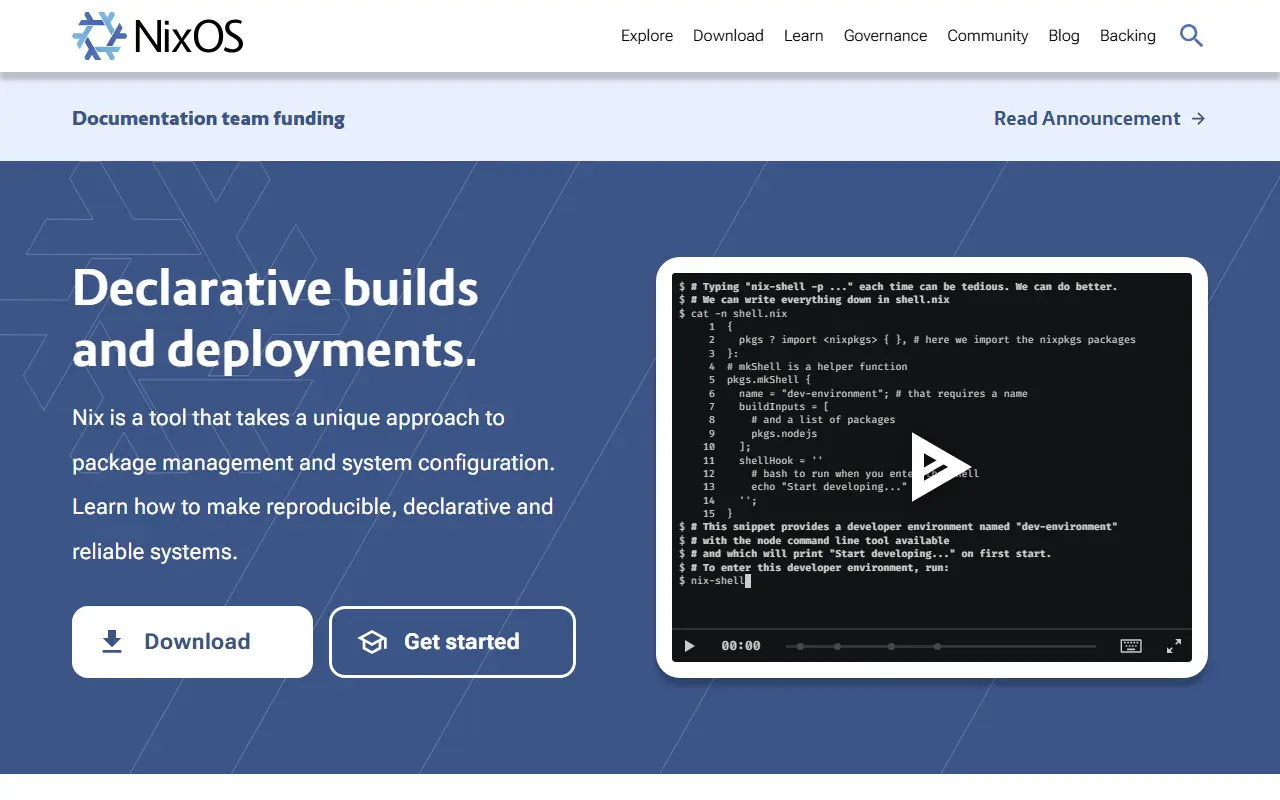
Nix is a purely functional package manager that takes a unique approach to package management and system configuration. It builds packages in isolation from each other, ensuring they are reproducible and don't have undeclared dependencies. This means if a package works on one machine, it will also work on another.
Nix makes it trivial to share development and build environments for projects regardless of programming languages and tools. It ensures that installing or upgrading one package cannot break other packages, allows rollback to previous versions, and ensures no package is in an inconsistent state during an upgrade.
Key features
- Builds packages in isolation from each other
- Ensures reproducibility and no undeclared dependencies
- Makes sharing development and build environments trivial
- Allows rollback to previous versions
- Ensures no package is in an inconsistent state during an upgrade
- Offers over 140,000 packages in the Nix Packages collection (Nixpkgs)

Crossplane is an open source CNCF project built on Kubernetes to orchestrate applications and infrastructure through custom declarative APIs.
- GitHub stars
- 12k
- Last commit
- yesterday
- Latest release
- v2.4.3
- Licence
- Apache-2.0
- Self-hosted
- Yes
crossplane.io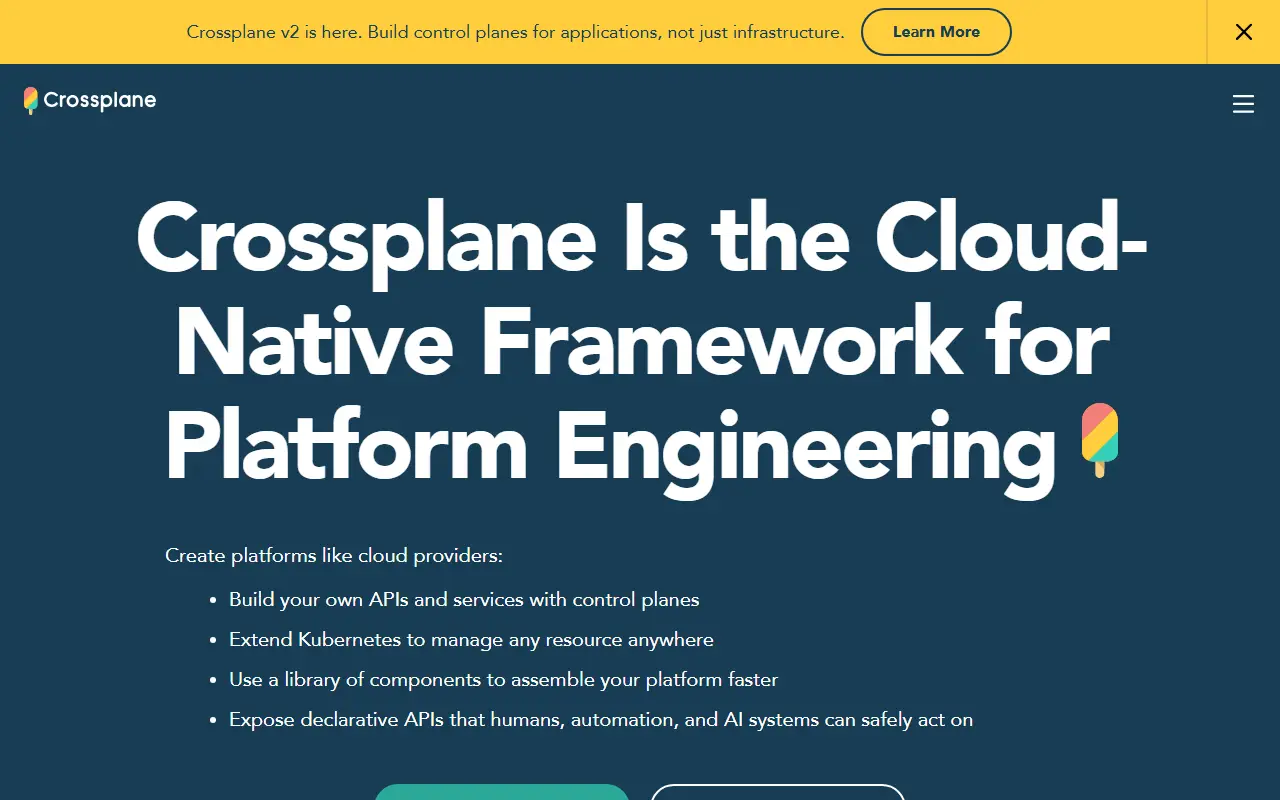
Crossplane is a cloud-native framework for platform engineering that enables organizations to build control planes similar to those used by cloud providers. It extends Kubernetes to manage any resource anywhere and provides a library of components for assembling platforms. The framework allows users to expose declarative APIs that humans, automation, and AI systems can safely act on.
Built on the Kubernetes control plane, Crossplane is designed for extensibility through Providers that orchestrate new kinds of applications and infrastructure, and Configurations that expose new APIs. It puts users in control by allowing them to build platforms around their own opinions using declarative APIs that are explicit, auditable, and machine-readable. The project is maintained by Upbound and is part of the CNCF.
Key features
- Build custom APIs and services with control planes
- Extend Kubernetes to manage any resource anywhere
- Use a library of components to assemble platforms faster
- Expose declarative APIs for humans, automation, and AI systems
- Encapsulate policies, permissions, and guardrails behind a custom API layer
- Extensible through Providers and Configurations

Devbox builds isolated, reproducible development shells from a devbox.json file, using the Nix package manager without requiring Nix code.
- GitHub stars
- 12k
- Last commit
- yesterday
- Latest release
- 0.20.0
- Licence
- Apache-2.0
- Hosted version
- Available
jetify.com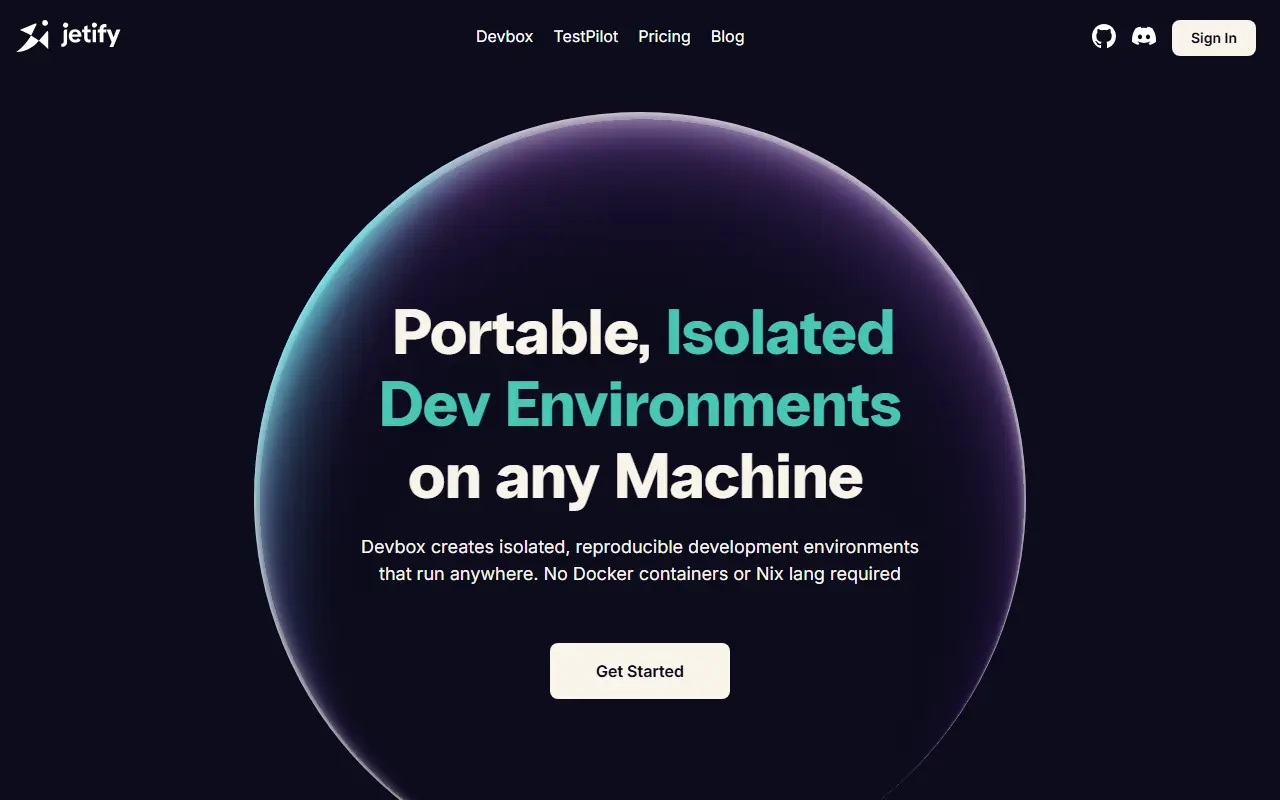
Devbox creates a development environment from a list of packages and scripts defined in devbox.json. Running a devbox shell opens an isolated, ephemeral shell with those dependencies, so several runtime and package versions can sit on one machine without Docker or a virtual machine.
Under the hood it uses the Nix Package Manager, but the interface is designed so users do not write the Nix language or Dockerfiles. A searchable index lists over 400,000 versions of 80,000 packages. Environments are shared through Git, so teammates run the same packages and configuration on their own machines.
Devbox is an open-source project built by Jetify with community support. Jetify also sells Jetify Cloud, a service for deploying projects, synchronizing secrets and sharing binaries across an organization, with monthly plans and usage billed after plan credits are consumed.
Key features
- Isolated shells without Docker or VMs
- Environment defined in devbox.json
- Searchable index of 400,000+ package versions
- Share environments through Git
- Nix package manager without the Nix language
- Prebuilt cache on Jetify Cloud plans
Pricing: Jetify Cloud plans: Solo $5 per month (first month free), Starter $25 per month, Scale-Up $250 per month, Enterprise custom. Usage beyond plan credits is billed.
#10
Gitpod Classic provided on-demand cloud development environments configured by a .gitpod.yml file; the product has since been renamed Ona.
- GitHub stars
- 14k
- Last commit
- 2 days ago
- Latest release
- 2022.11.3
- Licence
- AGPL-3.0
- Hosted version
- Available
gitpod.io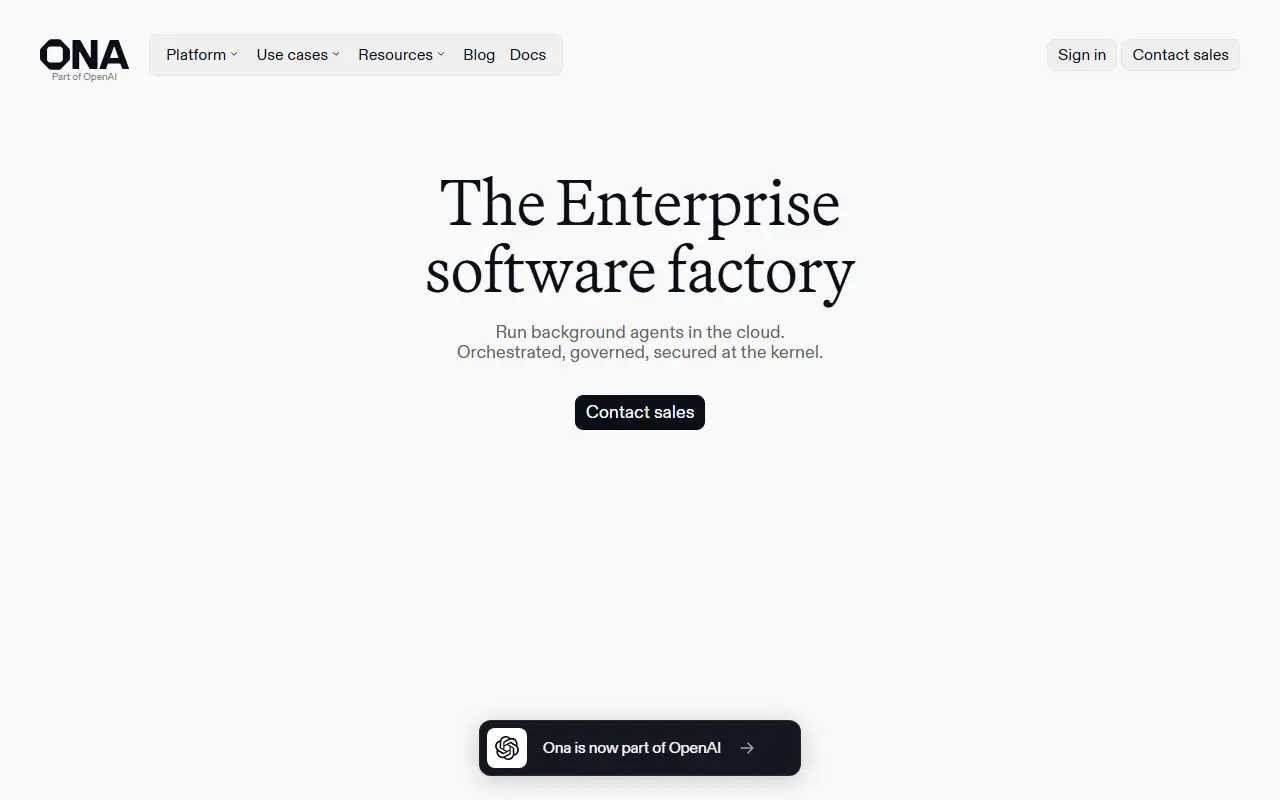
Gitpod Classic is described as a developer platform that spins up pre-configured, secure workspaces in the cloud from a simple .gitpod.yml file, removing manual environment setup. Workspaces are ephemeral and Docker-based, with the same capabilities as a local Linux machine in a consistent, reproducible environment. It integrates with GitHub, GitLab, Bitbucket and Azure DevOps.
The README now states that Gitpod has been renamed to Ona, and that the Classic version is no longer recommended. Ona is presented as mission control for software projects and engineering agents, with background agents, automations, Dev Container based environments and runs in Ona Cloud or a customer's own VPC on AWS or GCP.
The repository is AGPL-3.0 and also points to related open-source projects, including ready-made workspace images, OpenVSCode Server for running VS Code in a browser on a remote machine, and a browser extension that adds a Gitpod button to GitHub, GitLab, Bitbucket and Azure DevOps.
Key features
- Workspaces defined with a .gitpod.yml file
- Ephemeral Docker-based workspaces
- Integrates with four Git hosting services
- Prebuilt environments and collaborative code review
- OpenVSCode Server for VS Code in a browser
- Ona adds background agents run on PR events or schedules
Pricing: The README says Gitpod Classic pay-as-you-go ended on October 15th 2025 and points to Ona's free tier or contacting sales for enterprise; the Ona docs say new customer signup is closed.
4 more Humanitec alternatives
Commercial Humanitec alternatives
Hosted, closed-source products that compete with Humanitec.
Humanitec alternatives: questions
- What is the best open-source alternative to Humanitec?
- Kubernetes is the top-ranked open-source alternative to Humanitec on Enlisted: An open-source system for deploying, scaling and managing containerized applications across clusters of hosts, hosted by the CNCF. Other strong options are Coder, Backstage, Argo CD and Pulumi.
- What are the best commercial alternatives to Humanitec?
- OpsLevel, Port, Rafay, Atlassian Compass and Google Memorystore are among the hosted, closed-source alternatives to Humanitec listed on Enlisted, which lists 12 in total. Compare their pricing and features on each tool page.
- Are these Humanitec alternatives free?
- All 14 are open source, so the code is free to use under its licence, and all of them can be self-hosted on your own server or computer. 5 also offer a paid or managed cloud version if you'd rather not host it yourself.
- How is this list of Humanitec alternatives ranked?
- By a score built from GitHub stars, star growth over the last 30 days and how recently the code changed. 13 of these projects shipped code in the last 30 days. Data is refreshed daily, and nobody can pay to move up.
 TrackMedia
 TrackRev