
 IBM Cloud Kubernetes Service
 Oracle Kubernetes Engine
 DigitalOcean Kubernetes
 Civo
Civo Mirantis
 Platform9
 Spectro Cloud
 Rafay
Rafay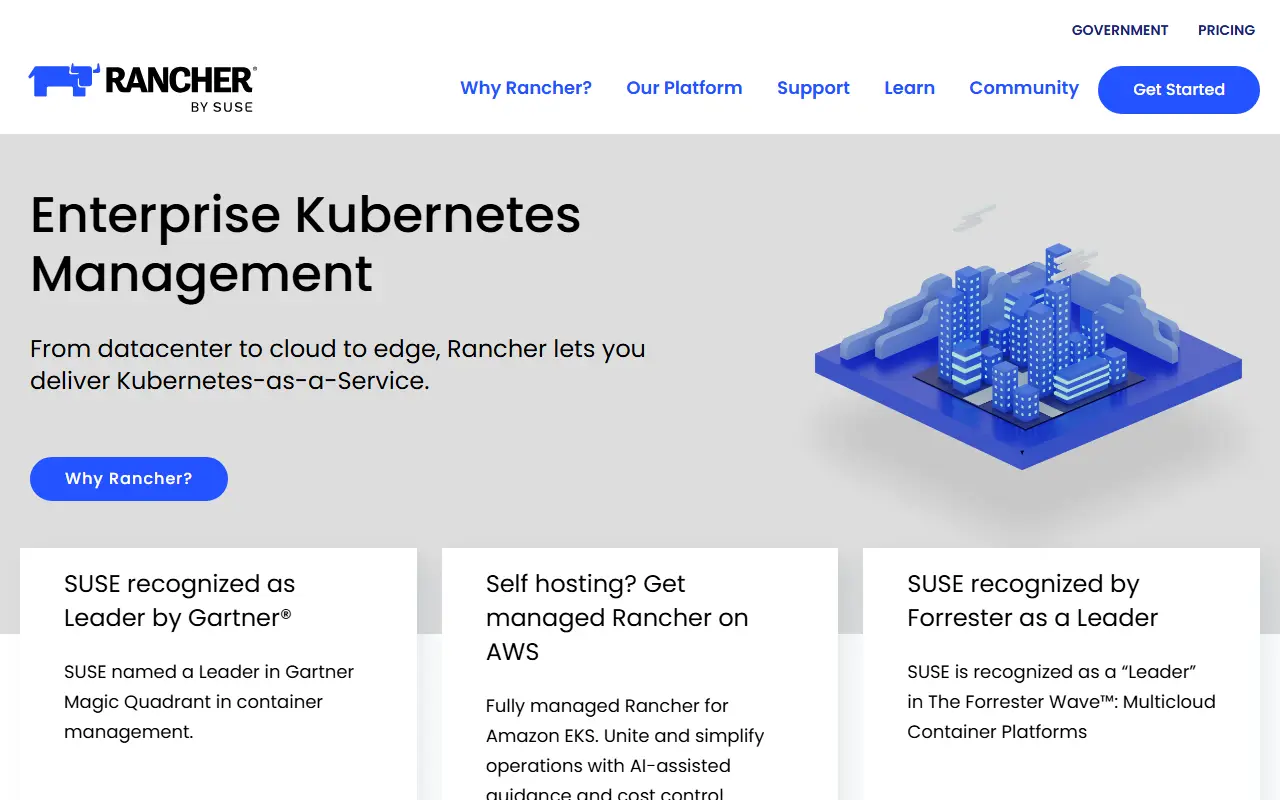
About Rancher
Rancher is an open-source container management platform for organizations that run containers in production. It aims to make Kubernetes easy to run in many places, to meet IT requirements and to support DevOps teams. It is written in Go, released under the Apache-2.0 license, and distributed as a container image that you can start with a single docker run command and then open in a browser.
The main repository is a meta-repository used for packaging that contains most of the Rancher codebase, with other projects and modules listed in go.mod. Stable releases are published as versioned images and a stable tag, and release announcements are posted on the SUSE forums. The README points to the installation guides, a support matrix of operating systems, hardware and software requirements, product documentation, and community help through forums and Slack.
Key features
- Container management platform for Kubernetes
- Quick start with a single Docker command
- Versioned stable release images
- Support matrix for operating systems
- Build documentation for custom packaging
- Community forums and Slack support
Good fit for
- →Managing several Kubernetes clusters centrally
- →Giving DevOps teams a unified cluster console
- Tags
- kubernetes
- container-management
- devops
- orchestration
- docker
- rancher
- cluster-management
- golang
Rancher: questions and answers
- What is Rancher used for?
- Rancher is an open-source container management platform for deploying and operating Kubernetes clusters across environments. It is a good fit for managing several Kubernetes clusters centrally and giving DevOps teams a unified cluster console.
- Is Rancher open source?
- Yes. Rancher is open source under the Apache-2.0 licence. Its source code is on GitHub at rancher/rancher and is written mainly in Go.
- Is Rancher free?
- Yes. Rancher is open source, so the software itself is free to use.
- Can I self-host Rancher?
- Yes. Rancher can be self-hosted on your own server or infrastructure.
- What is Rancher an alternative to?
- Rancher is an open-source alternative to Amazon EKS, Google Kubernetes Engine, Azure Kubernetes Service and Red Hat OpenShift. Other open-source alternatives to Amazon EKS include Talos Linux, Kubernetes and K3s.
- Is Rancher actively maintained?
- Yes. The most recent commit to Rancher was on 2 October 2026, and the latest release is v2.15.2, published on 23 September 2026. The project has 26k stars on GitHub.
Open-source alternatives to Rancher
See all
Talos Linux
Infrastructure & Containers
Talos Linux is a modern Linux distribution built for Kubernetes.
MPL-2.0vs Amazon EKS★ 11k
Kubernetes
Infrastructure & Containers
Production-Grade Container Scheduling and Management
Apache-2.0vs Amazon EKS★ 128k
K3s
Infrastructure & Containers
Lightweight Kubernetes
Apache-2.0vs Amazon EKS★ 34k
MicroK8s
Infrastructure & Containers
MicroK8s is a small, fast, single-package Kubernetes for datacenters and the edge.
Apache-2.0vs Amazon EKS★ 9.4k
Claudie
Infrastructure & Containers
Cloud-agnostic managed Kubernetes
Apache-2.0vs Amazon EKS★ 794
KubeStellar
Infrastructure & Containers
KubeStellar - a flexible solution for multi-cluster configuration management for edge, mul
Apache-2.0vs Azure Arc★ 715
SaaS alternatives to Rancher
See all
Amazon EKS
Infrastructure & Containers
Managed Kubernetes control plane and worker nodes on AWS
SaaS
Google Kubernetes Engine
Infrastructure & Containers
Managed Kubernetes service on Google Cloud with autoscaling and autopilot mode
SaaS
Azure Kubernetes Service
Infrastructure & Containers
Managed Kubernetes service on Microsoft Azure
SaaS
Red Hat OpenShift
Infrastructure & Containers
Enterprise Kubernetes application platform from Red Hat for hybrid and multi-cloud
SaaS
Amazon ECS
Infrastructure & Containers
Managed container orchestration service on AWS
SaaS
Azure Arc
Infrastructure & Containers
Azure management layer that extends services to on-premises, edge and multicloud environments
SaaS