6,598 open-source and SaaS tools, with GitHub stats refreshed every day.

7 alternatives ranked by real activity

Open-source Platform9 alternatives

A curated, ranked list of the 7 best open-source alternatives to Platform9.

The best open-source alternative to Platform9 is Kubernetes. If that doesn't suit you, other good options are K3s, Rancher, Talos Linux and MicroK8s.

Platform9 alternatives are mainly Infrastructure & Containers tools. 7 of them shipped code in the last 30 days, 7 can be self-hosted, and 7 use a permissive licence.

Last updated October 3, 2026 · ranked by GitHub stars, growth and recent commits

Kubernetes

An open-source system for deploying, scaling and managing containerized applications across clusters of hosts, hosted by the CNCF.

GitHub stars
128k
Last commit
today
Latest release
v1.37.1
Licence
Apache-2.0
Self-hosted
Yes
Hosted version
Available
kubernetes.ioKubernetes homepage screenshot

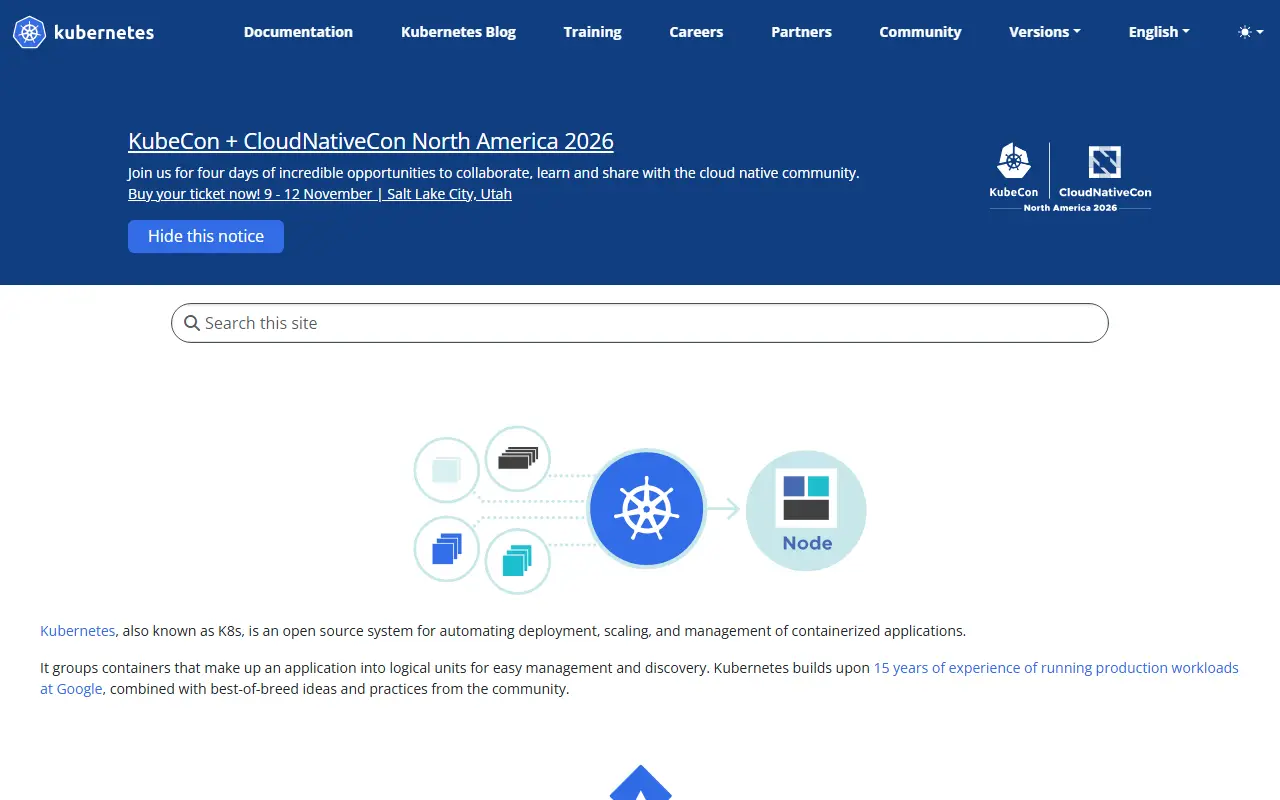
Kubernetes, also written K8s, is an open-source system that manages containerized applications across multiple hosts. It provides the basic mechanisms for deploying, maintaining and scaling applications, so teams can run containers reliably without scheduling each one by hand. It is written in Go and released under the Apache-2.0 license.

The project builds on years of experience running production workloads at Google with an internal system called Borg, combined with practices from the wider community. The Cloud Native Computing Foundation hosts the project. Users interact with it through declarative configuration and the documentation on kubernetes.io, which includes tutorials and a free course on scalable microservices.

Kubernetes can be run on your own infrastructure, and major cloud providers also offer managed Kubernetes services. The README adds that the k8s.io/kubernetes module is not supported for use as a library. It suits platform and DevOps teams running microservices that need scheduling, scaling and automatic recovery.

Key features

  • Container scheduling across multiple hosts
  • Automated application deployment and rollouts
  • Scaling of containerized workloads
  • Maintenance and self-healing of applications
  • Declarative configuration of desired state
  • CNCF-hosted with extensive documentation

Pricing: Free and open source under the Apache-2.0 license; cloud providers sell managed services built on it.

K3s

K3s is a conformant, resource-light Kubernetes distribution packaged as one binary, suited to edge, IoT, CI and development clusters.

GitHub stars
34k
Last commit
today
Latest release
v1.37.1+k3s1
Licence
Apache-2.0
Self-hosted
Yes
k3s.ioK3s homepage screenshot

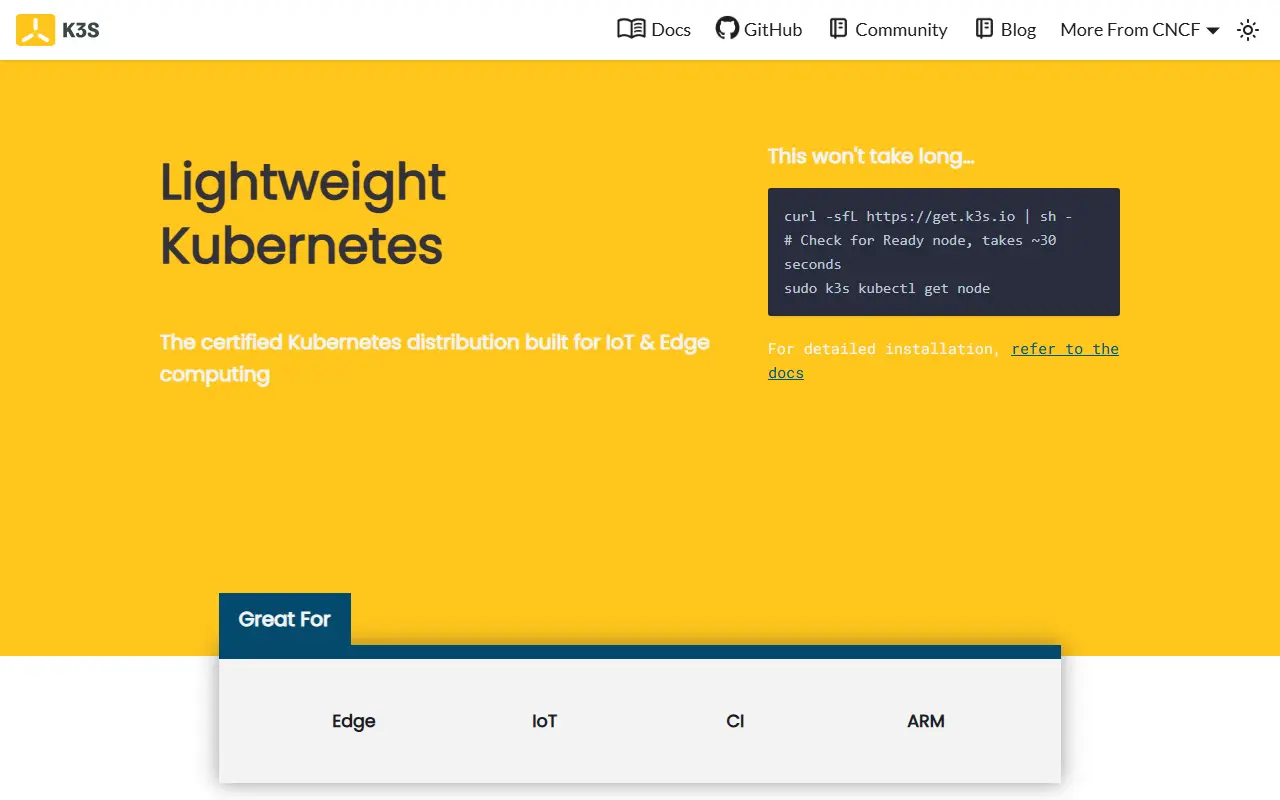
K3s is a Kubernetes distribution aimed at places where a full upstream install is too heavy: edge sites, IoT devices, CI pipelines, ARM boards, development machines and embedded use. It is certified as conformant, ships as a single binary of under 100 MB, and is written in Go under the Apache-2.0 license. The project promotes easy installation and roughly half the memory of a stock cluster.

To keep operations simple, K3s wraps Kubernetes and its supporting components in a single launcher, uses SQLite as the default datastore, and also supports etcd3, MariaDB, MySQL and Postgres. It bundles containerd and runc, Flannel, CoreDNS, Metrics Server, Traefik ingress, a service load balancer, network policy enforcement, a Helm controller and a local-path volume provisioner, any of which can be disabled or replaced. It has minimal operating system dependencies, handles TLS certificate management, and keeps the kubelet port closed on workers by tunneling over a websocket.

Key features

  • Single binary Kubernetes distribution under 100 MB
  • SQLite default with etcd, MySQL and Postgres options
  • Bundled containerd, Flannel, CoreDNS and Traefik
  • Built-in Helm controller and local-path storage
  • Automatic TLS certificate management
  • Components can be disabled or swapped out

Pricing: Free and open source under the Apache-2.0 license.

Read more about K3sWebsite GitHub

Rancher

Rancher is an open-source container management platform for deploying and operating Kubernetes clusters across environments.

GitHub stars
26k
Last commit
today
Latest release
v2.15.2
Licence
Apache-2.0
Self-hosted
Yes
rancher.comRancher homepage screenshot

Rancher is an open-source container management platform for organizations that run containers in production. It aims to make Kubernetes easy to run in many places, to meet IT requirements and to support DevOps teams. It is written in Go, released under the Apache-2.0 license, and distributed as a container image that you can start with a single docker run command and then open in a browser.

The main repository is a meta-repository used for packaging that contains most of the Rancher codebase, with other projects and modules listed in go.mod. Stable releases are published as versioned images and a stable tag, and release announcements are posted on the SUSE forums. The README points to the installation guides, a support matrix of operating systems, hardware and software requirements, product documentation, and community help through forums and Slack.

Key features

  • Container management platform for Kubernetes
  • Quick start with a single Docker command
  • Versioned stable release images
  • Support matrix for operating systems
  • Build documentation for custom packaging
  • Community forums and Slack support

Pricing: Rancher does not publish prices. Visitors fill out a form to get detailed pricing from the regional sales team.

Talos Linux

Minimal, immutable Linux operating system built to run Kubernetes, managed entirely through an API with no SSH or interactive shell.

GitHub stars
11k
Last commit
today
Latest release
v1.14.2
Licence
MPL-2.0
Self-hosted
Yes
siderolabs.comTalos Linux homepage screenshot

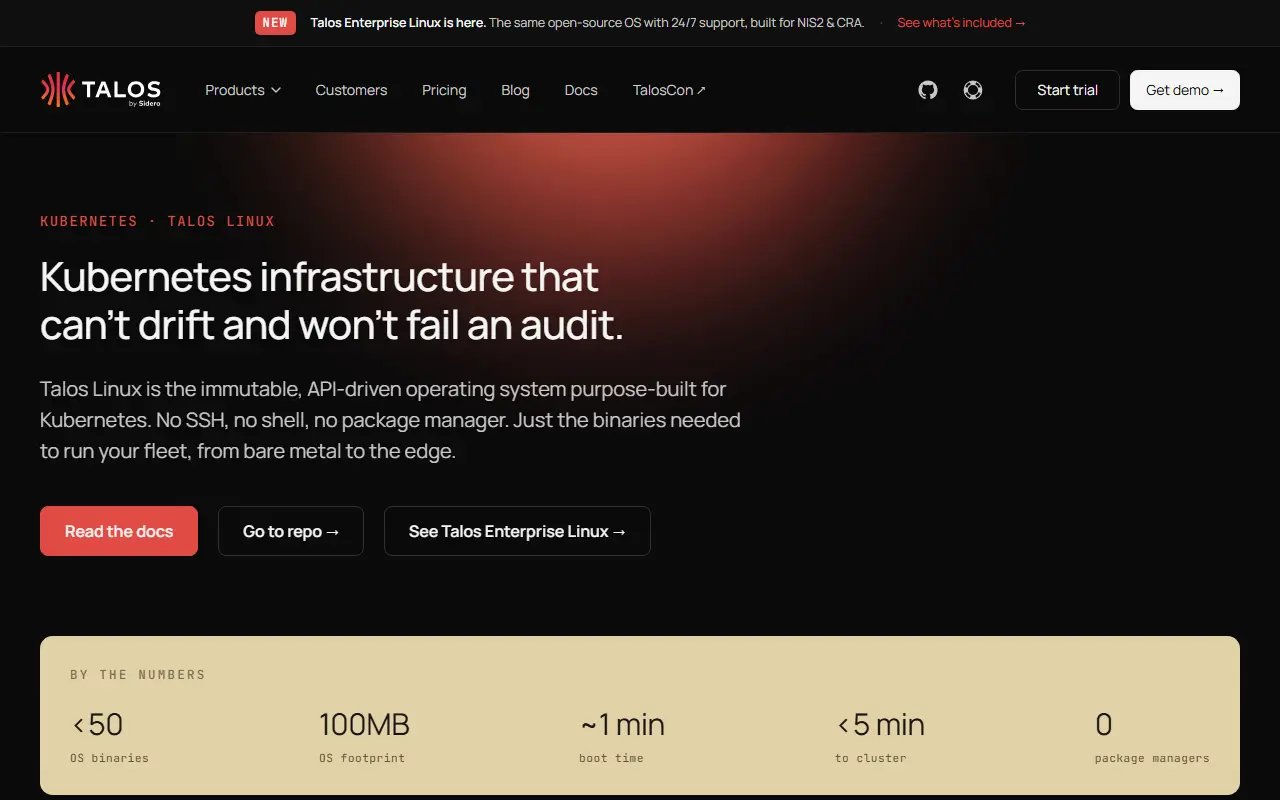
Talos Linux is an operating system designed specifically for running Kubernetes. The project describes it as secure, immutable and minimal, and it is fully open source and supported by Sidero Labs. It aims to replace a general-purpose Linux distribution on cluster nodes with something smaller and more predictable.

All system management happens through an API, and there is no shell or interactive console on the machine. Access to the API is protected with mutual TLS authentication. The design is meant to shrink the attack surface, prevent configuration drift through immutable infrastructure practices, deliver atomic updates, and keep current stable Kubernetes and Linux versions available.

Talos is written in Go and released under the MPL-2.0 license, although some distributed components fall under GPL-family licenses and their source is available on request. Documentation covers deployment and management. The community meets in GitHub Discussions and Slack, holds monthly office hours, and runs a feedback survey.

Key features

  • Immutable, minimal Linux for Kubernetes nodes
  • API-only management with no shell
  • Mutual TLS for all API access
  • Atomic system updates
  • Reduced attack surface by design

Pricing: The community edition is free. Enterprise Linux is $1,000 per node per year (10-node minimum); standalone Omni is $10 a month for hobby use or $25 per node per month for startups. Edge pricing is by quote.

MicroK8s

Lightweight, single-package Kubernetes from Canonical for developer workstations, edge, IoT and CI/CD, installed as a snap.

GitHub stars
9.4k
Last commit
today
Latest release
v1.36
Licence
Apache-2.0
Self-hosted
Yes
microk8s.ioMicroK8s homepage screenshot

MicroK8s is a lightweight, fully conformant Kubernetes distribution delivered as a single package. Canonical positions it for developer workstations, IoT, edge deployments and CI/CD, and says it aims to keep administration to a minimum by including all dependencies in one install.

It includes a curated set of manifests for common capabilities, such as the Istio and Linkerd service meshes, Knative for serverless, Fluentd, Prometheus and Grafana for monitoring, ingress, DNS, the dashboard, clustering and GPU bindings for AI and machine learning workloads. A microk8s kubectl command is bundled, and members of a microk8s user group can run commands without sudo. Security updates can be applied immediately or scheduled, and releases track upstream Kubernetes.

MicroK8s is mostly written in Python and is licensed under Apache-2.0. It is installed as a snap on Linux and is intended to be compatible with managed offerings such as Azure AKS, Amazon EKS and Google GKE when run on Ubuntu.

Key features

  • Single-package conformant Kubernetes
  • Install as a snap on Linux
  • Built-in Istio, Linkerd and Knative add-ons
  • Prometheus, Grafana and Fluentd monitoring
  • Clustering and GPU bindings
  • Bundled microk8s kubectl command

Pricing: Free and open source under the Apache-2.0 license.

Harvester

An open-source hyperconverged infrastructure platform built on Kubernetes, combining virtual machines and distributed storage on bare-metal servers.

GitHub stars
5.2k
Last commit
today
Latest release
v1.9.0
Licence
Apache-2.0
Self-hosted
Yes
harvesterhci.ioHarvester homepage screenshot

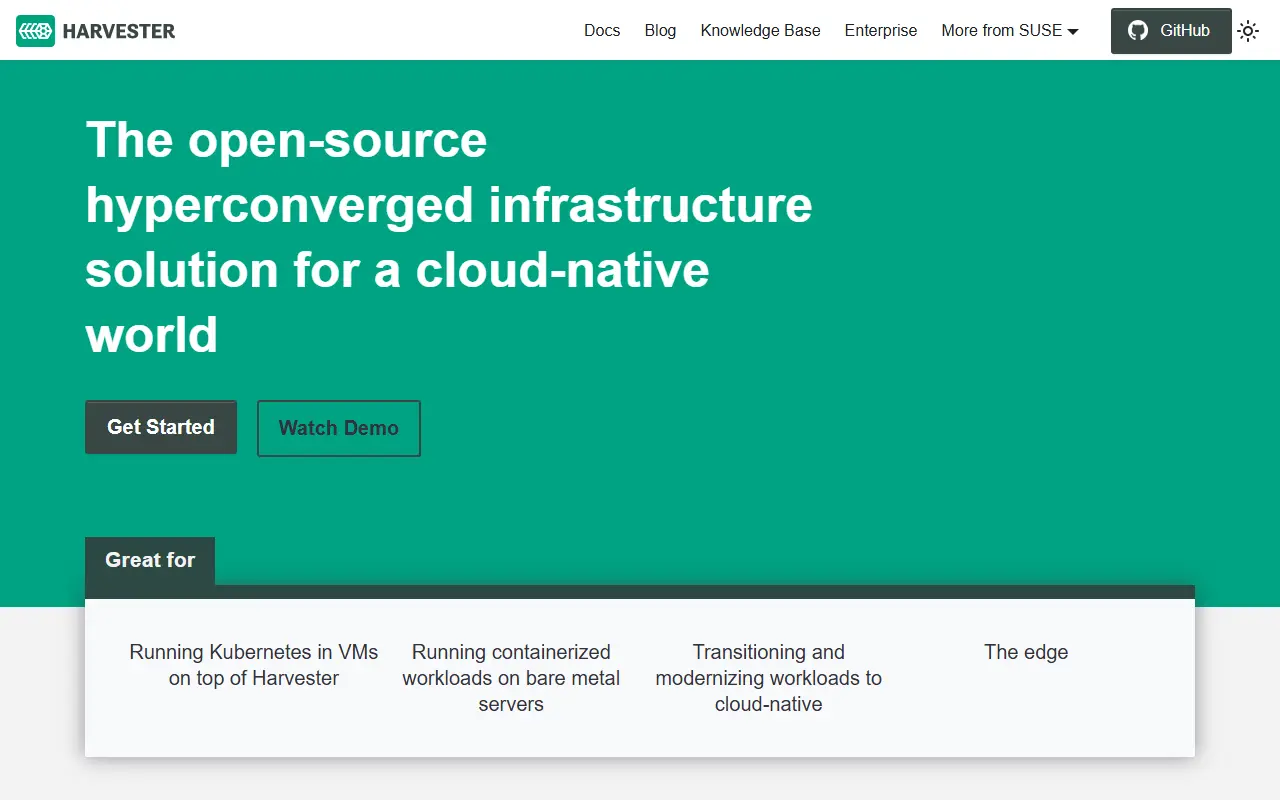
Harvester is a hyperconverged infrastructure (HCI) platform built on Kubernetes. It runs on bare-metal servers and combines virtualization with distributed storage, giving operators a cloud-native alternative to traditional virtualization stacks that relies on direct-attached local storage instead of complex external SANs.

Harvester ships as a bootable appliance image that can be installed from an ISO or automatically through iPXE scripts. Virtual machines can be created, edited, cloned and deleted with SSH key injection, cloud-init and console access, moved between hosts with live migration, and backed up to NFS, S3 or NAS targets for later restore. Storage management covers distributed block storage and tiering, and networking supports virtual IPs and multiple network cards.

Because it uses the Kubernetes API as a common automation layer for container and VM workloads, and integrates with Rancher to support containerized environments, it can unify older virtualized infrastructure with container adoption from core to edge locations. Harvester is written in Go and licensed under Apache-2.0.

Key features

  • Virtual machine lifecycle management
  • Live migration of VMs between hosts
  • VM backup, snapshot and restore
  • Distributed block storage with tiering
  • Virtual IP and multi-NIC networking
  • Bootable ISO or iPXE installation
  • Rancher integration for containers

Pricing: Free and open source under the Apache-2.0 licence.

Apache CloudStack

Apache CloudStack is an open-source infrastructure-as-a-service platform for deploying and managing large networks of virtual machines.

GitHub stars
3.1k
Last commit
today
Latest release
4.23.0.0
Licence
Apache-2.0
Self-hosted
Yes
cloudstack.apache.orgApache CloudStack homepage screenshot

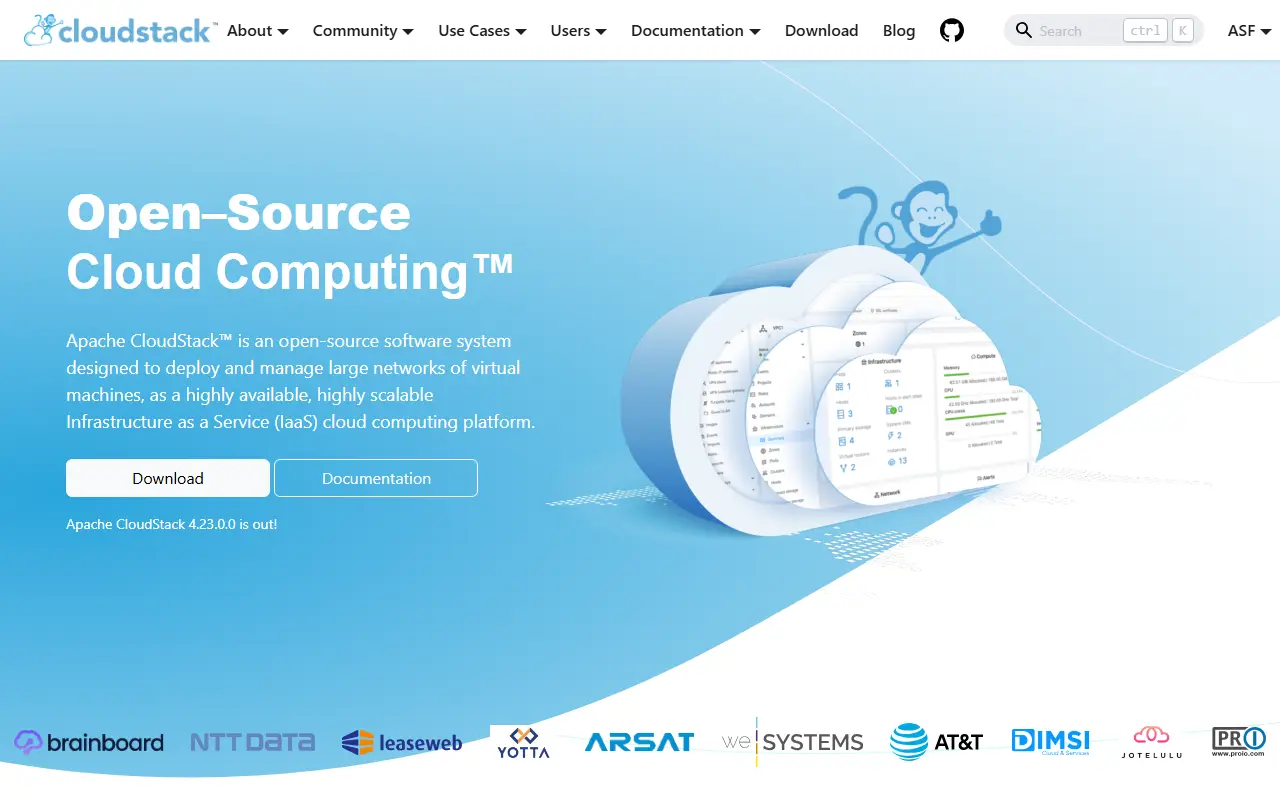
Apache CloudStack is open source software for deploying and managing large networks of virtual machines as a highly available, scalable infrastructure-as-a-service cloud. Service providers use it to offer public cloud services, while companies use it for private on-premises clouds or as part of a hybrid setup. It is written mainly in Java and Python.

The project describes it as a turnkey solution that includes the full stack most organizations want from an IaaS cloud: compute orchestration, network-as-a-service, user and account management, resource accounting, a complete native API and a user interface. Administrators can manage the cloud through a web interface, command-line tools or a query-based API.

CloudStack supports a range of hypervisors, including VMware vSphere, KVM, XenServer, XenProject and Hyper-V, as well as OVM and LXC containers. Topics also mention Kubernetes, XCP-ng and libvirt. It is an Apache Software Foundation project licensed under Apache-2.0, with documentation, a demo, news and events pages and security reporting procedures on its website.

Key features

  • Infrastructure-as-a-service cloud orchestration
  • Supports VMware, KVM, XenServer and Hyper-V
  • Network-as-a-service capabilities
  • User and account management
  • Web interface, command line and native API
  • Resource accounting

Pricing: Free and open source under the Apache-2.0 license.

Platform9 alternatives: questions

What is the best open-source alternative to Platform9?
Kubernetes is the top-ranked open-source alternative to Platform9 on Enlisted: An open-source system for deploying, scaling and managing containerized applications across clusters of hosts, hosted by the CNCF. Other strong options are K3s, Rancher, Talos Linux and MicroK8s.
Are these Platform9 alternatives free?
All 7 are open source, so the code is free to use under its licence, and 7 of them can be self-hosted on your own server. 1 also offer a paid or managed cloud version if you'd rather not host it yourself.
How is this list of Platform9 alternatives ranked?
By a score built from GitHub stars, star growth over the last 30 days and how recently the code changed. 7 of these projects shipped code in the last 30 days. Data is refreshed daily, and nobody can pay to move up.

People also look for alternatives to…

View all