
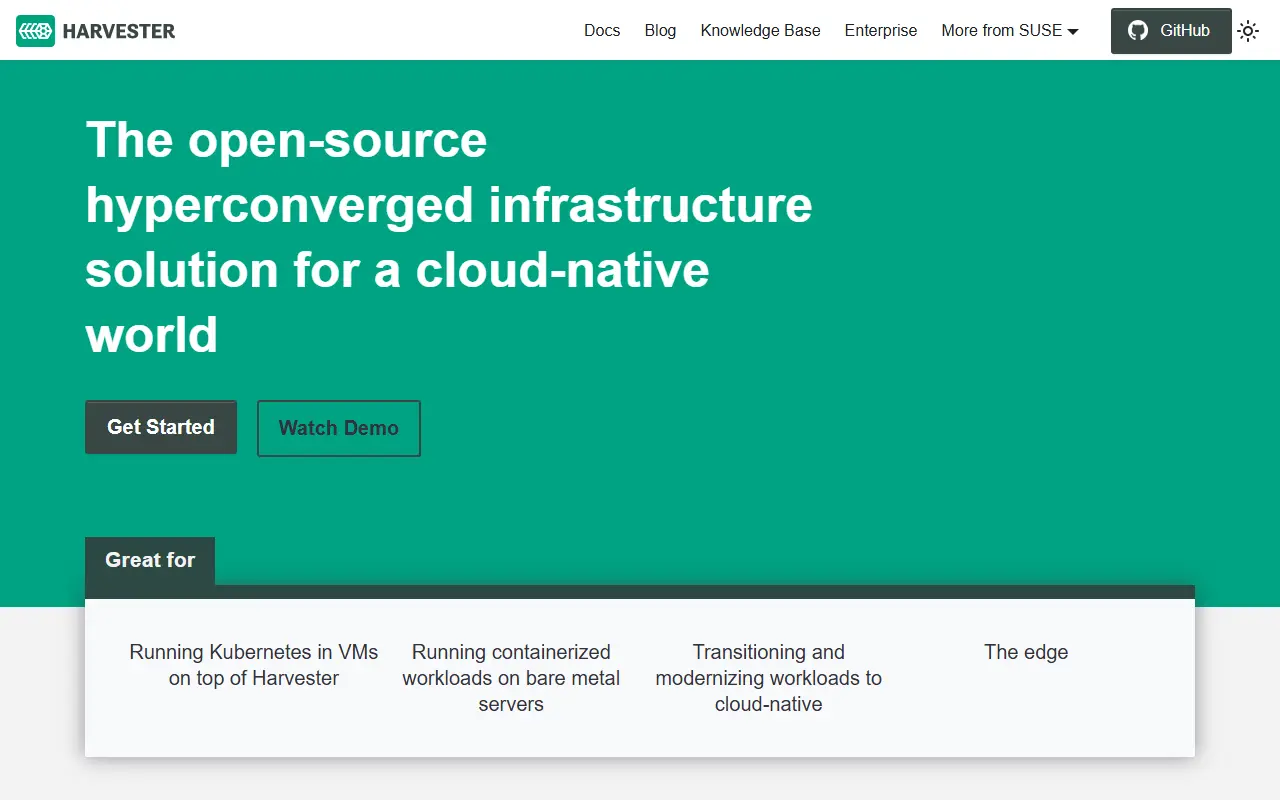
About Harvester
Harvester is a hyperconverged infrastructure (HCI) platform built on Kubernetes. It runs on bare-metal servers and combines virtualization with distributed storage, giving operators a cloud-native alternative to traditional virtualization stacks that relies on direct-attached local storage instead of complex external SANs.
Harvester ships as a bootable appliance image that can be installed from an ISO or automatically through iPXE scripts. Virtual machines can be created, edited, cloned and deleted with SSH key injection, cloud-init and console access, moved between hosts with live migration, and backed up to NFS, S3 or NAS targets for later restore. Storage management covers distributed block storage and tiering, and networking supports virtual IPs and multiple network cards.
Because it uses the Kubernetes API as a common automation layer for container and VM workloads, and integrates with Rancher to support containerized environments, it can unify older virtualized infrastructure with container adoption from core to edge locations. Harvester is written in Go and licensed under Apache-2.0.
Key features
- Virtual machine lifecycle management
- Live migration of VMs between hosts
- VM backup, snapshot and restore
- Distributed block storage with tiering
- Virtual IP and multi-NIC networking
- Bootable ISO or iPXE installation
- Rancher integration for containers
Good fit for
- →Replacing legacy virtualization with Kubernetes-based HCI
- →Running VMs and containers on one bare-metal cluster
- →Infrastructure at edge locations
- Tags
- hci
- hyperconverged
- kubernetes
- virtualization
- vm
- storage
- rancher
- bare-metal
- go
Harvester: questions and answers
- What is Harvester used for?
- Harvester is an open-source hyperconverged infrastructure platform built on Kubernetes, combining virtual machines and distributed storage on bare-metal servers. It is a good fit for replacing legacy virtualization with Kubernetes-based HCI, running VMs and containers on one bare-metal cluster, and infrastructure at edge locations.
- Is Harvester open source?
- Yes. Harvester is open source under the Apache-2.0 licence. Its source code is on GitHub at harvester/harvester and is written mainly in Go.
- Is Harvester free?
- Yes. Harvester is open source, so the software itself is free to use.
- Can I self-host Harvester?
- Yes. Harvester can be self-hosted on your own server or infrastructure; there is no official hosted version.
- What is Harvester an alternative to?
- Harvester is an open-source alternative to Amazon EC2, VMware vSphere, Nutanix and Google Compute Engine. Other open-source alternatives to Amazon EC2 include Apache CloudStack, LXD and Incus.
- Is Harvester actively maintained?
- Yes. The most recent commit to Harvester was on 2 October 2026, and the latest release is v1.9.0, published on 16 September 2026. The project has 5.2k stars on GitHub.
Open-source alternatives to Harvester
See all
Apache CloudStack
Infrastructure & Containers
Apache CloudStack is an opensource Infrastructure as a Service (IaaS) cloud computing plat
Apache-2.0vs Amazon Web Services★ 3.1k
LXD
Infrastructure & Containers
Powerful system container and virtual machine manager
AGPL-3.0vs Amazon EC2★ 4.8k
Incus
Infrastructure & Containers
Powerful system container and virtual machine manager
Apache-2.0vs Amazon EC2★ 6.3k
KubeVirt
Infrastructure & Containers
Kubernetes Virtualization API and runtime in order to define and manage virtual machines.
Apache-2.0vs Amazon EC2★ 7.1k
Ubicloud
Hosting & PaaS
Ubicloud is an open source cloud that can run anywhere. Our cloud services include elastic
AGPL-3.0vs Amazon Web Services★ 12k
Rancher
Infrastructure & Containers
Complete container management platform
Apache-2.0vs Amazon EKS★ 26k
SaaS alternatives to Harvester
See all
Amazon EC2
Hosting & PaaS
Resizable virtual servers in the AWS cloud
SaaS
VMware vSphere
Infrastructure & Containers
Server virtualization platform for managing virtual machines and clusters
SaaS
Nutanix
Infrastructure & Containers
Hyperconverged infrastructure and hybrid multicloud platform
SaaS
Google Compute Engine
Infrastructure & Containers
Virtual machine and compute infrastructure service on Google Cloud
SaaS
Azure Virtual Machines
Infrastructure & Containers
Scalable on-demand virtual machine compute on Microsoft Azure
SaaS
Platform9
Infrastructure & Containers
Managed Kubernetes and private cloud platform for hybrid environments
SaaS