
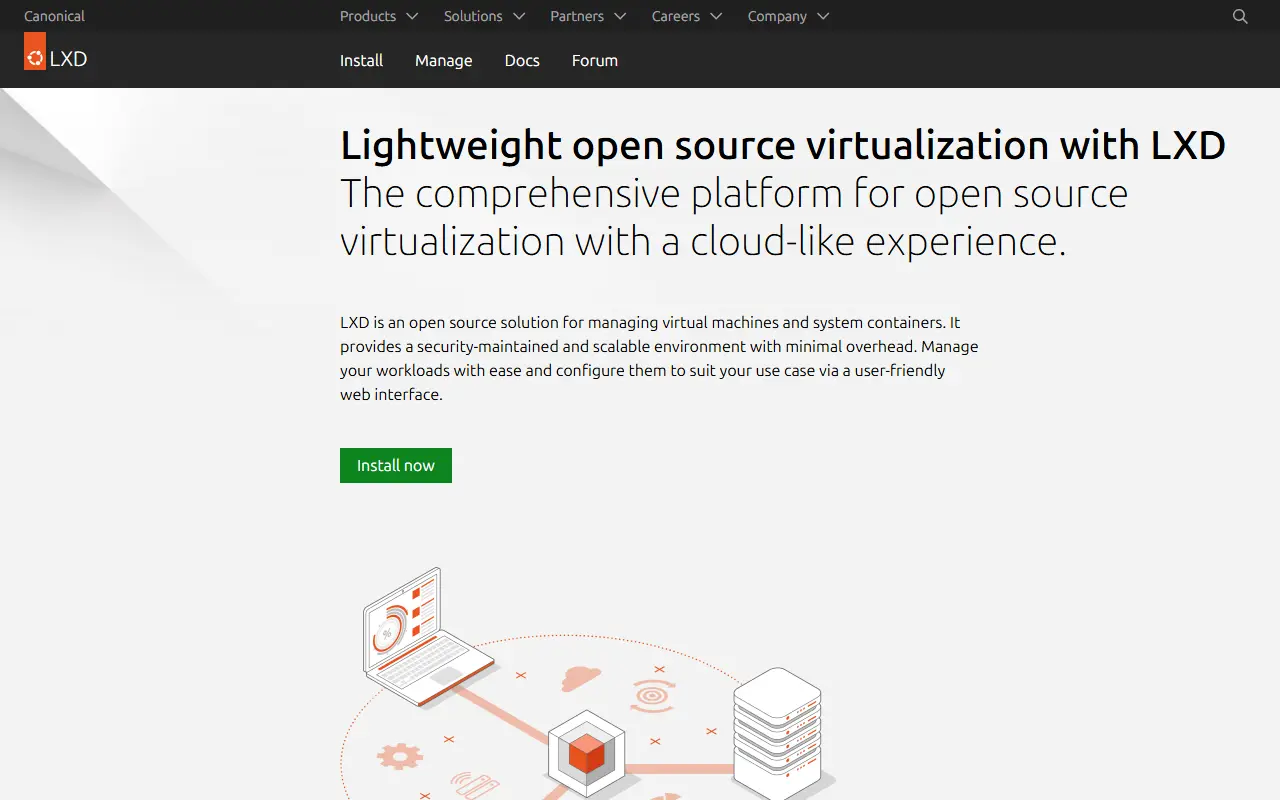
About LXD
LXD manages full Linux systems running inside system containers or virtual machines, giving a unified way to run and manage both. It supports images for many Linux distributions, including official Ubuntu images and community-provided ones, and is built around a REST API.
It scales from a single instance on one machine to a cluster spanning a data center rack, so it is used for both development and production workloads. The result is something that feels like a small private cloud, where different workloads can run efficiently while resource use stays optimized. The README suggests it for containerizing separate environments, running VMs, and managing infrastructure cost-effectively.
The LXD daemon runs only on Linux, but the lxc client tool is available on most platforms, installable through Snap, Chocolatey or Homebrew. LXD is written in Go, maintained by Canonical and licensed under AGPL-3.0, with documentation and release announcements published online.
Key features
- System containers and virtual machines
- REST API for management
- Images for many Linux distributions
- Clustering across multiple machines
- Client available on Linux, Windows and macOS
- Snap, Chocolatey and Homebrew installation
Good fit for
- →Private cloud on your own hardware
- →Development environments in system containers
- →Running VMs and containers on one platform
- Built with
- Go
- Tags
- lxd
- containers
- virtualization
- linux
- canonical
- lxc
- vm
- go
- private-cloud
LXD: questions and answers
- What is LXD used for?
- LXD is a system container and virtual machine manager for Linux with a REST API, scaling from a single machine to a cluster, maintained by Canonical. It is a good fit for private cloud on your own hardware, development environments in system containers, and running VMs and containers on one platform.
- Is LXD open source?
- Yes. LXD is open source under the AGPL-3.0 licence. Its source code is on GitHub at canonical/lxd and is written mainly in Go.
- Is LXD free?
- Yes. LXD is open source, so the software itself is free to use.
- Can I self-host LXD?
- Yes. LXD can be self-hosted on your own server or infrastructure; there is no official hosted version.
- What is LXD an alternative to?
- LXD is an open-source alternative to Amazon EC2, VMware vSphere, Google Compute Engine and Azure Virtual Machines. Other open-source alternatives to Amazon EC2 include Incus, Harvester and Apache CloudStack.
- Is LXD actively maintained?
- Yes. The most recent commit to LXD was on 2 October 2026. The project has 4.8k stars on GitHub.
Open-source alternatives to LXD
See all
Incus
Infrastructure & Containers
Powerful system container and virtual machine manager
Apache-2.0vs Amazon EC2★ 6.3k
Harvester
Infrastructure & Containers
Open source hyperconverged infrastructure (HCI) software
Apache-2.0vs Amazon EC2★ 5.2k
Apache CloudStack
Infrastructure & Containers
Apache CloudStack is an opensource Infrastructure as a Service (IaaS) cloud computing plat
Apache-2.0vs Amazon Web Services★ 3.1k
KubeVirt
Infrastructure & Containers
Kubernetes Virtualization API and runtime in order to define and manage virtual machines.
Apache-2.0vs Amazon EC2★ 7.1k
Ubicloud
Hosting & PaaS
Ubicloud is an open source cloud that can run anywhere. Our cloud services include elastic
AGPL-3.0vs Amazon Web Services★ 12k
libvirt
Infrastructure & Containers
Read-only mirror. Please submit merge requests / issues to https://gitlab.com/libvirt/libv
LGPL-2.1vs VMware vSphere★ 1.7k
SaaS alternatives to LXD
See all
Amazon EC2
Hosting & PaaS
Resizable virtual servers in the AWS cloud
SaaS
VMware vSphere
Infrastructure & Containers
Server virtualization platform for managing virtual machines and clusters
SaaS
Google Compute Engine
Infrastructure & Containers
Virtual machine and compute infrastructure service on Google Cloud
SaaS
Azure Virtual Machines
Infrastructure & Containers
Scalable on-demand virtual machine compute on Microsoft Azure
SaaSVirtuozzo
Infrastructure & Containers
Virtualization, containers and cloud infrastructure software for hosting providers
SaaS
Nutanix
Infrastructure & Containers
Hyperconverged infrastructure and hybrid multicloud platform
SaaS