
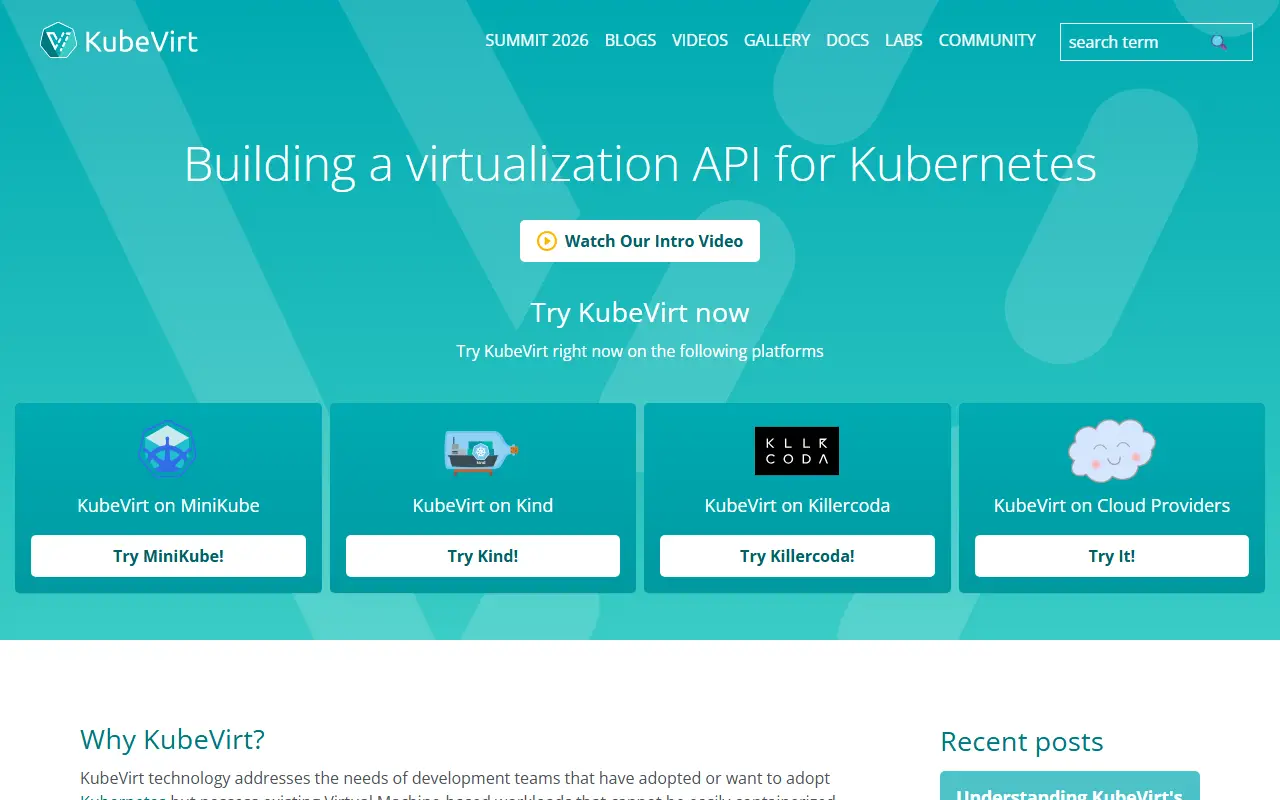
About KubeVirt
KubeVirt is an add-on that brings virtual machine management to Kubernetes. Its aim is to give virtualization solutions a shared foundation on top of Kubernetes, so that workloads that need a full virtual machine can run in the same cluster as containers.
KubeVirt extends Kubernetes by adding virtualization resource types, especially the VM type, through Custom Resource Definitions. This lets the Kubernetes API manage VMs alongside all other resources. That functionality does not go into Kubernetes itself; instead KubeVirt supplies extra controllers and agents that run on an existing cluster. Through these, a VM can be declaratively created from a predefined definition, scheduled onto the cluster, launched, stopped and deleted.
KubeVirt is written in Go and licensed under Apache-2.0. The project provides a quickstart, user documentation, a blog, a YouTube channel and developer documentation covering architecture, components and the API reference.
Key features
- VM resource types via Kubernetes CRDs
- Declarative VM creation and deletion
- VM scheduling on Kubernetes clusters
- Start and stop VMs through the API
- Controllers and agents added to existing clusters
Good fit for
- →Running VMs and containers on one platform
- →Migrating virtual machine workloads to Kubernetes
- Tags
- kubernetes
- virtualization
- virtual-machines
- libvirt
- cncf
- go
- infrastructure
- devops
KubeVirt: questions and answers
- What is KubeVirt used for?
- KubeVirt is a Kubernetes add-on that lets you define, schedule and manage virtual machines through the Kubernetes API alongside containers. It is a good fit for running VMs and containers on one platform, and migrating virtual machine workloads to Kubernetes.
- Is KubeVirt open source?
- Yes. KubeVirt is open source under the Apache-2.0 licence. Its source code is on GitHub at kubevirt/kubevirt and is written mainly in Go.
- Is KubeVirt free?
- Yes. KubeVirt is open source, so the software itself is free to use.
- Can I self-host KubeVirt?
- Yes. KubeVirt can be self-hosted on your own server or infrastructure.
- What is KubeVirt an alternative to?
- KubeVirt is an open-source alternative to Amazon EC2, VMware vSphere, Google Compute Engine and Azure Virtual Machines. Other open-source alternatives to Amazon EC2 include Incus, Harvester and LXD.
- Is KubeVirt actively maintained?
- Yes. The most recent commit to KubeVirt was on 2 October 2026, and the latest release is v1.9.0, published on 30 July 2026. The project has 7.1k stars on GitHub.
Open-source alternatives to KubeVirt
See all
Incus
Infrastructure & Containers
Powerful system container and virtual machine manager
Apache-2.0vs Amazon EC2★ 6.3k
Harvester
Infrastructure & Containers
Open source hyperconverged infrastructure (HCI) software
Apache-2.0vs Amazon EC2★ 5.2k
LXD
Infrastructure & Containers
Powerful system container and virtual machine manager
AGPL-3.0vs Amazon EC2★ 4.8k
Apache CloudStack
Infrastructure & Containers
Apache CloudStack is an opensource Infrastructure as a Service (IaaS) cloud computing plat
Apache-2.0vs Amazon Web Services★ 3.1k
Ubicloud
Hosting & PaaS
Ubicloud is an open source cloud that can run anywhere. Our cloud services include elastic
AGPL-3.0vs Amazon Web Services★ 12k
libvirt
Infrastructure & Containers
Read-only mirror. Please submit merge requests / issues to https://gitlab.com/libvirt/libv
LGPL-2.1vs VMware vSphere★ 1.7k
SaaS alternatives to KubeVirt
See all
Amazon EC2
Hosting & PaaS
Resizable virtual servers in the AWS cloud
SaaS
VMware vSphere
Infrastructure & Containers
Server virtualization platform for managing virtual machines and clusters
SaaS
Google Compute Engine
Infrastructure & Containers
Virtual machine and compute infrastructure service on Google Cloud
SaaS
Azure Virtual Machines
Infrastructure & Containers
Scalable on-demand virtual machine compute on Microsoft Azure
SaaS
Nutanix
Infrastructure & Containers
Hyperconverged infrastructure and hybrid multicloud platform
SaaS
Platform9
Infrastructure & Containers
Managed Kubernetes and private cloud platform for hybrid environments
SaaS