7,363 open-source and SaaS tools, with GitHub stats refreshed every day.

6 alternatives ranked by real activity

Open-source Amazon EC2 alternatives

A curated, ranked list of the 6 best open-source alternatives to Amazon EC2.

The best open-source alternative to Amazon EC2 is Ubicloud. If that doesn't suit you, other good options are KubeVirt, Incus, Harvester and LXD.

Amazon EC2 alternatives are mainly infrastructure & container tools, but some are also hosting & PaaS tools. 6 of them shipped code in the last 30 days, 6 can be self-hosted, and 4 use a permissive licence.

Last updated October 3, 2026 · ranked by GitHub stars, growth and recent commits

Ubicloud

An open-source cloud platform that turns bare-metal Linux servers into an AWS-style cloud with compute, storage, networking, managed Postgres, Kubernetes and AI inference.

GitHub stars
12k
Last commit
yesterday
Licence
AGPL-3.0
Self-hosted
Yes
Hosted version
Available
ubicloud.comUbicloud homepage screenshot

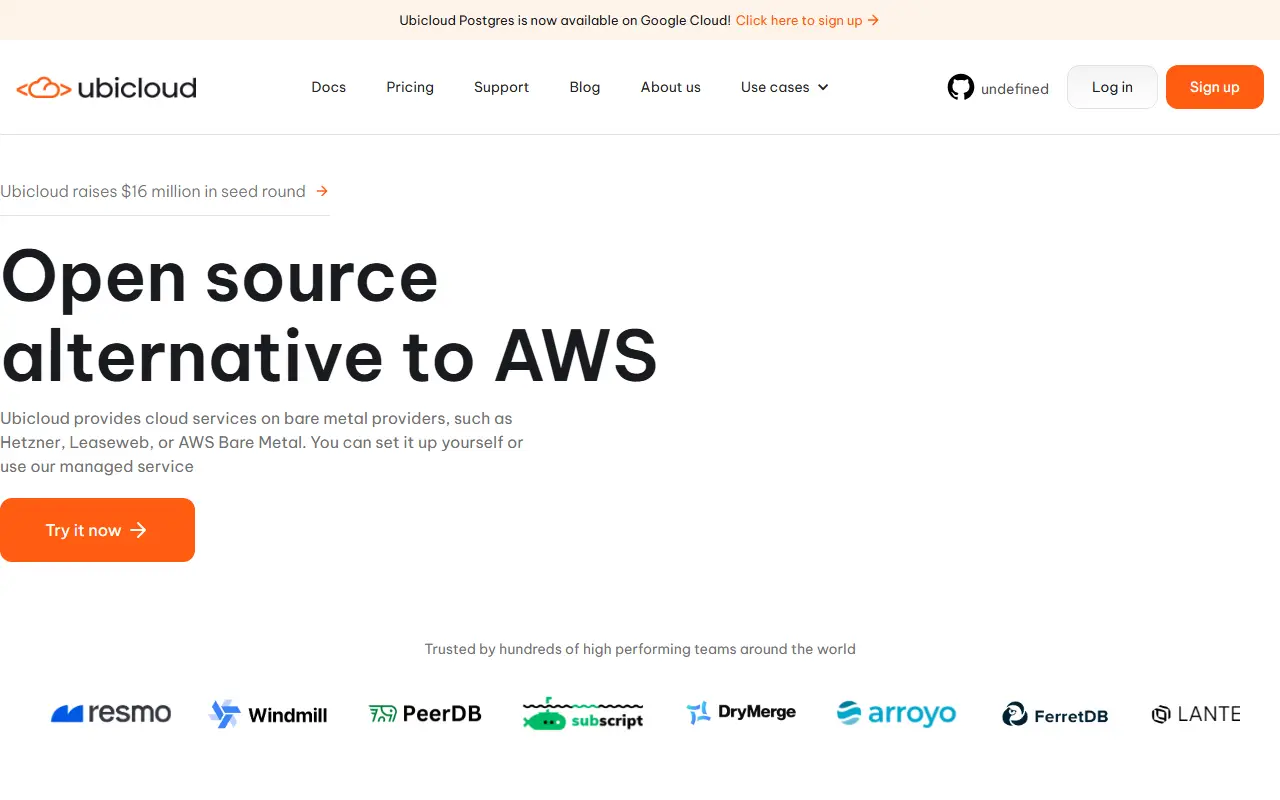
Ubicloud is an open-source cloud platform designed to run on any infrastructure, described by its authors as an open alternative to cloud providers in the way Linux is to proprietary operating systems. It delivers infrastructure-as-a-service capabilities on top of bare-metal hosts, for example Hetzner, Leaseweb and AWS Bare Metal.

Its services include elastic compute, non-replicated block storage, firewalls and load balancers, managed Postgres, Kubernetes, AI inference and IAM. A control plane takes leased bare-metal Linux machines, prepares them for cloud use, and then lets you provision and manage resources through a cloud console. The project is written in Ruby and topics also mention GitHub Actions runners.

You can use the managed platform at console.ubicloud.com without installing anything, where the underlying provider's price and location benefits are passed on to you, or build your own cloud by leasing servers and running the control plane yourself. Ubicloud is licensed under AGPL-3.0. The quick-start flow is currently described for Hetzner machines running Ubuntu 24.04.

Key features

  • Elastic compute on bare-metal servers
  • Block storage, firewalls and load balancers
  • Managed PostgreSQL databases
  • Managed Kubernetes clusters
  • AI inference services
  • IAM and cloud console

Pricing: Pay-as-you-go, billed per minute: runners from $0.00125 a minute, burstable VMs from $10.47 a month, managed PostgreSQL from $19.54 and Kubernetes from $71.82 a month. You can also self-host.

KubeVirt

KubeVirt is a Kubernetes add-on that lets you define, schedule and manage virtual machines through the Kubernetes API alongside containers.

GitHub stars
7.1k
Last commit
yesterday
Latest release
v1.9.0
Licence
Apache-2.0
Self-hosted
Yes
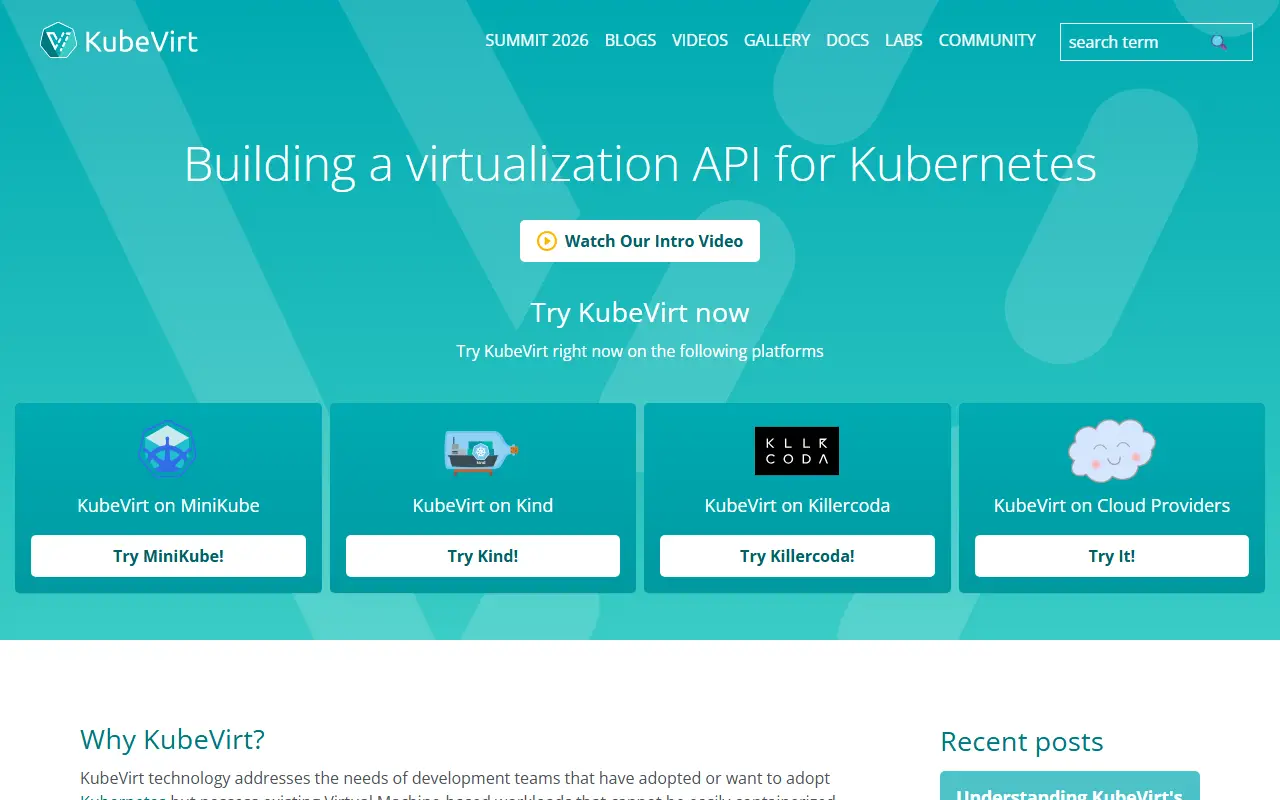
kubevirt.ioKubeVirt homepage screenshot

KubeVirt is an add-on that brings virtual machine management to Kubernetes. Its aim is to give virtualization solutions a shared foundation on top of Kubernetes, so that workloads that need a full virtual machine can run in the same cluster as containers.

KubeVirt extends Kubernetes by adding virtualization resource types, especially the VM type, through Custom Resource Definitions. This lets the Kubernetes API manage VMs alongside all other resources. That functionality does not go into Kubernetes itself; instead KubeVirt supplies extra controllers and agents that run on an existing cluster. Through these, a VM can be declaratively created from a predefined definition, scheduled onto the cluster, launched, stopped and deleted.

KubeVirt is written in Go and licensed under Apache-2.0. The project provides a quickstart, user documentation, a blog, a YouTube channel and developer documentation covering architecture, components and the API reference.

Key features

  • VM resource types via Kubernetes CRDs
  • Declarative VM creation and deletion
  • VM scheduling on Kubernetes clusters
  • Start and stop VMs through the API
  • Controllers and agents added to existing clusters

Pricing: Free and open source under the Apache-2.0 licence.

Incus

Incus is a system container and virtual machine manager for Linux with a REST API, scaling from one machine to a cluster, forked from LXD.

GitHub stars
6.3k
Last commit
today
Latest release
v7.5.1
Licence
Apache-2.0
Self-hosted
Yes
linuxcontainers.orgIncus homepage screenshot

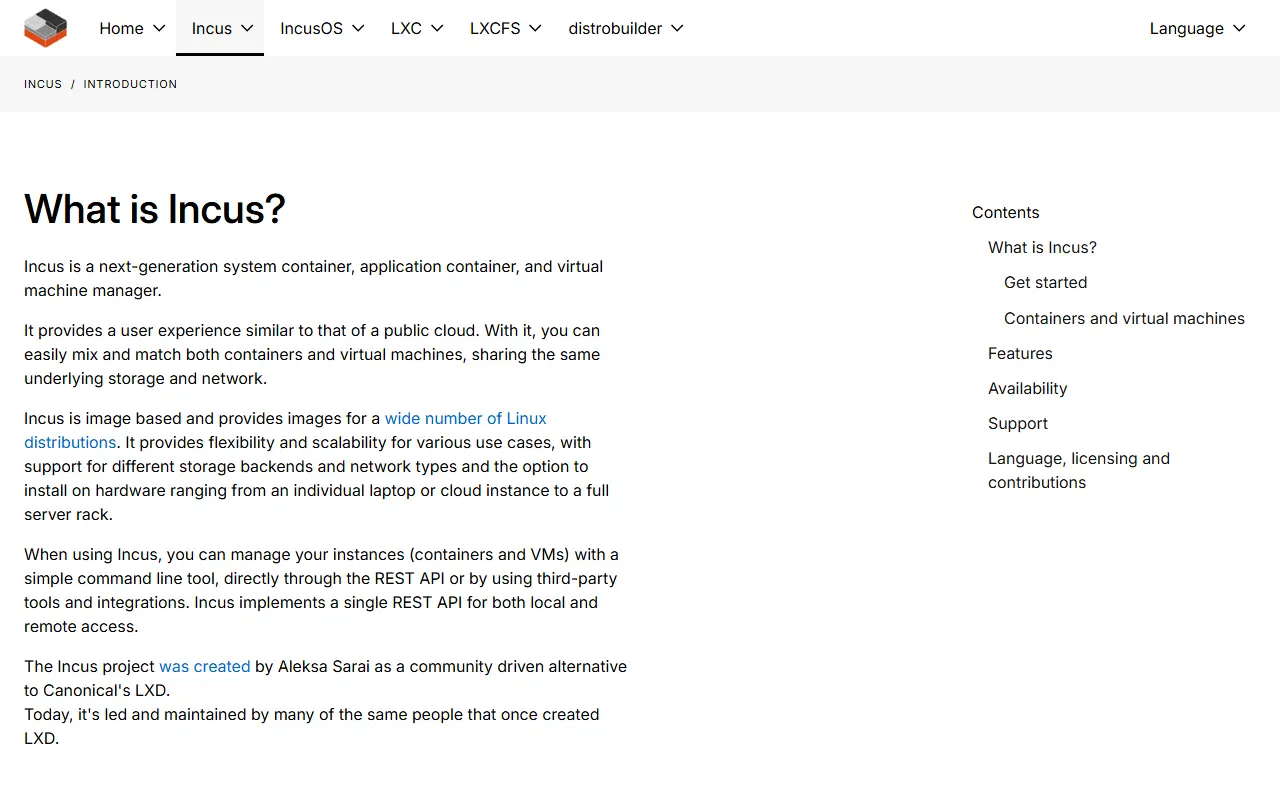
Incus manages system containers and virtual machines. It gives a single, unified way to run and manage full Linux systems inside either, with images for many Linux distributions, including official Ubuntu images and community-provided ones.

It is built around a REST API and runs anywhere from a lone instance on one host to a cluster that fills a data center rack, so it can serve both development and production workloads. The README describes it as a way to set up something that feels like a small private cloud, and suggests it for people who want to containerize different environments, run virtual machines or manage infrastructure cost-effectively. A try-it page lets you test Incus online.

Incus began as a community fork of LXD, made after Canonical took over that project from the Linux Containers community, and it is maintained by the same developers who first created LXD. It is written in Go, has no contributor license agreement and remains under the Apache 2.0 licence.

Key features

  • System containers and virtual machines
  • Images for many Linux distributions
  • REST API
  • Scales from one host to a cluster
  • Online try-it demo

Pricing: Free and open source under the Apache-2.0 licence.

Read more about IncusWebsite GitHub

Harvester

An open-source hyperconverged infrastructure platform built on Kubernetes, combining virtual machines and distributed storage on bare-metal servers.

GitHub stars
5.2k
Last commit
yesterday
Latest release
v1.9.0
Licence
Apache-2.0
Self-hosted
Yes
harvesterhci.ioHarvester homepage screenshot

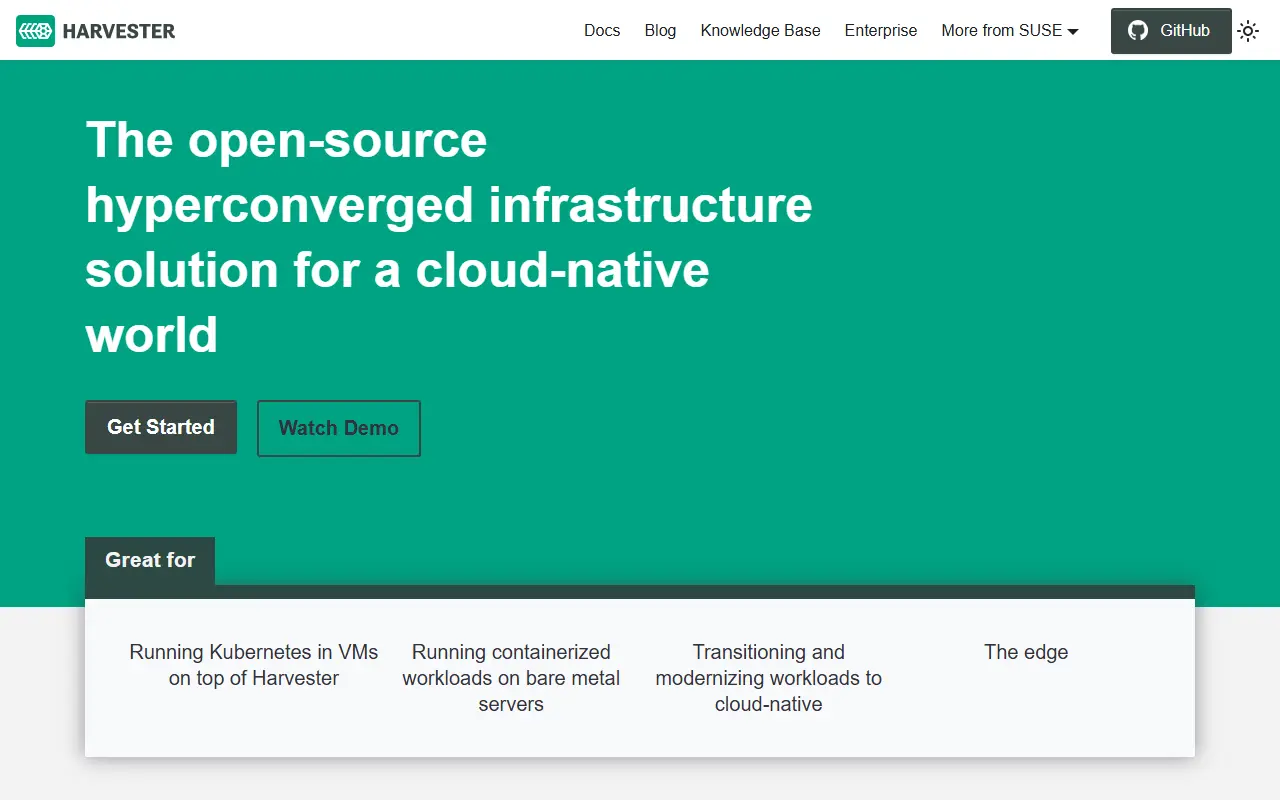
Harvester is a hyperconverged infrastructure (HCI) platform built on Kubernetes. It runs on bare-metal servers and combines virtualization with distributed storage, giving operators a cloud-native alternative to traditional virtualization stacks that relies on direct-attached local storage instead of complex external SANs.

Harvester ships as a bootable appliance image that can be installed from an ISO or automatically through iPXE scripts. Virtual machines can be created, edited, cloned and deleted with SSH key injection, cloud-init and console access, moved between hosts with live migration, and backed up to NFS, S3 or NAS targets for later restore. Storage management covers distributed block storage and tiering, and networking supports virtual IPs and multiple network cards.

Because it uses the Kubernetes API as a common automation layer for container and VM workloads, and integrates with Rancher to support containerized environments, it can unify older virtualized infrastructure with container adoption from core to edge locations. Harvester is written in Go and licensed under Apache-2.0.

Key features

  • Virtual machine lifecycle management
  • Live migration of VMs between hosts
  • VM backup, snapshot and restore
  • Distributed block storage with tiering
  • Virtual IP and multi-NIC networking
  • Bootable ISO or iPXE installation
  • Rancher integration for containers

Pricing: Free and open source under the Apache-2.0 licence.

LXD

A system container and virtual machine manager for Linux with a REST API, scaling from a single machine to a cluster, maintained by Canonical.

GitHub stars
4.8k
Last commit
today
Latest release
lxd-6.9
Licence
AGPL-3.0
Self-hosted
Yes
canonical.comLXD homepage screenshot

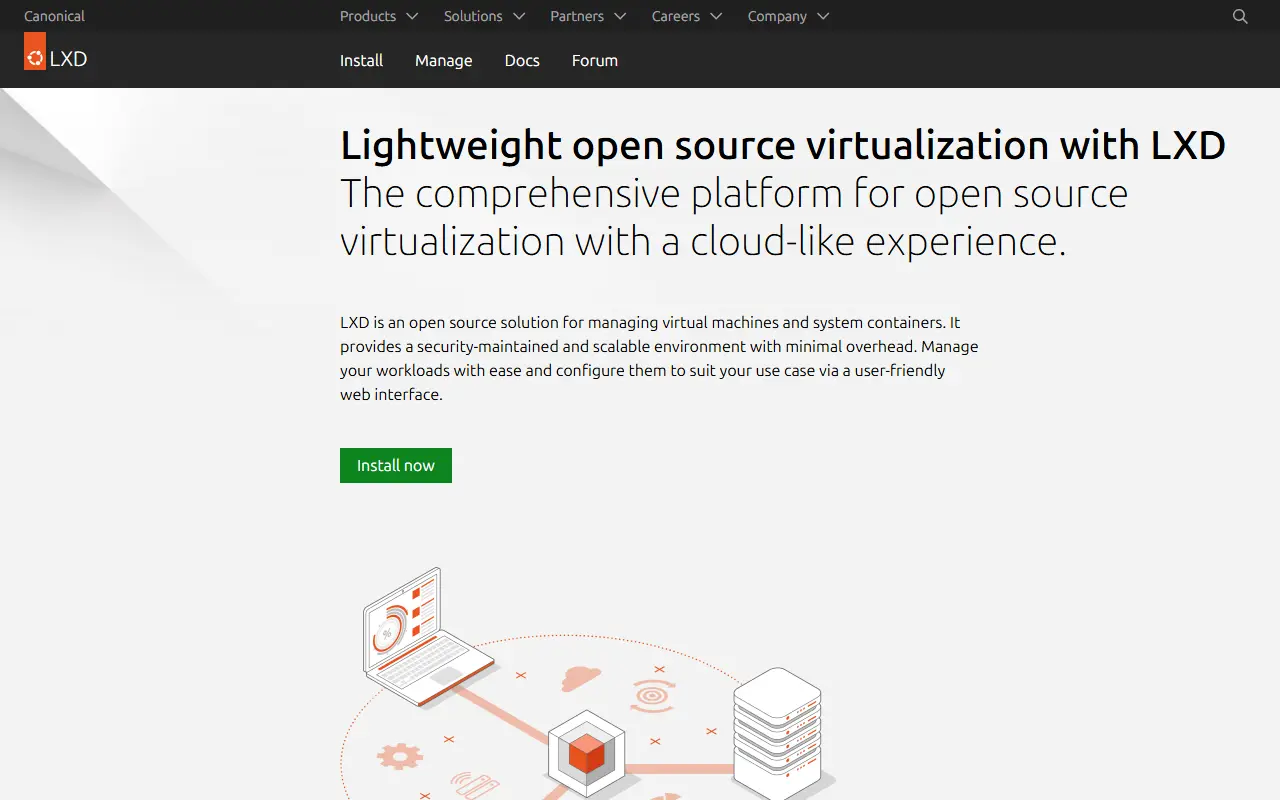
LXD manages full Linux systems running inside system containers or virtual machines, giving a unified way to run and manage both. It supports images for many Linux distributions, including official Ubuntu images and community-provided ones, and is built around a REST API.

It scales from a single instance on one machine to a cluster spanning a data center rack, so it is used for both development and production workloads. The result is something that feels like a small private cloud, where different workloads can run efficiently while resource use stays optimized. The README suggests it for containerizing separate environments, running VMs, and managing infrastructure cost-effectively.

The LXD daemon runs only on Linux, but the lxc client tool is available on most platforms, installable through Snap, Chocolatey or Homebrew. LXD is written in Go, maintained by Canonical and licensed under AGPL-3.0, with documentation and release announcements published online.

Key features

  • System containers and virtual machines
  • REST API for management
  • Images for many Linux distributions
  • Clustering across multiple machines
  • Client available on Linux, Windows and macOS
  • Snap, Chocolatey and Homebrew installation

Pricing: Free and open source under the AGPL-3.0 licence.

Read more about LXDWebsite GitHub

Apache CloudStack

Apache CloudStack is an open-source infrastructure-as-a-service platform for deploying and managing large networks of virtual machines.

GitHub stars
3.1k
Last commit
today
Latest release
4.23.0.0
Licence
Apache-2.0
Self-hosted
Yes
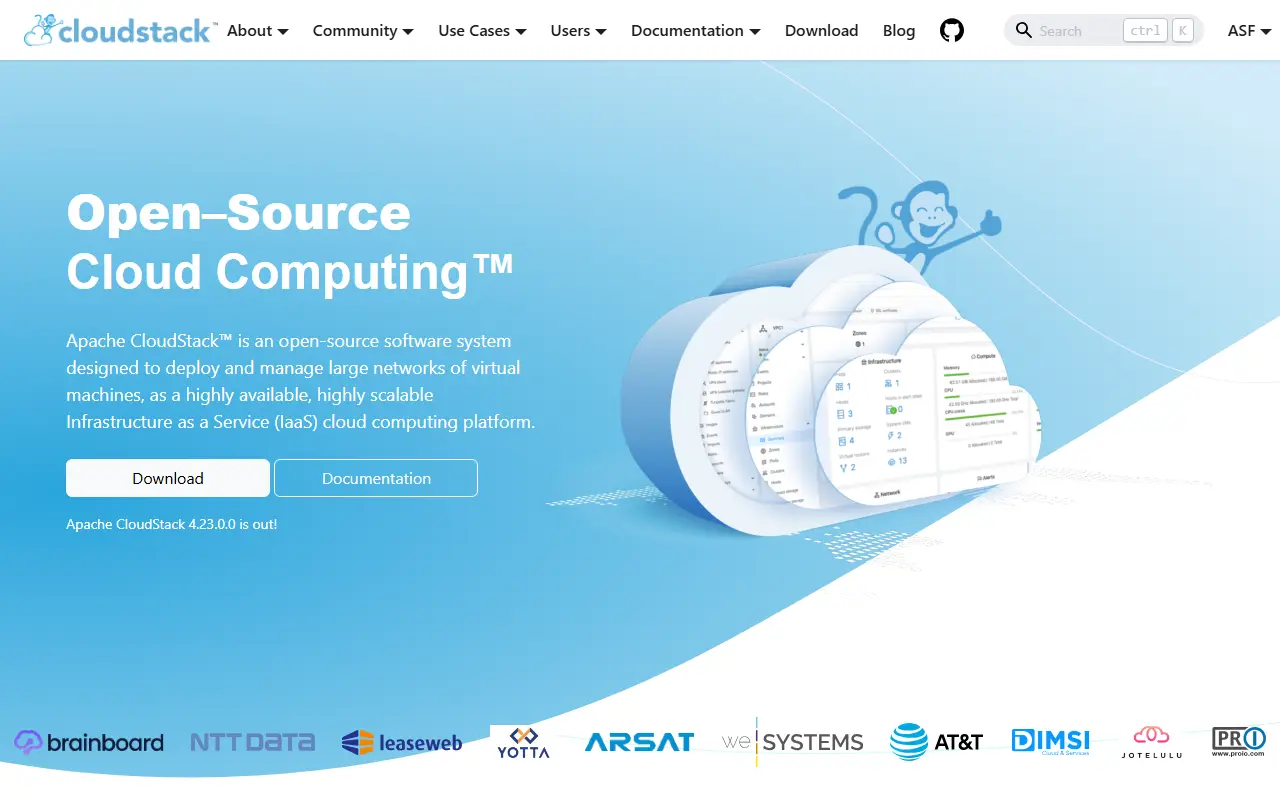
cloudstack.apache.orgApache CloudStack homepage screenshot

Apache CloudStack is open source software for deploying and managing large networks of virtual machines as a highly available, scalable infrastructure-as-a-service cloud. Service providers use it to offer public cloud services, while companies use it for private on-premises clouds or as part of a hybrid setup. It is written mainly in Java and Python.

The project describes it as a turnkey solution that includes the full stack most organizations want from an IaaS cloud: compute orchestration, network-as-a-service, user and account management, resource accounting, a complete native API and a user interface. Administrators can manage the cloud through a web interface, command-line tools or a query-based API.

CloudStack supports a range of hypervisors, including VMware vSphere, KVM, XenServer, XenProject and Hyper-V, as well as OVM and LXC containers. Topics also mention Kubernetes, XCP-ng and libvirt. It is an Apache Software Foundation project licensed under Apache-2.0, with documentation, a demo, news and events pages and security reporting procedures on its website.

Key features

  • Infrastructure-as-a-service cloud orchestration
  • Supports VMware, KVM, XenServer and Hyper-V
  • Network-as-a-service capabilities
  • User and account management
  • Web interface, command line and native API
  • Resource accounting

Pricing: Free and open source under the Apache-2.0 license.

Amazon EC2 alternatives: questions

What is the best open-source alternative to Amazon EC2?
Ubicloud is the top-ranked open-source alternative to Amazon EC2 on Enlisted: An open-source cloud platform that turns bare-metal Linux servers into an AWS-style cloud with compute, storage, networking, managed Postgres, Kubernetes and AI inference. Other strong options are KubeVirt, Incus, Harvester and LXD.
Are these Amazon EC2 alternatives free?
All 6 are open source, so the code is free to use under its licence, and all of them can be self-hosted on your own server or computer. 1 also offers a paid or managed cloud version if you'd rather not host it yourself.
How is this list of Amazon EC2 alternatives ranked?
By a score built from GitHub stars, star growth over the last 30 days and how recently the code changed. 6 of these projects shipped code in the last 30 days. Data is refreshed daily, and nobody can pay to move up.

People also look for alternatives to…

View all