 TrackMedia
 TrackRev

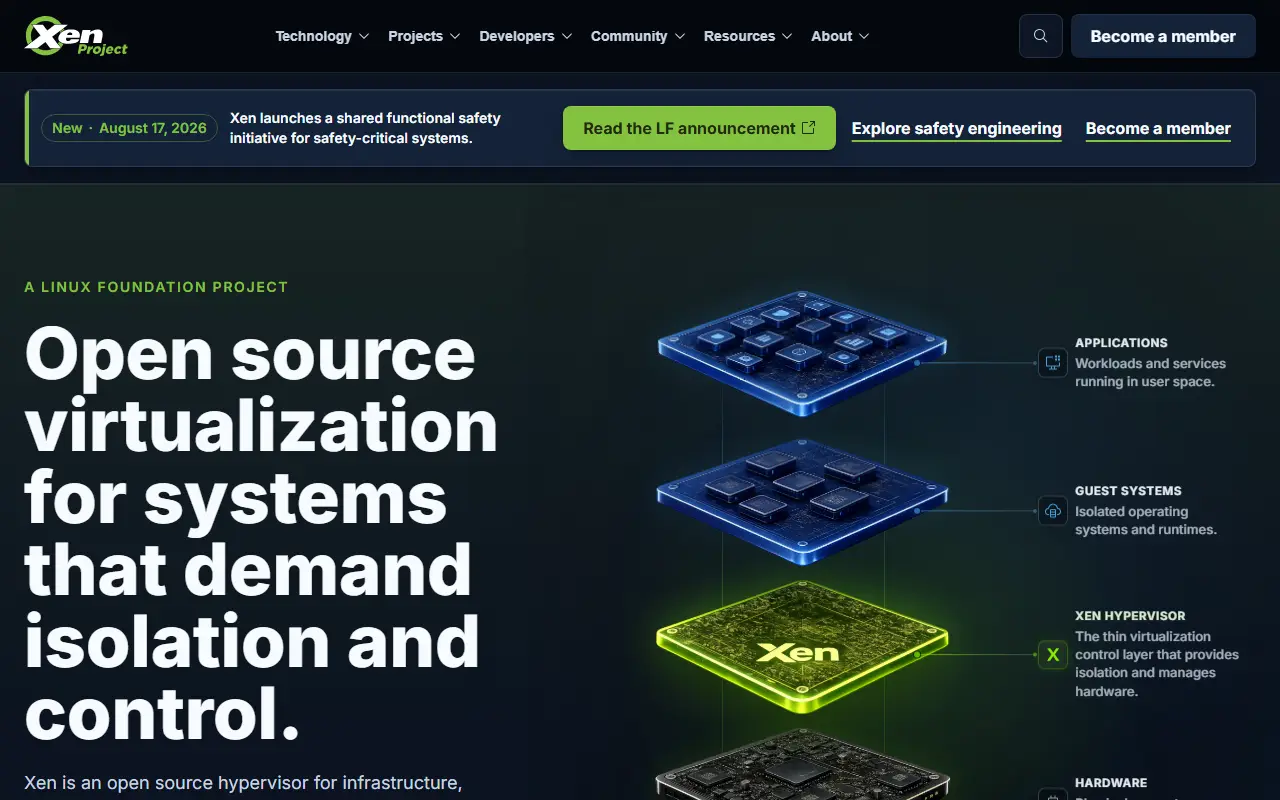
About Xen
Xen is a Virtual Machine Monitor, or hypervisor, first developed by the Systems Research Group of the University of Cambridge Computer Laboratory. The project describes it as an open-source hypervisor for infrastructure, embedded, security-sensitive and virtualization platforms, built around a layer that separates guest systems from the underlying hardware platform.
Xen is a Linux Foundation project with published governance, security policy and CI resources. Related projects listed on the site include XAPI, XCP-ng, MirageOS and Unikraft, and use cases named include embedded and automotive, cloud and infrastructure, and safety-critical systems. The README says the software is released under the GNU GPL and lists build prerequisites for x86, ARM and RISC-V 64-bit. The GitHub repository is a mirror and does not take pull requests.
Key features
- Hypervisor developed at the University of Cambridge
- Separates guest systems from the underlying platform
- Aimed at infrastructure, embedded and security-sensitive platforms
- Builds for x86, ARM and RISC-V 64-bit
- Related projects include XAPI, XCP-ng, MirageOS and Unikraft
- Functional safety initiative for safety-critical systems
Good fit for
- Cloud and infrastructure virtualization
- Embedded and automotive systems
- Safety-critical systems
Xen: questions and answers
- What is Xen used for?
- Xen is an open-source hypervisor, a Linux Foundation project, for infrastructure, embedded and security-sensitive virtualization. It is a good fit for cloud and infrastructure virtualization, embedded and automotive systems, and safety-critical systems.
- Is Xen open source?
- Yes. Xen is open source under a custom licence. Its source code is on GitHub at xen-project/xen and is written mainly in C.
- Is Xen free?
- Yes. Xen is open source, so the software itself is free to use under the terms of its own licence.
- Can I self-host Xen?
- Yes. Xen can be self-hosted on your own server or infrastructure.
- What is Xen an alternative to?
- Xen is an open-source alternative to Amazon EC2 and VMware Workstation. Other open-source alternatives to Amazon EC2 include Incus and KubeVirt.
- Is Xen actively maintained?
- Yes. The most recent commit to Xen was on 12 November 2026. The project has 864 stars on GitHub, with 8 added in the last 30 days.
Open-source alternatives to Xen
See all
Incus
Infrastructure & Containers
Powerful system container and virtual machine manager
Apache-2.0vs Amazon EC2★ 6.6k
QEMU
Infrastructure & Containers
Official QEMU mirror. Please see https://www.qemu.org/contribute/ for how to submit change
OSSvs VMware Workstation★ 14k
UTM
Infrastructure & Containers
Virtual machines for iOS and macOS
Apache-2.0vs Parallels Desktop★ 37k
Vagrant
Developer Tools
Vagrant is a tool for building and distributing development environments.
OSSvs OrbStack★ 27k
Multipass
Infrastructure & Containers
Multipass orchestrates virtual Ubuntu instances
GPL-3.0vs OrbStack★ 9.4k
KubeVirt
Infrastructure & Containers
Kubernetes Virtualization API and runtime in order to define and manage virtual machines.
Apache-2.0vs Amazon EC2★ 7.2k
SaaS alternatives to Xen
See all
Amazon EC2
Hosting & PaaS
Resizable virtual servers in the AWS cloud
SaaS
VMware Workstation
Infrastructure & Containers
Desktop hypervisor for running virtual machines on Windows and Linux
SaaS
1explain
Docs & Wikis
Turns videos, voice recordings, PDFs and notes into step-by-step instructions and SOPs for teams
SaaS
Adobe FrameMaker
Docs & Wikis
Technical authoring and publishing software for structured XML and DITA content
SaaS
Adobe RoboHelp
Docs & Wikis
Help authoring tool for online help, knowledge bases and policy documentation
SaaS
Almanac
Docs & Wikis
Team wiki with document branching, approvals and workflow templates
SaaS