Harvester
An open-source hyperconverged infrastructure platform built on Kubernetes, combining virtual machines and distributed storage on bare-metal servers.
- GitHub stars
- 5.2k
- Last commit
- today
- Latest release
- v1.9.0
- Licence
- Apache-2.0
- Self-hosted
- Yes
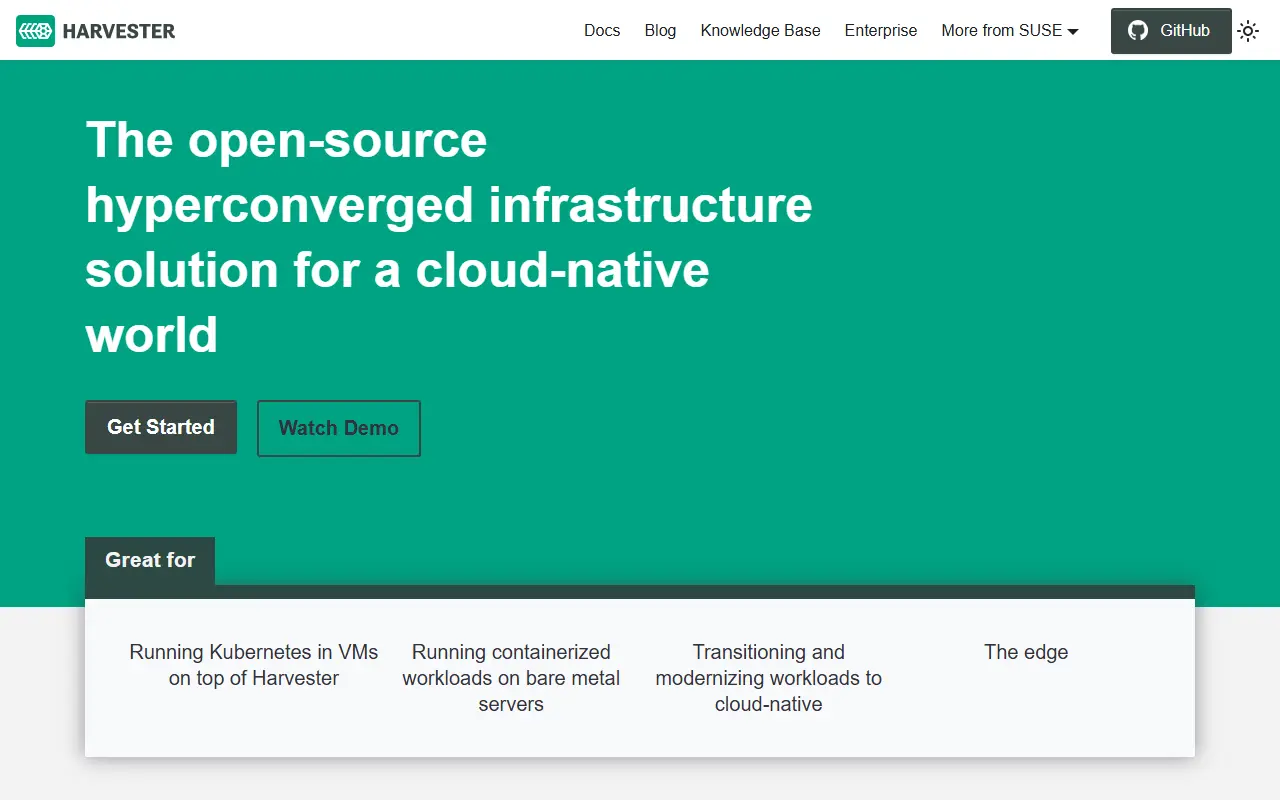
Harvester is a hyperconverged infrastructure (HCI) platform built on Kubernetes. It runs on bare-metal servers and combines virtualization with distributed storage, giving operators a cloud-native alternative to traditional virtualization stacks that relies on direct-attached local storage instead of complex external SANs.
Harvester ships as a bootable appliance image that can be installed from an ISO or automatically through iPXE scripts. Virtual machines can be created, edited, cloned and deleted with SSH key injection, cloud-init and console access, moved between hosts with live migration, and backed up to NFS, S3 or NAS targets for later restore. Storage management covers distributed block storage and tiering, and networking supports virtual IPs and multiple network cards.
Because it uses the Kubernetes API as a common automation layer for container and VM workloads, and integrates with Rancher to support containerized environments, it can unify older virtualized infrastructure with container adoption from core to edge locations. Harvester is written in Go and licensed under Apache-2.0.
Key features
- Virtual machine lifecycle management
- Live migration of VMs between hosts
- VM backup, snapshot and restore
- Distributed block storage with tiering
- Virtual IP and multi-NIC networking
- Bootable ISO or iPXE installation
- Rancher integration for containers
Pricing: Free and open source under the Apache-2.0 licence.