 TrackMedia
 TrackRev

 Oracle Kubernetes Engine
 DigitalOcean Kubernetes
 Civo
 Mirantis
 Platform9
 Spectro Cloud
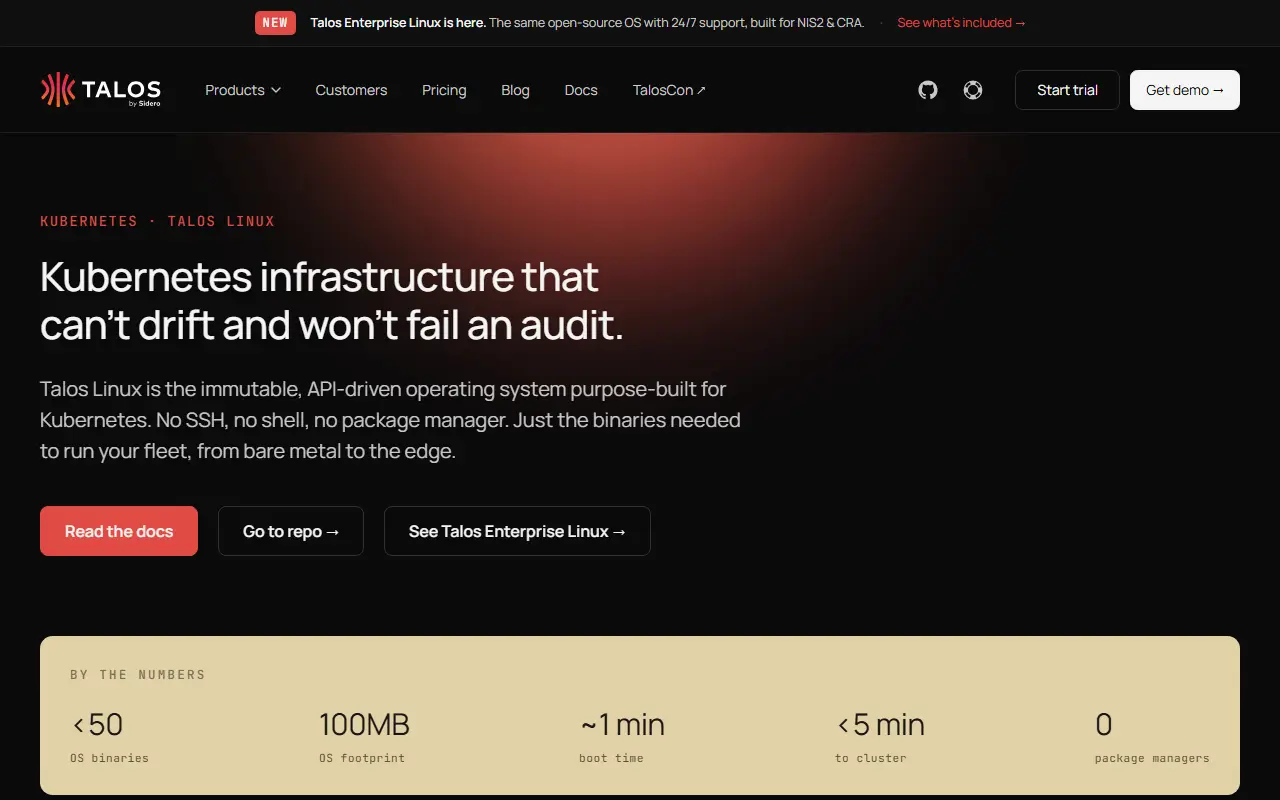
About Talos Linux
Talos Linux is an operating system designed specifically for running Kubernetes. The project describes it as secure, immutable and minimal, and it is fully open source and supported by Sidero Labs. It aims to replace a general-purpose Linux distribution on cluster nodes with something smaller and more predictable.
All system management happens through an API, and there is no shell or interactive console on the machine. Access to the API is protected with mutual TLS authentication. The design is meant to shrink the attack surface, prevent configuration drift through immutable infrastructure practices, deliver atomic updates, and keep current stable Kubernetes and Linux versions available.
Talos is written in Go and released under the MPL-2.0 license, although some distributed components fall under GPL-family licenses and their source is available on request. Documentation covers deployment and management. The community meets in GitHub Discussions and Slack, holds monthly office hours, and runs a feedback survey.
Key features
- Immutable, minimal Linux for Kubernetes nodes
- API-only management with no shell
- Mutual TLS for all API access
- Atomic system updates
- Reduced attack surface by design
Good fit for
- Running hardened Kubernetes clusters
- Eliminating configuration drift on nodes
Talos Linux: questions and answers
- What is Talos Linux used for?
- Talos Linux is a minimal, immutable Linux operating system built to run Kubernetes, managed entirely through an API with no SSH or interactive shell. It is a good fit for running hardened Kubernetes clusters and eliminating configuration drift on nodes.
- Is Talos Linux open source?
- Yes. Talos Linux is open source under the MPL-2.0 licence. Its source code is on GitHub at siderolabs/talos and is written mainly in Go.
- Is Talos Linux free?
- Yes. Talos Linux is open source, so the software itself is free to use. Paid plans are also available, starting at $10 per month.
- Can I self-host Talos Linux?
- Yes. Talos Linux can be self-hosted on your own server or infrastructure.
- What is Talos Linux an alternative to?
- Talos Linux is an open-source alternative to Amazon EKS, Google Kubernetes Engine, Azure Kubernetes Service and Red Hat OpenShift. Other open-source alternatives to Amazon EKS include Kubernetes, Rancher and K3s.
- Is Talos Linux actively maintained?
- Yes. The most recent commit to Talos Linux was on 12 November 2026, and the latest release is v1.14.6, published on 11 November 2026. The project has 12k stars on GitHub, with 177 added in the last 30 days.
Open-source alternatives to Talos Linux
See all
Kubernetes
Infrastructure & Containers
Production-Grade Container Scheduling and Management
Apache-2.0vs Amazon EKS★ 129k
Rancher
Infrastructure & Containers
Complete container management platform
Apache-2.0vs Amazon EKS★ 26k
K3s
Infrastructure & Containers
Lightweight Kubernetes
Apache-2.0vs Amazon EKS★ 34k
MicroK8s
Infrastructure & Containers
MicroK8s is a small, fast, single-package Kubernetes for datacenters and the edge.
Apache-2.0vs Amazon EKS★ 9.4k
Claudie
Infrastructure & Containers
Cloud-agnostic managed Kubernetes
Apache-2.0vs Amazon EKS★ 794
Kubermatic
Infrastructure & Containers
Kubermatic Kubernetes Platform - the Central Kubernetes Management Platform For Any Infras
OSSvs Railway★ 1.3k
SaaS alternatives to Talos Linux
See all
Amazon EKS
Infrastructure & Containers
Managed Kubernetes control plane and worker nodes on AWS
SaaS
Google Kubernetes Engine
Infrastructure & Containers
Managed Kubernetes service on Google Cloud with autoscaling and autopilot mode
SaaS
Azure Kubernetes Service
Infrastructure & Containers
Managed Kubernetes service on Microsoft Azure
SaaS
Red Hat OpenShift
Infrastructure & Containers
Enterprise Kubernetes application platform from Red Hat for hybrid and multi-cloud
SaaS
Amazon ECS
Infrastructure & Containers
Managed container orchestration service on AWS
SaaS
IBM Cloud Kubernetes Service
Infrastructure & Containers
Managed Kubernetes service on IBM Cloud
SaaS