
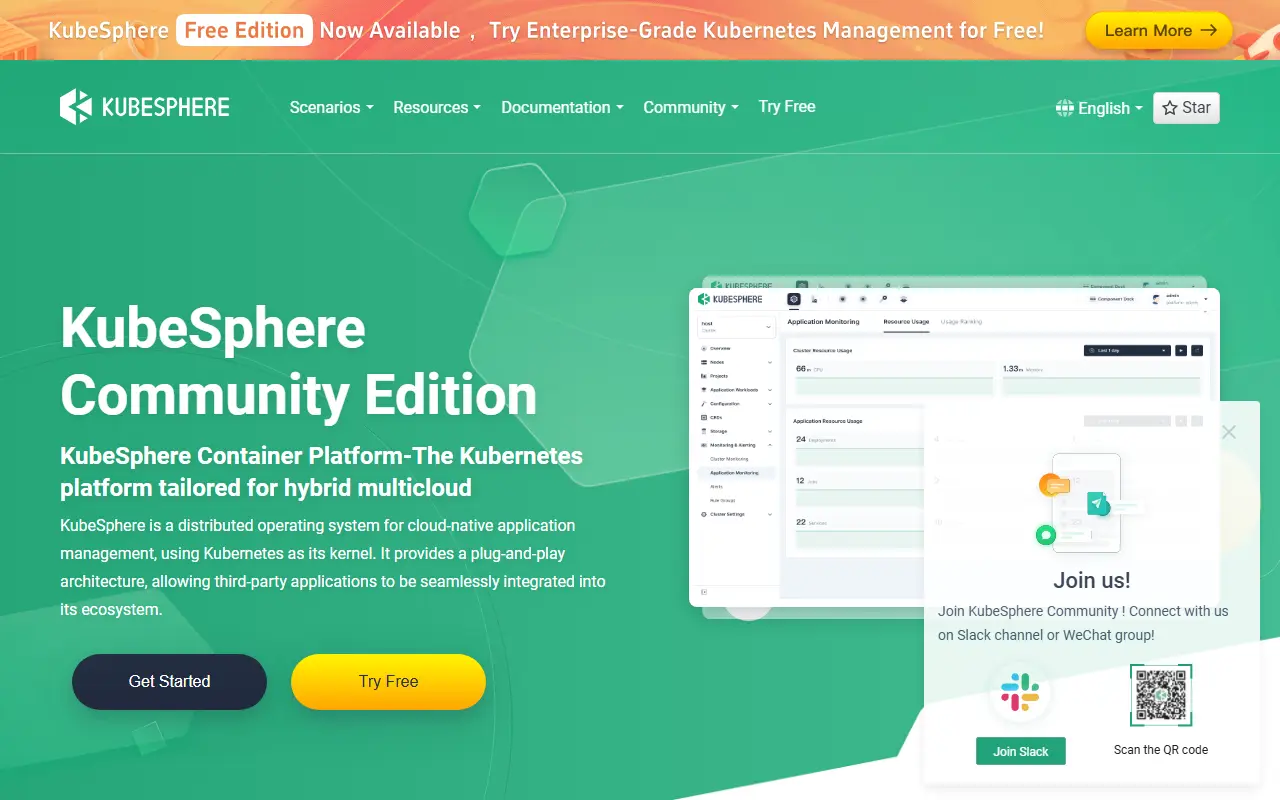
About KubeSphere
KubeSphere is a distributed operating system for cloud-native application management, using Kubernetes as its kernel. It provides a plug-and-play architecture that allows third-party applications to be integrated into its ecosystem. The platform is designed for hybrid multicloud, datacenter, and edge management.
It offers a developer-friendly wizard web UI and includes features such as multi-tenancy, multi-cluster support, cloud-native observability, application lifecycle management, storage and networking solutions, and DevOps capabilities. The platform supports deployment on any infrastructure, with online and offline installation, one-click upgrades, and cluster scaling.
Key features
- Multi-tenant enterprise-grade open-source Kubernetes container platform
- Full-stack automated IT operation and streamlined DevOps workflows
- Developer-friendly wizard web UI
- Multi-tenancy and multi-cluster support
- Cloud-native observability, application lifecycle management, storage and networking solutions
- Pluggable architecture for integrating mainstream open-source tools
Good fit for
- Running microservices on Kubernetes
- Building cloud-native observability
- One-stop DevOps workflow
KubeSphere: questions and answers
- What is KubeSphere used for?
- KubeSphere is a multi-tenant enterprise-grade open-source Kubernetes container platform with full-stack automated IT operation and DevOps workflows. It is a good fit for running microservices on Kubernetes, building cloud-native observability and one-stop DevOps workflow.
- Is KubeSphere open source?
- Yes. KubeSphere is open source under a custom licence. Its source code is on GitHub at kubesphere/kubesphere and is written mainly in Go.
- Is KubeSphere free?
- Yes. KubeSphere is open source, so the software itself is free to use under the terms of its own licence.
- Can I self-host KubeSphere?
- Yes. KubeSphere can be self-hosted on your own server or infrastructure.
- What is KubeSphere an alternative to?
- KubeSphere is an open-source alternative to Platform9, Mirantis, Humanitec and Spectro Cloud. Other open-source alternatives to Platform9 include Kubernetes, Rancher and Gardener.
- Is KubeSphere actively maintained?
- The most recent commit to KubeSphere was on 15 July 2026, and the latest release is v4.1.3, published on 24 March 2025. The project has 17k stars on GitHub.
Open-source alternatives to KubeSphere
See all
Kubernetes
Infrastructure & Containers
Production-Grade Container Scheduling and Management
Apache-2.0vs Amazon EKS★ 128k
Rancher
Infrastructure & Containers
Complete container management platform
Apache-2.0vs Amazon EKS★ 26k
Gardener
Infrastructure & Containers
Homogeneous Kubernetes clusters at scale on any infrastructure using hosted control planes
Apache-2.0vs Platform9★ 3.5k
Kubermatic
Infrastructure & Containers
Kubermatic Kubernetes Platform - the Central Kubernetes Management Platform For Any Infras
OSSvs Railway★ 1.3k
Talos Linux
Infrastructure & Containers
Talos Linux is a modern Linux distribution built for Kubernetes.
MPL-2.0vs Amazon EKS★ 11k
K3s
Infrastructure & Containers
Lightweight Kubernetes
Apache-2.0vs Amazon EKS★ 34k
SaaS alternatives to KubeSphere
See all
Platform9
Infrastructure & Containers
Managed Kubernetes and private cloud platform for hybrid environments
SaaS
Mirantis
Infrastructure & Containers
Kubernetes and container platform vendor with Mirantis Kubernetes Engine
SaaS
Humanitec
CI/CD & DevOps
Platform orchestrator that provisions infrastructure for each deployment on request
SaaS
Spectro Cloud
Infrastructure & Containers
Kubernetes management platform for clusters across data center, cloud and edge
SaaS
Rafay
Infrastructure & Containers
Kubernetes operations and platform-as-a-service for managing clusters at scale
SaaS
Lens
Infrastructure & Containers
Desktop Kubernetes IDE for managing clusters and workloads
SaaS