6,598 open-source and SaaS tools, with GitHub stats refreshed every day.

4 alternatives ranked by real activity

Open-source Rafay alternatives

A curated, ranked list of the 4 best open-source alternatives to Rafay.

The best open-source alternative to Rafay is Rancher. If that doesn't suit you, other good options are KubeVela, Claudie and KubeStellar.

Rafay alternatives are mainly Infrastructure & Containers tools. 4 of them shipped code in the last 30 days, 4 can be self-hosted, and 4 use a permissive licence.

Last updated October 3, 2026 · ranked by GitHub stars, growth and recent commits

Rancher

Rancher is an open-source container management platform for deploying and operating Kubernetes clusters across environments.

GitHub stars
26k
Last commit
today
Latest release
v2.15.2
Licence
Apache-2.0
Self-hosted
Yes
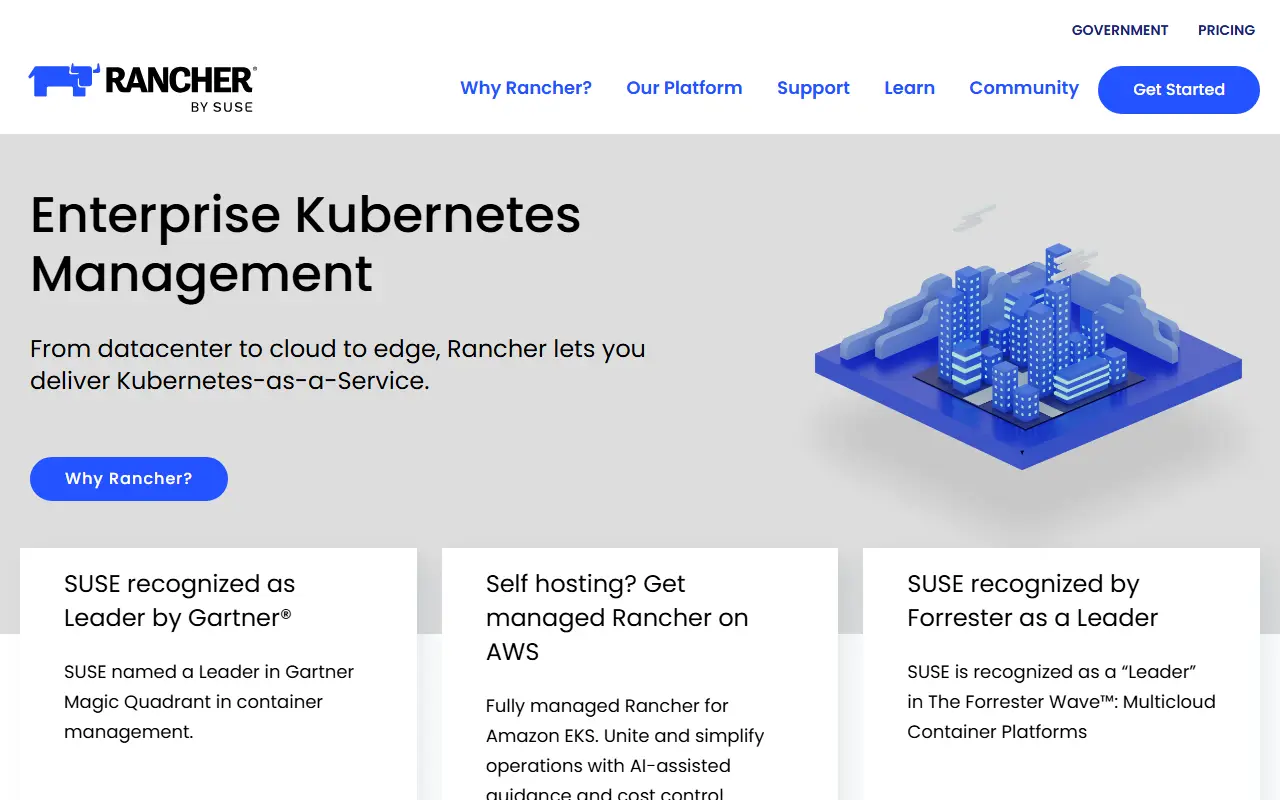
rancher.comRancher homepage screenshot

Rancher is an open-source container management platform for organizations that run containers in production. It aims to make Kubernetes easy to run in many places, to meet IT requirements and to support DevOps teams. It is written in Go, released under the Apache-2.0 license, and distributed as a container image that you can start with a single docker run command and then open in a browser.

The main repository is a meta-repository used for packaging that contains most of the Rancher codebase, with other projects and modules listed in go.mod. Stable releases are published as versioned images and a stable tag, and release announcements are posted on the SUSE forums. The README points to the installation guides, a support matrix of operating systems, hardware and software requirements, product documentation, and community help through forums and Slack.

Key features

  • Container management platform for Kubernetes
  • Quick start with a single Docker command
  • Versioned stable release images
  • Support matrix for operating systems
  • Build documentation for custom packaging
  • Community forums and Slack support

Pricing: Rancher does not publish prices. Visitors fill out a form to get detailed pricing from the regional sales team.

KubeVela

A CNCF application delivery platform that lets teams define deployments as code and roll out apps across hybrid and multi-cluster Kubernetes environments.

GitHub stars
7.9k
Last commit
3 days ago
Latest release
v1.11.0
Licence
Apache-2.0
Self-hosted
Yes
kubevela.ioKubeVela homepage screenshot

KubeVela is a modern application delivery platform that aims to make deploying and operating applications across hybrid and multi-cloud environments easier and more reliable. It follows a render, orchestrate, deploy approach built on the Open Application Model, and is a CNCF project written in Go.

Deployment plans are declared as workflows that can be run by any CI/CD or GitOps system and extended with CUE, so there is no need for ad hoc scripts. It natively supports multi-cluster and hybrid-cloud scenarios, including progressive rollout across test, staging and production, automatic canary and blue-green releases, continuous verification, and placement strategies across clusters and clouds. Observability dashboards, LDAP integrations, multi-tenancy and fine-grained RBAC are built in.

The architecture is lightweight, with a control plane that can run in a single pod, and extensible through reusable modules and community addons. KubeVela is licensed under Apache-2.0. It suits platform engineering teams that want to give developers a simpler way to ship applications onto Kubernetes.

Key features

  • Deployment plans defined as workflows
  • CUE-extensible workflow steps
  • Multi-cluster and hybrid-cloud delivery
  • Canary and blue-green rollouts
  • Multi-tenancy with fine-grained RBAC
  • Built-in observability dashboards
  • Lightweight single-pod control plane

Pricing: Free and open source under the Apache-2.0 licence.

Claudie

Claudie is a platform for building and managing multi-cloud, hybrid-cloud and on-premises Kubernetes clusters from a single declarative manifest.

GitHub stars
794
Last commit
yesterday
Latest release
v0.16.1
Licence
Apache-2.0
Self-hosted
Yes
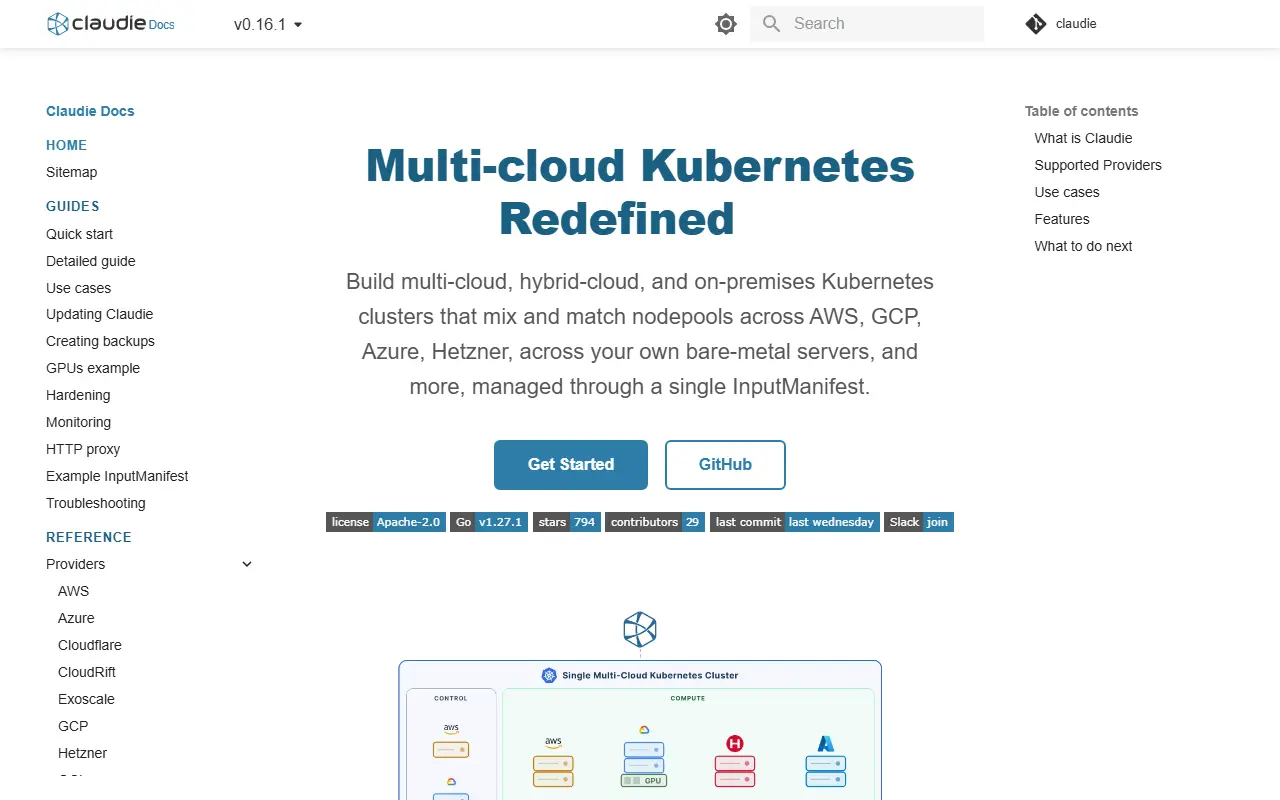
docs.claudie.ioClaudie homepage screenshot

Claudie is an open-source platform for managing multi-cloud, hybrid-cloud and on-premises Kubernetes clusters. It lets nodepools mix several cloud providers and your own bare-metal or co-located servers, all defined in one YAML InputManifest, with the aim of a Kubernetes engine you never need to migrate away from.

Typical reasons to use it, according to the project, include cost savings, data locality and compliance such as GDPR, managed Kubernetes for providers that do not offer it, cloud bursting, service interconnect, integrating existing servers as nodepools and adding GPU nodes for AI workloads. You supply cloud credentials, describe the cluster declaratively, and Claudie provisions the infrastructure. Scaling up or down means editing a few manifest lines, and a managed load-balancing solution is included for ingresses and the Kubernetes API server.

Supported providers in its topics include AWS, Azure, Cloudflare, GCP, Hetzner and OCI. Claudie is written in Go, licensed under Apache-2.0, and documented at docs.claudie.io with an introduction video.

Key features

  • Multi-cloud and hybrid Kubernetes clusters
  • Single declarative YAML manifest
  • Mix cloud and bare-metal nodepools
  • Managed load balancing
  • Fast scale-up and scale-down
  • Providers including AWS, Azure, GCP and Hetzner

Pricing: Free and open source under the Apache-2.0 license.

KubeStellar

KubeStellar is a CNCF Sandbox project for managing application deployment and configuration across many Kubernetes clusters through binding policies.

GitHub stars
715
Last commit
yesterday
Latest release
v0.30.0
Licence
Apache-2.0
Self-hosted
Yes
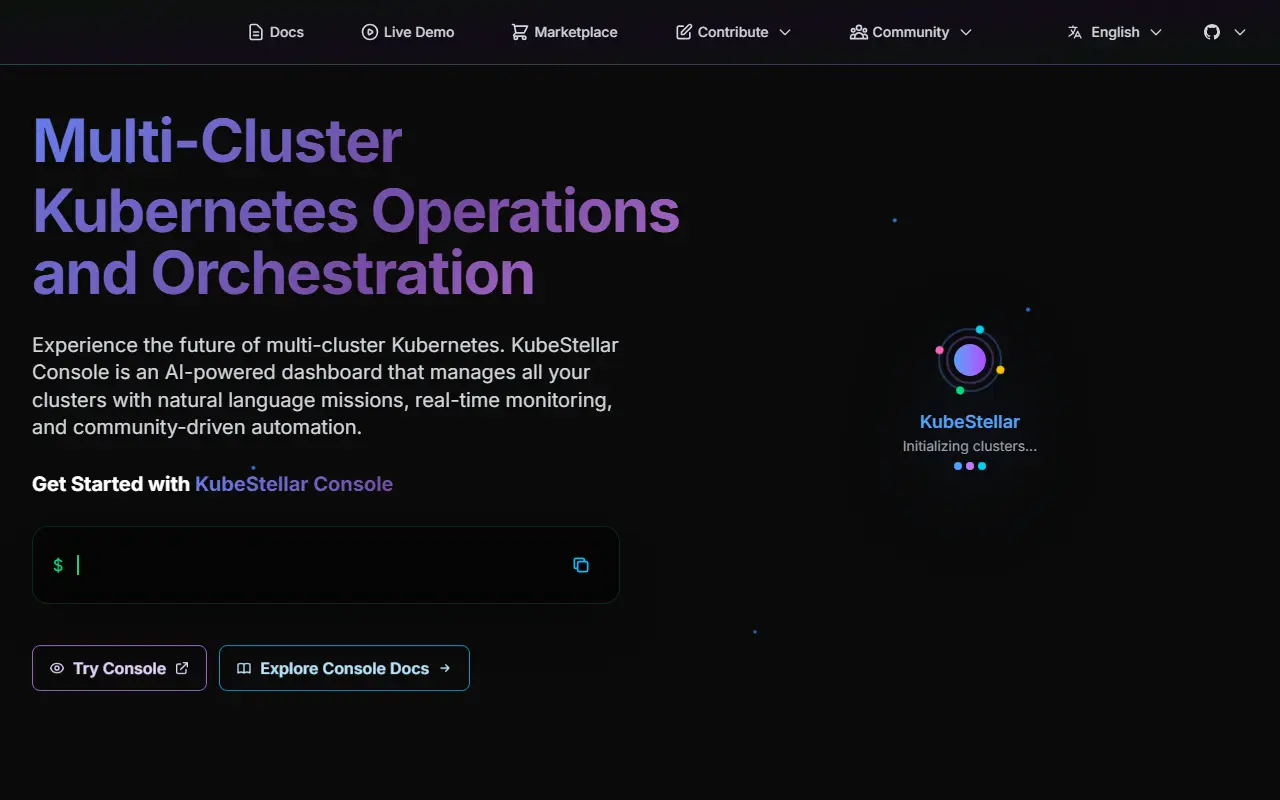
kubestellar.ioKubeStellar homepage screenshot

KubeStellar is a Cloud Native Computing Foundation Sandbox project that simplifies deploying and configuring applications across multiple Kubernetes clusters. It aims to give an experience similar to working with a single cluster and integrates with tools developers already use, without requiring existing resources to be modified.

Instead of configuring each cluster individually, developers define a binding policy between clusters and Kubernetes objects, and KubeStellar uses regular single-cluster tooling to deploy and configure each cluster accordingly. The README lists reasons for using multiple clusters, such as separating development, testing and staging, isolating teams, meeting security or data governance rules, improving resilience across clouds, accessing heterogeneous resources and running at the edge, including in disconnected environments.

The topics mention placement, scheduling, synchronization, rollout, status summarization and GitOps. KubeStellar is written in Go, licensed under Apache-2.0 and aimed at teams moving from one cluster to many or seeking a more streamlined multi-cluster developer experience.

Key features

  • Multi-cluster application placement
  • Binding policies between clusters and objects
  • Works with single-cluster tooling
  • Edge, multi-cloud and hybrid support
  • Status summarization across clusters
  • GitOps-friendly deployment

Pricing: Free and open source under the Apache-2.0 license.

Rafay alternatives: questions

What is the best open-source alternative to Rafay?
Rancher is the top-ranked open-source alternative to Rafay on Enlisted: Rancher is an open-source container management platform for deploying and operating Kubernetes clusters across environments. Other strong options are KubeVela, Claudie and KubeStellar.
Are these Rafay alternatives free?
All 4 are open source, so the code is free to use under its licence, and 4 of them can be self-hosted on your own server.
How is this list of Rafay alternatives ranked?
By a score built from GitHub stars, star growth over the last 30 days and how recently the code changed. 4 of these projects shipped code in the last 30 days. Data is refreshed daily, and nobody can pay to move up.

People also look for alternatives to…

View all