 TrackMedia
 TrackRev

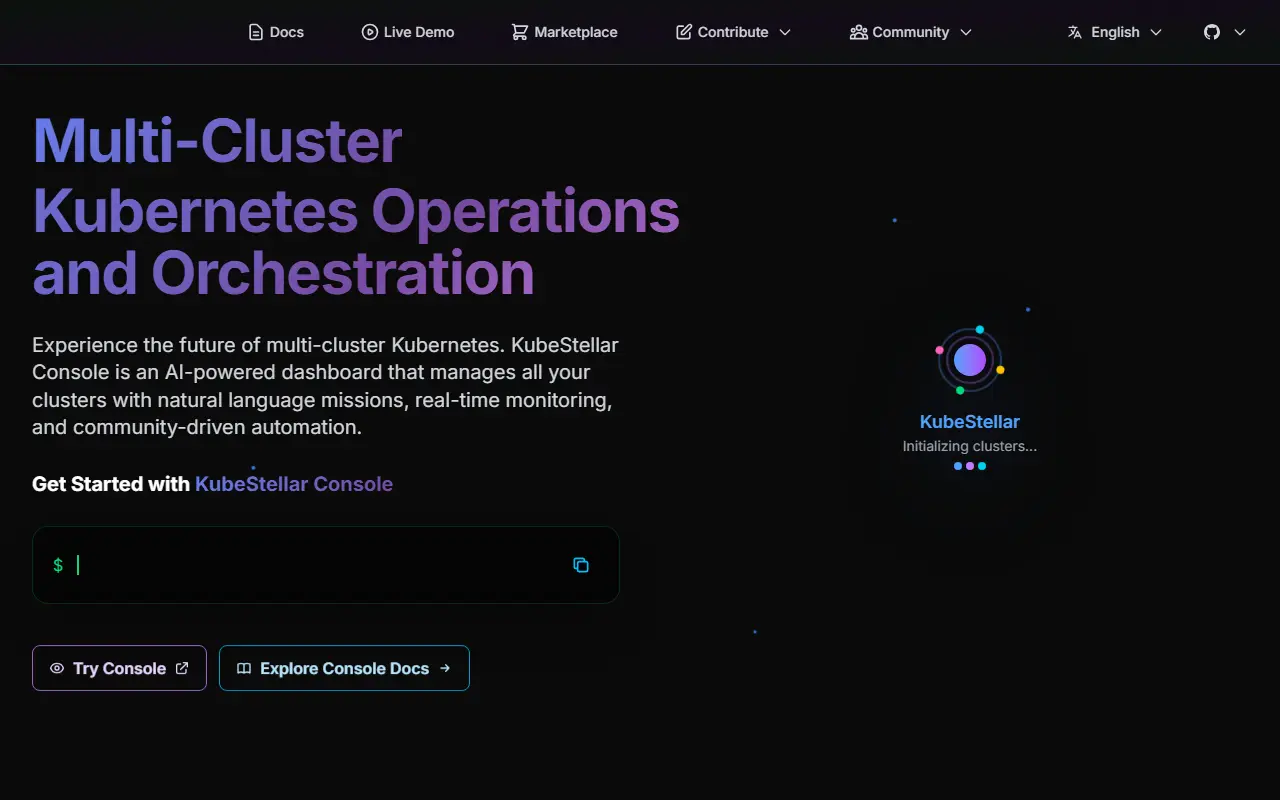
About KubeStellar
KubeStellar is a Cloud Native Computing Foundation Sandbox project that simplifies deploying and configuring applications across multiple Kubernetes clusters. It aims to give an experience similar to working with a single cluster and integrates with tools developers already use, without requiring existing resources to be modified.
Instead of configuring each cluster individually, developers define a binding policy between clusters and Kubernetes objects, and KubeStellar uses regular single-cluster tooling to deploy and configure each cluster accordingly. The README lists reasons for using multiple clusters, such as separating development, testing and staging, isolating teams, meeting security or data governance rules, improving resilience across clouds, accessing heterogeneous resources and running at the edge, including in disconnected environments.
The topics mention placement, scheduling, synchronization, rollout, status summarization and GitOps. KubeStellar is written in Go, licensed under Apache-2.0 and aimed at teams moving from one cluster to many or seeking a more streamlined multi-cluster developer experience.
Key features
- Multi-cluster application placement
- Binding policies between clusters and objects
- Works with single-cluster tooling
- Edge, multi-cloud and hybrid support
- Status summarization across clusters
- GitOps-friendly deployment
Good fit for
- Rolling out apps to many Kubernetes clusters
- Edge deployments in disconnected environments
KubeStellar: questions and answers
- What is KubeStellar used for?
- KubeStellar is a CNCF Sandbox project for managing application deployment and configuration across many Kubernetes clusters through binding policies. It is a good fit for rolling out apps to many Kubernetes clusters and edge deployments in disconnected environments.
- Is KubeStellar open source?
- Yes. KubeStellar is open source under the Apache-2.0 licence. Its source code is on GitHub at kubestellar/kubestellar and is written mainly in Go.
- Is KubeStellar free?
- Yes. KubeStellar is open source, so the software itself is free to use.
- Can I self-host KubeStellar?
- Yes. KubeStellar can be self-hosted on your own server or infrastructure.
- What is KubeStellar an alternative to?
- KubeStellar is an open-source alternative to Azure Arc, Spectro Cloud and Rafay. Other open-source alternatives to Azure Arc include Claudie and Rancher.
- Is KubeStellar actively maintained?
- Yes. The most recent commit to KubeStellar was on 9 November 2026, and the latest release is v0.30.1, published on 3 November 2026. The project has 729 stars on GitHub, with 12 added in the last 30 days.
Open-source alternatives to KubeStellar
See all
Claudie
Infrastructure & Containers
Cloud-agnostic managed Kubernetes
Apache-2.0vs Amazon EKS★ 794
Rancher
Infrastructure & Containers
Complete container management platform
Apache-2.0vs Amazon EKS★ 26k
Kubernetes
Infrastructure & Containers
Production-Grade Container Scheduling and Management
Apache-2.0vs Amazon EKS★ 129k
Kubermatic
Infrastructure & Containers
Kubermatic Kubernetes Platform - the Central Kubernetes Management Platform For Any Infras
OSSvs Railway★ 1.3k
Gardener
Infrastructure & Containers
Homogeneous Kubernetes clusters at scale on any infrastructure using hosted control planes
Apache-2.0vs Platform9★ 3.5k
KubeSphere
AI Tools
The container platform tailored for Kubernetes multi-cloud, datacenter, and edge managemen
OSSvs Platform9★ 17k
SaaS alternatives to KubeStellar
See all
Azure Arc
Infrastructure & Containers
Azure management layer that extends services to on-premises, edge and multicloud environments
SaaS
Spectro Cloud
Infrastructure & Containers
Kubernetes management platform for clusters across data center, cloud and edge
SaaS
Rafay
Infrastructure & Containers
Kubernetes operations and platform-as-a-service for managing clusters at scale
SaaS
Mirantis
Infrastructure & Containers
Kubernetes and container platform vendor with Mirantis Kubernetes Engine
SaaS
Platform9
Infrastructure & Containers
Managed Kubernetes and private cloud platform for hybrid environments
SaaS
Komodor
Infrastructure & Containers
Kubernetes troubleshooting and cluster management platform
SaaS