 TrackMedia
 TrackRev

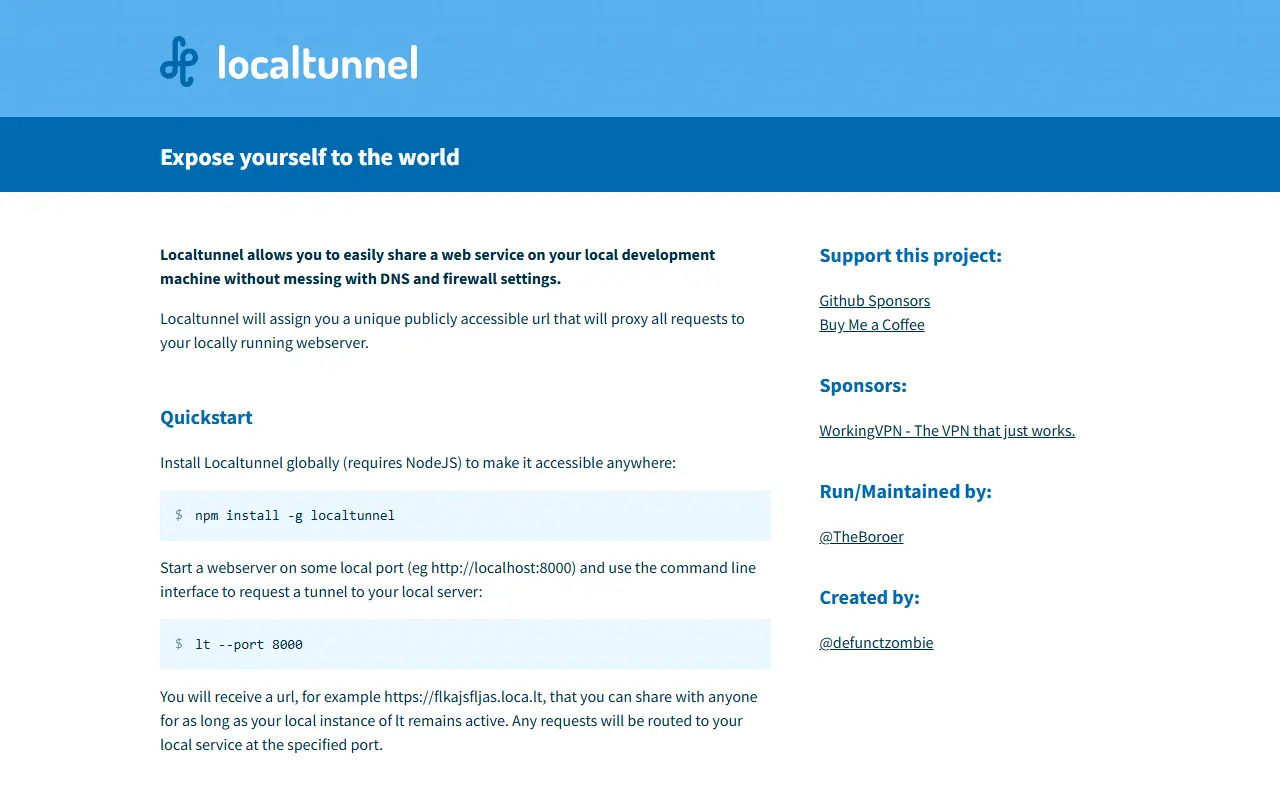
About Localtunnel
Localtunnel lets you share a web service running on your development machine without messing with DNS and firewall settings. It assigns a unique, publicly accessible URL that proxies all requests to your local web server.
Setup is two steps. Install it globally with npm, which requires NodeJS, then start a web server on a local port and run lt with that port, for example lt --port 8000. You receive a URL such as one under loca.lt, which stays valid for as long as your local lt instance remains active.
The site lists secure https for all tunnels, showing your work to anyone, using the API to test webhooks, and testing your UI in cloud browsers. It points to the GitHub page and wiki for clients in other languages and the full API for the tunnel proxy, and asks for support through GitHub Sponsors.
Key features
- Public URL proxying to your local web server
- No DNS or firewall changes needed
- Https on every tunnel
- Command line tool started with the lt command
- Useful for testing webhooks through its API
- Testing your UI in cloud browsers
Good fit for
- Sharing a local site
- Receiving webhooks during development
- Testing a UI in cloud browsers
Localtunnel: questions and answers
- What is Localtunnel used for?
- Localtunnel is a Node.js tool that gives a locally running web server a public https URL, so you can share it without touching DNS or firewalls. It is a good fit for sharing a local site, receiving webhooks during development and testing a UI in cloud browsers.
- Is Localtunnel open source?
- Yes. Localtunnel is open source under the MIT licence. Its source code is on GitHub at localtunnel/localtunnel and is written mainly in JavaScript.
- Is Localtunnel free?
- Yes. Localtunnel is open source, so the software itself is free to use.
- Can I self-host Localtunnel?
- Yes. Localtunnel can be self-hosted on your own server or infrastructure.
- What is Localtunnel an alternative to?
- Localtunnel is an open-source alternative to ngrok and Cloudflare Tunnel. Other open-source alternatives to ngrok include Bore, frp and Sish.
- Is Localtunnel actively maintained?
- The most recent commit to Localtunnel was on 29 August 2025. The project has 23k stars on GitHub, with 9 added in the last 30 days.
Open-source alternatives to Localtunnel
See allBore
Open source
🕳 bore is a simple CLI tool for making tunnels to localhost
MITvs ngrok★ 12kfrp
Networking & VPN
A fast reverse proxy to help you expose a local server behind a NAT or firewall to the int
Apache-2.0vs ngrok★ 111k
Sish
Networking & VPN
HTTP(S)/WS(S)/TCP Tunnels to localhost using only SSH.
MITvs Cloudflare Tunnel★ 4.8k
Pangolin
Networking & VPN
Open-source SASE platform providing secure access and connectivity to apps, infrastructure
OSSvs Cloudflare Tunnel★ 24k
Octelium
Networking & VPN
A next-gen FOSS self-hosted unified zero trust secure access platform that can operate as
AGPL-3.0vs Tailscale★ 4.2k
Zrok
Networking & VPN
Secure internet sharing made simple.
Apache-2.0vs ngrok★ 4.8k

SaaS alternatives to Localtunnel
See all
ngrok
Networking & VPN
ngrok is developer infrastructure that exposes local apps and APIs to the internet and routes and secures traffic to services wherever they run.
SaaS
Cloudflare Tunnel
Networking & VPN
Cloudflare Tunnel securely connects web services and private networks to Cloudflare without opening inbound ports on the origin server.
SaaS