
 F5
F5 DataDome
 HUMAN Security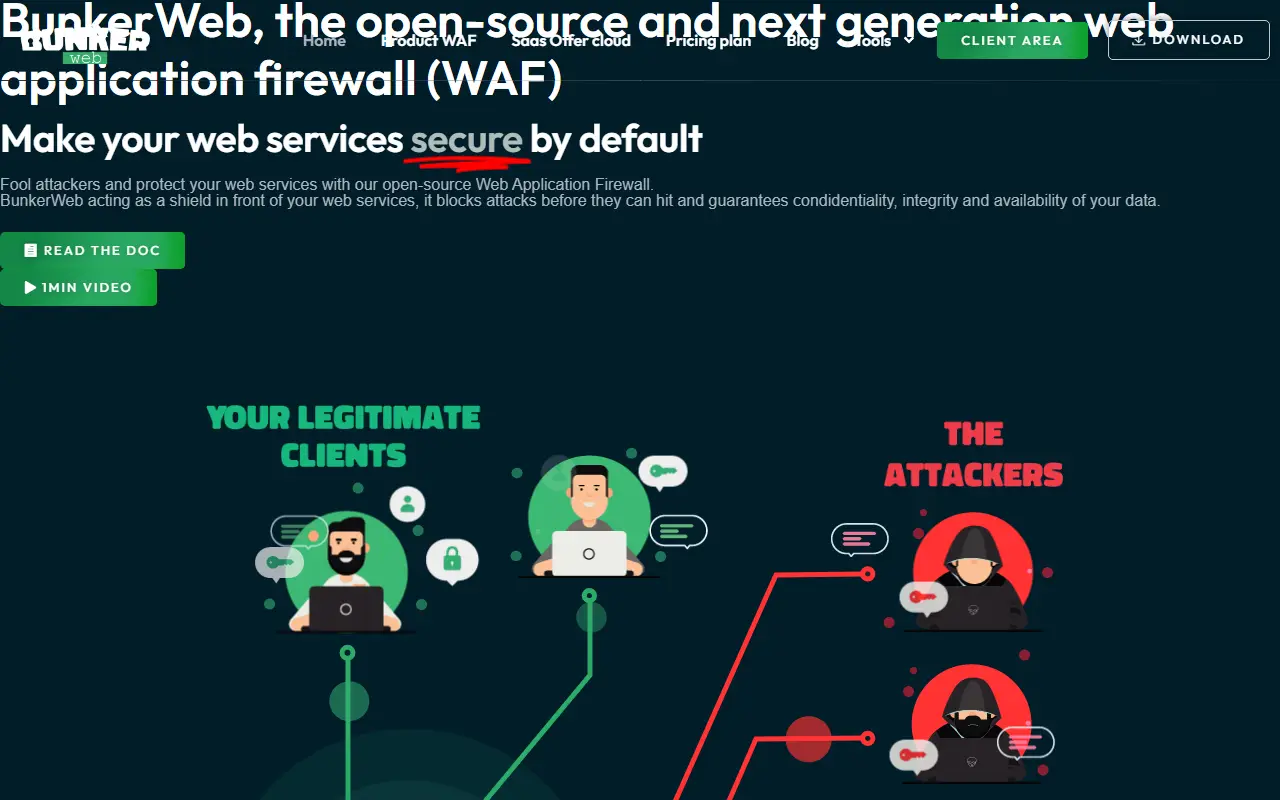
About BunkerWeb
BunkerWeb is an open-source web application firewall that protects web services and aims to make them secure by default. It is a complete web server based on NGINX that sits in front of your applications as a reverse proxy, filtering traffic before it reaches them.
It can be deployed in Linux, Docker, Swarm and Kubernetes environments and is configurable through a command line or a web user interface. Core security features ship in the box, and additional ones can be added with a plugin system. Related topics in the repository include ModSecurity, anti-bot protection, DNS blocklists and Let's Encrypt certificate handling.
The software is written mainly in Python and released under the AGPL-3.0 license. The project provides documentation, a demo, community templates, examples and a forum. Its goal is for administrators to get a reasonable level of protection with minimal configuration while keeping room to tune individual settings for their own use cases.
Key features
- NGINX-based reverse proxy and WAF
- Secure-by-default configuration
- Web UI for managing settings
- Plugin system for extra protections
- Deploys on Linux, Docker, Swarm and Kubernetes
- Anti-bot and DNS blocklist options
Good fit for
- →Shielding self-hosted web apps from attacks
- →Adding a WAF in front of Kubernetes services
- Tags
- waf
- web-security
- nginx
- reverse-proxy
- modsecurity
- devsecops
- self-hosted
- docker
BunkerWeb: questions and answers
- What is BunkerWeb used for?
- BunkerWeb is an open-source web application firewall built on NGINX that acts as a reverse proxy with a web UI and a plugin system. It is a good fit for shielding self-hosted web apps from attacks and adding a WAF in front of Kubernetes services.
- Is BunkerWeb open source?
- Yes. BunkerWeb is open source under the AGPL-3.0 licence. Its source code is on GitHub at bunkerity/bunkerweb and is written mainly in Python.
- Is BunkerWeb free?
- Yes. BunkerWeb is open source, so the software itself is free to use. Paid plans are also available, starting at €49 per month.
- Can I self-host BunkerWeb?
- Yes. BunkerWeb can be self-hosted on your own server or infrastructure.
- What is BunkerWeb an alternative to?
- BunkerWeb is an open-source alternative to Cloudflare, Akamai, Fortinet and Fastly. Other open-source alternatives to Cloudflare include SafeLine, ModSecurity and CrowdSec.
- Is BunkerWeb actively maintained?
- Yes. The most recent commit to BunkerWeb was on 2 October 2026, and the latest release is v1.6.15, published on 21 September 2026. The project has 11k stars on GitHub.
Open-source alternatives to BunkerWeb
See all
SafeLine
Security
CyberServal open-source WAF is a self-hosted WAF with 20.9K GitHub stars. Block SQL inject
GPL-3.0vs Cloudflare★ 23k
ModSecurity
Security
ModSecurity is an open source, cross platform web application firewall (WAF) engine for Ap
Apache-2.0vs Cloudflare★ 9.8k
CrowdSec
Security
Open-source IDS/IPS, WAF and bot detection for Linux, Windows, Docker and Kubernetes, with
MITvs Cloudflare★ 15k
NGINX
Networking & VPN
The official NGINX Open Source repository.
BSD-2-Clausevs Cloudflare★ 32k
OPNsense
Security
OPNsense GUI, API and systems backend
BSD-2-Clausevs Fortinet★ 4.7k
pfSense
Security
Main repository for pfSense
Apache-2.0vs Fortinet★ 5.7k
SaaS alternatives to BunkerWeb
See all
Cloudflare
Networking & VPN
CDN, DNS, DDoS protection and edge computing platform
SaaS
Akamai
Networking & VPN
CDN, security and edge compute platform for enterprise web delivery
SaaS
Fortinet
Security
FortiGate firewalls and a broad security fabric for network, cloud and endpoints
SaaS
Fastly
Networking & VPN
Edge cloud platform for CDN, security and serverless compute
SaaS
Barracuda Networks
Security
Email, network and application security products
SaaS
Imperva
Security
Web application, API and data security platform
SaaS