7,363 open-source and SaaS tools, with GitHub stats refreshed every day.

3 alternatives ranked by real activity

Open-source F5 alternatives

A curated, ranked list of the 3 best open-source alternatives to F5.

The best open-source alternative to F5 is SafeLine. If that doesn't suit you, other good options are BunkerWeb and ModSecurity.

F5 alternatives are mainly security tools. 3 of them shipped code in the last 30 days, 3 can be self-hosted, and 1 uses a permissive licence.

Last updated October 3, 2026 · ranked by GitHub stars, growth and recent commits

SafeLine

Self-hosted web application firewall and reverse proxy that filters HTTP traffic to block attacks such as SQL injection, XSS, and bot abuse.

GitHub stars
23k
Last commit
5 days ago
Latest release
v9.4.2
Licence
GPL-3.0
Self-hosted
Yes
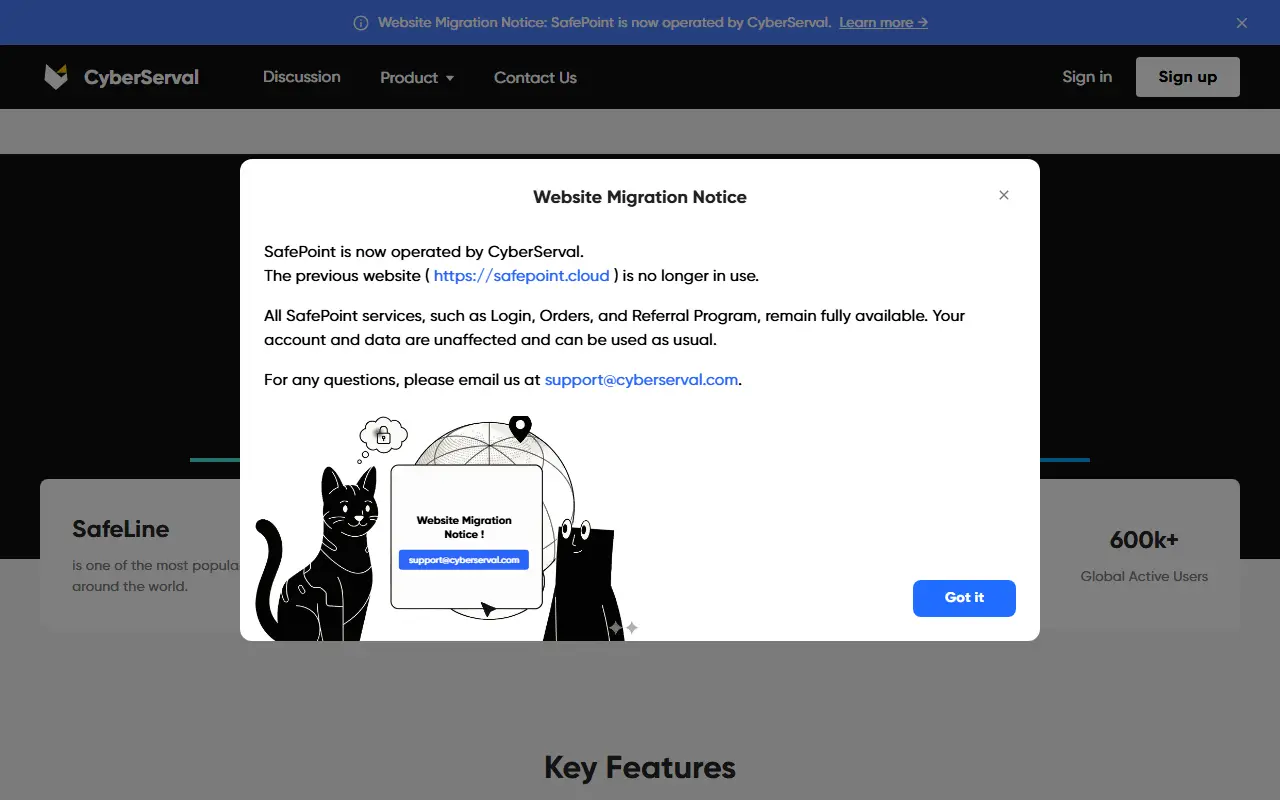
ly.safepoint.cloudSafeLine homepage screenshot

SafeLine is a self-hosted web application firewall (WAF) from Chaitin, released under the GPL-3.0 license. It sits in front of a web application as a reverse proxy, so visitors' requests pass through it first. It filters, monitors, and blocks malicious HTTP and HTTPS traffic before that traffic reaches the origin server, and it is also meant to stop unauthorized data from leaving the application.

The firewall targets common web attack classes, including SQL injection, cross-site scripting, command and code injection, server-side request forgery, path traversal, XXE, and remote code execution, as well as brute-force attempts, HTTP floods, and abusive bots. Beyond rule-based filtering, its documented core capabilities include IP-based rate limiting, a web access control list, bot defense, and encryption of the HTML and JavaScript code served to clients.

Security and operations teams that run their own websites or APIs can use it to add a protective layer in front of existing applications. The project is written in Go and hosted on GitHub, and the maintainers provide documentation, a live demo, and a Discord community. Because it is self-hosted, traffic inspection stays on infrastructure you control.

Key features

  • Reverse-proxy WAF filtering HTTP and HTTPS traffic
  • Blocks SQL injection, XSS, and RCE attempts
  • Defense against bot abuse and brute force
  • IP-based rate limiting
  • Web access control list rules
  • HTML and JavaScript code encryption
  • Self-hosted deployment on your own infrastructure

Pricing: Personal is free forever for up to 10 apps. Lite costs $10 per month ($100 per year) and Pro $100 per month ($1000 per year); Ultimate is custom. A 7-day trial is offered.

BunkerWeb

Open-source web application firewall built on NGINX that acts as a reverse proxy with a web UI and a plugin system.

GitHub stars
11k
Last commit
today
Latest release
v1.6.15
Licence
AGPL-3.0
Self-hosted
Yes
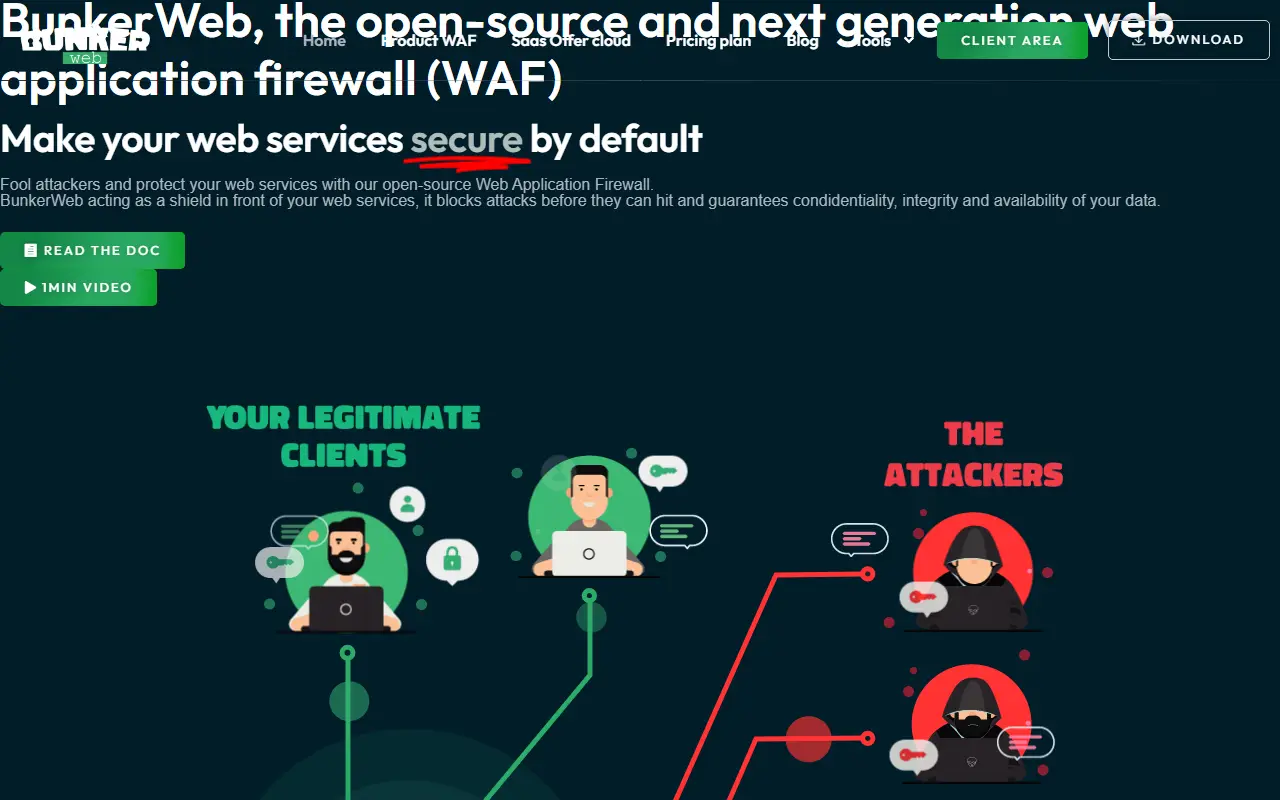
bunkerweb.ioBunkerWeb homepage screenshot

BunkerWeb is an open-source web application firewall that protects web services and aims to make them secure by default. It is a complete web server based on NGINX that sits in front of your applications as a reverse proxy, filtering traffic before it reaches them.

It can be deployed in Linux, Docker, Swarm and Kubernetes environments and is configurable through a command line or a web user interface. Core security features ship in the box, and additional ones can be added with a plugin system. Related topics in the repository include ModSecurity, anti-bot protection, DNS blocklists and Let's Encrypt certificate handling.

The software is written mainly in Python and released under the AGPL-3.0 license. The project provides documentation, a demo, community templates, examples and a forum. Its goal is for administrators to get a reasonable level of protection with minimal configuration while keeping room to tune individual settings for their own use cases.

Key features

  • NGINX-based reverse proxy and WAF
  • Secure-by-default configuration
  • Web UI for managing settings
  • Plugin system for extra protections
  • Deploys on Linux, Docker, Swarm and Kubernetes
  • Anti-bot and DNS blocklist options

Pricing: A free open-source edition is available. Paid self-hosted plans are 49 euros (Shield) and 149 euros (Fortress) a month with a 30-day trial; managed Cloud starts from 639 euros a month and Sentinel is custom.

ModSecurity

Cross-platform web application firewall engine for Apache, IIS and Nginx that inspects HTTP traffic with SecRules-based rule sets.

GitHub stars
9.8k
Last commit
2 days ago
Latest release
v3.0.17
Licence
Apache-2.0
Self-hosted
Yes
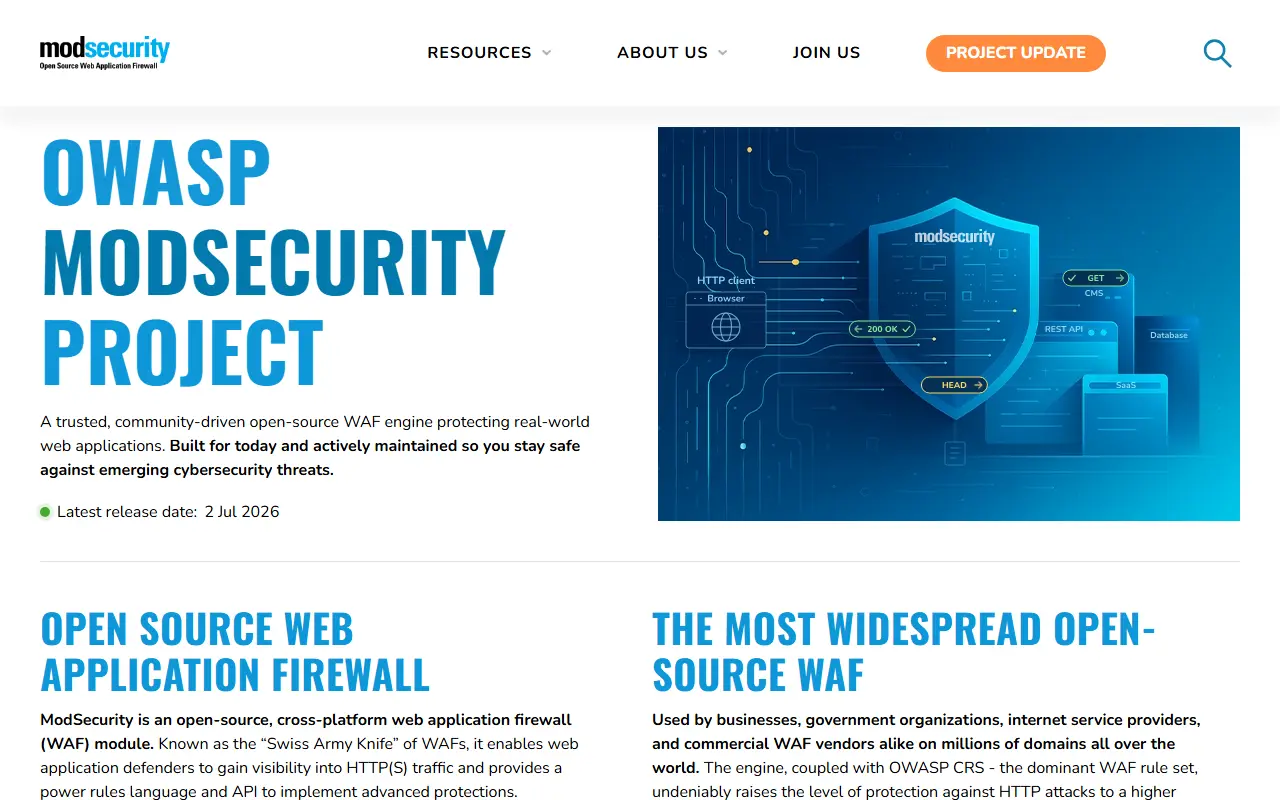
modsecurity.orgModSecurity homepage screenshot

ModSecurity is an open-source, cross-platform web application firewall engine. It started as an Apache module and now serves Apache, IIS and Nginx, protecting web applications from a range of attacks while also allowing HTTP traffic monitoring, logging and real-time analysis through an event-based rule language.

This repository contains libmodsecurity, the ModSecurity v3 library. It acts as an interface to connectors that pass web traffic in, loads and interprets rules written in the SecRules format, and applies them to HTTP content from your application. Version 3 is a full rewrite that removes the Apache dependencies, aims for higher performance and a new architecture, and plans native JSON audit logs.

The older ModSecurity v2.x for Apache is still maintained in its own repository. The code is written in C++ and released under the Apache-2.0 license, under the OWASP organization. Rule sets such as the OWASP Core Rule Set are typically used alongside it.

Key features

  • WAF engine for Apache, IIS and Nginx
  • SecRules rule language
  • HTTP traffic monitoring and logging
  • Connector-based architecture in v3
  • Rewrite without Apache dependencies

Pricing: Free and open source under the Apache-2.0 license.

F5 alternatives: questions

What is the best open-source alternative to F5?
SafeLine is the top-ranked open-source alternative to F5 on Enlisted: Self-hosted web application firewall and reverse proxy that filters HTTP traffic to block attacks such as SQL injection, XSS, and bot abuse. Other strong options are BunkerWeb and ModSecurity.
Are these F5 alternatives free?
All 3 are open source, so the code is free to use under its licence, and all of them can be self-hosted on your own server or computer.
How is this list of F5 alternatives ranked?
By a score built from GitHub stars, star growth over the last 30 days and how recently the code changed. 3 of these projects shipped code in the last 30 days. Data is refreshed daily, and nobody can pay to move up.

People also look for alternatives to…

View all