
About Kache
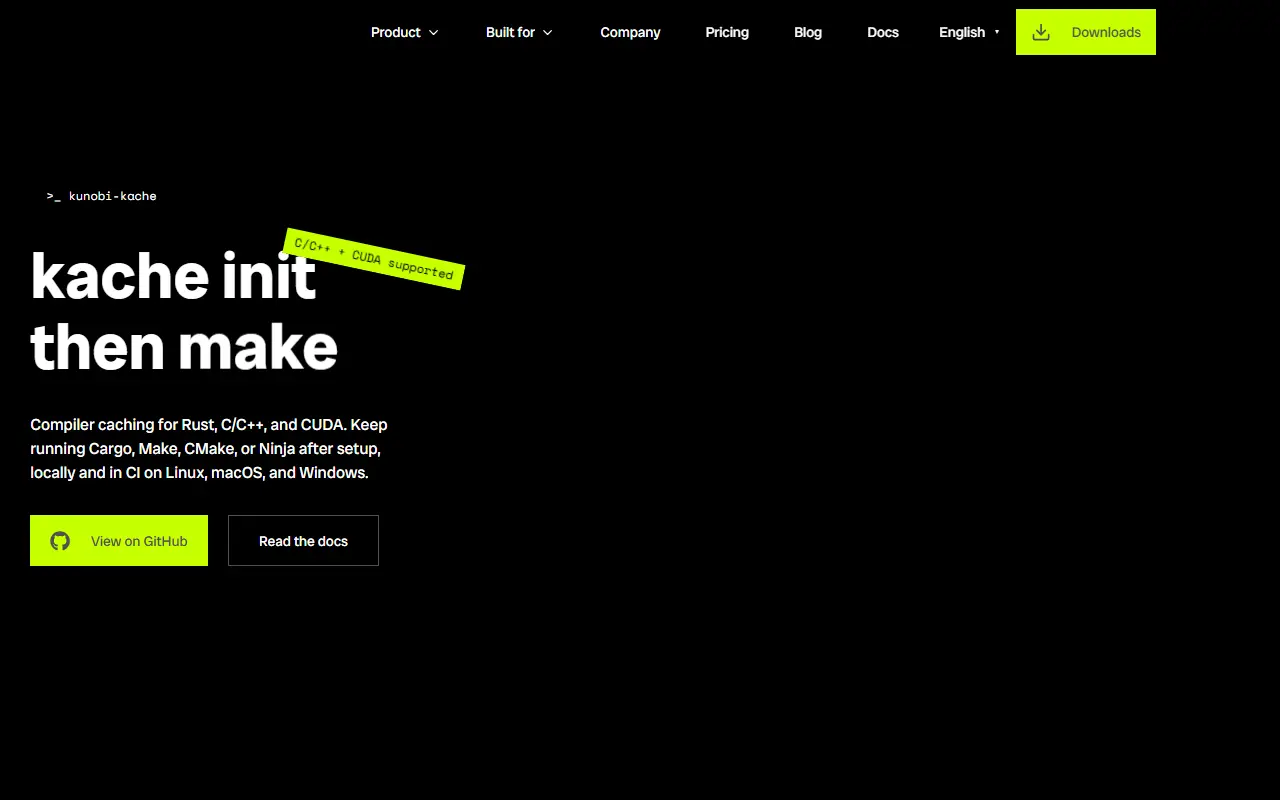
Kache, built by Kunobi, is a compiler cache for Rust, C and C++ and CUDA. It keys every compiler invocation by the content of its inputs, so something built once is restored instead of rebuilt in your next worktree, branch or CI run. Cargo commands stay the same, because it plugs in as the rustc wrapper after a one-time init command.
A compiler wrapper hashes the inputs that change the output, normalizing machine-local paths so two worktrees of the same revision produce the same key. Outputs live in a local content-addressed store that uses hardlinks to avoid copies and wasted disk, and they can be shared through S3-compatible or filesystem remotes, with an optional background daemon. It supports Linux, macOS and Windows on x86_64 and ARM, and a comparison with sccache and benchmarks are published.
Kache is written in Rust and licensed under Apache-2.0. Installation is available through cargo install, Homebrew, APT, AUR, winget, Scoop, Chocolatey, mise and Nix. It runs on developer machines and in CI, and suits teams with large Rust or C++ builds who want faster iterations.
Key features
- Content-addressed compiler cache
- Zero-copy storage using hardlinks
- Rust, C/C++, and CUDA support
- Sharing through S3-compatible remotes
- Reuse across worktrees and branches
- Packages for Homebrew, APT, and winget
Good fit for
- →Speeding up Rust builds across git worktrees
- →Sharing build caches between CI runs
- →Cutting disk usage from duplicate build outputs
- Built with
- Rust
- Tags
- build-cache
- rust
- compiler-cache
- ci
- cpp
- cuda
- sccache-alternative
- developer-tools
- s3
Kache: questions and answers
- What is Kache used for?
- Kache is a zero-copy, content-addressed compiler cache for Rust, C/C++ and CUDA that reuses build outputs across worktrees, branches and CI runs. It is a good fit for speeding up Rust builds across git worktrees, sharing build caches between CI runs and cutting disk usage from duplicate build outputs.
- Is Kache open source?
- Yes. Kache is open source under the Apache-2.0 licence. Its source code is on GitHub at kunobi-ninja/kache and is written mainly in Rust.
- Is Kache free?
- Yes. Kache is open source, so the software itself is free to use.
- What are some alternatives to Kache?
- Similar open-source tools in the CI/CD & DevOps category include NativeLink, Danger JS and Danger. SaaS products in the same category include Blacksmith, Depot and Travis CI.
- Is Kache actively maintained?
- Yes. The most recent commit to Kache was on 2 October 2026, and the latest release is v0.28.1, published on 29 September 2026. The project has 1k stars on GitHub.
Open-source alternatives to Kache
See all
NativeLink
CI/CD & DevOps
NativeLink is a Nix-powered, open source, high-performance build cache and remote executio
OSSvs Depot★ 1.6k
Danger JS
CI/CD & DevOps
⚠️ Stop saying "you forgot to …" in code review
MIT★ 5.5k
Danger
CI/CD & DevOps
🚫 Stop saying "you forgot to …" in code review (in Ruby)
MIT★ 5.7k
release-plz
CI/CD & DevOps
Publish Rust crates from CI with a Release PR.
Apache-2.0★ 1.5k
Dockerfile Roast
CI/CD & DevOps
droast - a dockerfile linter that actually has opinions 🔥
MIT★ 1.1k
Act
CI/CD & DevOps
Run your GitHub Actions locally 🚀
MIT★ 72k
SaaS alternatives to Kache
See all
Blacksmith
CI/CD & DevOps
Faster GitHub Actions runners billed per minute, with build caching
SaaS
Depot
CI/CD & DevOps
Remote container build and CI runner service that speeds up Docker builds
SaaS
Travis CI
CI/CD & DevOps
Hosted continuous integration service that builds and tests code from Git repos
SaaS
Appcircle
CI/CD & DevOps
Mobile CI/CD platform for building, testing and publishing apps, cloud or self-hosted
SaaS
Apptio Cloudability
CI/CD & DevOps
Cloud financial management platform from IBM Apptio for FinOps reporting
SaaS
AppVeyor
CI/CD & DevOps
CI/CD service for Windows, Linux and macOS projects
SaaS