
About Act
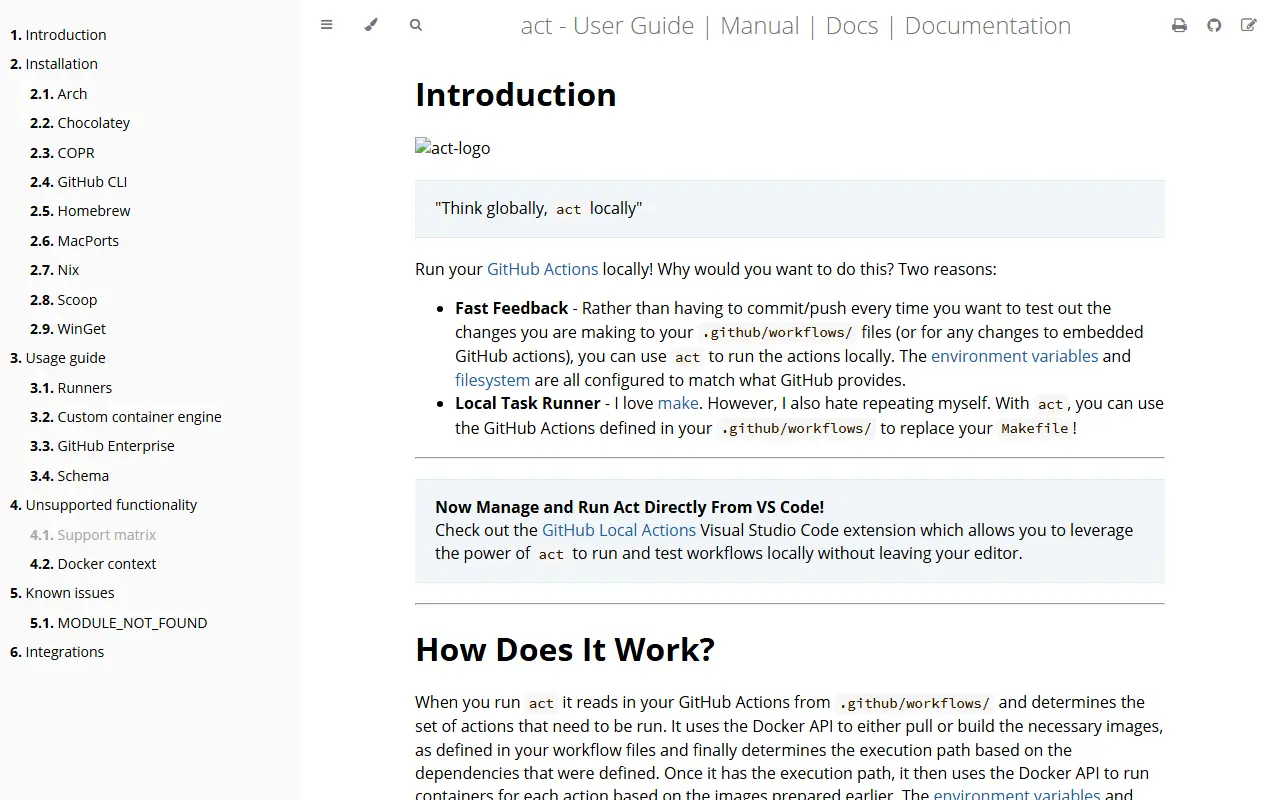
act lets you run your GitHub Actions workflows locally. Instead of committing and pushing every time you tweak a file under .github/workflows to see if it works, you run the workflow on your own computer and get feedback right away. The tool sets up environment variables and the filesystem to match what GitHub provides.
It works by reading your workflow files, working out which actions need to run, and using the Docker API to pull or build the images they need, then running them in containers. The author also suggests using it as a local task runner, replacing a Makefile with workflows you already have. A companion GitHub Local Actions extension for Visual Studio Code lets you manage and run act without leaving the editor.
act is written in Go and MIT licensed, and the project name plays on the phrase think globally, act locally. It is a developer tool that runs entirely on your machine, with Docker as the main requirement, and it suits anyone who writes CI workflows and wants a faster edit and test loop.
Key features
- Runs GitHub Actions workflows locally
- Uses Docker to mirror the GitHub environment
- Fast feedback without pushing commits
- Can replace Makefile task running
- VS Code extension integration
- Single Go binary
Good fit for
- →Debugging CI workflows before pushing
- →Running project tasks defined as Actions
- →Testing custom GitHub Actions locally
- Built with
- Go
- Tags
- github-actions
- ci
- devops
- docker
- cli
- go
- testing
- local-development
Act: questions and answers
- What is Act used for?
- Act is a command line tool that runs GitHub Actions workflows on your own machine using Docker, for quick feedback and as a local task runner. It is a good fit for debugging CI workflows before pushing, running project tasks defined as Actions and testing custom GitHub Actions locally.
- Is Act open source?
- Yes. Act is open source under the MIT licence. Its source code is on GitHub at nektos/act and is written mainly in Go.
- Is Act free?
- Yes. Act is open source, so the software itself is free to use.
- What are some alternatives to Act?
- Similar open-source tools in the CI/CD & DevOps category include actionlint, Earthly and GitHub Local Actions. SaaS products in the same category include Blacksmith, Travis CI and Buildkite.
- Is Act actively maintained?
- Yes. The most recent commit to Act was on 9 August 2026, and the latest release is v0.2.89, published on 1 June 2026. The project has 72k stars on GitHub.
Open-source alternatives to Act
See allactionlint
CI/CD & DevOps
:octocat: Static checker for GitHub Actions workflow files
MIT★ 4.3k
Earthly
CI/CD & DevOps
Super simple build framework with fast, repeatable builds and an instantly familiar syntax
MPL-2.0vs Depot★ 12k
GitHub Local Actions
CI/CD & DevOps
✨ Run your GitHub Actions locally in VS Code!
Apache-2.0★ 761
release-plz
CI/CD & DevOps
Publish Rust crates from CI with a Release PR.
Apache-2.0★ 1.5k
ttl.sh
CI/CD & DevOps
An anonymous & ephemeral Docker image registry
Apache-2.0★ 836kube-score
CI/CD & DevOps
Kubernetes object analysis with recommendations for improved reliability and security. kub
MIT★ 3.1k
SaaS alternatives to Act
See all
Blacksmith
CI/CD & DevOps
Faster GitHub Actions runners billed per minute, with build caching
SaaS
Travis CI
CI/CD & DevOps
Hosted continuous integration service that builds and tests code from Git repos
SaaS
Buildkite
CI/CD & DevOps
CI/CD platform that runs pipelines on build agents you host yourself
SaaS
Depot
CI/CD & DevOps
Remote container build and CI runner service that speeds up Docker builds
SaaS
Namespace
CI/CD & DevOps
Cloud build and CI runner infrastructure for faster builds and remote development
SaaS
Sonatype Nexus Repository
CI/CD & DevOps
Artifact repository manager for storing and distributing software packages
SaaS