
 Axiom
Axiom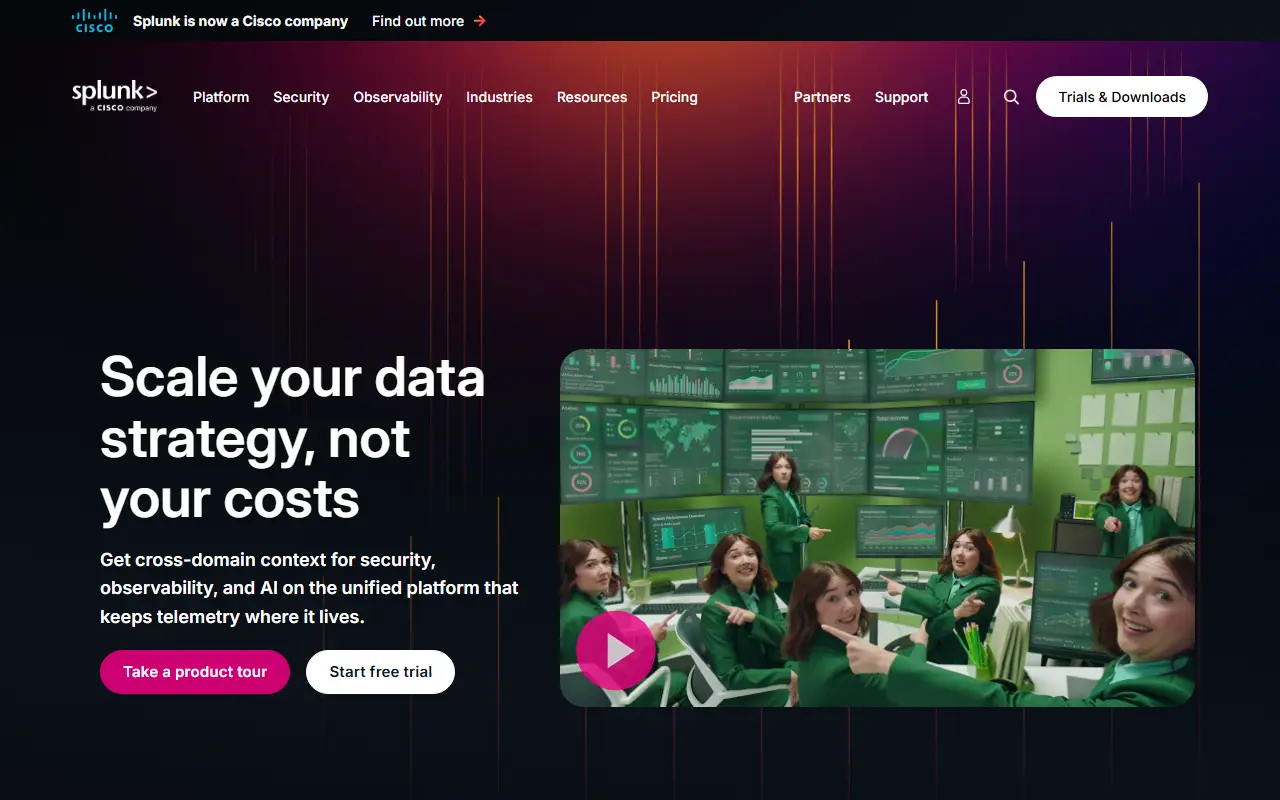
About Splunk
Splunk is a commercial data platform used for security operations and IT observability. It ingests large volumes of machine data such as logs and events, then lets teams search, analyze and alert on that data to find threats or understand outages.
The vendor describes it as a platform that unifies security and observability at large scale for trusted AI. Capabilities listed include artificial intelligence for agentic operations, federated search across different sources, data management to optimize pipelines and control costs, an AI toolkit and a Splunk MCP server. Use cases include data optimization, IT modernization with AIOps and IT service health, and a security line includes Enterprise Security for threat detection, investigation and response.
Splunk is proprietary software, offered both as Splunk Cloud Platform and as software that organizations can run themselves. A pricing page lists options, and a product tour is available. It suits security operations centers, IT operations teams and large enterprises with significant data volumes.
Key features
- Machine data search and analysis
- Security operations and threat detection
- Federated search across data sources
- Data pipeline management and cost control
- AIOps for IT service health
- AI toolkit and MCP server
Good fit for
- →Security operations centers detecting threats
- →IT operations analyzing service health
- →Enterprises centralizing log data
- Tags
- observability
- security
- siem
- logs
- aiops
- enterprise
Splunk: questions and answers
- What is Splunk used for?
- Splunk is a data platform for security and observability that collects, searches and analyzes machine data to detect threats and prevent downtime. It is a good fit for security operations centers detecting threats, IT operations analyzing service health and enterprises centralizing log data.
- Is Splunk open source?
- No. Splunk is proprietary (closed-source) software. Open-source alternatives to Splunk include Grafana, OpenObserve and Graylog.
- Can I self-host Splunk?
- Yes. Although Splunk is closed source, it can be self-hosted on your own servers, and the vendor also offers a hosted version.
- What are some alternatives to Splunk?
- Splunk competes with Datadog, Elastic and Sumo Logic. For open-source options, see Enlisted's ranked list of open-source Splunk alternatives.
Open-source alternatives to Splunk
See all
Grafana
Monitoring & Observability
The open and composable observability and data visualization platform. Visualize metrics,
AGPL-3.0vs Datadog★ 77k
OpenObserve
Monitoring & Observability
High-performance, unified observability for the AI era. 140x lower storage cost.
AGPL-3.0vs Datadog★ 22k
Graylog
Monitoring & Observability
Free and open log management
OSSvs Splunk★ 8.2k
Kibana
Monitoring & Observability
Your window into all of your data
OSSvs Splunk★ 21k
Grafana Loki
Monitoring & Observability
Like Prometheus, but for logs.
AGPL-3.0vs Datadog★ 29k
Quickwit
Monitoring & Observability
Cloud-native OSS search engine for observability
Apache-2.0vs Datadog★ 12k
SaaS alternatives to Splunk
See all
Datadog
Monitoring & Observability
Datadog is a cloud monitoring and observability platform that brings metrics, logs and traces from applications, tools and services into one place.
SaaS
Elastic
Search
Elastic builds Elasticsearch, a distributed search and analytics engine used for application search, logs, vector search and security analytics.
SaaS
Sumo Logic
Monitoring & Observability
Cloud log analytics and security monitoring platform
SaaS
Dynatrace
Monitoring & Observability
Full-stack observability with automatic instrumentation and AI-based root-cause analysis
SaaS
Coralogix
Monitoring & Observability
Observability platform that analyzes logs, metrics and traces as they are ingested
SaaS
Logz.io
Monitoring & Observability
Managed observability stack for logs, metrics and traces built on open tooling
SaaS