7,363 open-source and SaaS tools, with GitHub stats refreshed every day.

6 alternatives ranked by real activity

Open-source Front alternatives

A curated, ranked list of the 6 best open-source alternatives to Front.

The best open-source alternative to Front is Chatwoot. If that doesn't suit you, other good options are Zammad, FreeScout, Lowdefy and Libredesk.

Front alternatives are mainly customer support tools, but some are also low-code & internal tools and email clients & servers. 5 of them shipped code in the last 30 days, 6 can be self-hosted, and 1 uses a permissive licence.

Last updated October 2, 2026 · ranked by GitHub stars, growth and recent commits

Chatwoot

An open-source omnichannel customer support desk with live chat, email and social inbox, an AI agent and a help center, positioned against Intercom and Zendesk.

GitHub stars
37k
Last commit
today
Latest release
v4.18.0
Self-hosted
Yes
Hosted version
Available
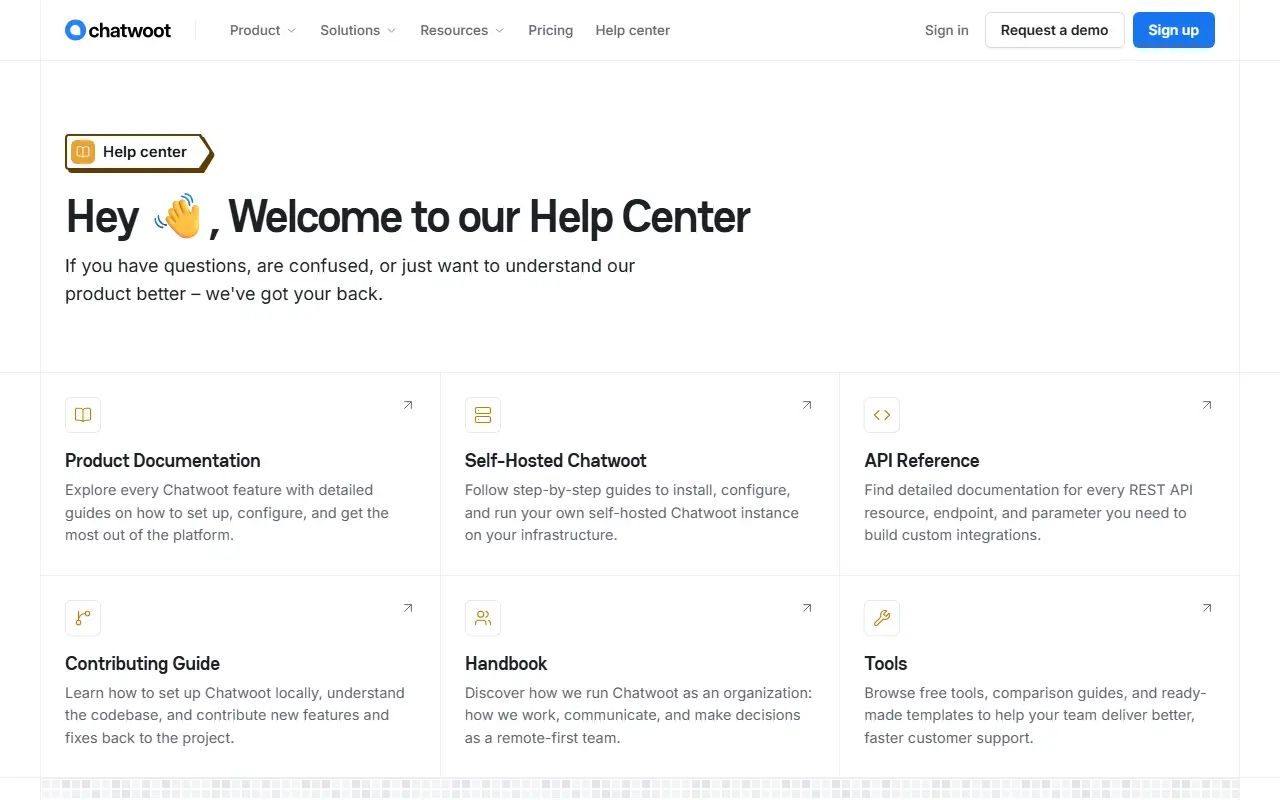
chatwoot.comChatwoot homepage screenshot

Chatwoot is an open-source, self-hostable customer support platform that gathers all customer conversations into one inbox. It is presented as an alternative to Intercom, Zendesk and Salesforce Service Cloud, and aims to give businesses control over their customer data while managing conversations across channels.

The shared inbox takes in website live chat, email, SMS and messaging channels such as Facebook, Instagram, Twitter, WhatsApp, Telegram and Line. An AI agent called Captain automates replies to common questions to reduce agent workload, and a built-in Help Center portal lets you publish articles and FAQs so customers can find answers themselves. Collaboration tools include private notes with mentions, labels, canned responses, auto-assignment based on availability, custom views and filters, a command bar and multi-language support.

Chatwoot is built with Ruby on Rails and Vue and can be run with Docker, with deployment guides on its help center. The repository license is listed as 'Other', so confirm which parts are open source. A hosted cloud version is also available for teams that prefer not to maintain their own server.

Key features

  • Shared inbox across chat, email and social channels
  • Captain AI agent for automated replies
  • Built-in Help Center portal
  • Private notes and @mentions
  • Canned responses and auto-assignment
  • Custom views and filters
  • Support for multiple languages

Pricing: Hacker is free for up to 2 agents. Startups costs $19, Business $39 and Enterprise $99 per agent per month, with a 15-day free trial; extra Captain AI credits are $20 per 1,000.

Zammad

Zammad is an open-source helpdesk for support teams that gathers email, chat, phone and social media requests into one ticket system.

GitHub stars
6k
Last commit
today
Licence
AGPL-3.0
Self-hosted
Yes
Hosted version
Available
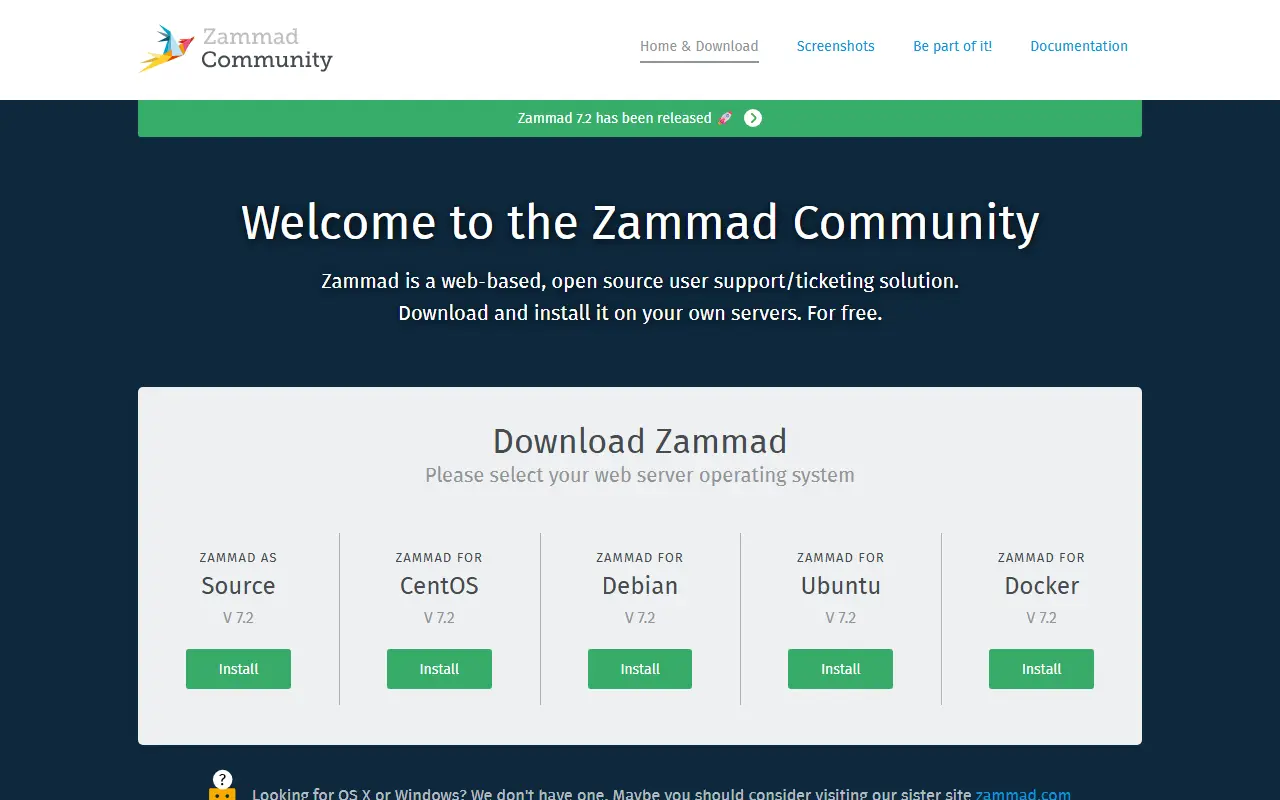
zammad.orgZammad homepage screenshot

Zammad is a browser-based helpdesk and customer support platform. Support teams use it to manage inquiries that arrive through email, chat, telephone and social media channels in a single ticket system, so conversations stay organized and the whole team can see what is happening.

The README stresses that the software is and will stay open source under the GNU AGPLv3. Ownership of the source code sits with the Zammad Foundation, an entity separate from commercial providers like Zammad GmbH, the company whose team does much of the development. The technology stack includes Ruby on Rails, GraphQL, TypeScript and Vue.

You can self-host Zammad on your own servers or buy hosting and support from the company behind it. It suits customer support, IT helpdesk and service teams that want an open-source ticketing system with multichannel support and control over where their data lives.

Key features

  • Multichannel tickets from email and chat
  • Telephone and social media channels
  • Web-based agent interface
  • GraphQL API and Vue front end
  • Independent Zammad Foundation owns the code
  • Self-hosted or vendor-hosted deployment

Pricing: The software is free under AGPLv3; hosting and support are offered by Zammad GmbH.

FreeScout

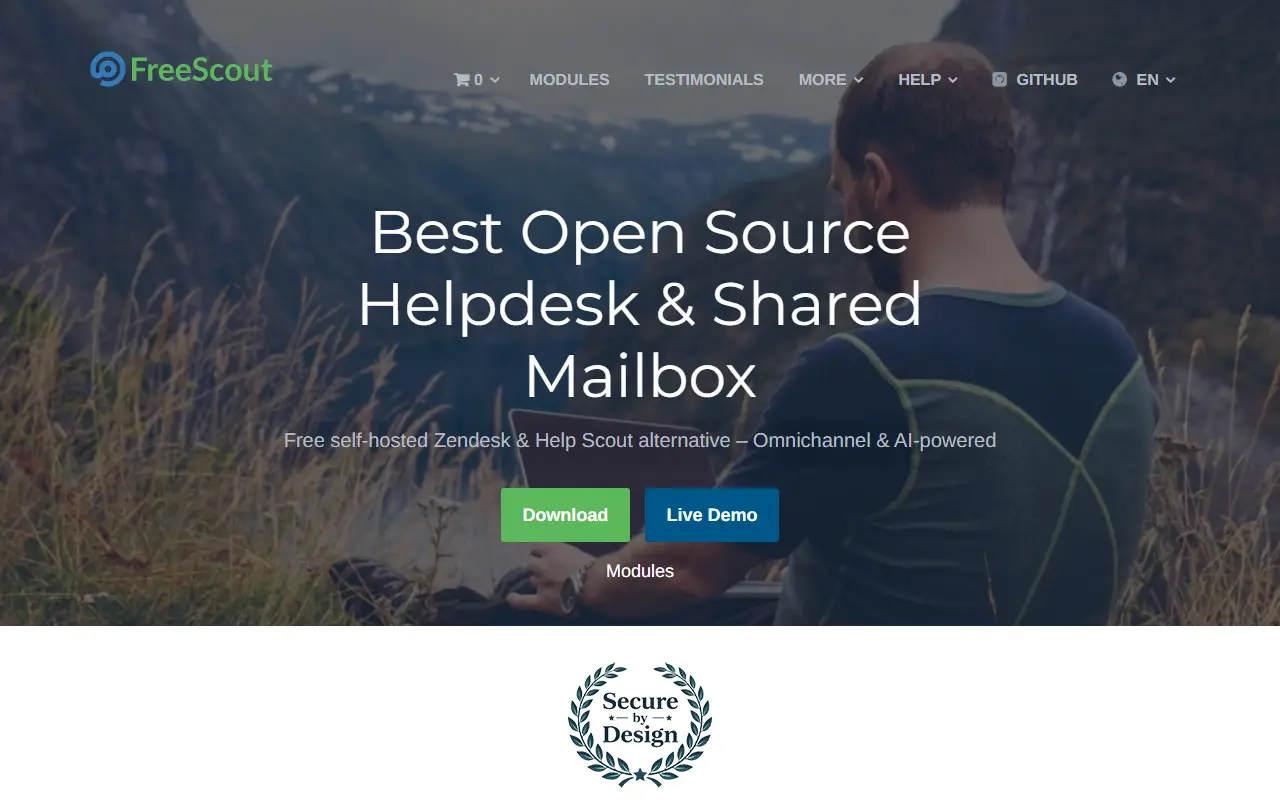
FreeScout is a free, self-hosted help desk and shared mailbox built on PHP and Laravel, positioned as an alternative to Zendesk and Help Scout.

GitHub stars
4.6k
Last commit
today
Latest release
1.8.243
Licence
AGPL-3.0
Self-hosted
Yes
freescout.netFreeScout homepage screenshot

FreeScout is a compact open-source help desk and shared inbox written in PHP on the Laravel framework. It lets support teams handle customer emails and conversations together, with tickets, shared mailboxes and an omnichannel approach, while keeping data on their own servers rather than in a vendor's cloud.

The README presents it as a free self-hosted alternative to Zendesk and Help Scout, developed from scratch without using any copyrighted material from either product. Its table of contents points to a demo, a feature list, mobile apps and system requirements, and the tagline mentions AI-powered assistance. Repository topics also name osTicket as a comparison point.

FreeScout is licensed under AGPL-3.0. Some optional add-on modules are sold separately by the project. It suits small and medium businesses, agencies and nonprofits that want a capable help desk without per-agent subscription fees and with full control over their data.

Key features

  • Shared mailbox and ticketing
  • Omnichannel customer conversations
  • AI-assisted helpdesk features
  • Mobile apps for agents
  • Self-hosted PHP and Laravel application
  • Alternative to Zendesk and Help Scout

Pricing: Free and open source under AGPL-3.0; some optional add-on modules are sold by the project.

Lowdefy

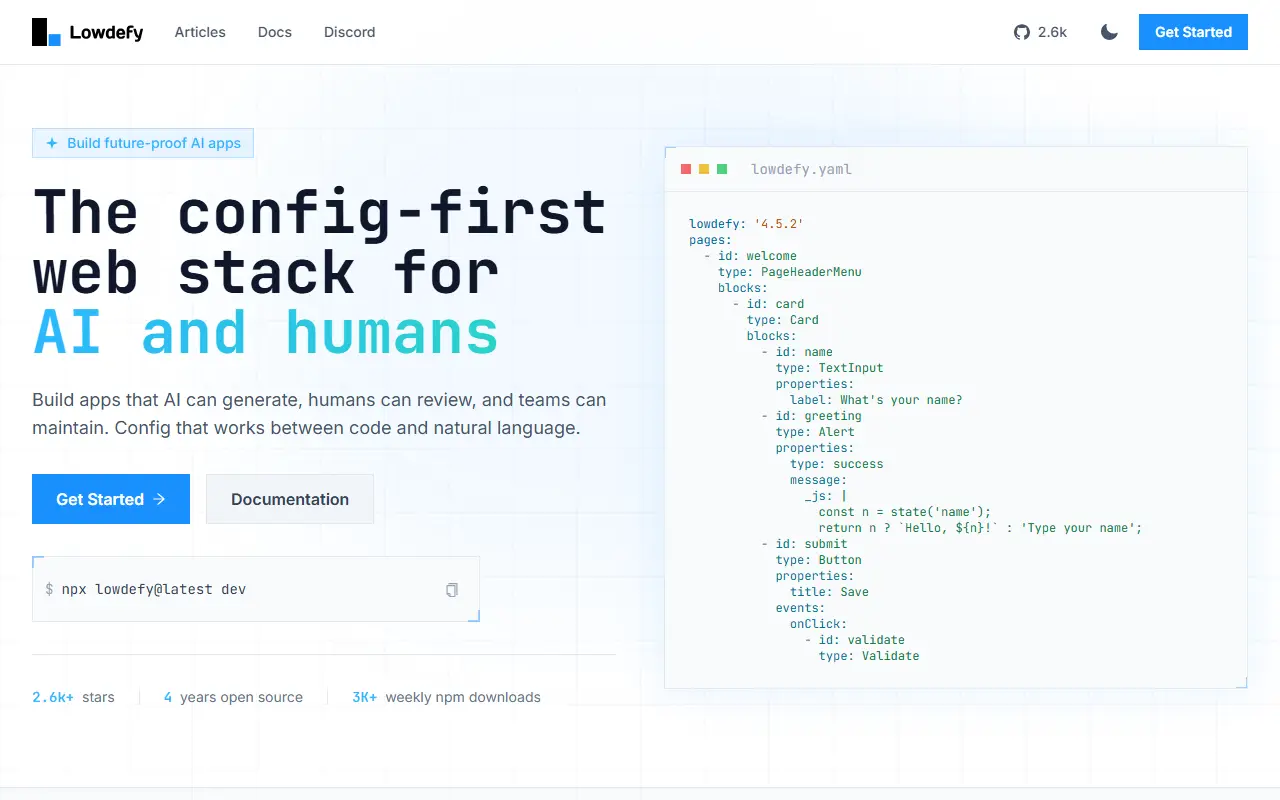
Config-first web stack for building internal tools, admin panels, and dashboards from YAML configuration instead of hand-written front-end code.

GitHub stars
3k
Last commit
today
Latest release
v6.1.0
Licence
Apache-2.0
Self-hosted
Yes
lowdefy.comLowdefy homepage screenshot

Lowdefy is an open-source framework for building web apps from configuration files rather than code. Its pitch is that concise, schema-validated config is easier for both people and AI tools to generate, review, and maintain than thousands of lines of generated React. It is released under the Apache-2.0 license.

Apps are described in YAML, and the runtime interprets the config instead of executing arbitrary code, with authentication, permissions, and data validation built in. The framework includes over 70 UI components such as forms, tables, charts, and markdown, more than 50 logic operators for dynamic behavior, and over 10 data connectors including MongoDB, PostgreSQL, MySQL, REST APIs, Google Sheets, and S3.

It is built on Hono, Vite, and Auth.js and can be deployed anywhere Node.js runs. A framework update upgrades every app at once, which the authors present as a maintenance benefit. It suits teams building CRUD apps, admin panels, dashboards, and workflow tools who want something between a low-code platform and a custom codebase.

Key features

  • YAML configuration instead of front-end code
  • 70+ built-in UI components
  • 50+ logic operators for dynamic pages
  • Connectors for MongoDB, PostgreSQL, MySQL, and REST
  • Built-in authentication and permissions
  • Deployable anywhere Node.js runs

Pricing: Free and open source under the Apache-2.0 license.

Libredesk

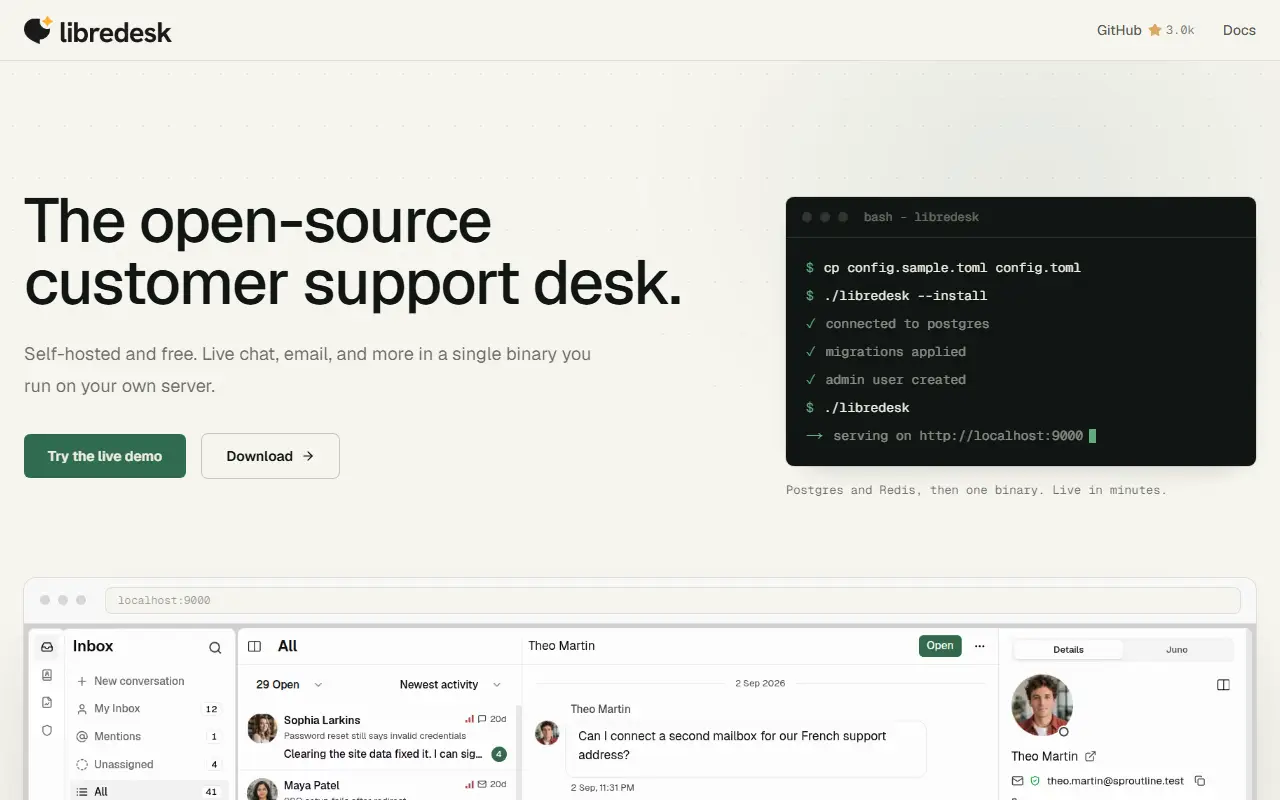
Self-hosted customer support desk shipped as a single binary, combining email, live chat, and WhatsApp in one shared inbox with a help center and AI features.

GitHub stars
3k
Last commit
4 days ago
Latest release
v2.8.0
Licence
AGPL-3.0
Self-hosted
Yes
libredesk.ioLibredesk homepage screenshot

Libredesk is an open-source customer support platform that you host yourself and run as one binary. It brings email, a live chat widget for your website, and WhatsApp conversations (connected through the Meta Cloud API) into a shared inbox, and positions itself as a lightweight alternative to Zendesk, Intercom, and Chatwoot. It is released under the AGPL-3.0 license.

Teams can organize conversations with tags, custom statuses and attributes, snoozing, and search. Automations tag, assign, and route conversations by rules, macros apply saved replies and actions in a single step, and auto-assignment distributes work by agent capacity. SLA management warns about conversations at risk of missing targets, and CSAT ratings and analytics track response times and resolution rates.

A multilingual help center publishes a searchable knowledge base, an AI assistant can answer chat questions from it and hand off to an agent, and an agent copilot drafts replies and summarizes threads. Roles with per-action permissions, OIDC single sign-on, activity logs, an API, and webhooks cover administration. It is written in Go and Vue and suits small and mid-sized support teams.

Key features

  • Shared inbox for email, live chat, and WhatsApp
  • Searchable multilingual help center
  • AI assistant and agent copilot
  • Automations, macros, and auto-assignment
  • SLA tracking and CSAT ratings
  • Role-based permissions and OIDC single sign-on
  • API and webhooks

Pricing: Free and open source under the AGPL-3.0 license; run it yourself as a single binary.

UnInbox

Email platform for teams that adds shared conversations, notes and a new-sender screener on top of existing email, positioned as an alternative to Hey, Front and Missive.

GitHub stars
1.8k
Last commit
7 mo ago
Hosted version
Available
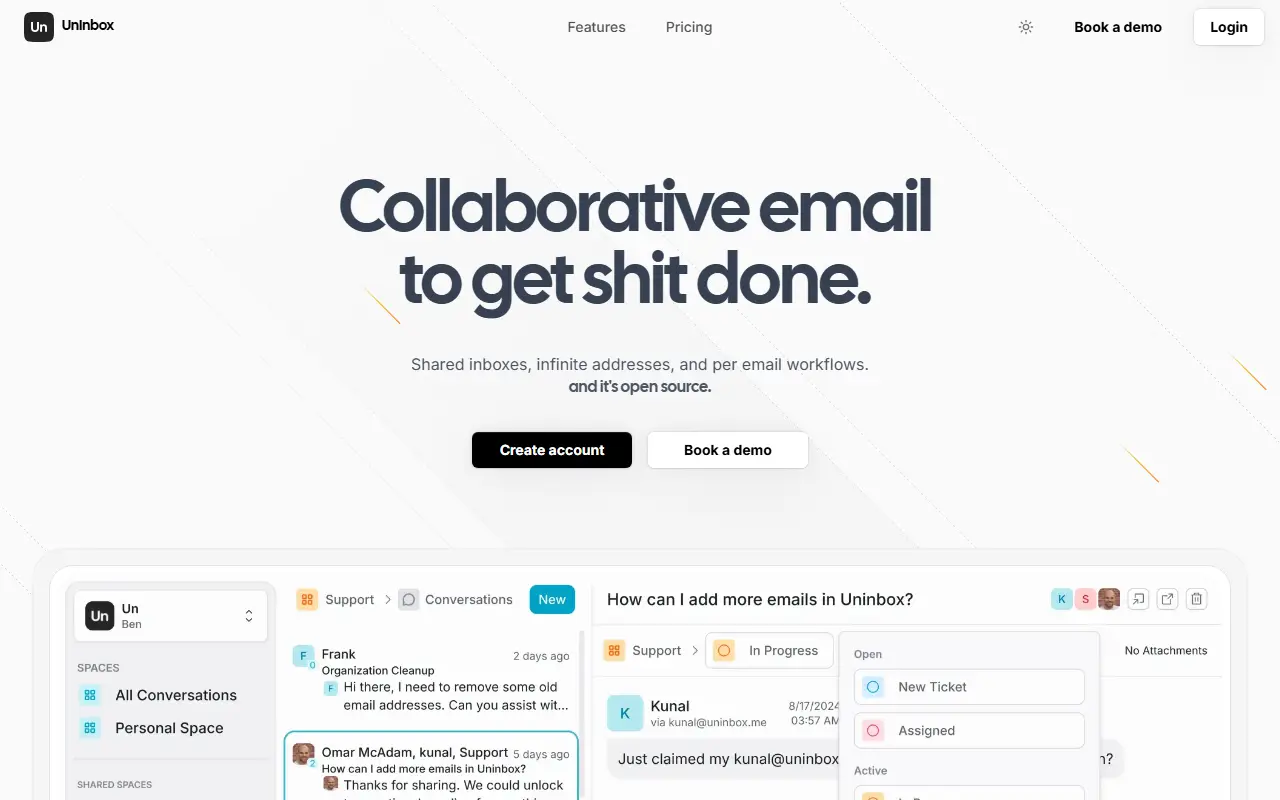
uninbox.comUnInbox homepage screenshot

UnInbox is an open-source communication platform that reimagines email for teams and professionals. Its README argues that email has changed little since the late 1970s while volume and noise have grown, so it builds a modern layer on top of email rather than trying to replace it. The project lists Hey, Front and Missive as products it is an alternative to.

Features described as native include team collaboration, conversation notes and a new-sender screener. It is built to work with your current email infrastructure or to replace it entirely, and the maintainers say email is only the start of a broader communication infrastructure. A hosted app is live at app.uninbox.com, and the team asks users to join its Discord for updates and feedback.

The stack is TypeScript with Next.js and React for the web app, Hono for the public API, Tailwind CSS and tRPC for type-safe APIs. The repository metadata lists the license as Other, so check the license file for the exact terms. It is positioned as open communication infrastructure that teams can build on.

Key features

  • Shared team conversations over email
  • Conversation notes for collaboration
  • New sender screener
  • Works with existing email infrastructure
  • Public API built with Hono
  • Type-safe tRPC architecture

Front alternatives: questions

What is the best open-source alternative to Front?
Chatwoot is the top-ranked open-source alternative to Front on Enlisted: An open-source omnichannel customer support desk with live chat, email and social inbox, an AI agent and a help center, positioned against Intercom and Zendesk. Other strong options are Zammad, FreeScout, Lowdefy and Libredesk.
Are these Front alternatives free?
All 6 are open source, so the code is free to use under its licence, and all of them can be self-hosted on your own server or computer. 3 also offer a paid or managed cloud version if you'd rather not host it yourself.
How is this list of Front alternatives ranked?
By a score built from GitHub stars, star growth over the last 30 days and how recently the code changed. 5 of these projects shipped code in the last 30 days. Data is refreshed daily, and nobody can pay to move up.

People also look for alternatives to…

View all