 TrackMedia
 TrackRev

 Sinequa
 Jina AI
 Amazon Kendra
 Vectara
 kapa.ai
 Cohere
 DataStax Astra DB
 IBM Watson Discovery
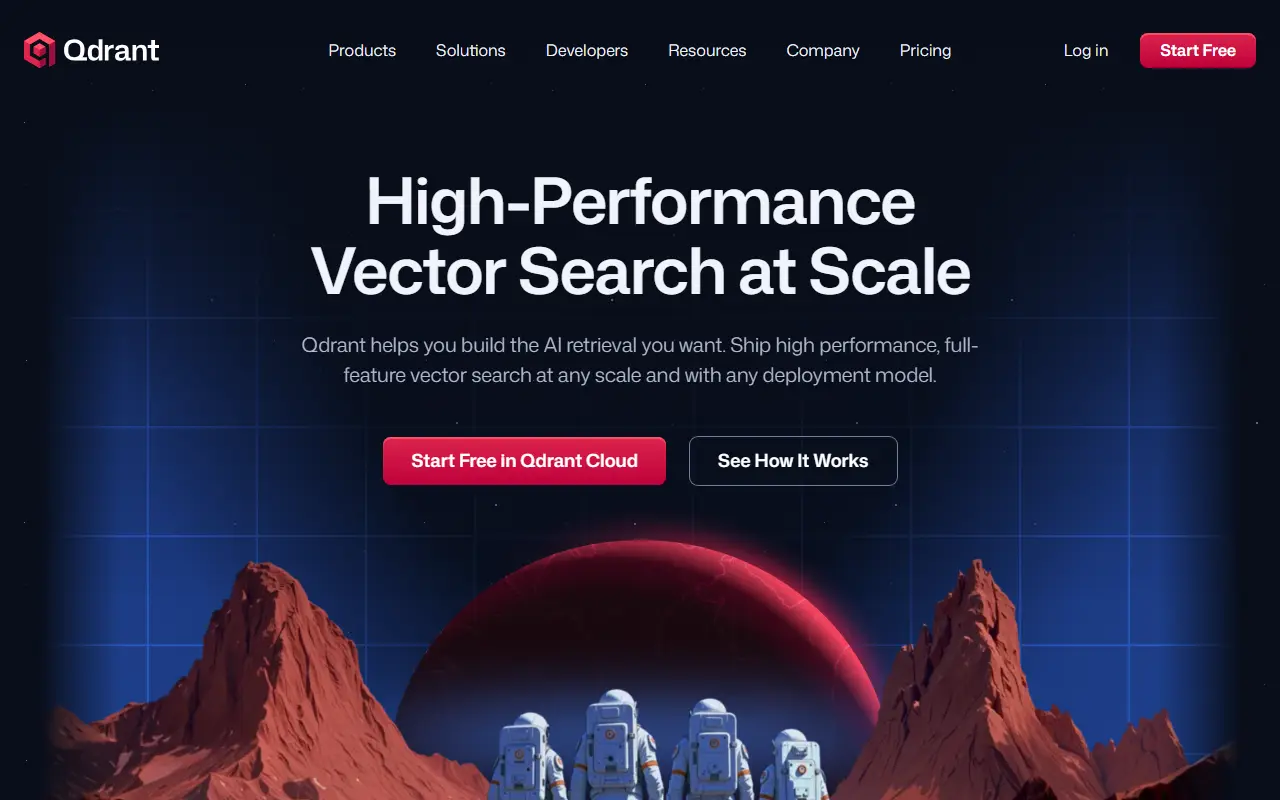
About Qdrant
Qdrant is a vector database and similarity search engine. It stores points, which are vectors plus an attached payload, and exposes an API to store, search and manage them. That makes it a building block for semantic search, recommendations, image search and other applications that rely on embeddings from neural networks.
A key selling point is extended filtering support, so a vector query can be combined with conditions on the payload, which is useful for faceted search and matching. The engine is written in Rust and the maintainers point to benchmarks for its speed and reliability under load. Topics mention HNSW indexing and nearest-neighbor search, and there are client libraries, demo projects, integrations and a collection of agent skills that bring vector search into AI coding assistants.
Qdrant is Apache-2.0 licensed and can run on your own infrastructure. It is also available as the fully managed Qdrant Cloud, which includes a free tier. Teams building retrieval-augmented generation, recommendation and similarity features use it as the storage and retrieval layer for their embeddings.
Key features
- Vector storage with attached payloads
- Filtering combined with vector search
- HNSW-based nearest-neighbor search
- REST-style API with client libraries
- Agent skills for AI coding assistants
- Self-hosted or managed Qdrant Cloud
Good fit for
- Semantic search over documents
- Recommendation and similarity features
- Retrieval layer for RAG applications
Qdrant: questions and answers
- What is Qdrant used for?
- Qdrant is a vector database and similarity search engine written in Rust, offering filtering over stored vectors and payloads, available self-hosted or as Qdrant Cloud. It is a good fit for semantic search over documents, recommendation and similarity features, and retrieval layer for RAG applications.
- Is Qdrant open source?
- Yes. Qdrant is open source under the Apache-2.0 licence. Its source code is on GitHub at qdrant/qdrant and is written mainly in Rust.
- Is Qdrant free?
- Yes. Qdrant is open source, so the software itself is free to use. A managed cloud version is also available.
- Can I self-host Qdrant?
- Yes. Qdrant can be self-hosted on your own server or infrastructure.
- What is Qdrant an alternative to?
- Qdrant is an open-source alternative to Pinecone, Glean, Upstash and Azure AI Search. Other open-source alternatives to Pinecone include Weaviate, Milvus and Chroma.
- Is Qdrant actively maintained?
- Yes. The most recent commit to Qdrant was on 13 November 2026, and the latest release is v1.20.1, published on 13 November 2026. The project has 36k stars on GitHub, with 482 added in the last 30 days.
Open-source alternatives to Qdrant
See all
Weaviate
Databases
Weaviate is an open-source vector database that stores both objects and vectors, allowing
OSSvs Pinecone★ 17k
Milvus
Databases
Milvus is a high-performance, cloud-native vector database built for scalable vector ANN s
Apache-2.0vs Pinecone★ 47k
Meilisearch
Search
A lightning-fast search engine API bringing AI-powered hybrid search to your sites and app
OSSvs Algolia★ 60k
Typesense
Search
Typesense is an open-source search engine for fast, typo-tolerant site and app search, wit
GPL-3.0vs Algolia★ 27k
Apache Solr
Search
Apache Solr open-source search software
Apache-2.0vs Elastic★ 1.7k
Chroma
Databases
Search infrastructure for AI
Apache-2.0vs Pinecone★ 30k
SaaS alternatives to Qdrant
See all
Pinecone
Databases
Managed vector database for semantic search and retrieval apps
SaaS
Glean
Search
Enterprise AI search and assistant across a company's connected work apps
SaaS
Upstash
Databases
Serverless Redis, Kafka and vector database with per-request pricing
SaaS
Azure AI Search
Search
Azure managed search with full-text, vector and hybrid retrieval
SaaS
Exa
Search
Search API that returns web pages by meaning, built for AI applications
SaaS
Klevu
Search
AI-powered ecommerce site search and merchandising
SaaS