#1
A vector database and similarity search engine written in Rust, offering filtering over stored vectors and payloads, available self-hosted or as Qdrant Cloud.
- GitHub stars
- 36k
- Last commit
- today
- Latest release
- v1.20.0
- Licence
- Apache-2.0
- Self-hosted
- Yes
- Hosted version
- Available
qdrant.tech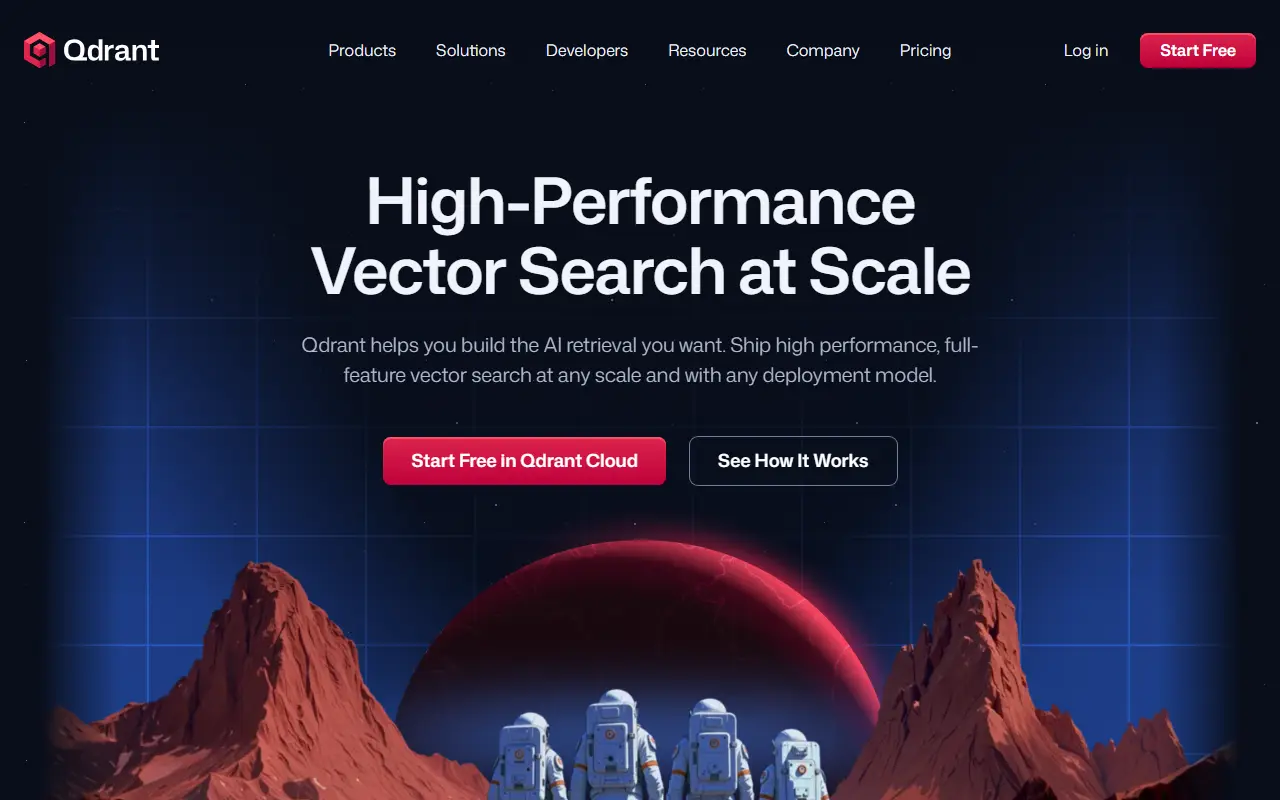
Qdrant is a vector database and similarity search engine. It stores points, which are vectors plus an attached payload, and exposes an API to store, search and manage them. That makes it a building block for semantic search, recommendations, image search and other applications that rely on embeddings from neural networks.
A key selling point is extended filtering support, so a vector query can be combined with conditions on the payload, which is useful for faceted search and matching. The engine is written in Rust and the maintainers point to benchmarks for its speed and reliability under load. Topics mention HNSW indexing and nearest-neighbor search, and there are client libraries, demo projects, integrations and a collection of agent skills that bring vector search into AI coding assistants.
Qdrant is Apache-2.0 licensed and can run on your own infrastructure. It is also available as the fully managed Qdrant Cloud, which includes a free tier. Teams building retrieval-augmented generation, recommendation and similarity features use it as the storage and retrieval layer for their embeddings.
Key features
- Vector storage with attached payloads
- Filtering combined with vector search
- HNSW-based nearest-neighbor search
- REST-style API with client libraries
- Agent skills for AI coding assistants
- Self-hosted or managed Qdrant Cloud
Pricing: A free-forever cloud tier is available. The Standard tier is usage-based, from $25; Premium requires a minimum spend and Hybrid and Private Cloud are quoted by the team.
#2
An open-source, cloud-native vector database for scalable similarity search over embeddings, with distributed, standalone and lightweight Python modes.
- GitHub stars
- 47k
- Last commit
- yesterday
- Latest release
- v3.0.6
- Licence
- Apache-2.0
- Self-hosted
- Yes
- Hosted version
- Available
milvus.io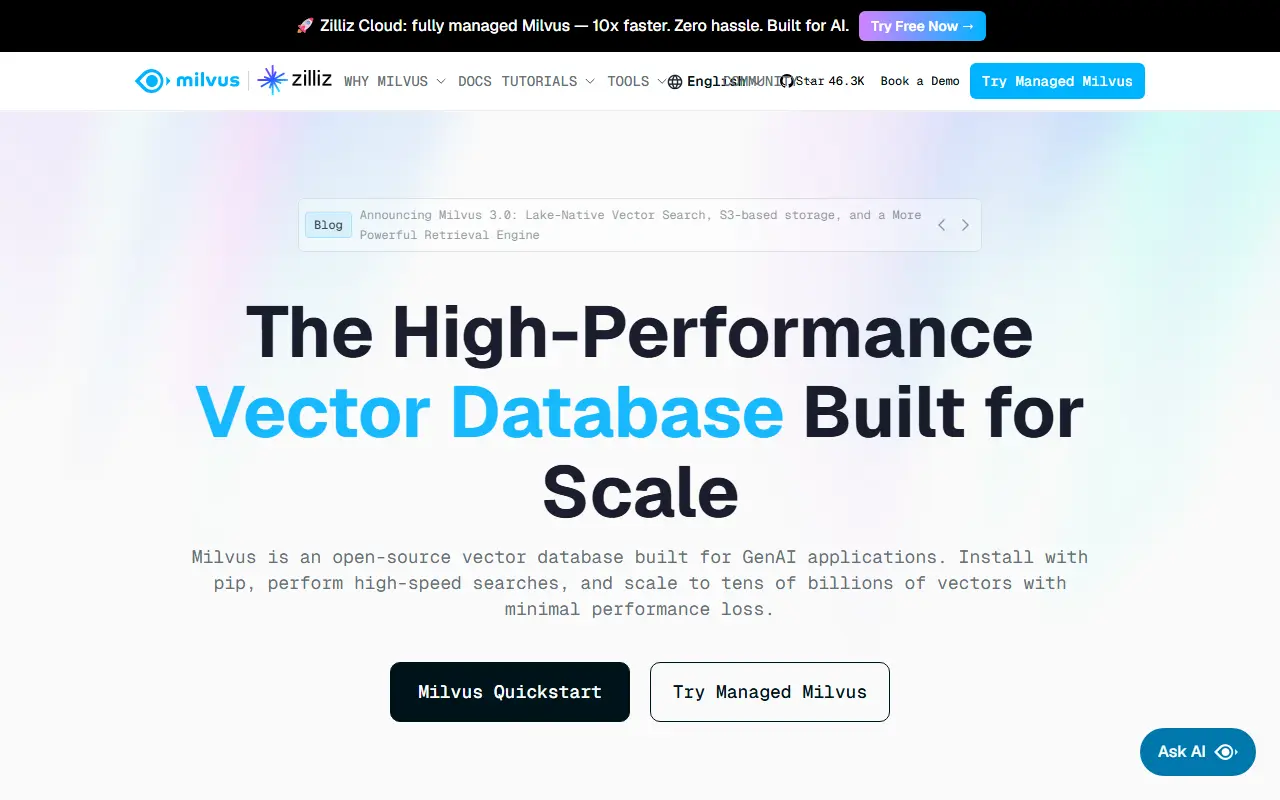
Milvus is an open-source vector database designed to scale. It supports AI applications by handling large volumes of unstructured data, including text, images and mixed-media content. It is written in Go and C++ with hardware acceleration for CPUs and GPUs, and it is released under the Apache-2.0 license.
The architecture is fully distributed and Kubernetes-native, so it can scale out horizontally while staying current through streaming updates in real time. Smaller deployments are covered too: a Standalone mode runs on a single machine, and Milvus Lite is a lightweight version installed with pip for quick starts in Python. The pymilvus SDK and its MilvusClient are used to create collections, ingest data and run vector searches.
Milvus can be self-hosted, or consumed as a managed service through Zilliz Cloud, which offers Serverless, Dedicated and bring-your-own-cloud options. The project is hosted by the LF AI & Data Foundation, with Zilliz as its major contributor. It suits teams building retrieval-augmented generation, semantic search and recommendation systems.
Key features
- Vector similarity search over embeddings
- Distributed, Kubernetes-native architecture
- Standalone mode for single machines
- Milvus Lite for quick Python starts
- Real-time streaming updates
- CPU and GPU hardware acceleration
Pricing: Open source under Apache 2.0; Zilliz Cloud offers a managed service with Serverless, Dedicated and BYOC options.
#3
Open-source search infrastructure for AI that stores embeddings and supports vector, hybrid and full-text search, with a small API and a hosted Chroma Cloud.
- GitHub stars
- 30k
- Last commit
- 6 days ago
- Latest release
- 1.5.9
- Licence
- Apache-2.0
- Self-hosted
- Yes
- Hosted version
- Available
trychroma.com
Chroma is open-source data infrastructure for AI applications, centered on storing embeddings and searching them. It supports vector search, hybrid search and full-text search, and its core API is deliberately small, only four functions, so developers can add retrieval to an app quickly. The engine is written in Rust and clients are available through PyPI and npm packages.
For hosting, Chroma Cloud is the company's serverless managed service, which it describes as fast, cost-effective and scalable, and new users can create a database and try it with free starting credits. You can also run Chroma yourself. The project is developing rapidly, and the maintainers release new tagged versions of the Python and npm packages on Mondays, with hotfixes shipped whenever needed.
Chroma is Apache-2.0 licensed. Contributors can join the Discord contributing channel, review the roadmap and pick up good-first issues. Developers use it in retrieval-augmented generation setups, agent memory and semantic search features where they want an easy, embedded-friendly vector store.
Key features
- Vector, hybrid and full-text search
- Small four-function core API
- Python and JavaScript clients
- Serverless Chroma Cloud service
- Rust core engine
- Weekly tagged releases
Pricing: Chroma Cloud's Starter plan is $0 per month plus usage, with $5 in free credits. Team is $250 per month plus usage with $100 in credits; Enterprise is custom.
#4
An embedded retrieval library and vector database for multimodal AI, built on the Lance columnar format with vector, full-text and SQL search.
- GitHub stars
- 12k
- Last commit
- today
- Latest release
- v0.41.0
- Licence
- Apache-2.0
- Self-hosted
- Yes
- Hosted version
- Available
lancedb.com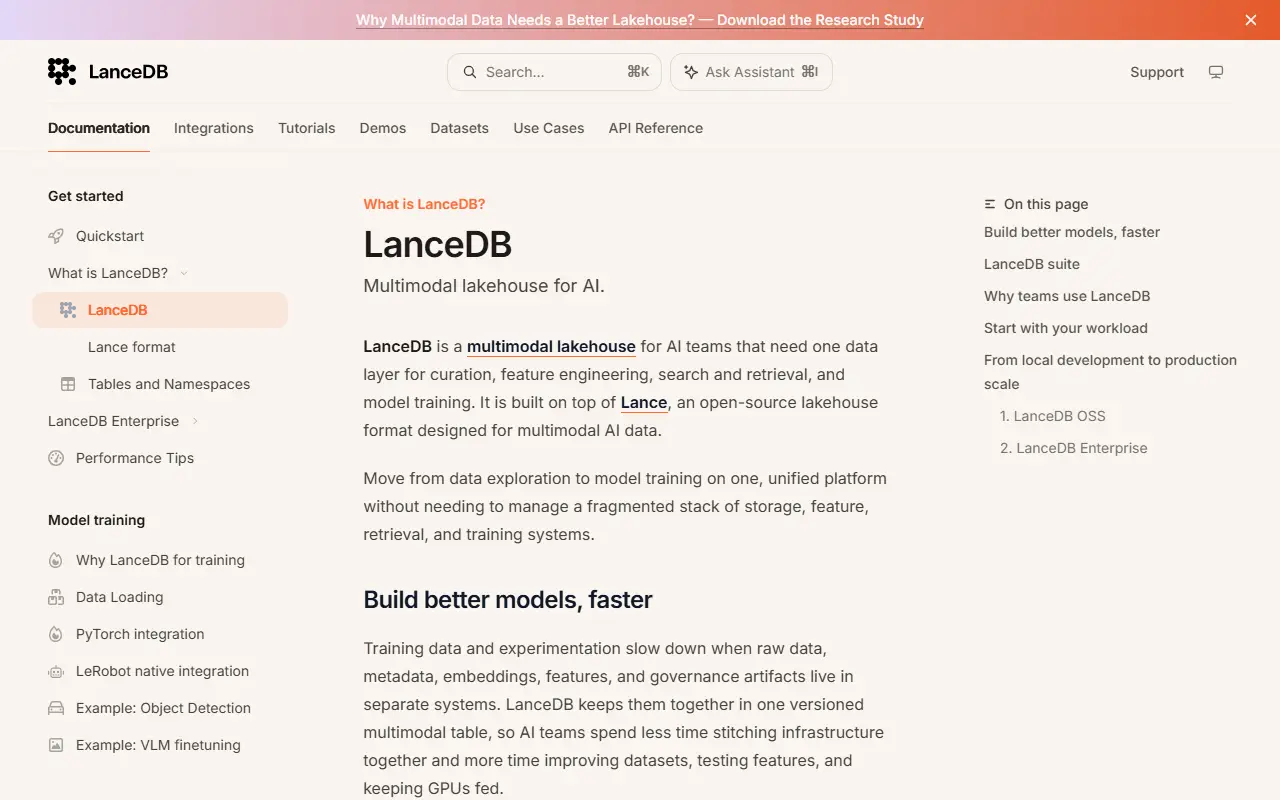
LanceDB is an open-source retrieval library and vector database for AI and machine learning applications. It is built on the Lance columnar format and lets developers store, index and search vectors alongside metadata and multimodal data such as text, images, video and point clouds.
Search options include vector similarity, full-text search and SQL, with features such as zero-copy access, automatic versioning of data without extra infrastructure, and GPU support when building vector indexes. It offers Python, Node.js, Rust and REST APIs, with native Python and JavaScript or TypeScript support, and integrates with LangChain, LlamaIndex, Apache Arrow, Pandas, Polars and DuckDB.
The open-source library is Apache-2.0 licensed, runs locally or in your own cloud and is written in Rust, with an embedded design that needs no separate server for simple setups. A separate cloud and enterprise offering runs vector search at production scale without any servers for you to manage. LanceDB suits developers building semantic search, recommendation and retrieval pipelines for AI applications.
Key features
- Vector similarity search
- Full-text search and SQL queries
- Multimodal data storage
- Automatic data versioning
- GPU-assisted vector index building
- Python, Node.js, Rust and REST APIs
- Integrations with LangChain and LlamaIndex
Pricing: Open source under Apache-2.0; a separate cloud and enterprise offering is available.
#5
A cloud-native vector database that stores objects and embeddings and combines semantic search with keyword filtering, RAG and reranking in one query interface.
- GitHub stars
- 17k
- Last commit
- yesterday
- Latest release
- v1.40.5
- Self-hosted
- Yes
- Hosted version
- Available
weaviate.io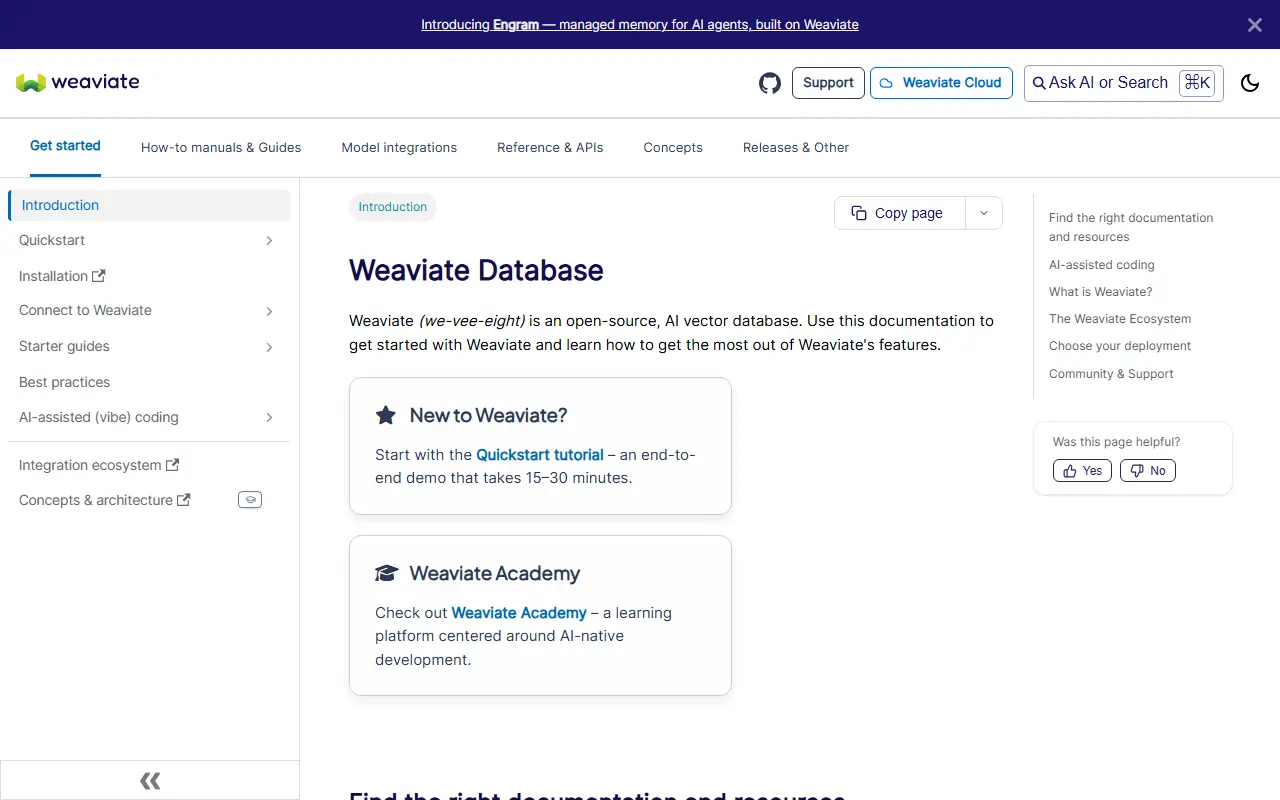
Weaviate is a vector database that stores both data objects and their vector embeddings, enabling semantic search at scale. One query interface can blend vector similarity search, keyword filtering, retrieval-augmented generation and reranking, and it is written in Go as a cloud-native system.
Common applications are RAG pipelines, semantic and image search, recommenders, chatbots and content classification. Vectors can be created automatically on import by integrated models from providers such as OpenAI, Cohere and Hugging Face, or you can import pre-computed embeddings. For production, it offers built-in multi-tenancy, replication and role-based access control. Topics reference approximate nearest neighbor search and HNSW indexing.
Weaviate can be deployed with Docker, on Kubernetes, or through the managed Weaviate Cloud, with guides for AWS and GCP, and the documentation includes quickstarts for both cloud and a local Docker instance. Its license is listed as 'Other' on GitHub, so check the repository terms. It suits teams building AI applications that need a scalable store for embeddings alongside structured filters.
Key features
- Stores objects and vectors together
- Hybrid vector and keyword search
- Integrated vectorizer models or bring your own
- Multi-tenancy and replication
- Role-based access control
- Docker, Kubernetes and Weaviate Cloud options

SvelteKit chat interface for large language models that connects to any OpenAI-compatible API and powers HuggingChat.
- GitHub stars
- 11k
- Last commit
- yesterday
- Latest release
- v0.10.0
- Licence
- Apache-2.0
- Self-hosted
- Yes
- Hosted version
- Available
huggingface.co
Chat UI is a chat interface for LLMs built as a SvelteKit application. It is the open source codebase behind HuggingChat on Hugging Face and lets you run a similar conversational front end against models you choose, whether hosted or running locally.
The current version speaks only to OpenAI-compatible APIs, configured through a base URL and a models endpoint. The README lists the Hugging Face Inference Providers router, a llama.cpp server, Ollama through its OpenAI-compatible bridge, OpenRouter and Poe as example backends. Older provider-specific integrations were removed from the main branch but remain available on a legacy branch.
Setup involves creating an .env.local file with the endpoint and key, choosing a database option, and launching the app, with an optional Docker image. The project is written in TypeScript with Tailwind CSS and is licensed under Apache-2.0, making it a base for self-hosted assistants.
Key features
- Chat front end for any OpenAI-compatible API
- Works with llama.cpp, Ollama and OpenRouter
- Hugging Face Inference Providers support
- Configured through a simple .env.local file
- Optional Docker image
- SvelteKit and Tailwind CSS codebase
Pricing: Free and open source under the Apache-2.0 license.
#7
Wigolo gives AI coding agents local-first web search, fetch, crawl and research tools over MCP, with no API keys or cloud accounts required.
- GitHub stars
- 5.5k
- Last commit
- yesterday
- Latest release
- v0.3.1
- Self-hosted
- Yes
wigolo.app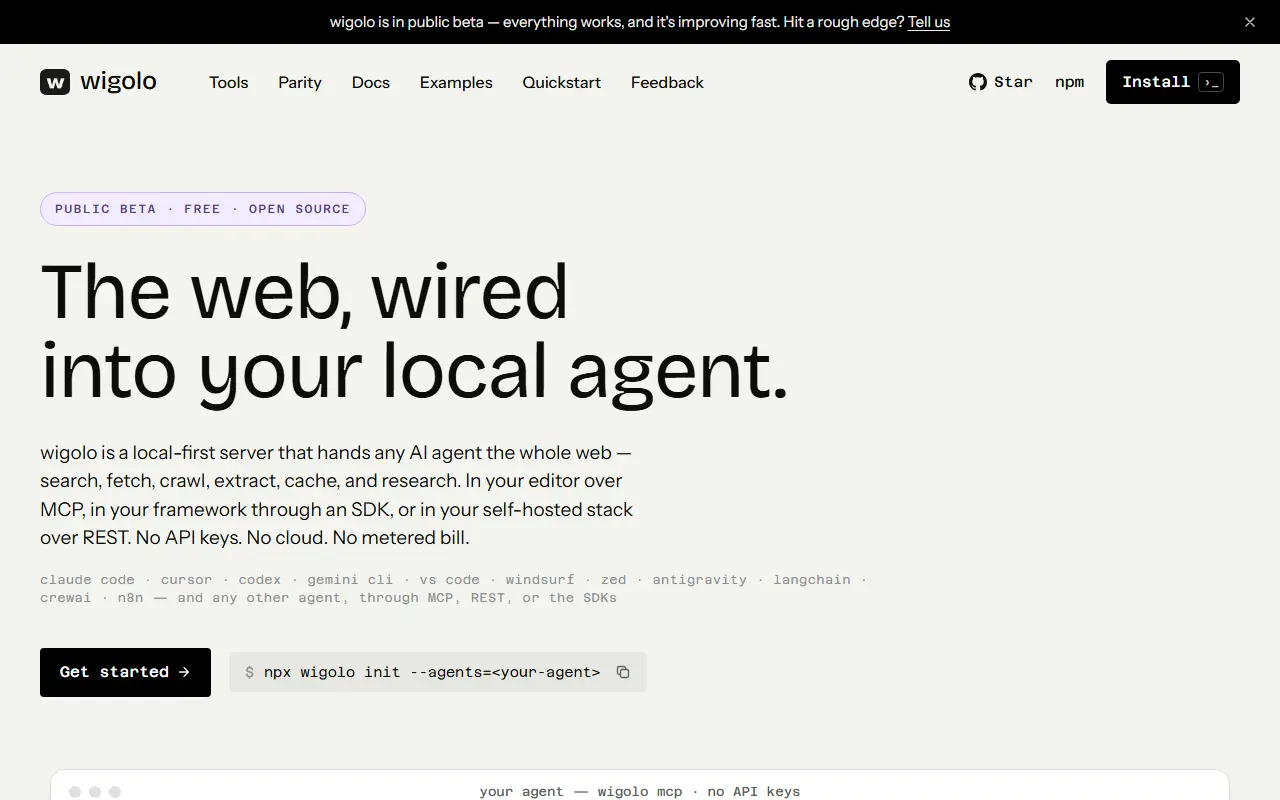
Wigolo is a local-first web access layer for AI agents. It exposes search, page fetching, crawling and research capabilities over the Model Context Protocol, so a coding agent can look things up on the web without you buying a search API key or sending queries through a metered cloud service.
The README says it works with a long list of clients, including Claude Code, Cursor, Codex and Gemini CLI as well as OpenCode, Windsurf, Zed and VS Code, and with frameworks such as LangChain, CrewAI, LlamaIndex, the Vercel AI SDK and n8n, plus any MCP client or plain REST. Repository topics describe it as a metasearch and web crawler and name Exa, Firecrawl and Tavily as the services it stands in for. The project is in public beta.
Wigolo is written in TypeScript and its license is listed as 'Other' on GitHub, so read the licensing section before commercial use. It runs on your own machine. It suits developers who want agent-ready web search that is private and free of per-query costs.
Key features
- Local web search over MCP
- Page fetching and crawling for agents
- Research workflows with no API keys
- Works with Claude Code, Cursor and Codex
- REST access for non-MCP clients
- Metasearch across multiple engines
Pricing: Runs locally with no per-query fees; check the repository for license terms.
#8
Marqo is an AI-native ecommerce search and discovery platform, with an open-source multi-modal search engine repository maintained alongside it.
- GitHub stars
- 5k
- Last commit
- 2 mo ago
- Latest release
- 2.26.0
- Licence
- Apache-2.0
- Self-hosted
- Yes
- Hosted version
- Available
marqo.ai
Marqo builds AI-native search and product discovery for online brands in categories such as fashion, beauty, electronics and home goods. Using semantic search and personalization, it learns from browsing clicks, orders and other events to infer what shoppers want and return relevant search results and recommendations.
The vendor says its platform helps commerce teams improve search relevance, raise conversion and order value, and reduce manual merchandising through automated ranking and optimization. The repository also hosts the open-source search engine project, with topics covering multi-modal search and machine learning. A notice at the top of the README clarifies the status of the open-source project relative to the commercial platform, so read it before adopting the code.
The code is written in Python under the Apache-2.0 license. You can run the open-source engine yourself, or buy the managed ecommerce platform from the vendor. It suits online retailers and developers evaluating vector search for product catalogs.
Key features
- Semantic product search
- Personalized search results and recommendations
- Clickstream and purchase data learning
- Automated ranking and merchandising
- Multi-modal search support
- Open-source engine in Python

Trieve is an MIT-licensed platform that provides search, recommendations, RAG and analytics through an API, with self-hosting guides.
- GitHub stars
- 2.7k
- Last commit
- 9 mo ago
- Latest release
- trieve-helm-0.2.2
- Licence
- MIT
- Self-hosted
- Yes
- Hosted version
- Available
Trieve bundles search, recommendations, retrieval-augmented generation and analytics behind an API. It is written in Rust and licensed under MIT, with TypeScript and Python SDKs and an OpenAPI specification listed in the README.
Search options include semantic dense-vector search using OpenAI or Jina embeddings with Qdrant, typo-tolerant neural sparse-vector search, hybrid search with cross-encoder re-ranking, sub-sentence highlighting, recency biasing, filtering by date range, tag and numeric values, and grouping of chunks by file.
The README describes self-hosting in your own VPC or on-prem, with guides for AWS, GCP, Kubernetes and Docker Compose. RAG routes connect to OpenRouter for model access, and you can bring your own embedding, SPLADE, re-ranking or language models. A hosted sign-up with 1k chunks free is also linked.
Key features
- Semantic dense vector search with Qdrant
- Typo-tolerant neural search
- Hybrid search with cross-encoder re-ranking
- Recommendations API for similar chunks
- RAG routes via OpenRouter
- Bring your own models
- Grouping chunks to search at file level
Jina AI alternatives: questions
- What is the best open-source alternative to Jina AI?
- Qdrant is the top-ranked open-source alternative to Jina AI on Enlisted: A vector database and similarity search engine written in Rust, offering filtering over stored vectors and payloads, available self-hosted or as Qdrant Cloud. Other strong options are Milvus, Chroma, LanceDB and Weaviate.
- What are the best commercial alternatives to Jina AI?
- Voyage AI, Serper, Tavily, Brave Search API and Exa are among the hosted, closed-source alternatives to Jina AI listed on Enlisted, which lists 23 in total. Compare their pricing and features on each tool page.
- Are these Jina AI alternatives free?
- All 9 are open source, so the code is free to use under its licence, and all of them can be self-hosted on your own server or computer. 8 also offer a paid or managed cloud version if you'd rather not host it yourself.
- How is this list of Jina AI alternatives ranked?
- By a score built from GitHub stars, star growth over the last 30 days and how recently the code changed. 7 of these projects shipped code in the last 30 days. Data is refreshed daily, and nobody can pay to move up.
 TrackMedia
 TrackRev