
About Chroma
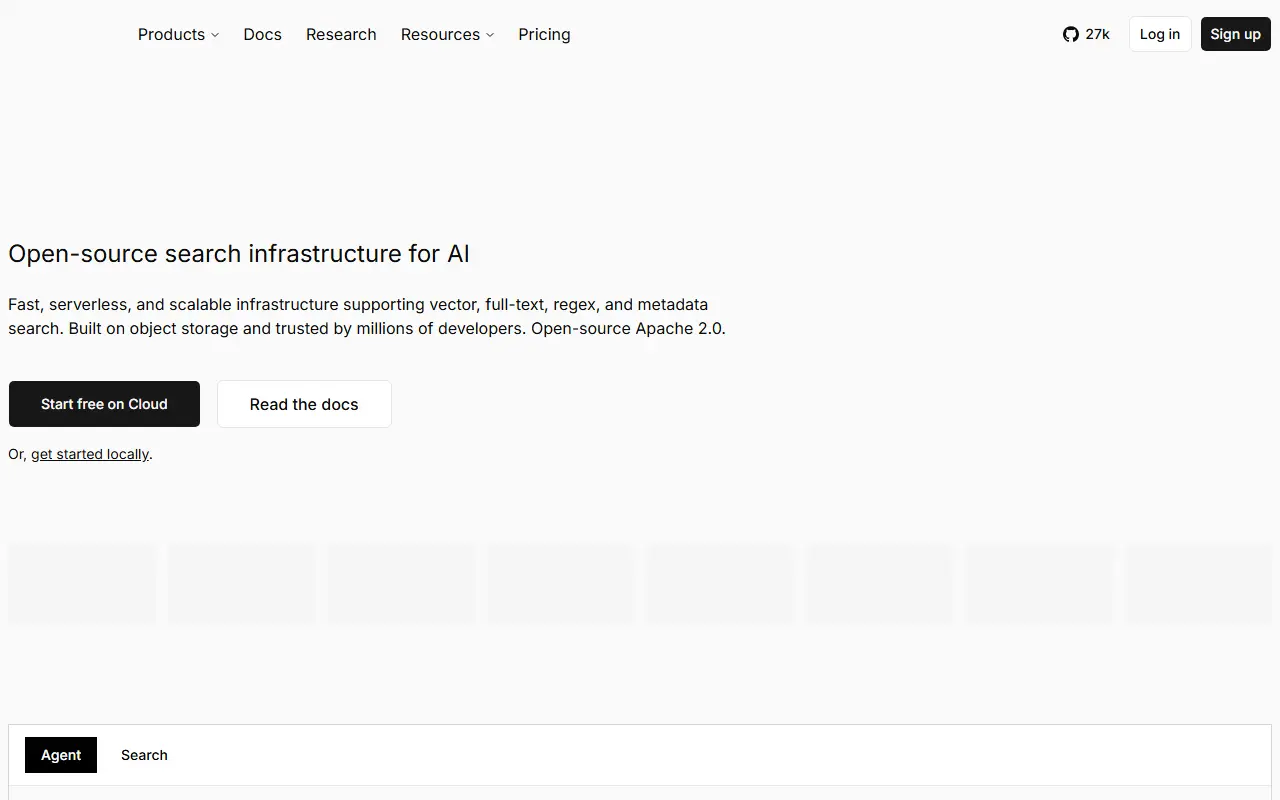
Chroma is open-source data infrastructure for AI applications, centered on storing embeddings and searching them. It supports vector search, hybrid search and full-text search, and its core API is deliberately small, only four functions, so developers can add retrieval to an app quickly. The engine is written in Rust and clients are available through PyPI and npm packages.
For hosting, Chroma Cloud is the company's serverless managed service, which it describes as fast, cost-effective and scalable, and new users can create a database and try it with free starting credits. You can also run Chroma yourself. The project is developing rapidly, and the maintainers release new tagged versions of the Python and npm packages on Mondays, with hotfixes shipped whenever needed.
Chroma is Apache-2.0 licensed. Contributors can join the Discord contributing channel, review the roadmap and pick up good-first issues. Developers use it in retrieval-augmented generation setups, agent memory and semantic search features where they want an easy, embedded-friendly vector store.
Key features
- Vector, hybrid and full-text search
- Small four-function core API
- Python and JavaScript clients
- Serverless Chroma Cloud service
- Rust core engine
- Weekly tagged releases
Good fit for
- →Retrieval layer for RAG applications
- →Memory store for AI agents
- →Semantic search in prototypes and products
- Built with
- Rust
- Tags
- vector-database
- embeddings
- ai
- rag
- search
- rust
- agents
- semantic-search
Chroma: questions and answers
- What is Chroma used for?
- Chroma is open-source search infrastructure for AI that stores embeddings and supports vector, hybrid and full-text search, with a small API and a hosted Chroma Cloud. It is a good fit for retrieval layer for RAG applications, memory store for AI agents, and semantic search in prototypes and products.
- Is Chroma open source?
- Yes. Chroma is open source under the Apache-2.0 licence. Its source code is on GitHub at chroma-core/chroma and is written mainly in Rust.
- Is Chroma free?
- Yes. Chroma is open source, so the software itself is free to use. A managed cloud version is also available.
- Can I self-host Chroma?
- Yes. Chroma can be self-hosted on your own server or infrastructure.
- What is Chroma an alternative to?
- Chroma is an open-source alternative to Pinecone. Other open-source alternatives to Pinecone include Qdrant, Weaviate and Milvus.
- Is Chroma actively maintained?
- Yes. The most recent commit to Chroma was on 2 October 2026, and the latest release is 1.5.9, published on 5 May 2026. The project has 29k stars on GitHub.
Open-source alternatives to Chroma
See all
Qdrant
Databases
Qdrant - High-performance, massive-scale Vector Database and Vector Search Engine for the
Apache-2.0vs Pinecone★ 35k
Weaviate
Databases
Weaviate is an open-source vector database that stores both objects and vectors, allowing
OSSvs Pinecone★ 17k
Milvus
Databases
Milvus is a high-performance, cloud-native vector database built for scalable vector ANN s
Apache-2.0vs Pinecone★ 46k
LanceDB
Databases
Developer-friendly OSS embedded retrieval library for multimodal AI. Search More; Manage L
Apache-2.0vs Pinecone★ 12k
NucliaDB
Databases
NucliaDB, The AI Search database for RAG
OSSvs Pinecone★ 722
Epsilla VectorDB
Databases
A high performance Vector Database leveraging parallel graph computing
GPL-3.0vs Pinecone★ 875
SaaS alternatives to Chroma
See all
Pinecone
Databases
Managed vector database for semantic search and retrieval apps
SaaS
DataStax Astra DB
Databases
Cassandra-based serverless database with vector search for AI applications
SaaS
Upstash
Databases
Serverless Redis, Kafka and vector database with per-request pricing
SaaS
Aerospike
Databases
Real-time NoSQL database for low-latency, high-throughput applications
SaaS
Azure Cosmos DB
Databases
Microsoft globally distributed multi-model NoSQL database
SaaS
EDB Postgres AI
Databases
Enterprise PostgreSQL distribution, managed service and tooling from EnterpriseDB
SaaS