
About NucliaDB
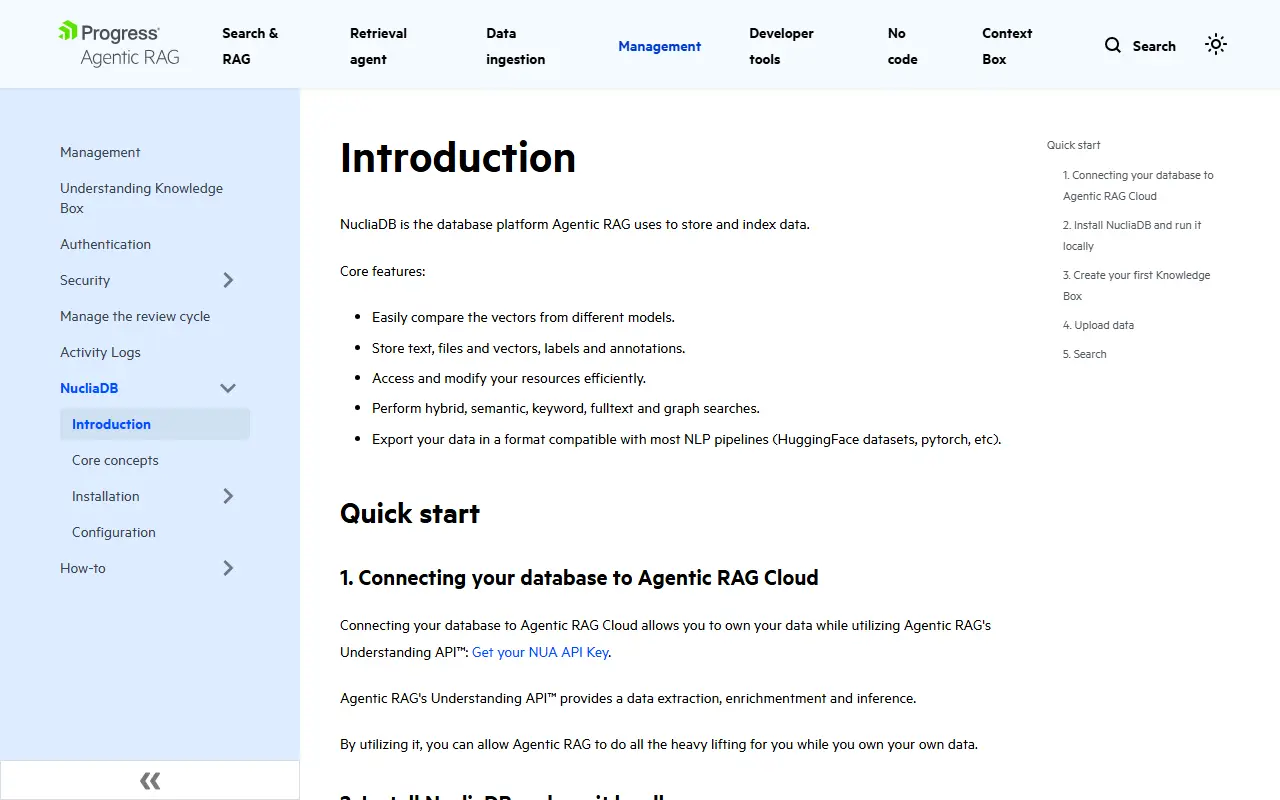
NucliaDB, from Nuclia, is a database for storing and searching unstructured data, described as an AI search database for retrieval-augmented generation. It works as an out-of-the-box hybrid search engine that combines vector, full-text and graph indexes, and it was designed to index large datasets with multi-tenant support.
It stores text, files, vectors, labels and annotations in resources with multiple fields and metadata, with field types for text, files, links and conversations. Users can run keyword searches and semantic searches over vectors, export data in formats suited to NLP pipelines such as Hugging Face datasets, and apply role-based security with upstream proxy authentication. The storage layer uses PostgreSQL, with blob support through S3-compatible storage, Google Cloud Storage or Azure Blob Storage, plus index replication and distributed search.
NucliaDB can also connect to Nuclia's cloud APIs, the Understanding API for data and insight extraction and the Learning API for training models. The core is written in Rust and Python, and its license is listed as Other, so check the repository for the exact terms.
Key features
- Hybrid vector, full-text and graph search
- Multi-tenant resource storage
- Text, file, link and conversation fields
- S3, GCS and Azure blob storage support
- Role-based security
- Export for NLP pipelines
Good fit for
- →Retrieval layer for RAG applications
- →Semantic search over documents and files
- Tags
- vector-search
- search
- rag
- database
- semantic-search
- rust
- python
- unstructured-data
NucliaDB: questions and answers
- What is NucliaDB used for?
- NucliaDB is a Rust and Python database for storing and searching unstructured data with hybrid vector, full-text and graph indexes, aimed at RAG. It is a good fit for retrieval layer for RAG applications, and semantic search over documents and files.
- Is NucliaDB open source?
- Yes. NucliaDB is open source under a custom licence. Its source code is on GitHub at nuclia/nucliadb and is written mainly in Python.
- Is NucliaDB free?
- Yes. NucliaDB is open source, so the software itself is free to use under the terms of its own licence. A managed cloud version is also available.
- Can I self-host NucliaDB?
- Yes. NucliaDB can be self-hosted on your own server or infrastructure.
- What is NucliaDB an alternative to?
- NucliaDB is an open-source alternative to Pinecone and Vectara. Other open-source alternatives to Pinecone include Vespa, Qdrant and Chroma.
- Is NucliaDB actively maintained?
- Yes. The most recent commit to NucliaDB was on 2 October 2026, and the latest release is v7.1.0, published on 11 August 2026. The project has 722 stars on GitHub.
Open-source alternatives to NucliaDB
See all
Vespa
Search
The AI search platform
Apache-2.0vs Elastic★ 7.1k
Qdrant
Databases
Qdrant - High-performance, massive-scale Vector Database and Vector Search Engine for the
Apache-2.0vs Pinecone★ 35k
Chroma
Databases
Search infrastructure for AI
Apache-2.0vs Pinecone★ 29k
Weaviate
Databases
Weaviate is an open-source vector database that stores both objects and vectors, allowing
OSSvs Pinecone★ 17k
LanceDB
Databases
Developer-friendly OSS embedded retrieval library for multimodal AI. Search More; Manage L
Apache-2.0vs Pinecone★ 12k
MyScaleDB
Databases
A @ClickHouse fork that supports high-performance vector search and full-text search.
Apache-2.0vs Pinecone★ 1k
SaaS alternatives to NucliaDB
See all
Pinecone
Databases
Managed vector database for semantic search and retrieval apps
SaaS
Vectara
Search
Managed retrieval and RAG platform with semantic search APIs
SaaS
DataStax Astra DB
Databases
Cassandra-based serverless database with vector search for AI applications
SaaS
Upstash
Databases
Serverless Redis, Kafka and vector database with per-request pricing
SaaS
MarkLogic
Databases
Multi-model database and data hub platform for integrating and searching enterprise data
SaaS
Aerospike
Databases
Real-time NoSQL database for low-latency, high-throughput applications
SaaS