7,363 open-source and SaaS tools, with GitHub stats refreshed every day.

7 alternatives ranked by real activity

Open-source Vectara alternatives

A curated, ranked list of the 7 best open-source alternatives to Vectara.

The best open-source alternative to Vectara is RAGFlow. If that doesn't suit you, other good options are Vespa, Swirl, NucliaDB and Trieve.

Vectara alternatives are mainly search tools, but some are also AI infrastructure tools and databases. 4 of them shipped code in the last 30 days, 7 can be self-hosted, and 6 use a permissive licence.

Last updated October 2, 2026 · ranked by GitHub stars, growth and recent commits

RAGFlow

An open-source retrieval-augmented generation engine that combines document understanding with agent capabilities to give LLMs grounded context.

GitHub stars
92k
Last commit
today
Latest release
v1.0.0-rc1
Licence
Apache-2.0
Self-hosted
Yes
Hosted version
Available
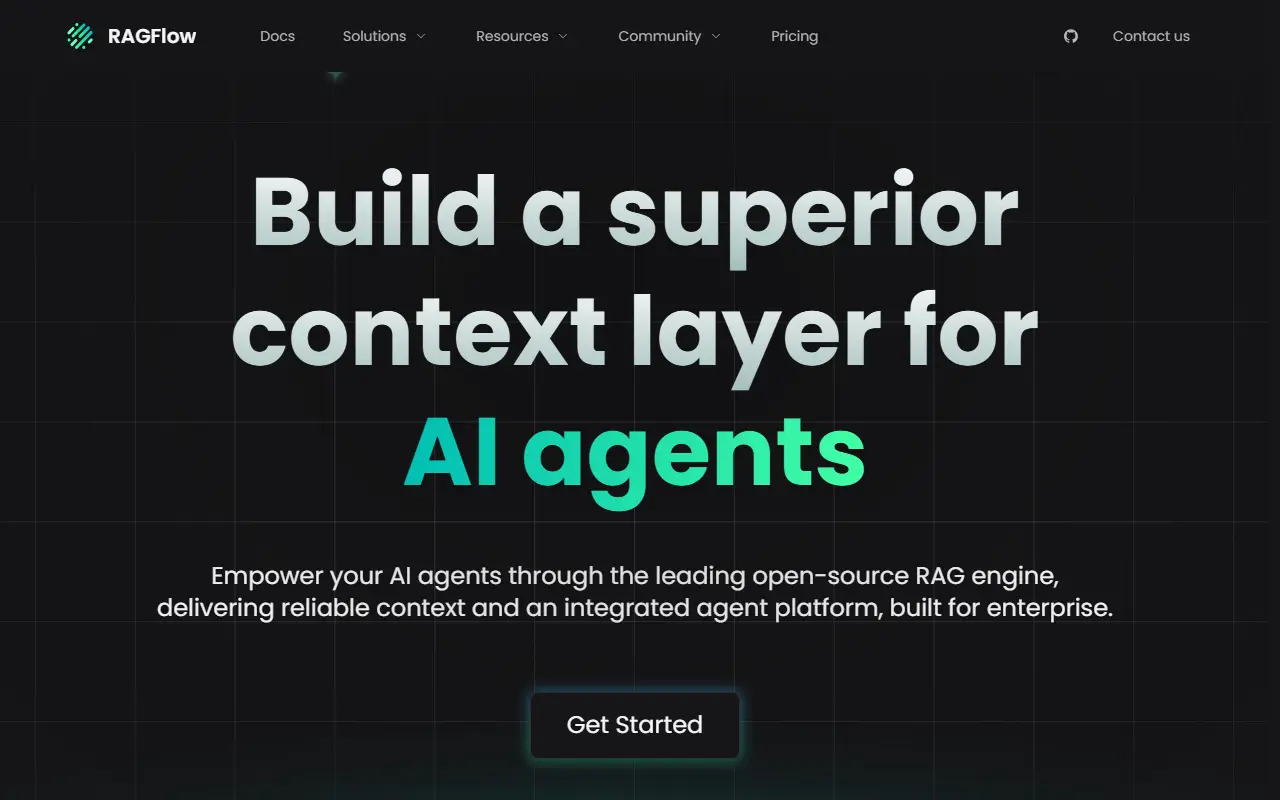
ragflow.ioRAGFlow homepage screenshot

RAGFlow is an open-source engine for retrieval-augmented generation (RAG). It combines RAG with agent capabilities to give large language models a context layer built from your own documents, so applications can answer from real data. It is released under the Apache-2.0 license and, per the repository, is currently at a 1.0.0 release candidate.

It extracts knowledge from unstructured documents with complicated formats using deep document understanding, and offers pre-built agent templates. Recent updates mentioned in the README include website ingestion through sitemaps, Google BigQuery data sources with incremental sync, knowledge compilation that generates wikis, graphs, trees and mind maps, and agentic RAG with multiple thinking modes.

You can try the managed cloud service or deploy it locally by following the local deployment guide. The project provides documentation, a roadmap and a Discord community. It suits developers and enterprises building document question answering and knowledge-based assistants who want control over their data pipeline.

Key features

  • Deep document understanding for unstructured files
  • Retrieval-augmented generation workflows
  • Pre-built agent templates
  • Agentic RAG with adjustable thinking modes
  • Website ingestion through sitemaps
  • Knowledge compilation into wikis and graphs
  • Google BigQuery data source sync

Pricing: Free plan with 500 credits per month. Starter shows $59 and Pro $259 per month (a lower unlabeled price of $29 and $129 likely applies with annual billing); Enterprise is quoted and can be deployed on-premises.

Vespa

An open-source platform for search, recommendation and personalization that serves vectors, tensors, text and structured data with machine-learned ranking at any scale.

GitHub stars
7.1k
Last commit
today
Latest release
v8.753.16
Licence
Apache-2.0
Self-hosted
Yes
Hosted version
Available

Vespa is a platform for applications that must pick a subset of data from a large, changing corpus, evaluate machine-learned models over it, organize and aggregate the results and return them quickly. Typical examples are search, recommendation and personalization, and the platform adds vector search and retrieval-augmented generation as well, as shown in its topics.

Doing this over large data sets distributed across many nodes and evaluated in parallel is hard, and Vespa handles it with high availability and performance. It handles searching, running inference over and organizing vectors, tensors, text and structured data while serving. According to the README, Vespa has been developed over many years and runs behind several large internet services.

The repository contains all the code needed to build and run Vespa yourself under the Apache 2.0 licence, and new releases are made from the master branch on weekday mornings. You can deploy applications to the Vespa Cloud service, which offers a free trial, or run your own instance following the getting started guide. It is written in Java and C++ and suits teams building large-scale search and recommendation systems.

Key features

  • Search over text, vectors and tensors
  • Machine-learned model inference at serving time
  • Structured data filtering and aggregation
  • Distributed, highly available serving
  • Real-time updates while serving queries
  • Cloud service with a free trial

Pricing: Free and open source under Apache 2.0; Vespa Cloud is a managed service with a free trial.

Swirl

Federated AI search and RAG that queries your existing apps live, ranks results, and returns cited answers without copying data into a vector database.

GitHub stars
3k
Last commit
6 days ago
Latest release
v4.5.0.7
Licence
Apache-2.0
Self-hosted
Yes
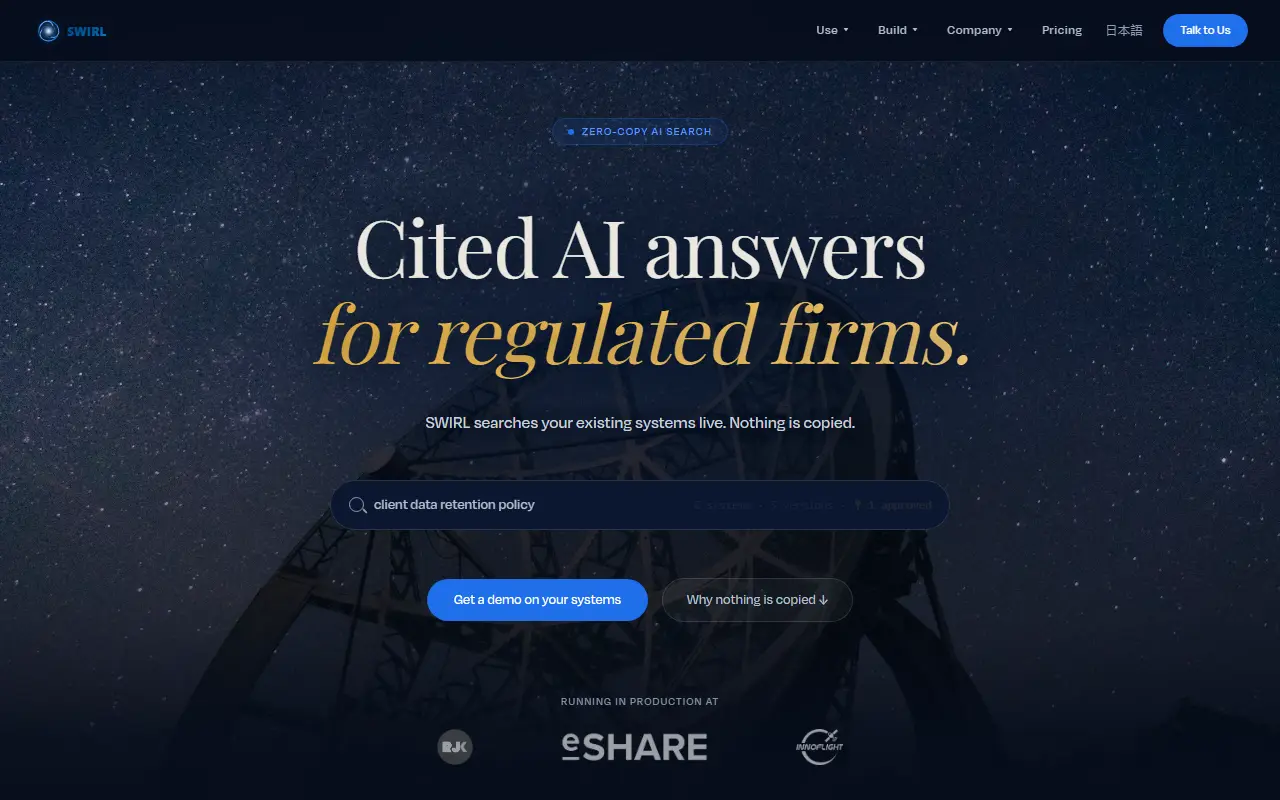
swirlaiconnect.comSwirl homepage screenshot

SWIRL is an AI search and retrieval-augmented generation tool that works without moving your data. Instead of copying content into a vector database, it queries your sources live with each user's own permissions, re-ranks the results, and can generate an answer with citations using the language model of your choice. The Community edition in this repository is released under the Apache-2.0 license.

Connectors reach many business applications, and the project's tagline refers to more than 100 apps. The approach avoids building ETL pipelines, standing up a vector store, or maintaining a second copy of data that needs security and audit controls, since permissions are enforced at the source. The stack is Python and Django, and a Docker quick start gets an instance running in about two minutes.

A separate SWIRL Enterprise edition adds a three-pass reranker, canonical answers, an MCP server for agents, and managed support. The Community edition is free to self-host. It suits IT and data teams wanting enterprise search across many systems while keeping data in place.

Key features

  • Federated search across connected apps
  • Live queries with source-level permissions
  • No vector database or ETL needed
  • Cited answers from your choice of language model
  • Django-based with Docker quick start
  • Enterprise tier adds reranking and MCP server

Pricing: Annual platform licences: Departmental $24K, Business $72K and Enterprise from $150K per year. No free plan is listed; a paid $12,000 pilot is credited to the first annual contract.

NucliaDB

NucliaDB is a Rust and Python database for storing and searching unstructured data with hybrid vector, full-text and graph indexes, aimed at RAG.

GitHub stars
722
Last commit
today
Latest release
v7.1.0
Self-hosted
Yes
Hosted version
Available
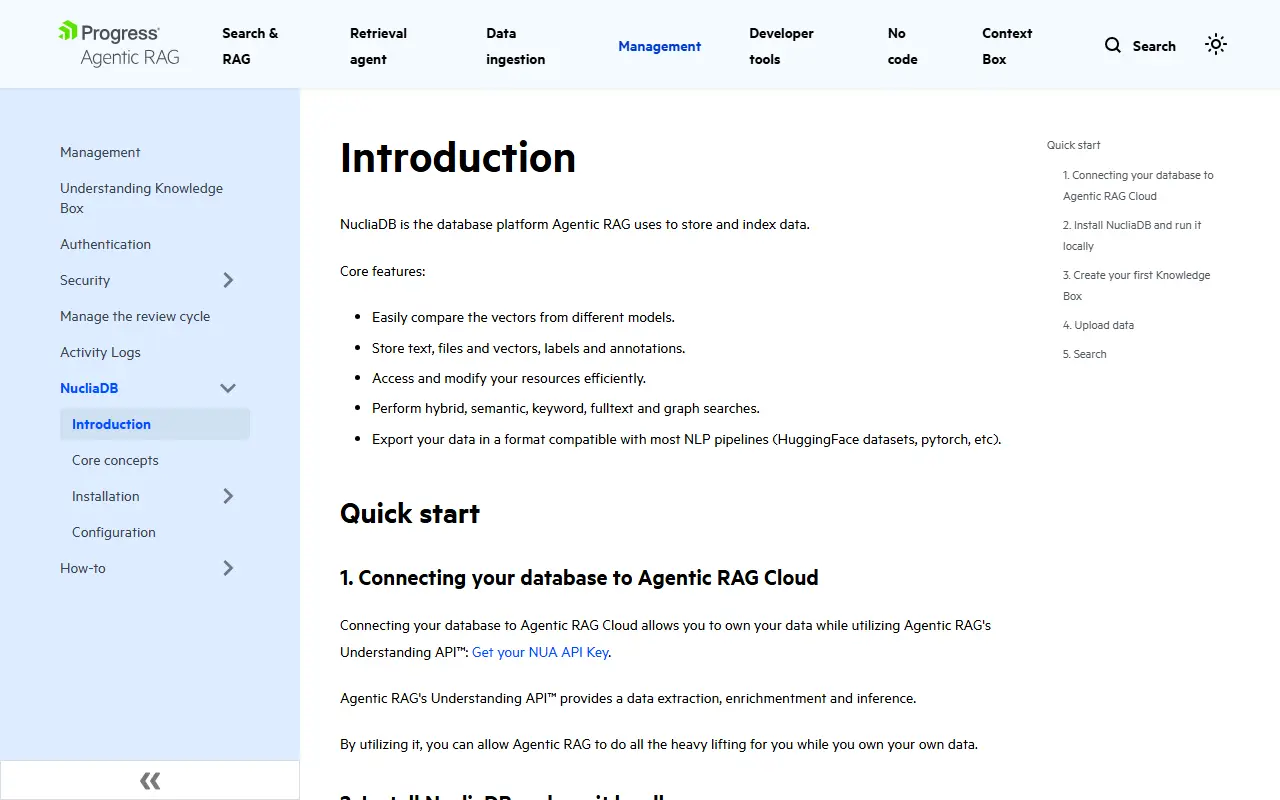
docs.nuclia.devNucliaDB homepage screenshot

NucliaDB, from Nuclia, is a database for storing and searching unstructured data, described as an AI search database for retrieval-augmented generation. It works as an out-of-the-box hybrid search engine that combines vector, full-text and graph indexes, and it was designed to index large datasets with multi-tenant support.

It stores text, files, vectors, labels and annotations in resources with multiple fields and metadata, with field types for text, files, links and conversations. Users can run keyword searches and semantic searches over vectors, export data in formats suited to NLP pipelines such as Hugging Face datasets, and apply role-based security with upstream proxy authentication. The storage layer uses PostgreSQL, with blob support through S3-compatible storage, Google Cloud Storage or Azure Blob Storage, plus index replication and distributed search.

NucliaDB can also connect to Nuclia's cloud APIs, the Understanding API for data and insight extraction and the Learning API for training models. The core is written in Rust and Python, and its license is listed as Other, so check the repository for the exact terms.

Key features

  • Hybrid vector, full-text and graph search
  • Multi-tenant resource storage
  • Text, file, link and conversation fields
  • S3, GCS and Azure blob storage support
  • Role-based security
  • Export for NLP pipelines

Trieve

API platform for search, recommendations, retrieval-augmented generation and analytics, built in Rust on Qdrant and Postgres and available self-hosted or as a hosted service.

GitHub stars
2.7k
Last commit
8 mo ago
Latest release
trieve-helm-0.2.2
Licence
MIT
Self-hosted
Yes
Hosted version
Available

Trieve is an all-in-one platform that exposes search, recommendations, retrieval-augmented generation (RAG) and analytics through an API. Developers upload content as chunks and then query it with semantic, keyword or hybrid search, without assembling the vector database, embedding and reranking pieces themselves.

Its search features include dense vector search with OpenAI or Jina embeddings stored in Qdrant, typo-tolerant neural sparse search, sub-sentence highlighting, recency biasing, merchandising controls and hybrid search with cross-encoder reranking. A recommendations API finds similar chunks or files, and RAG routes use OpenRouter so you can pick the language model. You can also plug in your own embedding, reranking and LLM models.

Trieve can be self-hosted in your VPC or on-premises, with guides for AWS, GCP, Kubernetes and Docker Compose, and it also offers a hosted sign-up with a free allowance of 1,000 chunks. The backend is Rust with Actix and Diesel on PostgreSQL, with a SolidJS front end, an OpenAPI specification and TypeScript and Python SDKs. It is released under the MIT licence.

Key features

  • Semantic vector search with Qdrant
  • Typo-tolerant neural sparse search
  • Hybrid search with cross-encoder reranking
  • Recommendations API for similar items
  • RAG routes with a choice of LLMs
  • Sub-sentence highlighting and recency biasing
  • TypeScript and Python SDKs

Pricing: Open source under the MIT licence and self-hostable; the hosted service advertises a free allowance of 1,000 chunks.

Supavec

Open-source RAG-as-a-service platform that provides vector search and a chat API over your own data, positioned as an alternative to Carbon.ai.

GitHub stars
1.2k
Last commit
9 mo ago
Licence
Apache-2.0
Self-hosted
Yes
Hosted version
Available
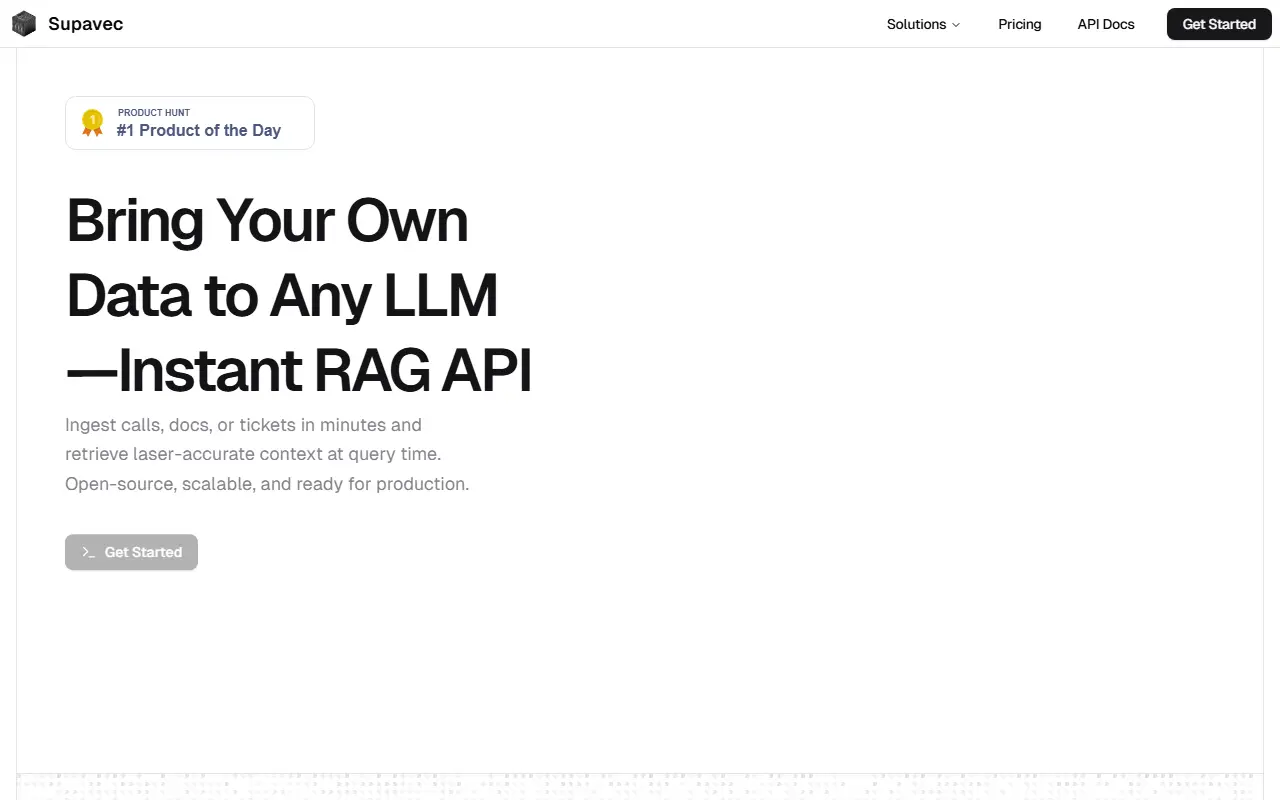
supavec.comSupavec homepage screenshot

Supavec is an open-source retrieval-augmented generation (RAG) service. It lets developers build AI applications that answer questions over their own documents by providing vector search and a chat API, without assembling the embedding and retrieval pipeline themselves. The project presents itself as an open-source alternative to Carbon.ai and offers both a cloud version and code you can run on your own infrastructure.

The README describes a multi-tenant design that uses row-level security for team-level data isolation, usage-based billing on the cloud version, and batched embeddings to reduce OpenAI costs. Retrieval can be tuned with configurable chunk size and overlap, and searches combine a file filter with cosine similarity. Operationally it includes PostHog analytics, request-level tracing with unique IDs, asynchronous usage logging, streaming or standard responses, and Redis-backed rate limiting.

The product is API-first with REST endpoints, documentation at docs.supavec.com and a related Python API repository. A chat interface shows live embedding previews for debugging. It is built with Next.js, Supabase, Tailwind CSS, Bun and Upstash, written in TypeScript, and licensed under Apache-2.0.

Key features

  • Vector search and chat API over your documents
  • Multi-tenant isolation with row-level security
  • Configurable chunk size and overlap
  • Streaming or standard API responses
  • Request tracing and PostHog analytics
  • Redis-backed rate limiting

Pricing: A free tier allows 100 API calls per month. Yearly pricing is $190 for Basic (750 calls) and $1,490 for Enterprise (5,000 calls), with a 14-day refund window.

Nixiesearch

Nixiesearch is an Apache-licensed hybrid search engine on Apache Lucene that keeps stateless indexes in S3-compatible storage and adds local embeddings and RAG.

GitHub stars
618
Last commit
8 mo ago
Latest release
0.8.0
Licence
Apache-2.0
Self-hosted
Yes
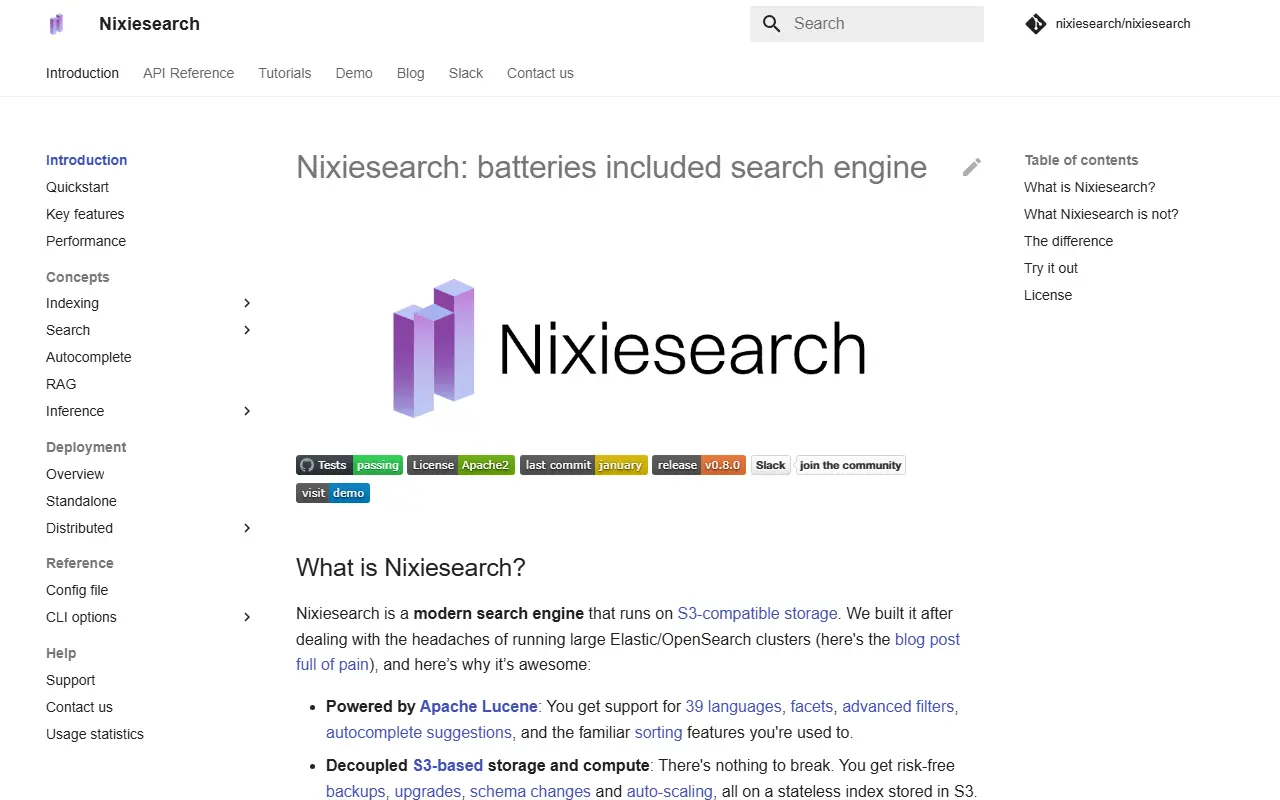
nixiesearch.aiNixiesearch homepage screenshot

Nixiesearch is a search engine that combines classic text search with semantic search and runs on S3-compatible storage. The team built it after struggling to operate large Elasticsearch and OpenSearch clusters, aiming to remove much of the operational burden of reindexing, capacity planning and maintenance.

It is built on Apache Lucene, so it offers support for 39 languages, facets, filters, autocomplete suggestions and sorting. Storage and compute are decoupled: indexes are stateless and live in S3, so backups, upgrades and schema changes are handled as configuration updates. Indexing is pull-based, with offline and incremental runs through an Apache Spark ETL process, and embedding and LLM inference run locally, with a first-class RAG API.

It can be deployed on Kubernetes, Docker or AWS Lambda for scale-to-zero. Nixiesearch is written in Scala and released under Apache-2.0. The project is explicit that it is a search index for consumer-facing applications rather than a general database or a tool for searching logs.

Key features

  • Hybrid text and semantic search
  • Stateless indexes stored in S3-compatible storage
  • Facets, filters and autocomplete suggestions
  • Local embedding and LLM inference
  • RAG API support
  • Spark-based pull indexing
  • Runs on Kubernetes, Docker or AWS Lambda

Pricing: Free and open source under the Apache-2.0 license.

Vectara alternatives: questions

What is the best open-source alternative to Vectara?
RAGFlow is the top-ranked open-source alternative to Vectara on Enlisted: An open-source retrieval-augmented generation engine that combines document understanding with agent capabilities to give LLMs grounded context. Other strong options are Vespa, Swirl, NucliaDB and Trieve.
Are these Vectara alternatives free?
All 7 are open source, so the code is free to use under its licence, and all of them can be self-hosted on your own server or computer. 5 also offer a paid or managed cloud version if you'd rather not host it yourself.
How is this list of Vectara alternatives ranked?
By a score built from GitHub stars, star growth over the last 30 days and how recently the code changed. 4 of these projects shipped code in the last 30 days. Data is refreshed daily, and nobody can pay to move up.

People also look for alternatives to…

View all