
About Milvus
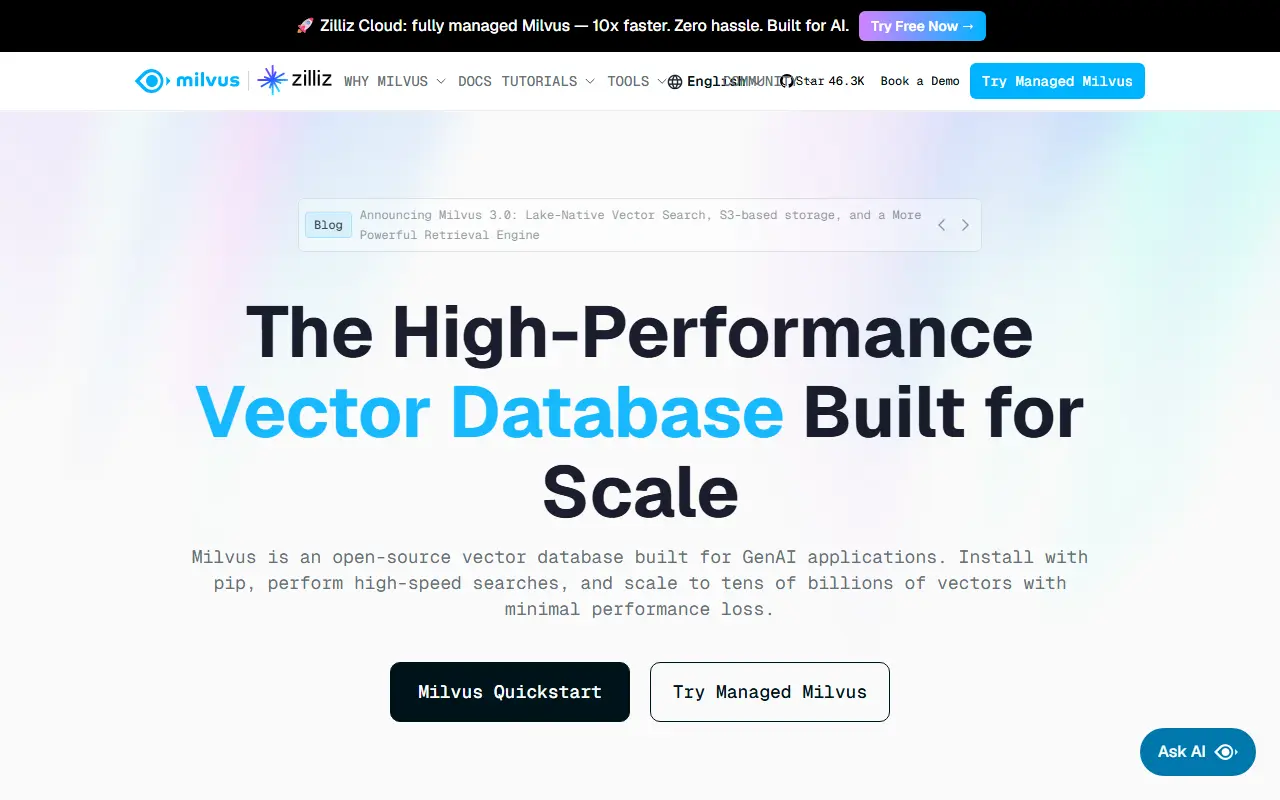
Milvus is an open-source vector database designed to scale. It supports AI applications by handling large volumes of unstructured data, including text, images and mixed-media content. It is written in Go and C++ with hardware acceleration for CPUs and GPUs, and it is released under the Apache-2.0 license.
The architecture is fully distributed and Kubernetes-native, so it can scale out horizontally while staying current through streaming updates in real time. Smaller deployments are covered too: a Standalone mode runs on a single machine, and Milvus Lite is a lightweight version installed with pip for quick starts in Python. The pymilvus SDK and its MilvusClient are used to create collections, ingest data and run vector searches.
Milvus can be self-hosted, or consumed as a managed service through Zilliz Cloud, which offers Serverless, Dedicated and bring-your-own-cloud options. The project is hosted by the LF AI & Data Foundation, with Zilliz as its major contributor. It suits teams building retrieval-augmented generation, semantic search and recommendation systems.
Key features
- Vector similarity search over embeddings
- Distributed, Kubernetes-native architecture
- Standalone mode for single machines
- Milvus Lite for quick Python starts
- Real-time streaming updates
- CPU and GPU hardware acceleration
Good fit for
- →Retrieval-augmented generation backends
- →Semantic and image search
- →Recommendation systems
- Built with
- Go
- Tags
- vector-database
- similarity-search
- embeddings
- rag
- cloud-native
- golang
- ai
- kubernetes
Milvus: questions and answers
- What is Milvus used for?
- Milvus is an open-source, cloud-native vector database for scalable similarity search over embeddings, with distributed, standalone and lightweight Python modes. It is a good fit for retrieval-augmented generation backends, semantic and image search, and recommendation systems.
- Is Milvus open source?
- Yes. Milvus is open source under the Apache-2.0 licence. Its source code is on GitHub at milvus-io/milvus and is written mainly in Go.
- Is Milvus free?
- Yes. Milvus is open source, so the software itself is free to use. A managed cloud version is also available.
- Can I self-host Milvus?
- Yes. Milvus can be self-hosted on your own server or infrastructure.
- What is Milvus an alternative to?
- Milvus is an open-source alternative to Pinecone. Other open-source alternatives to Pinecone include Weaviate, Qdrant and Chroma.
- Is Milvus actively maintained?
- Yes. The most recent commit to Milvus was on 2 October 2026, and the latest release is v3.0.2, published on 20 September 2026. The project has 46k stars on GitHub.
Open-source alternatives to Milvus
See all
Weaviate
Databases
Weaviate is an open-source vector database that stores both objects and vectors, allowing
OSSvs Pinecone★ 17k
Qdrant
Databases
Qdrant - High-performance, massive-scale Vector Database and Vector Search Engine for the
Apache-2.0vs Pinecone★ 35k
Chroma
Databases
Search infrastructure for AI
Apache-2.0vs Pinecone★ 29k
Epsilla VectorDB
Databases
A high performance Vector Database leveraging parallel graph computing
GPL-3.0vs Pinecone★ 875
MyScaleDB
Databases
A @ClickHouse fork that supports high-performance vector search and full-text search.
Apache-2.0vs Pinecone★ 1k
LanceDB
Databases
Developer-friendly OSS embedded retrieval library for multimodal AI. Search More; Manage L
Apache-2.0vs Pinecone★ 12k
SaaS alternatives to Milvus
See all
Pinecone
Databases
Managed vector database for semantic search and retrieval apps
SaaS
DataStax Astra DB
Databases
Cassandra-based serverless database with vector search for AI applications
SaaS
Upstash
Databases
Serverless Redis, Kafka and vector database with per-request pricing
SaaS
EDB Postgres AI
Databases
Enterprise PostgreSQL distribution, managed service and tooling from EnterpriseDB
SaaS
Aerospike
Databases
Real-time NoSQL database for low-latency, high-throughput applications
SaaS
Azure Cosmos DB
Databases
Microsoft globally distributed multi-model NoSQL database
SaaS