#1
A distributed, RESTful search and analytics engine written in Java, used for full-text search, log analysis and vector search across large datasets.
- GitHub stars
- 79k
- Last commit
- today
- Latest release
- v9.5.6
- Self-hosted
- Yes
- Hosted version
- Available
elastic.co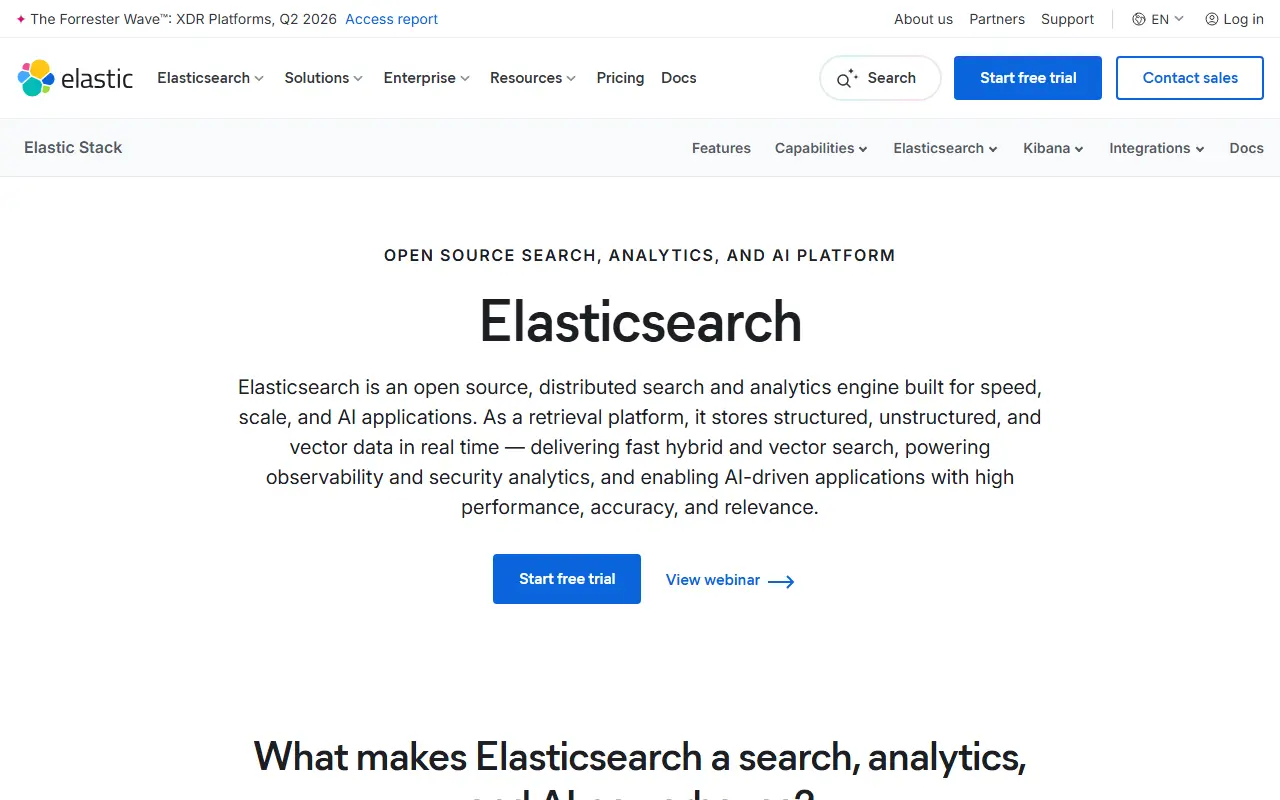
Elasticsearch is a distributed, RESTful search engine written in Java. It stores documents as JSON, indexes them so they can be searched quickly, and exposes everything through an HTTP API, which makes it a common backbone for site search, application search and log analytics. It is built on the Apache Lucene library.
Beyond full-text queries it supports filtering, aggregations for analytics and, in recent versions, vector search for semantic and AI-assisted retrieval. Data is spread across nodes in a cluster using shards and replicas, so capacity and resilience grow by adding machines. It is the core of the Elastic Stack, usually paired with Kibana for exploration and with ingestion tools for logs and metrics.
The repository describes the project as free and open source, while its license metadata is listed as 'Other', so review the current license terms before relying on it commercially. It can be self-managed on your own servers or used as a managed service through Elastic Cloud.
Key features
- Distributed full-text search over JSON documents
- RESTful HTTP API
- Aggregations for analytics
- Vector search for semantic retrieval
- Clustering with shards and replicas

A vector database and similarity search engine written in Rust, offering filtering over stored vectors and payloads, available self-hosted or as Qdrant Cloud.
- GitHub stars
- 36k
- Last commit
- today
- Latest release
- v1.20.0
- Licence
- Apache-2.0
- Self-hosted
- Yes
- Hosted version
- Available
qdrant.tech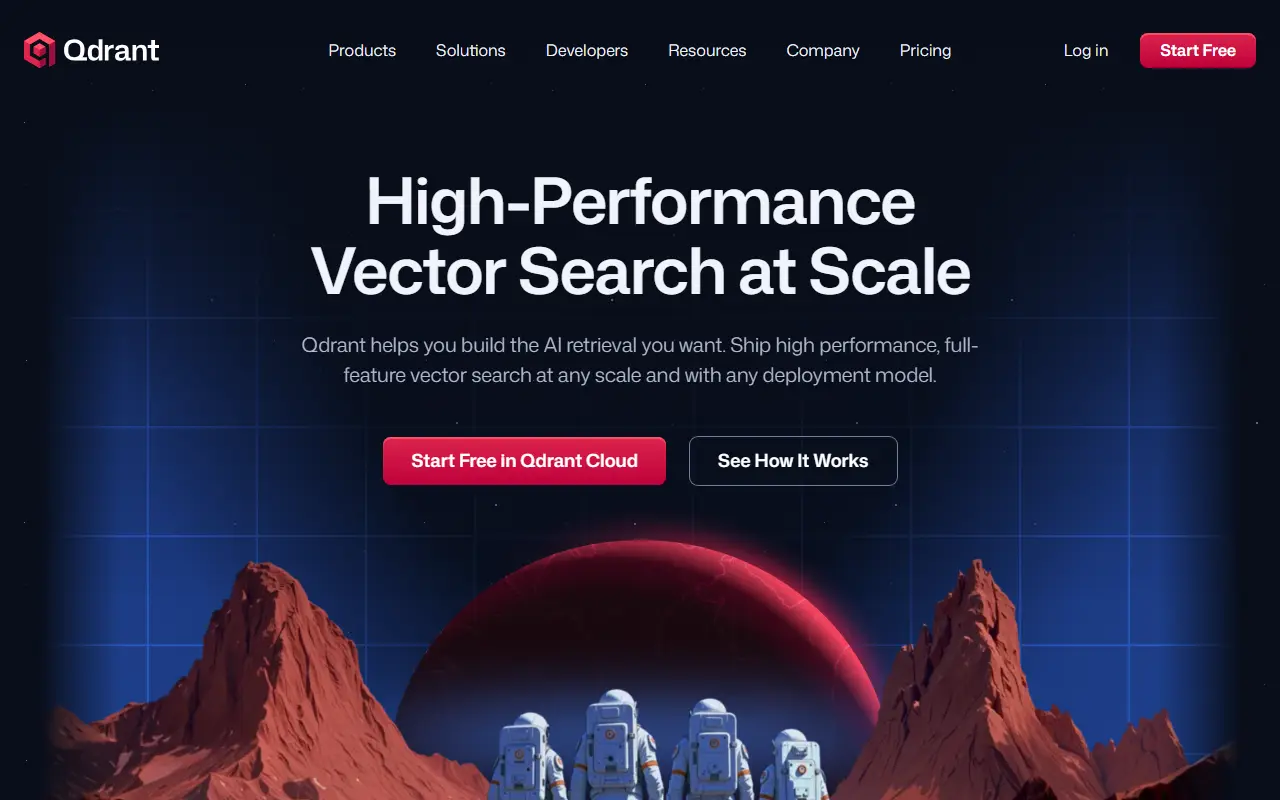
Qdrant is a vector database and similarity search engine. It stores points, which are vectors plus an attached payload, and exposes an API to store, search and manage them. That makes it a building block for semantic search, recommendations, image search and other applications that rely on embeddings from neural networks.
A key selling point is extended filtering support, so a vector query can be combined with conditions on the payload, which is useful for faceted search and matching. The engine is written in Rust and the maintainers point to benchmarks for its speed and reliability under load. Topics mention HNSW indexing and nearest-neighbor search, and there are client libraries, demo projects, integrations and a collection of agent skills that bring vector search into AI coding assistants.
Qdrant is Apache-2.0 licensed and can run on your own infrastructure. It is also available as the fully managed Qdrant Cloud, which includes a free tier. Teams building retrieval-augmented generation, recommendation and similarity features use it as the storage and retrieval layer for their embeddings.
Key features
- Vector storage with attached payloads
- Filtering combined with vector search
- HNSW-based nearest-neighbor search
- REST-style API with client libraries
- Agent skills for AI coding assistants
- Self-hosted or managed Qdrant Cloud
Pricing: A free-forever cloud tier is available. The Standard tier is usage-based, from $25; Premium requires a minimum spend and Hybrid and Private Cloud are quoted by the team.
#3
An open-source, cloud-native vector database for scalable similarity search over embeddings, with distributed, standalone and lightweight Python modes.
- GitHub stars
- 47k
- Last commit
- yesterday
- Latest release
- v3.0.6
- Licence
- Apache-2.0
- Self-hosted
- Yes
- Hosted version
- Available
milvus.io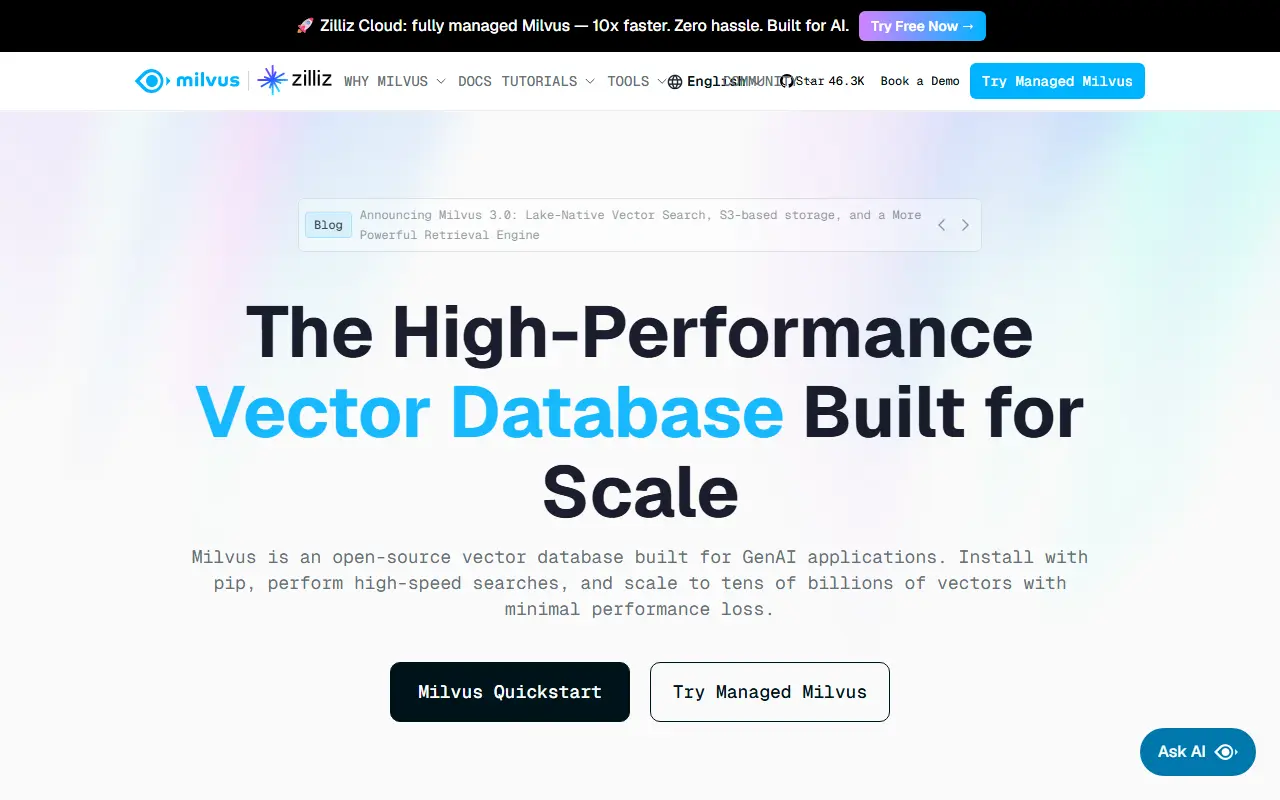
Milvus is an open-source vector database designed to scale. It supports AI applications by handling large volumes of unstructured data, including text, images and mixed-media content. It is written in Go and C++ with hardware acceleration for CPUs and GPUs, and it is released under the Apache-2.0 license.
The architecture is fully distributed and Kubernetes-native, so it can scale out horizontally while staying current through streaming updates in real time. Smaller deployments are covered too: a Standalone mode runs on a single machine, and Milvus Lite is a lightweight version installed with pip for quick starts in Python. The pymilvus SDK and its MilvusClient are used to create collections, ingest data and run vector searches.
Milvus can be self-hosted, or consumed as a managed service through Zilliz Cloud, which offers Serverless, Dedicated and bring-your-own-cloud options. The project is hosted by the LF AI & Data Foundation, with Zilliz as its major contributor. It suits teams building retrieval-augmented generation, semantic search and recommendation systems.
Key features
- Vector similarity search over embeddings
- Distributed, Kubernetes-native architecture
- Standalone mode for single machines
- Milvus Lite for quick Python starts
- Real-time streaming updates
- CPU and GPU hardware acceleration
Pricing: Open source under Apache 2.0; Zilliz Cloud offers a managed service with Serverless, Dedicated and BYOC options.
#4
An open-source, MySQL-compatible distributed SQL database with horizontal scaling, ACID transactions, Raft-based high availability and support for analytics and vector search.
- GitHub stars
- 41k
- Last commit
- today
- Latest release
- v7.5.8
- Licence
- Apache-2.0
- Self-hosted
- Yes
- Hosted version
- Available
tidb.io
TiDB is a cloud-native, open-source distributed SQL database from PingCAP. The name's Ti stands for titanium, and it is built for high availability, strong consistency and the ability to scale out as data and traffic grow, while staying compatible with MySQL so existing applications and tools can connect with little change.
Distributed transactions use a two-phase commit protocol to keep ACID guarantees even across nodes, through network partitions or node failures. It scales horizontally by adding nodes or vertically by adding resources, without downtime, and its architecture separates compute from storage so each can be adjusted independently. Built-in Raft consensus keeps multiple replicas in sync and handles automated failover. Topics also mention HTAP workloads, analytics and native vector search.
TiDB is written in Go under the Apache-2.0 license. It can be deployed on your own infrastructure or consumed as a managed cloud service, and it suits teams that have outgrown a single MySQL server and want horizontal scale without sharding by hand.
Key features
- MySQL-compatible distributed SQL
- Distributed ACID transactions
- Horizontal and vertical scaling without downtime
- Separated compute and storage layers
- Raft-based replication and automated failover
- Analytics and vector search support
Pricing: TiDB Community is free and Cloud Starter has a monthly free quota. Cloud Premium starts from $1800 per month and Dedicated from $0.22 per hour; Self-Managed is priced on request.
#5
Open-source search infrastructure for AI that stores embeddings and supports vector, hybrid and full-text search, with a small API and a hosted Chroma Cloud.
- GitHub stars
- 30k
- Last commit
- 6 days ago
- Latest release
- 1.5.9
- Licence
- Apache-2.0
- Self-hosted
- Yes
- Hosted version
- Available
trychroma.com
Chroma is open-source data infrastructure for AI applications, centered on storing embeddings and searching them. It supports vector search, hybrid search and full-text search, and its core API is deliberately small, only four functions, so developers can add retrieval to an app quickly. The engine is written in Rust and clients are available through PyPI and npm packages.
For hosting, Chroma Cloud is the company's serverless managed service, which it describes as fast, cost-effective and scalable, and new users can create a database and try it with free starting credits. You can also run Chroma yourself. The project is developing rapidly, and the maintainers release new tagged versions of the Python and npm packages on Mondays, with hotfixes shipped whenever needed.
Chroma is Apache-2.0 licensed. Contributors can join the Discord contributing channel, review the roadmap and pick up good-first issues. Developers use it in retrieval-augmented generation setups, agent memory and semantic search features where they want an easy, embedded-friendly vector store.
Key features
- Vector, hybrid and full-text search
- Small four-function core API
- Python and JavaScript clients
- Serverless Chroma Cloud service
- Rust core engine
- Weekly tagged releases
Pricing: Chroma Cloud's Starter plan is $0 per month plus usage, with $5 in free credits. Team is $250 per month plus usage with $100 in credits; Enterprise is custom.
#6
A cloud-native vector database that stores objects and embeddings and combines semantic search with keyword filtering, RAG and reranking in one query interface.
- GitHub stars
- 17k
- Last commit
- yesterday
- Latest release
- v1.40.5
- Self-hosted
- Yes
- Hosted version
- Available
weaviate.io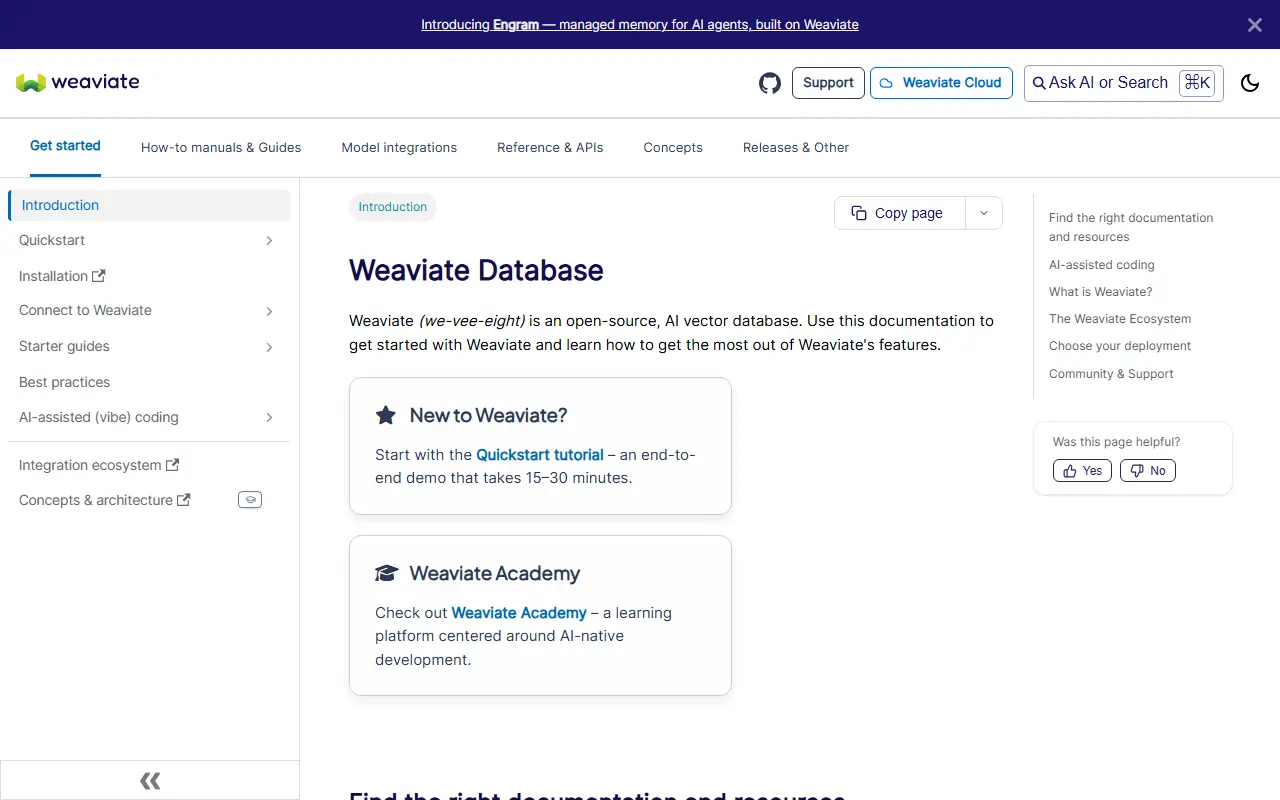
Weaviate is a vector database that stores both data objects and their vector embeddings, enabling semantic search at scale. One query interface can blend vector similarity search, keyword filtering, retrieval-augmented generation and reranking, and it is written in Go as a cloud-native system.
Common applications are RAG pipelines, semantic and image search, recommenders, chatbots and content classification. Vectors can be created automatically on import by integrated models from providers such as OpenAI, Cohere and Hugging Face, or you can import pre-computed embeddings. For production, it offers built-in multi-tenancy, replication and role-based access control. Topics reference approximate nearest neighbor search and HNSW indexing.
Weaviate can be deployed with Docker, on Kubernetes, or through the managed Weaviate Cloud, with guides for AWS and GCP, and the documentation includes quickstarts for both cloud and a local Docker instance. Its license is listed as 'Other' on GitHub, so check the repository terms. It suits teams building AI applications that need a scalable store for embeddings alongside structured filters.
Key features
- Stores objects and vectors together
- Hybrid vector and keyword search
- Integrated vectorizer models or bring your own
- Multi-tenancy and replication
- Role-based access control
- Docker, Kubernetes and Weaviate Cloud options

A high-throughput C++ NoSQL database on the Seastar framework that speaks the Apache Cassandra and Amazon DynamoDB APIs.
- GitHub stars
- 16k
- Last commit
- today
- Self-hosted
- Yes
- Hosted version
- Available
scylladb.com
ScyllaDB is a NoSQL database that implements the Apache Cassandra and Amazon DynamoDB APIs, so existing applications and drivers for those systems can talk to it. It is written in C++ on the Seastar framework and is aimed at real-time big data workloads that need high throughput and predictable latency.
The project describes a shared-nothing approach in which each CPU core manages its own slice of data, which it says increases throughput and storage capacity per machine and cuts hardware costs. Building the database is demanding: it needs a very recent C++23 compiler and many up-to-date libraries, so the project offers a frozen toolchain as a pre-configured Docker image that includes everything required. You then only need Docker or Podman to compile it.
The repository's license is listed as 'Other' on GitHub, so confirm the current terms before using it commercially. You can run ScyllaDB on your own servers or consume it as a managed cloud service from the company. It suits teams that have outgrown Cassandra's resource footprint or want a DynamoDB-compatible database they can run themselves.
Key features
- Compatible with the Cassandra API
- Compatible with the DynamoDB API
- Shared-nothing architecture on Seastar
- C++ implementation for high throughput
- Frozen Docker toolchain for building
- Self-hosted or managed cloud
Pricing: ScyllaDB Cloud comes in Standard, Professional and Premium tiers with no list prices on the page; Standard is costed with an online calculator and the other two by quote. A self-managed edition is also listed.
#8
A PostgreSQL-compatible, cloud-native distributed SQL database for transactional workloads that need scale, fault tolerance or multi-region deployment.
- GitHub stars
- 11k
- Last commit
- today
- Latest release
- v2026.1.3.0
- Self-hosted
- Yes
yugabyte.com
YugabyteDB is a distributed SQL database that is compatible with PostgreSQL. It combines the relational features of traditional databases with the scale-out design of NoSQL systems, and is intended for cloud-native OLTP applications that need correct data and at least one of scalability, tolerance to failures or global distribution.
Its SQL layer, YSQL, reuses the PostgreSQL query layer and so supports most PostgreSQL features, including data types, stored procedures, triggers and extensions. Its transaction model follows the design of Google Spanner, using Raft consensus for replication and hybrid logical clocks for distributed ACID transactions, with snapshot, serializable and read committed isolation. Reads are strongly consistent by default and can be tuned to read from followers and replicas.
The database can be configured to withstand failures at the level of a disk, rack, node, zone, region or whole cloud, recovering on its own, and the topics mention multi-region, multi-cloud and Kubernetes deployments. The project is written mainly in C and C++, the repository lists its license as Other, and documentation covers architecture, roadmap and how to build applications.
Key features
- PostgreSQL-compatible SQL layer
- Distributed ACID transactions
- Replication using Raft consensus
- Snapshot, serializable and read committed isolation
- Automatic failover and repair
- Multi-region and multi-cloud deployments
- Kubernetes deployment support
Pricing: The open-source database is free. The managed Aeon service starts at $125 (Standard) or $167 (Professional) per vCPU per month plus storage and transfer, with a free trial; Enterprise is quoted.
#9
Apache Cassandra is an open-source distributed NoSQL database built for linear scalability and fault tolerance on commodity hardware or cloud infrastructure.
- GitHub stars
- 10k
- Last commit
- yesterday
- Licence
- Apache-2.0
- Self-hosted
- Yes
cassandra.apache.org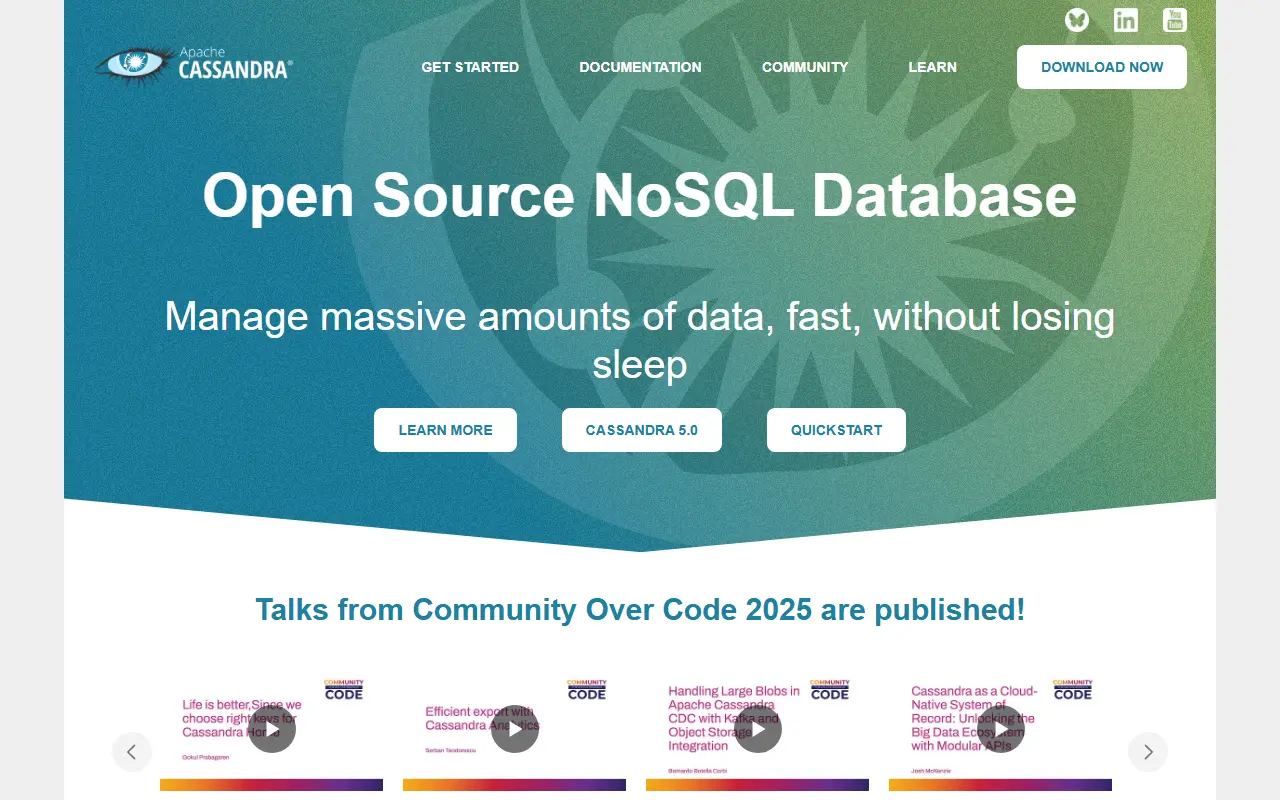
Apache Cassandra is an open-source, transactional, distributed NoSQL database. It is built to manage very large amounts of data across many machines, aiming for linear scalability and proven fault tolerance whether it runs on commodity servers or in the cloud, with no loss of performance. It is written in Java and developed under the Apache Software Foundation.
The project site presents Cassandra 5.0 along with documentation, a quickstart and community resources, and recent talks from the community cover topics such as Storage Attached Indexes, the Accord transaction protocol, mutation tracking, backups with Medusa, a sidecar process and analytics integrations. Cassandra is queried through CQL and can be run in clusters spanning racks, data centers or cloud regions.
Cassandra is licensed under Apache-2.0 and you run it yourself, either on your own servers or on cloud virtual machines or Kubernetes. It is typically chosen for write-heavy, always-on applications such as time-series data, messaging, IoT and large user-facing systems that must stay available when individual nodes fail.
Key features
- Distributed NoSQL storage
- Linear scalability across nodes
- Fault tolerance on commodity hardware
- CQL query language
- Storage Attached Indexes in 5.0
- Multi data center deployments
Pricing: Free and open source under the Apache-2.0 licence.
#10
Redis Insight is a visual developer tool from Redis for browsing, querying and optimizing Redis data, with a workbench, profiler and slow log analysis.
- GitHub stars
- 8.9k
- Last commit
- 2 days ago
- Latest release
- 3.8.0
redis.io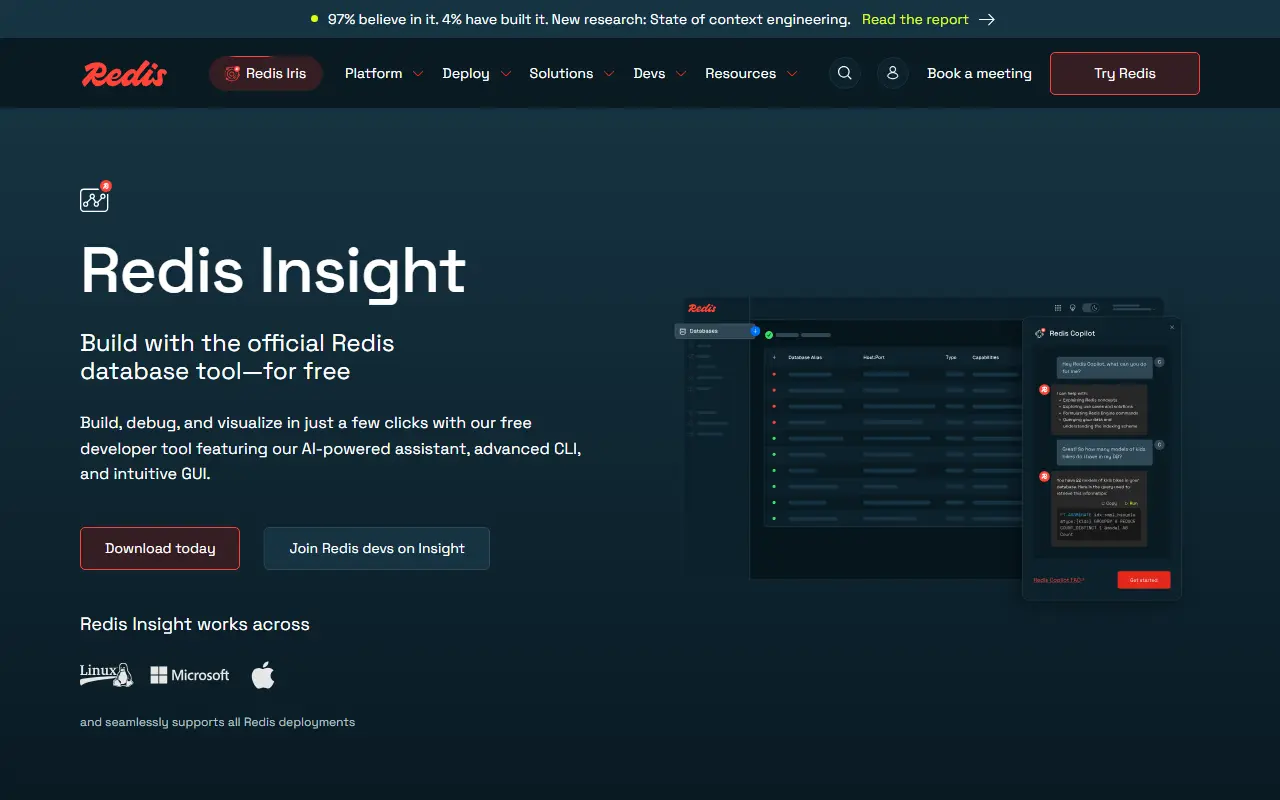
Redis Insight is a graphical client for Redis, published by Redis. It helps developers design, build and tune applications by letting them browse, filter and visualize key-value data and view values in formats such as JSON, Hex and ASCII.
It offers create, read, update and delete support for lists, hashes, strings, sets, sorted sets, streams and JSON, plus management of vector sets, including similarity search. A Workbench provides a command-line interface with command auto-complete, while Profiler shows commands sent to Redis in real time and SlowLog highlights slow operations. Pub/Sub support, bulk deletion by filter and in-context recommendations for performance and memory use round out the tool, along with interactive tutorials.
The application is built with Electron, the Monaco editor and Node.js, and it works with Redis modules. The repository licence is listed as non-standard rather than a common open-source licence, so check the repository for the exact terms before redistributing.
Key features
- Browse and filter Redis keys visually
- CRUD for core data types and JSON
- Vector set creation and similarity search
- Workbench with command auto-complete
- Real-time command profiler
- SlowLog analysis and Pub/Sub support
Commercial DataStax Astra DB alternatives
Hosted, closed-source products that compete with DataStax Astra DB.
DataStax Astra DB alternatives: questions
- What is the best open-source alternative to DataStax Astra DB?
- Elasticsearch is the top-ranked open-source alternative to DataStax Astra DB on Enlisted: A distributed, RESTful search and analytics engine written in Java, used for full-text search, log analysis and vector search across large datasets. Other strong options are Qdrant, Milvus, TiDB and Chroma.
- What are the best commercial alternatives to DataStax Astra DB?
- Amazon Keyspaces, Instaclustr, Google Cloud Bigtable, Aerospike and Azure Cosmos DB are among the hosted, closed-source alternatives to DataStax Astra DB listed on Enlisted, which lists 10 in total. Compare their pricing and features on each tool page.
- Are these DataStax Astra DB alternatives free?
- All 10 are open source, so the code is free to use under its licence, and all of them can be self-hosted on your own server or computer. 7 also offer a paid or managed cloud version if you'd rather not host it yourself.
- How is this list of DataStax Astra DB alternatives ranked?
- By a score built from GitHub stars, star growth over the last 30 days and how recently the code changed. 10 of these projects shipped code in the last 30 days. Data is refreshed daily, and nobody can pay to move up.
 TrackMedia
 TrackRev