 TrackMedia
 TrackRev

 Aerospike
 Instaclustr
 Snowflake
 Azure Data Explorer
 SAP HANA
 KX kdb+
 CockroachDB
 Amazon DocumentDB
 MarkLogic
About Apache Cassandra
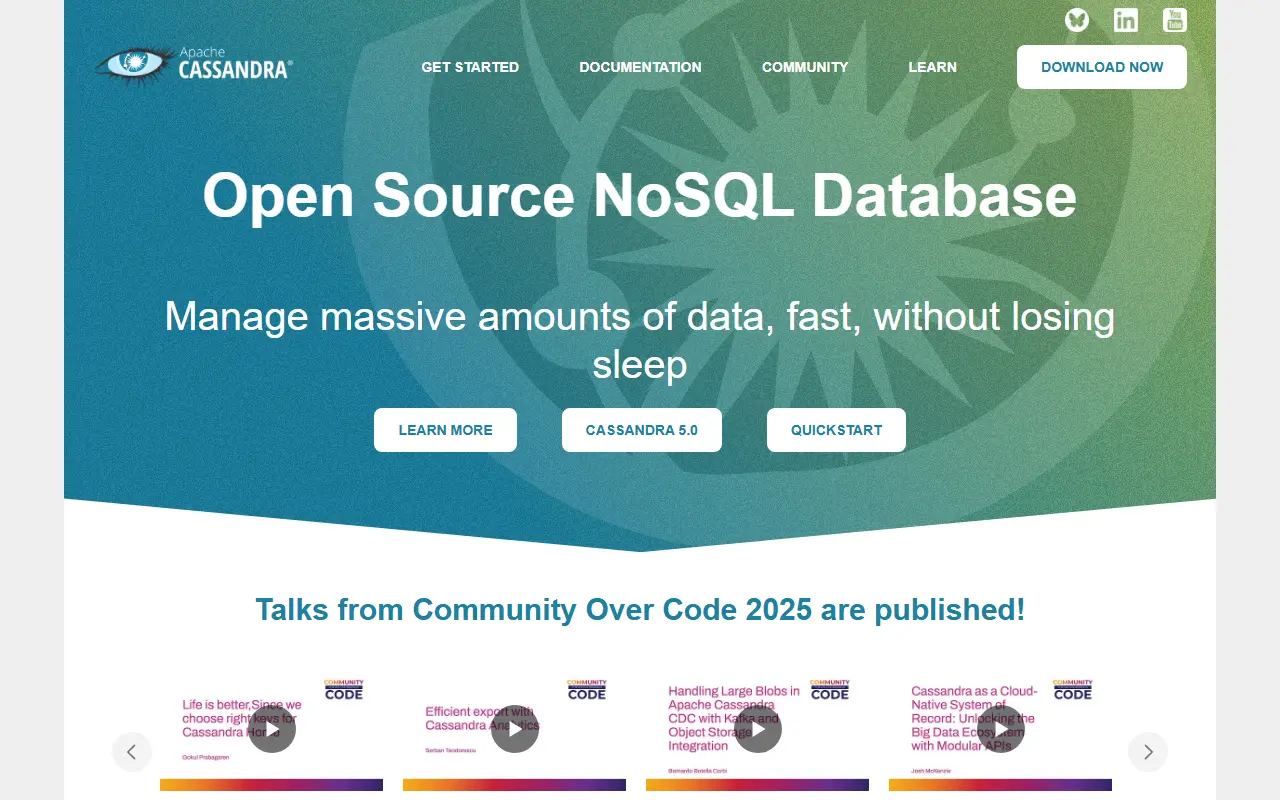
Apache Cassandra is an open-source, transactional, distributed NoSQL database. It is built to manage very large amounts of data across many machines, aiming for linear scalability and proven fault tolerance whether it runs on commodity servers or in the cloud, with no loss of performance. It is written in Java and developed under the Apache Software Foundation.
The project site presents Cassandra 5.0 along with documentation, a quickstart and community resources, and recent talks from the community cover topics such as Storage Attached Indexes, the Accord transaction protocol, mutation tracking, backups with Medusa, a sidecar process and analytics integrations. Cassandra is queried through CQL and can be run in clusters spanning racks, data centers or cloud regions.
Cassandra is licensed under Apache-2.0 and you run it yourself, either on your own servers or on cloud virtual machines or Kubernetes. It is typically chosen for write-heavy, always-on applications such as time-series data, messaging, IoT and large user-facing systems that must stay available when individual nodes fail.
Key features
- Distributed NoSQL storage
- Linear scalability across nodes
- Fault tolerance on commodity hardware
- CQL query language
- Storage Attached Indexes in 5.0
- Multi data center deployments
Good fit for
- Always-on, write-heavy applications
- Time-series and IoT data storage
- Large-scale user-facing data stores
Apache Cassandra: questions and answers
- What is Apache Cassandra used for?
- Apache Cassandra is an open-source distributed NoSQL database built for linear scalability and fault tolerance on commodity hardware or cloud infrastructure. It is a good fit for always-on, write-heavy applications; time-series and IoT data storage; and large-scale user-facing data stores.
- Is Apache Cassandra open source?
- Yes. Apache Cassandra is open source under the Apache-2.0 licence. Its source code is on GitHub at apache/cassandra and is written mainly in Java.
- Is Apache Cassandra free?
- Yes. Apache Cassandra is open source, so the software itself is free to use.
- Can I self-host Apache Cassandra?
- Yes. Apache Cassandra can be self-hosted on your own server or infrastructure.
- What is Apache Cassandra an alternative to?
- Apache Cassandra is an open-source alternative to Amazon DynamoDB, Azure Cosmos DB, Aiven and Amazon Keyspaces. Other open-source alternatives to Amazon DynamoDB include ScyllaDB, YugabyteDB and Apache HBase.
- Is Apache Cassandra actively maintained?
- Yes. The most recent commit to Apache Cassandra was on 12 November 2026. The project has 10k stars on GitHub, with 32 added in the last 30 days.
Open-source alternatives to Apache Cassandra
See all
ScyllaDB
Databases
NoSQL data store using the Seastar framework, compatible with Apache Cassandra and Amazon
OSSvs Amazon DynamoDB★ 16k
YugabyteDB
Databases
YugabyteDB - the cloud native distributed SQL database for mission-critical applications.
OSSvs Google Cloud Spanner★ 11k
ClickHouse
Databases
ClickHouse is a fast open-source column-oriented database management system that allows ge
Apache-2.0vs Snowflake★ 51k
Apache HBase
Databases
Apache HBase
Apache-2.0vs Google Cloud Bigtable★ 5.6k
TiDB
Databases
TiDB is built for agentic workloads that grow unpredictably, with ACID guarantees and nati
Apache-2.0vs Amazon Aurora★ 41k
MongoDB
Databases
The MongoDB Database
OSSvs Amazon DynamoDB★ 29k
SaaS alternatives to Apache Cassandra
See all
Amazon DynamoDB
Databases
Serverless key-value and document database from AWS
SaaS
Azure Cosmos DB
Databases
Microsoft globally distributed multi-model NoSQL database
SaaS
Aiven
Databases
Managed service for running Postgres, MySQL, Kafka and other data systems in the cloud
SaaS
Amazon Keyspaces
Databases
Serverless managed database on AWS compatible with Apache Cassandra
SaaS
Google Cloud Bigtable
Databases
Managed wide-column NoSQL database on Google Cloud for large analytical and operational workloads
SaaS
DataStax Astra DB
Databases
Cassandra-based serverless database with vector search for AI applications
SaaS