6,598 open-source and SaaS tools, with GitHub stats refreshed every day.

8 alternatives ranked by real activity

Open-source Azure Cosmos DB alternatives

A curated, ranked list of the 8 best open-source alternatives to Azure Cosmos DB.

The best open-source alternative to Azure Cosmos DB is SurrealDB. If that doesn't suit you, other good options are MongoDB, ScyllaDB, ArangoDB and Apache Cassandra.

Azure Cosmos DB alternatives are mainly Databases tools. 8 of them shipped code in the last 30 days, 8 can be self-hosted, and 3 use a permissive licence.

Last updated October 2, 2026 · ranked by GitHub stars, growth and recent commits

SurrealDB

A multi-model database written in Rust that combines document, graph, relational, time-series and vector data with real-time features, from embedded use to distributed clusters.

GitHub stars
33k
Last commit
2 days ago
Latest release
v3.3.0
Self-hosted
Yes
Hosted version
Available
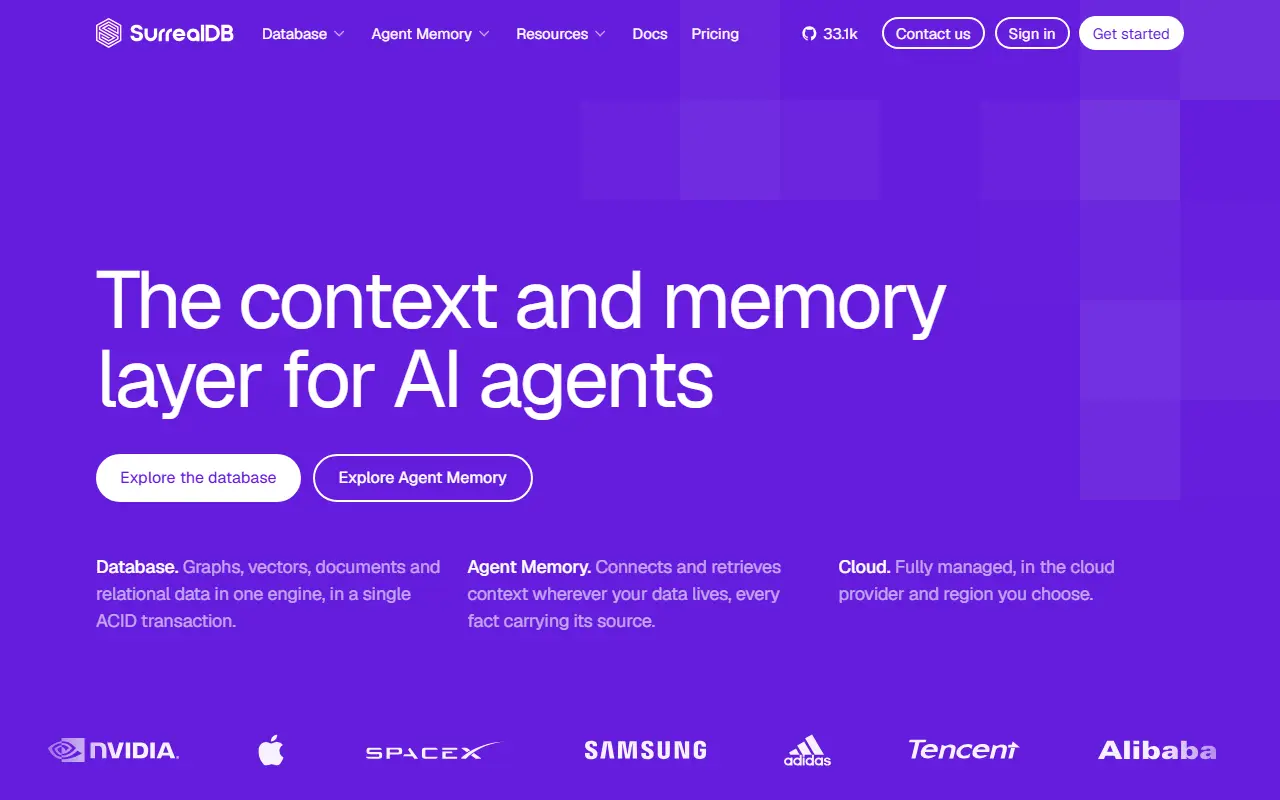
surrealdb.comSurrealDB homepage screenshot

SurrealDB is a Rust-based multi-model database that brings several data models into one engine: key-value, document, graph, relational, time-series and geospatial data. Search and retrieval options include full-text, vector and hybrid, and it adds real-time and event-driven capabilities, queried through its SQL-like language, SurrealQL.

Because it supports end-user authentication, SurrealDB can also act as a backend-as-a-service, reducing the amount of server-side code an app needs. It ships as a single Rust binary that can run embedded inside an application, in the browser via WebAssembly, at the edge, as a self-hosted single node, or as a distributed cluster in the cloud. Typical workloads include data-intensive systems that need several data types, storage for AI agents, knowledge graphs, live applications such as recommenders and fraud detection, and embedded or edge deployments.

The repository license is listed as 'Other' on GitHub, so confirm the terms before commercial use. SurrealDB also offers cloud-hosted database service, and topics tag it as a serverless, realtime database for the web.

Key features

  • Document, graph and relational models in one engine
  • Full-text, vector and hybrid search
  • Real-time and event-driven queries
  • Built-in user authentication
  • Single binary: embedded, edge or cluster
  • SurrealQL SQL-like query language

Pricing: The Start plan includes one free instance with 1GB of storage; extra instances are from $0.021 per hour. Scale is $0.192 per node hour with a three-node minimum; self-hosted Enterprise is custom.

Read more about SurrealDBWebsite GitHub

MongoDB

The source repository for MongoDB, a document-oriented NoSQL database server written in C++, with sharding support and official drivers for most languages.

GitHub stars
29k
Last commit
today
Self-hosted
Yes
Hosted version
Available
mongodb.comMongoDB homepage screenshot

This repository holds the source of MongoDB, the document-oriented NoSQL database. It is written in C++ and contains the main server components: mongod, the database server, and mongos, the router used for sharded clusters. MongoDB stores flexible JSON-like documents rather than rows in fixed tables.

Most users install prebuilt packages rather than building from source. The README points to the community server download page, the mongodb-community-server Docker image and Homebrew taps, and also covers the MongoDB Shell, mongosh, and MongoDB Compass, a graphical client that can be installed with a packaged script. Client drivers exist for most programming languages, and RPM and Debian packages are produced by the build scripts. Documentation and a developer center help with learning.

The repository's license is listed as 'Other' on GitHub, so read the current license terms before building services on it. MongoDB can be run on your own infrastructure, and MongoDB Inc. also operates a managed cloud service. It is widely used as a general-purpose database for applications with evolving schemas.

Key features

  • Document-oriented NoSQL database server
  • mongos router for sharded clusters
  • MongoDB Shell and Compass GUI
  • Official drivers for most languages
  • Docker image and Homebrew packages
  • RPM and Debian packaging scripts
Read more about MongoDBWebsite GitHub

ScyllaDB

A high-throughput C++ NoSQL database on the Seastar framework that speaks the Apache Cassandra and Amazon DynamoDB APIs.

GitHub stars
16k
Last commit
today
Self-hosted
Yes
Hosted version
Available
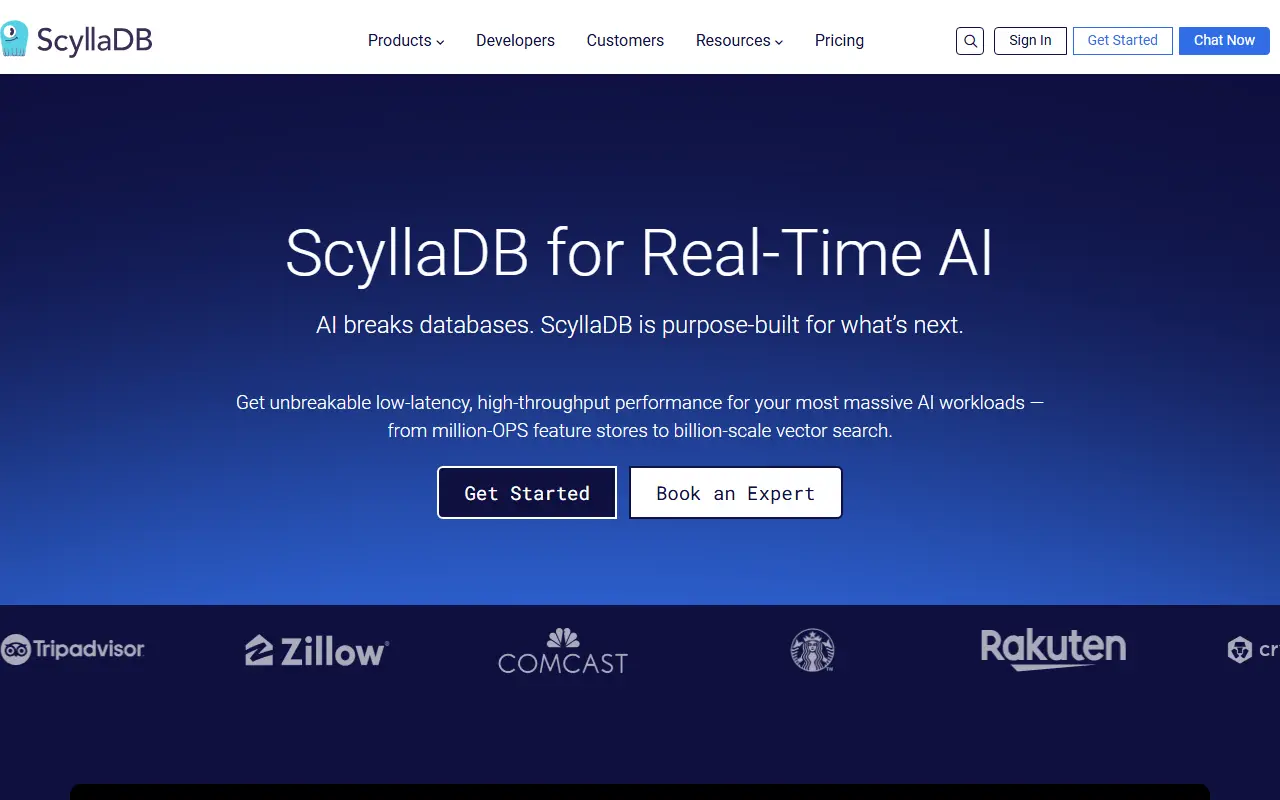
scylladb.comScyllaDB homepage screenshot

ScyllaDB is a NoSQL database that implements the Apache Cassandra and Amazon DynamoDB APIs, so existing applications and drivers for those systems can talk to it. It is written in C++ on the Seastar framework and is aimed at real-time big data workloads that need high throughput and predictable latency.

The project describes a shared-nothing approach in which each CPU core manages its own slice of data, which it says increases throughput and storage capacity per machine and cuts hardware costs. Building the database is demanding: it needs a very recent C++23 compiler and many up-to-date libraries, so the project offers a frozen toolchain as a pre-configured Docker image that includes everything required. You then only need Docker or Podman to compile it.

The repository's license is listed as 'Other' on GitHub, so confirm the current terms before using it commercially. You can run ScyllaDB on your own servers or consume it as a managed cloud service from the company. It suits teams that have outgrown Cassandra's resource footprint or want a DynamoDB-compatible database they can run themselves.

Key features

  • Compatible with the Cassandra API
  • Compatible with the DynamoDB API
  • Shared-nothing architecture on Seastar
  • C++ implementation for high throughput
  • Frozen Docker toolchain for building
  • Self-hosted or managed cloud

Pricing: ScyllaDB Cloud comes in Standard, Professional and Premium tiers with no list prices on the page; Standard is costed with an online calculator and the other two by quote. A self-managed edition is also listed.

Read more about ScyllaDBWebsite GitHub

ArangoDB

A native multi-model database for documents, graphs and key-values, queried with an SQL-like language and including built-in search, available self-managed or as a cloud service.

GitHub stars
14k
Last commit
today
Self-hosted
Yes
Hosted version
Available
arangodb.comArangoDB homepage screenshot

ArangoDB is a multi-model database that stores documents, graphs and key-value data in a single engine. Instead of running separate systems for each data model, applications query connected data through one SQL-like language, with JavaScript extensions available for custom logic.

Every node in a graph is a JSON document, so existing document data can be imported and relationships can be queried across multiple levels of joins. ArangoSearch, an integrated search engine, adds text search and ranking. For scale and resilience the database can shard data horizontally across machines and replicate it to cluster nodes with automatic failover.

ArangoDB can be installed from a download or started in Docker, and runs on-premises or in any cloud. The Arango Managed Platform (AMP) creates deployments on major cloud providers and can be tried for free. A free Community Edition and a commercial Enterprise Edition without a dataset size limit are offered; the repository lists its license simply as Other, so check the terms before production use.

Key features

  • Document, graph and key-value data models
  • SQL-like query language
  • JavaScript extensions for custom logic
  • ArangoSearch full-text search and ranking
  • Horizontal scaling through sharding
  • Replication with automatic failover
  • Managed cloud deployments via AMP

Pricing: The Community Edition is open source and free for evaluation and non-commercial use. Enterprise Edition, the platform suites and the managed cloud are priced on request.

Read more about ArangoDBWebsite GitHub

Apache Cassandra

Apache Cassandra is an open-source distributed NoSQL database built for linear scalability and fault tolerance on commodity hardware or cloud infrastructure.

GitHub stars
10k
Last commit
today
Licence
Apache-2.0
Self-hosted
Yes
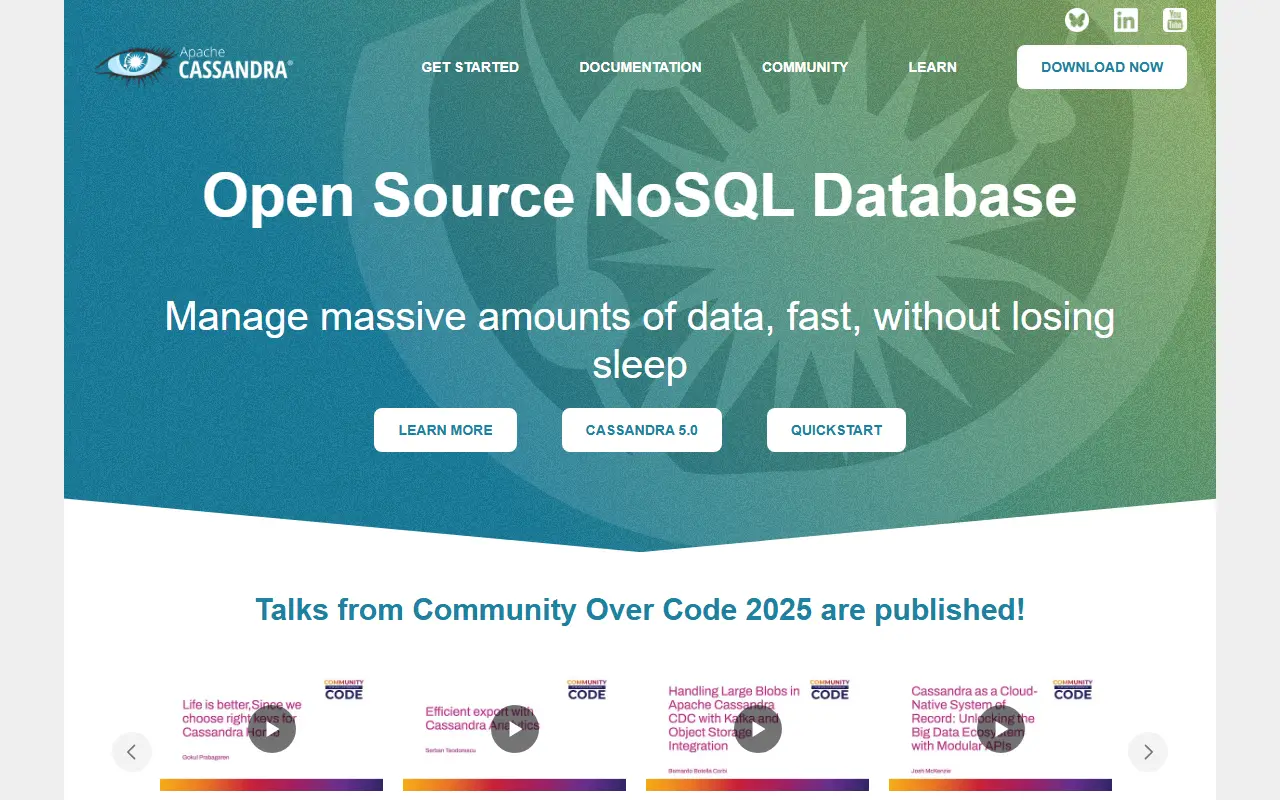
cassandra.apache.orgApache Cassandra homepage screenshot

Apache Cassandra is an open-source, transactional, distributed NoSQL database. It is built to manage very large amounts of data across many machines, aiming for linear scalability and proven fault tolerance whether it runs on commodity servers or in the cloud, with no loss of performance. It is written in Java and developed under the Apache Software Foundation.

The project site presents Cassandra 5.0 along with documentation, a quickstart and community resources, and recent talks from the community cover topics such as Storage Attached Indexes, the Accord transaction protocol, mutation tracking, backups with Medusa, a sidecar process and analytics integrations. Cassandra is queried through CQL and can be run in clusters spanning racks, data centers or cloud regions.

Cassandra is licensed under Apache-2.0 and you run it yourself, either on your own servers or on cloud virtual machines or Kubernetes. It is typically chosen for write-heavy, always-on applications such as time-series data, messaging, IoT and large user-facing systems that must stay available when individual nodes fail.

Key features

  • Distributed NoSQL storage
  • Linear scalability across nodes
  • Fault tolerance on commodity hardware
  • CQL query language
  • Storage Attached Indexes in 5.0
  • Multi data center deployments

Pricing: Free and open source under the Apache-2.0 licence.

Apache CouchDB

Apache CouchDB is a document database with multi-primary replication, a JSON-over-HTTP API and an offline-first sync model that scales from servers to mobile devices.

GitHub stars
7k
Last commit
yesterday
Licence
Apache-2.0
Self-hosted
Yes
couchdb.apache.orgApache CouchDB homepage screenshot

Apache CouchDB is a database that stores JSON documents and is reached through an HTTP/JSON API. Its headline feature is multi-primary sync: the Couch Replication Protocol lets data flow between server clusters, mobile phones and web browsers, which supports offline-first applications that reconcile changes when connectivity returns.

It can run as a single-node database behind an application server or as a cluster, stores binary data alongside JSON, and offers a developer-friendly query language with optional MapReduce views. The protocol is implemented by a variety of projects and products across computing environments. CouchDB is written in Erlang, known for reliability, and the homepage presents the design as built for dependable operation.

Apache CouchDB is licensed under Apache-2.0 and runs on your own servers or with any cloud provider. Documentation, a technical overview and download packages are on the project site. It suits teams building apps that must keep working offline and sync later, or that want a simple, HTTP-native document store.

Key features

  • Multi-primary replication between nodes
  • JSON documents over an HTTP API
  • Offline-first sync to mobile and browsers
  • Binary attachments alongside JSON
  • Query language and MapReduce views
  • Single-node or clustered deployment

Pricing: Free and open source under the Apache-2.0 licence.

Read more about Apache CouchDBWebsite GitHub

RavenDB

RavenDB is a fully ACID NoSQL document database for .NET and other platforms, with built-in full-text, vector and time series features.

GitHub stars
4k
Last commit
today
Latest release
7.2.6
Self-hosted
Yes
Hosted version
Available
ravendb.netRavenDB homepage screenshot

RavenDB is a NoSQL document database that is fully ACID and secure by default. Its makers, frustrated with the state of the database industry, aim to combine strong performance with ease of use so developers can concentrate on their application instead of managing data infrastructure. It is built on .NET.

Repository topics list full-text search, indexing, sharding, spatial queries, time series, vector search and IoT use, and the README links to documentation, articles, a book and a try-from-your-browser option. It describes itself as completely open source under AGPLv3 and mentions a free developer license, while GitHub reports the license as 'Other', so confirm the terms for production use.

RavenDB can be run on your own servers or consumed as a managed cloud service from the vendor, which also sells commercial licenses. It suits .NET teams that want a document store with transactions, indexing and search built in.

Key features

  • Fully ACID document database
  • Secure by default
  • Full-text and vector search
  • Time series and spatial support
  • Sharding for scale
  • Free developer license

Pricing: Source available under AGPLv3 with a free developer license; commercial licenses and managed cloud plans are sold by the vendor.

Read more about RavenDBWebsite GitHub

ArcadeDB

ArcadeDB is a multi-model database written in Java that supports graph, document, key-value and time-series data with SQL, Cypher, Gremlin and vector search.

GitHub stars
1.2k
Last commit
today
Latest release
26.9.1
Licence
Apache-2.0
Self-hosted
Yes
arcadedb.comArcadeDB homepage screenshot

ArcadeDB is a multi-model database management system created by Luca Garulli, the founder of OrientDB, and described as a conceptual fork of it. It stores graph, document, key-value and time-series data in one engine, and supports ACID transactions, structured and unstructured data, a native graph engine that uses links rather than joins, full-text indexing and geospatial queries.

It can be queried in several ways: SQL, Cypher, Gremlin, HTTP and JSON, and it offers compatibility with MongoDB and Redis protocols. It also supports vector embeddings for similarity search, which its topics tie to vector database use. The engine is written in low-level Java 21 or newer to reduce garbage collection pressure, and it can run from a Raspberry Pi to multiple servers, embedded in an application, or in Docker and Kubernetes.

ArcadeDB is licensed under Apache-2.0 and is self-hosted on your own hardware or cloud. It reuses a modified version of OrientDB's SQL engine. It suits developers who want one database for connected data, documents and vectors rather than running separate graph and document stores.

Key features

  • Graph, document, key-value, and time-series models
  • SQL, Cypher, Gremlin, and HTTP/JSON queries
  • ACID transactions
  • Vector embeddings and similarity search
  • Full-text and geospatial indexing
  • Embedded, Docker, and Kubernetes deployment

Pricing: The database is free and open source. Optional support subscriptions cost $299 (Silver), $599 (Gold) or $1,499 (Platinum) per server per month; the Studio AI Assistant is $19.99 per month standalone.

Read more about ArcadeDBWebsite GitHub

Azure Cosmos DB alternatives: questions

What is the best open-source alternative to Azure Cosmos DB?
SurrealDB is the top-ranked open-source alternative to Azure Cosmos DB on Enlisted: A multi-model database written in Rust that combines document, graph, relational, time-series and vector data with real-time features, from embedded use to distributed clusters. Other strong options are MongoDB, ScyllaDB, ArangoDB and Apache Cassandra.
Are these Azure Cosmos DB alternatives free?
All 8 are open source, so the code is free to use under its licence, and 8 of them can be self-hosted on your own server. 5 also offer a paid or managed cloud version if you'd rather not host it yourself.
How is this list of Azure Cosmos DB alternatives ranked?
By a score built from GitHub stars, star growth over the last 30 days and how recently the code changed. 8 of these projects shipped code in the last 30 days. Data is refreshed daily, and nobody can pay to move up.

People also look for alternatives to…

View all