 TrackMedia
 TrackRev

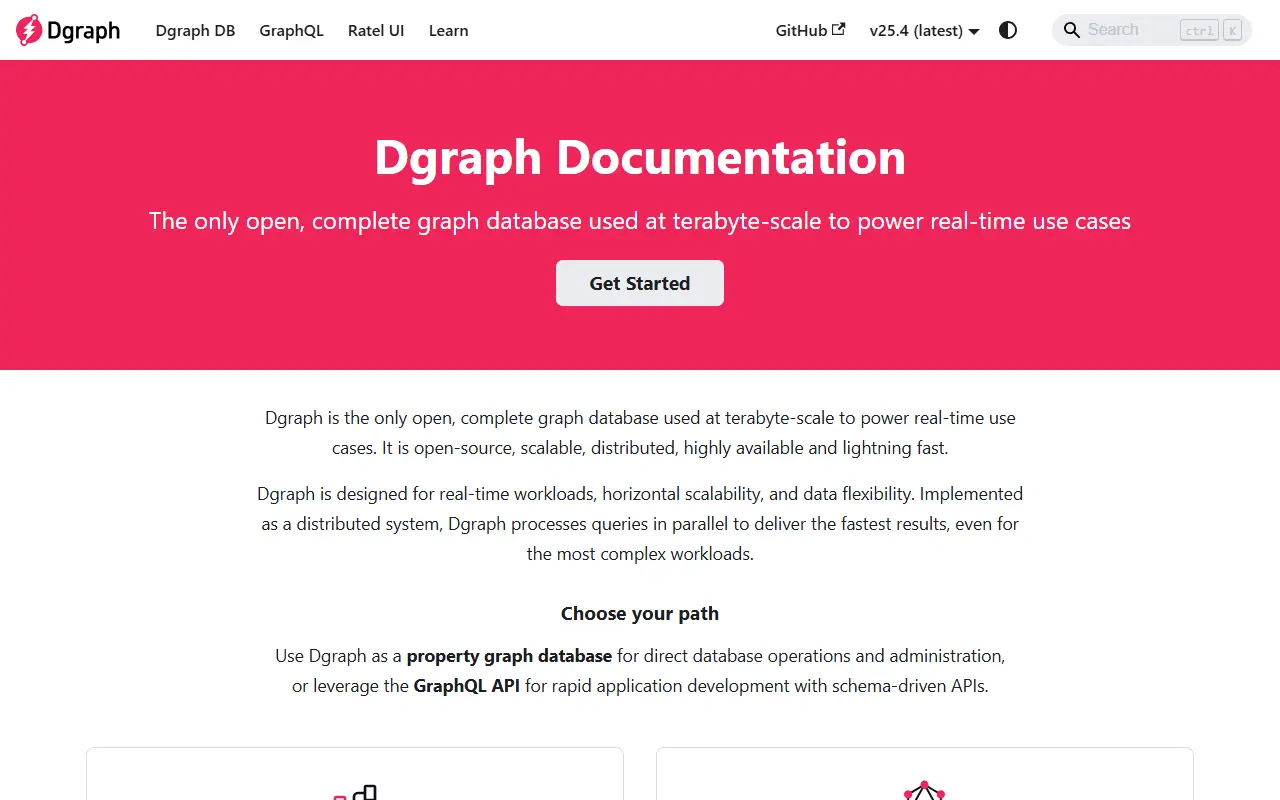
About Dgraph
Dgraph is a distributed database that stores data as a graph while exposing it through GraphQL. It scales horizontally across machines and offers ACID transactions, consistent replication and linearizable reads, so a cluster behaves predictably even as it grows.
The project was built from scratch around the way graph data is laid out on disk, which it says reduces disk seeks and network calls in a cluster and improves query performance and throughput. The stated aim is production-level scale with latency low enough to answer live user queries across terabytes of structured data. Clients send queries in GraphQL syntax and receive JSON or Protocol Buffers over gRPC and HTTP. Topics point to uses such as knowledge graphs.
Dgraph is written in Go and licensed under Apache-2.0. The README describes it as production-ready at version 25 and in use at multiple large companies, and it officially supports Linux on amd64 and arm64 architectures. It is a fit for teams modeling highly connected data, such as social graphs, recommendations or knowledge bases, who also want a GraphQL API.
Key features
- Native GraphQL database with graph backend
- ACID transactions across a cluster
- Consistent replication and linearizable reads
- Horizontal scaling and distribution
- JSON and Protocol Buffers responses
- gRPC and HTTP APIs
Good fit for
- Knowledge graphs
- Highly connected data such as social networks
- GraphQL backends needing a graph model
Dgraph: questions and answers
- What is Dgraph used for?
- Dgraph is a horizontally scalable, distributed graph database with native GraphQL support, ACID transactions and consistent replication, written in Go. It is a good fit for knowledge graphs, highly connected data such as social networks and GraphQL backends needing a graph model.
- Is Dgraph open source?
- Yes. Dgraph is open source under the Apache-2.0 licence. Its source code is on GitHub at dgraph-io/dgraph and is written mainly in Go.
- Is Dgraph free?
- Yes. Dgraph is open source, so the software itself is free to use.
- Can I self-host Dgraph?
- Yes. Dgraph can be self-hosted on your own server or infrastructure.
- What is Dgraph an alternative to?
- Dgraph is an open-source alternative to Amazon Neptune, Neo4j AuraDB, TigerGraph and Azure Cosmos DB. Other open-source alternatives to Amazon Neptune include Neo4j, ArangoDB and OrientDB.
- Is Dgraph actively maintained?
- Yes. The most recent commit to Dgraph was on 5 November 2026, and the latest release is v25.5.1, published on 22 October 2026. The project has 22k stars on GitHub, with 23 added in the last 30 days.
Open-source alternatives to Dgraph
See all
Neo4j
Databases
Graphs for Everyone
GPL-3.0vs Amazon Neptune★ 17k
ArangoDB
Databases
🥑 ArangoDB is a native multi-model database with flexible data models for documents, grap
OSSvs Azure Cosmos DB★ 14k
OrientDB
Databases
OrientDB is the most versatile DBMS supporting Graph, Document, Reactive, Full-Text and Ge
Apache-2.0vs Amazon Neptune★ 5k
ArcadeDB
Databases
ArcadeDB Multi-Model Database, one DBMS that supports SQL, Cypher, Gremlin, HTTP/JSON, Mon
Apache-2.0vs Azure Cosmos DB★ 1.3k
TerminusDB
Databases
TerminusDB is a distributed, collaborative database designed for building, sharing, versio
Apache-2.0vs Neo4j AuraDB★ 3.5k
NebulaGraph
Databases
A distributed, fast open-source graph database featuring horizontal scalability and high
Apache-2.0vs Amazon Neptune★ 12k
SaaS alternatives to Dgraph
See all
Amazon Neptune
Databases
Managed graph database service on AWS supporting property graph and RDF models
SaaS
Neo4j AuraDB
Databases
Fully managed graph database service from Neo4j
SaaS
TigerGraph
Databases
Graph database and analytics platform for connected-data and fraud use cases
SaaS
Azure Cosmos DB
Databases
Microsoft globally distributed multi-model NoSQL database
SaaS
MarkLogic
Databases
Multi-model database and data hub platform for integrating and searching enterprise data
SaaS
Amazon DocumentDB
Databases
Managed document database on AWS with a MongoDB-compatible API
SaaS