
About TigerGraph
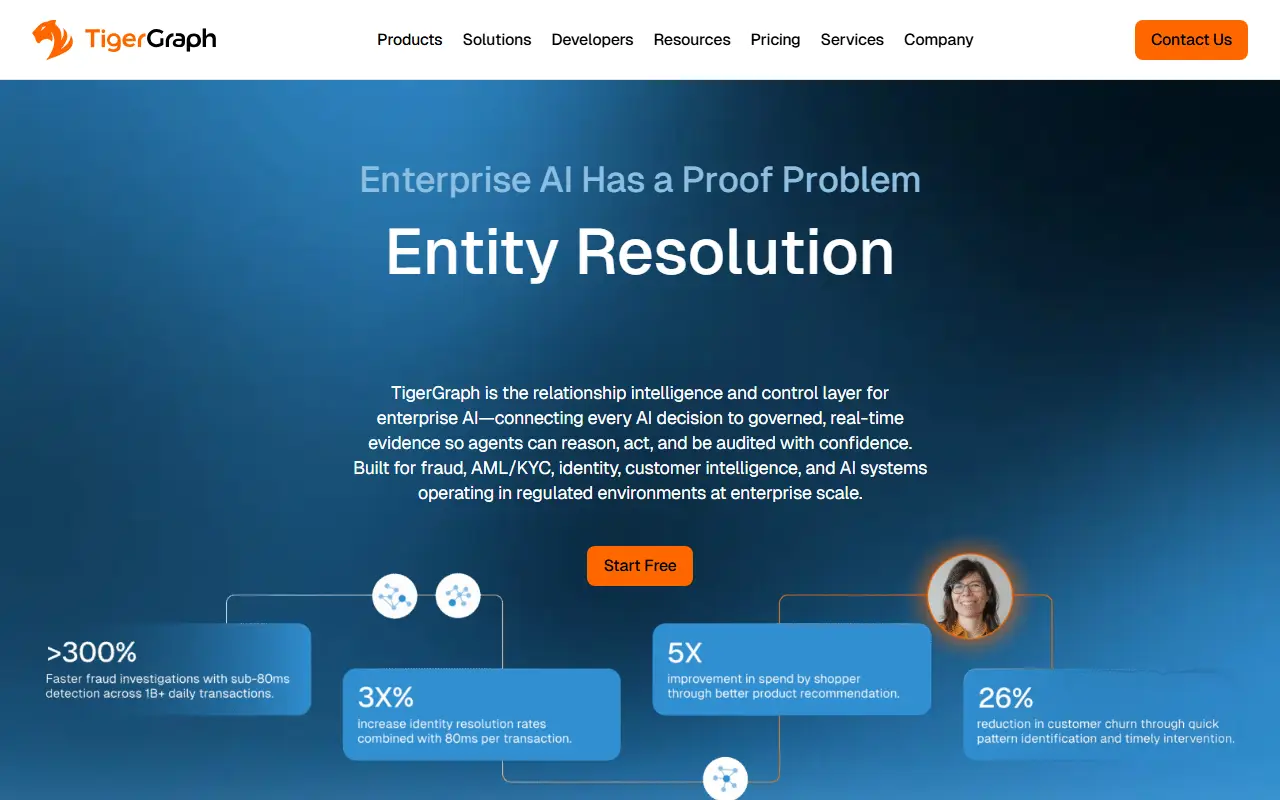
TigerGraph is a graph database and analytics platform. It stores data as vertices and edges and is used to find relationships, patterns and hidden connections, with a focus on enterprise use cases such as fraud detection, entity resolution and recommendations.
The product line includes TigerGraph DB, a Community Edition, and the managed TigerGraph Savanna service. Tools and languages include the GSQL query language, openCypher support, GraphStudio and Insights, along with a graph data science library, hybrid graph and vector search and GraphRAG for AI applications. Solution areas include customer 360, anti-money laundering, cybersecurity threat detection, supply chain analysis and energy management.
TigerGraph can be downloaded, including as a Docker image, or used as a managed service. It is a commercial product with a pricing page, documentation, training and a community forum.
Key features
- Graph storage and analytics
- GSQL and openCypher query languages
- GraphStudio visual tools
- Hybrid graph and vector search
- Graph data science library
- Community Edition and managed cloud service
Good fit for
- →Fraud detection and anti-money laundering
- →Entity resolution and customer 360
- →Supply chain analysis
- Tags
- graph-database
- analytics
- fraud-detection
- graphrag
- gsql
- entity-resolution
- enterprise
TigerGraph: questions and answers
- What is TigerGraph used for?
- TigerGraph is a graph database and analytics platform for connected data, fraud detection, entity resolution and real-time AI use cases. It is a good fit for fraud detection and anti-money laundering, entity resolution and customer 360, and supply chain analysis.
- Is TigerGraph free?
- Yes. TigerGraph has a free plan. Community edition is free to self-host (single server, up to 300 GB). Managed Savanna costs $45 per GB per month and Business Critical $126, with a free trial; Enterprise is by contact.
- Is TigerGraph open source?
- No. TigerGraph is proprietary (closed-source) software. Open-source alternatives to TigerGraph include NebulaGraph, FalkorDB and Dgraph.
- Can I self-host TigerGraph?
- Yes. Although TigerGraph is closed source, it can be self-hosted on your own servers, and the vendor also offers a hosted version.
- What are some alternatives to TigerGraph?
- TigerGraph competes with Neo4j AuraDB and Amazon Neptune. For open-source options, see Enlisted's ranked list of open-source TigerGraph alternatives.
Open-source alternatives to TigerGraph
See all
NebulaGraph
Databases
A distributed, fast open-source graph database featuring horizontal scalability and high
Apache-2.0vs Amazon Neptune★ 12k
FalkorDB
Databases
A super fast Graph Database uses GraphBLAS under the hood for its sparse adjacency matrix
OSSvs Amazon Neptune★ 6.6k
Dgraph
Databases
high-performance graph database for real-time use cases
Apache-2.0vs Amazon Neptune★ 22k
Neo4j
Databases
Graphs for Everyone
GPL-3.0vs Amazon Neptune★ 17k
ArangoDB
Databases
🥑 ArangoDB is a native multi-model database with flexible data models for documents, grap
OSSvs Azure Cosmos DB★ 14k
GraphScope
Data Pipelines & ETL
🔨 🍇 💻 🚀 GraphScope: A One-Stop Large-Scale Graph Computing System from Alibaba | 一站式图计
Apache-2.0vs TigerGraph★ 3.6k
SaaS alternatives to TigerGraph
See all
Neo4j AuraDB
Databases
Fully managed graph database service from Neo4j
SaaS
Amazon Neptune
Databases
Managed graph database service on AWS supporting property graph and RDF models
SaaS
EDB Postgres AI
Databases
Enterprise PostgreSQL distribution, managed service and tooling from EnterpriseDB
SaaS
KX kdb+
Databases
Time-series database used for high-frequency market and sensor data analytics
SaaS
SAP HANA
Databases
In-memory database and data platform from SAP for transactional and analytical workloads
SaaS
Snowflake
Databases
Cloud data platform for warehousing, data sharing and analytics
SaaS