
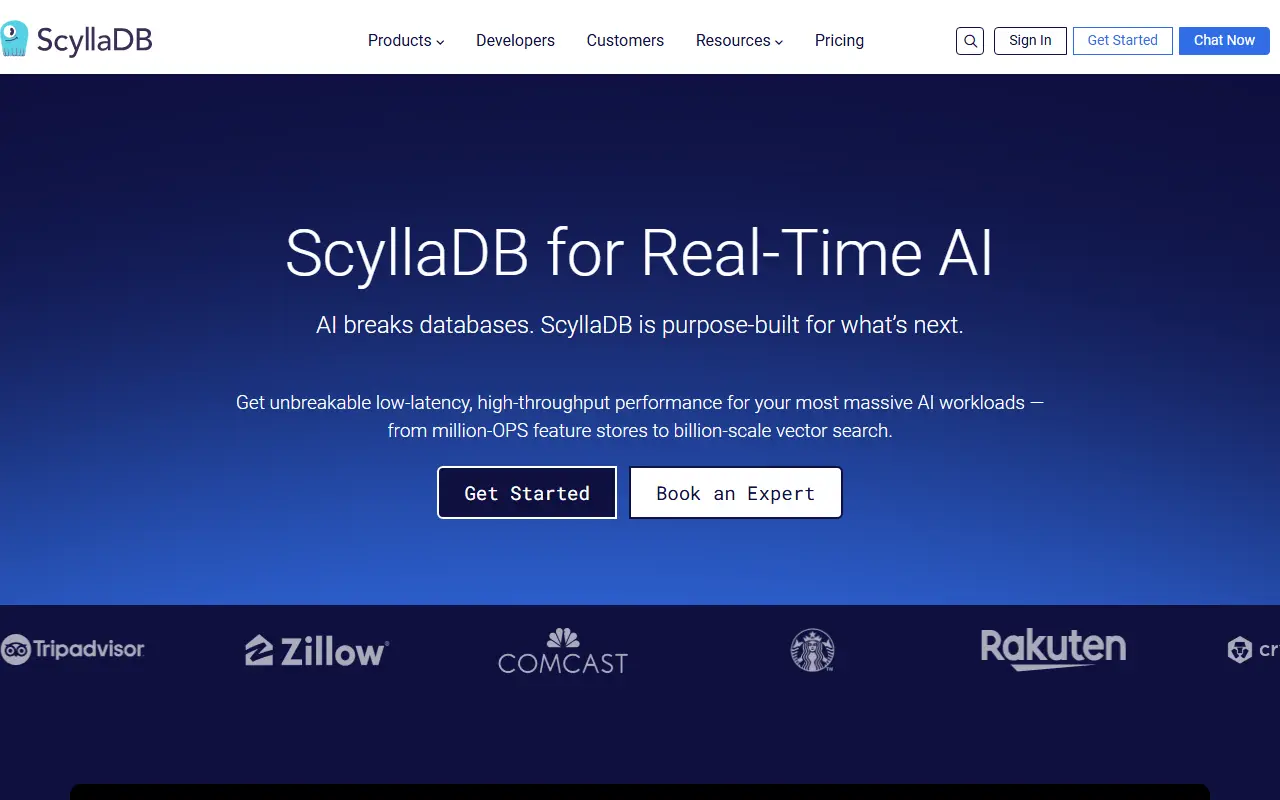
About ScyllaDB
ScyllaDB is a NoSQL database that implements the Apache Cassandra and Amazon DynamoDB APIs, so existing applications and drivers for those systems can talk to it. It is written in C++ on the Seastar framework and is aimed at real-time big data workloads that need high throughput and predictable latency.
The project describes a shared-nothing approach in which each CPU core manages its own slice of data, which it says increases throughput and storage capacity per machine and cuts hardware costs. Building the database is demanding: it needs a very recent C++23 compiler and many up-to-date libraries, so the project offers a frozen toolchain as a pre-configured Docker image that includes everything required. You then only need Docker or Podman to compile it.
The repository's license is listed as 'Other' on GitHub, so confirm the current terms before using it commercially. You can run ScyllaDB on your own servers or consume it as a managed cloud service from the company. It suits teams that have outgrown Cassandra's resource footprint or want a DynamoDB-compatible database they can run themselves.
Key features
- Compatible with the Cassandra API
- Compatible with the DynamoDB API
- Shared-nothing architecture on Seastar
- C++ implementation for high throughput
- Frozen Docker toolchain for building
- Self-hosted or managed cloud
Good fit for
- →Replacing Cassandra with lower hardware cost
- →High-throughput real-time data stores
- →Self-hosted DynamoDB-compatible workloads
- Built with
- C++
- Tags
- nosql
- database
- cassandra-compatible
- dynamodb
- cpp
- seastar
- distributed
- big-data
ScyllaDB: questions and answers
- What is ScyllaDB used for?
- ScyllaDB is a high-throughput C++ NoSQL database on the Seastar framework that speaks the Apache Cassandra and Amazon DynamoDB APIs. It is a good fit for replacing Cassandra with lower hardware cost, high-throughput real-time data stores and self-hosted DynamoDB-compatible workloads.
- Is ScyllaDB open source?
- Yes. ScyllaDB is open source under a custom licence. Its source code is on GitHub at scylladb/scylladb and is written mainly in C++.
- Is ScyllaDB free?
- Yes. ScyllaDB is open source, so the software itself is free to use under the terms of its own licence. A managed cloud version is also available.
- Can I self-host ScyllaDB?
- Yes. ScyllaDB can be self-hosted on your own server or infrastructure.
- What is ScyllaDB an alternative to?
- ScyllaDB is an open-source alternative to Amazon DynamoDB, Azure Cosmos DB, Amazon Keyspaces and Google Cloud Bigtable. Other open-source alternatives to Amazon DynamoDB include Apache Cassandra, MongoDB and RavenDB.
- Is ScyllaDB actively maintained?
- Yes. The most recent commit to ScyllaDB was on 2 October 2026. The project has 16k stars on GitHub.
Open-source alternatives to ScyllaDB
See all
Apache Cassandra
Databases
Open source transactional distributed database. Linear scalability and proven fault-tolera
Apache-2.0vs Amazon DynamoDB★ 10k
MongoDB
Databases
The MongoDB Database
OSSvs Amazon DynamoDB★ 29k
RavenDB
Databases
ACID Document Database
OSSvs MongoDB Atlas★ 4k
Apache CouchDB
Databases
Seamless multi-primary syncing database with an intuitive HTTP/JSON API, designed for reli
Apache-2.0vs Amazon DynamoDB★ 7k
Dragonfly
Databases
A modern replacement for Redis and Memcached
OSSvs Upstash★ 32k
ArangoDB
Databases
🥑 ArangoDB is a native multi-model database with flexible data models for documents, grap
OSSvs Azure Cosmos DB★ 14k
SaaS alternatives to ScyllaDB
See all
Amazon DynamoDB
Databases
Serverless key-value and document database from AWS
SaaS
Azure Cosmos DB
Databases
Microsoft globally distributed multi-model NoSQL database
SaaS
Amazon Keyspaces
Databases
Serverless managed database on AWS compatible with Apache Cassandra
SaaS
Google Cloud Bigtable
Databases
Managed wide-column NoSQL database on Google Cloud for large analytical and operational workloads
SaaS
DataStax Astra DB
Databases
Cassandra-based serverless database with vector search for AI applications
SaaS
Aerospike
Databases
Real-time NoSQL database for low-latency, high-throughput applications
SaaS