#1
An open-source column-oriented database management system built for real-time analytical reports, available to self-host or as the managed ClickHouse Cloud service.
- GitHub stars
- 51k
- Last commit
- today
- Latest release
- v26.10.2.103-stable
- Licence
- Apache-2.0
- Self-hosted
- Yes
- Hosted version
- Available
clickhouse.com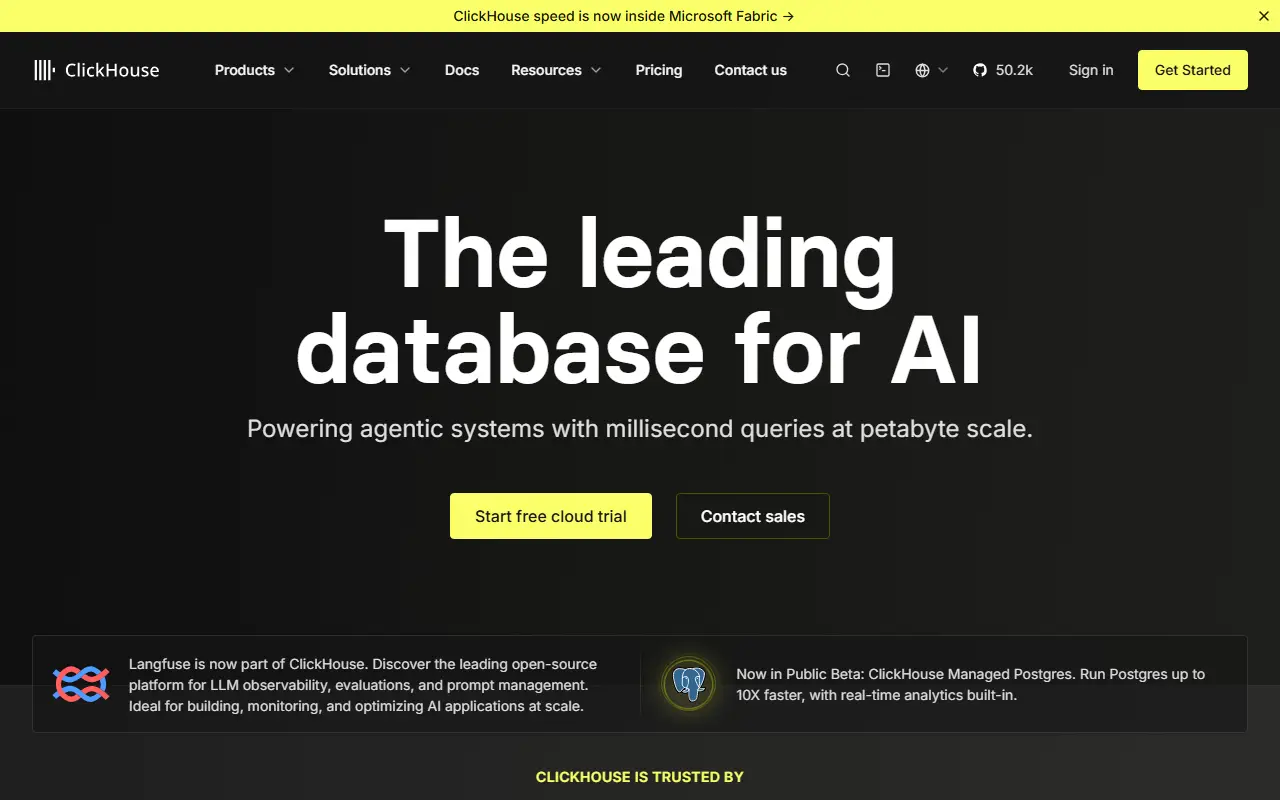
ClickHouse is an open-source database management system built to generate analytical reports in real time. Its column-oriented storage makes scans and aggregations over very large tables efficient, which is why it is widely used for event data, logs, metrics and product analytics. It is written in C++ and queried with SQL.
The project's topics describe it as an OLAP, massively parallel and distributed system, and it is used for big data workloads where query latency matters. You can install it on Linux, macOS or FreeBSD, follow a tutorial that sets up a small cluster, or skip installation by trying ClickHouse Cloud, a managed service built by its creators. Releases arrive monthly, with a community call for each one, and there are Slack and Telegram channels for help.
ClickHouse is Apache-2.0 licensed. It is a good fit for analytics engineers and platform teams who need fast aggregations over billions of rows and are comfortable operating a database, or who prefer to hand that operation to the vendor's cloud.
Key features
- Column-oriented storage for analytics
- SQL queries over large datasets
- Distributed, massively parallel processing
- Real-time analytical reporting
- Install on Linux, macOS or FreeBSD
- Managed ClickHouse Cloud option
Pricing: The open-source distribution is free. ClickHouse Cloud is usage-based, with plans from $53 (Basic), $437 (Scale) and $571 (Enterprise) per month and a 30-day trial with $300 in credits.
#2
An analytics engine for processing large datasets, with APIs in Scala, Java, Python and R and libraries for SQL, machine learning, graphs and streaming.
- GitHub stars
- 44k
- Last commit
- yesterday
- Licence
- Apache-2.0
- Self-hosted
- Yes
spark.apache.org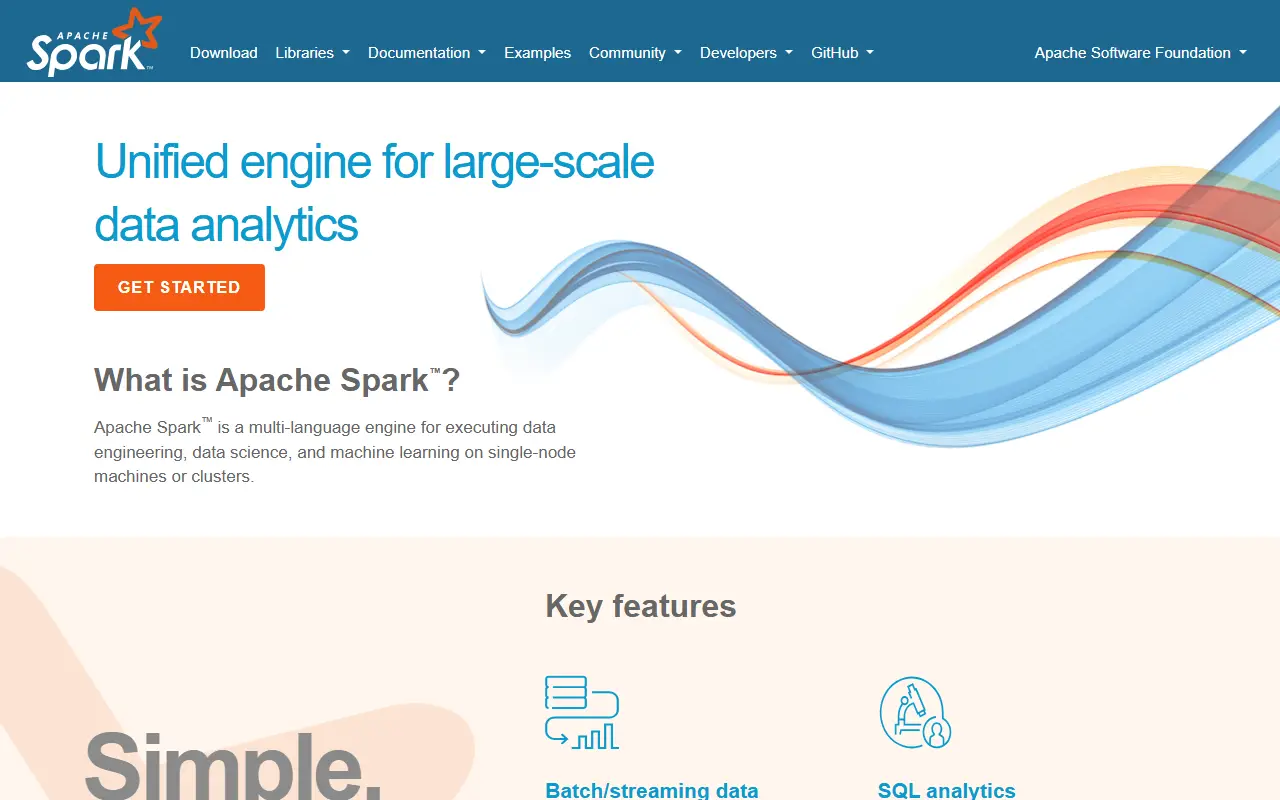
Apache Spark is an analytics engine that brings batch, SQL, machine learning, graph and streaming workloads together for processing data at scale. It is maintained by the Apache Software Foundation under the Apache-2.0 license. It is written mainly in Scala and offers high-level APIs in Scala, Java and Python, with an R API that is now deprecated, on top of an engine optimized to execute general computation graphs.
A set of higher-level tools is included: Spark SQL for queries and DataFrames, MLlib for machine learning, GraphX for graphs, Structured Streaming for streams, and a pandas-style API for existing pandas workloads. Together they let teams run batch analytics, machine learning and streaming jobs on a single engine and share code between them.
The README points to the project website for full documentation and programming guides, and it contains only basic setup and build instructions. Spark suits data engineers and data scientists who process datasets too large for a single machine, and organizations that want one framework for ETL, analytics and machine learning on clusters.
Key features
- High-level APIs in Scala, Java and Python
- Optimized engine for computation graphs
- Spark SQL and DataFrames
- MLlib for machine learning
- GraphX for graph analytics
- Structured Streaming for stream processing
- Pandas API on Spark
Pricing: Free and open source under the Apache-2.0 license.
#3
MariaDB Server is an open-source relational database that began as a fork of MySQL, with vector search, pluggable storage engines and Galera clustering.
- GitHub stars
- 8.6k
- Last commit
- today
- Latest release
- mariadb-13.0.2
- Licence
- GPL-2.0
- Self-hosted
- Yes
mariadb.org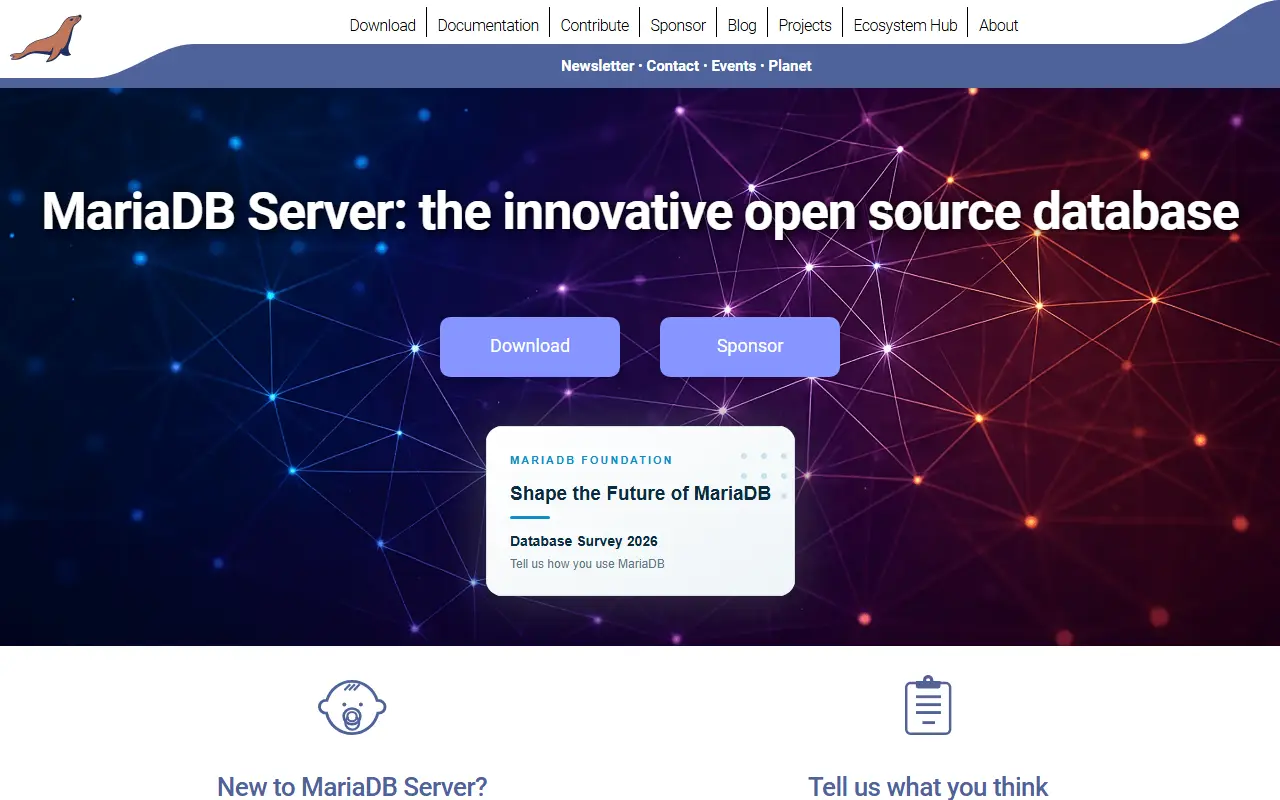
MariaDB Server is an open-source relational database built by a global community with the MariaDB Foundation and MariaDB plc. It started out as a MySQL fork driven by the people who created MySQL, keeps a high degree of MySQL compatibility, and is described as a straightforward migration target for existing MySQL deployments.
Since then it has gained its own capabilities. A native VECTOR data type with approximate nearest-neighbour HNSW indexing has been available since version 11.8. Pluggable storage engines include InnoDB, Aria and MyRocks, plus ColumnStore (analytics), Spider (sharding) and S3 (archiving). Replication options include async, semi-sync and parallel modes using global transaction IDs, and Galera provides synchronous multi-primary clustering. On the SQL side it offers common table expressions, window functions, temporal tables with system versioning, sequences and a range of JSON functions.
It also offers an Oracle SQL mode with PL/SQL-style routines, GIS data types and full-text indexing, and security features such as role-based access control, pluggable authentication, data-at-rest encryption and TLS. MariaDB is written in C++ and licensed under GPL-2.0, and you run it on your own servers or in the cloud.
Key features
- Native vector search with HNSW indexing
- Pluggable storage engines including InnoDB
- Galera synchronous multi-primary clustering
- Temporal tables and window functions
- MySQL and Oracle compatibility modes
- Spatial and full-text indexing
- Role-based access and data-at-rest encryption
Pricing: Free and open source under the GPL-2.0 licence.
#4
A distributed SQL query engine for big data analytics that runs fast queries across many data sources, formerly known as PrestoSQL.
- GitHub stars
- 14k
- Last commit
- today
- Latest release
- 484
- Licence
- Apache-2.0
- Self-hosted
- Yes
trino.io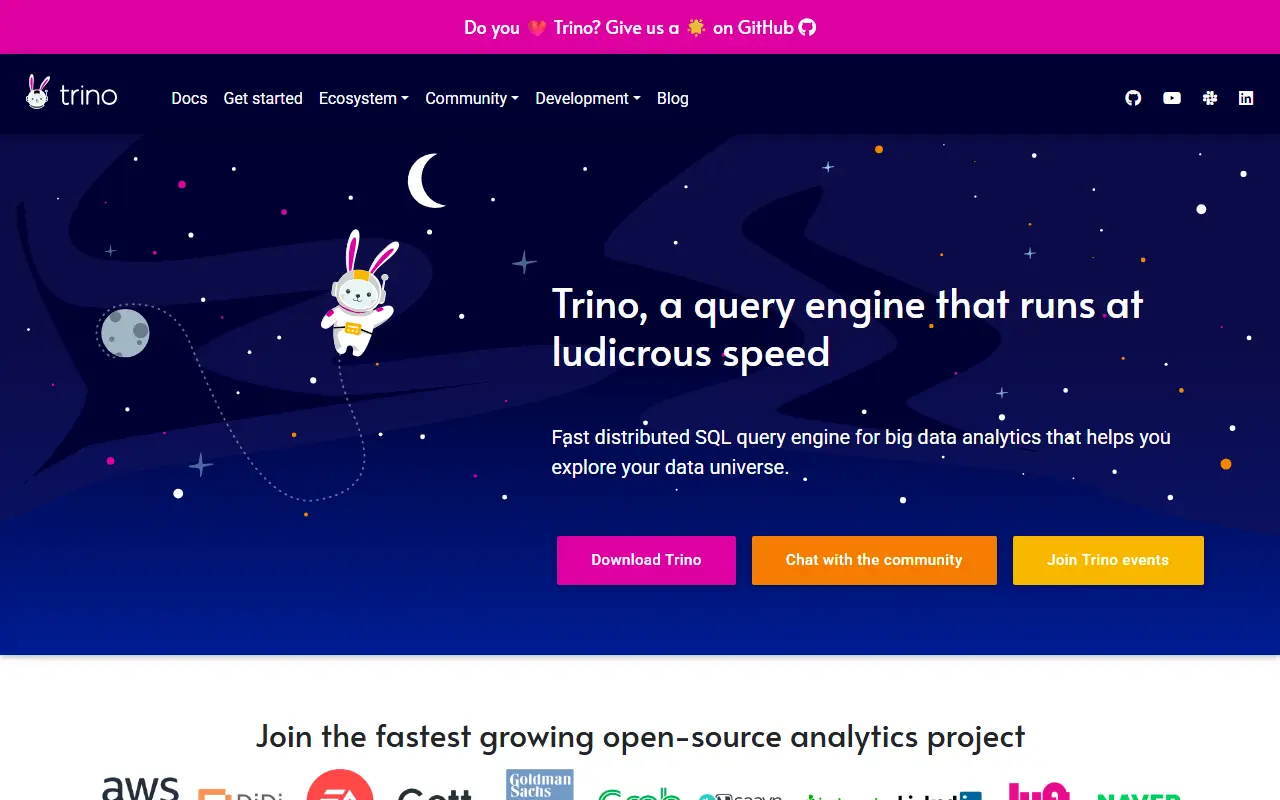
Trino is a distributed SQL query engine built for analytics on large data sets. It was formerly called PrestoSQL, and it lets analysts and engineers run interactive SQL against data wherever it lives rather than first moving it into a single warehouse.
The project's topics point to its role in the data lake ecosystem, with connectors and integrations for systems such as Hive, Hadoop, Iceberg and Delta Lake, and a JDBC driver for applications. Trino is a Maven project written in Java, and its repository covers development guidelines, plugin implementors, a security policy and reproducible builds. It runs as a cluster of servers and has a web UI.
Trino is released under the Apache-2.0 licence and is deployed and operated by the user, with deployment instructions and end-user documentation in the project's user manual. It is a fit for data platform teams that need fast, standards-based SQL over many sources, rather than for individual analysts looking for a point-and-click tool.
Key features
- Distributed SQL query engine
- Fast analytics on big data
- Connectors for data lake formats like Iceberg
- JDBC access for applications
- Plugin architecture for custom connectors
- Reproducible builds since version 449
Pricing: Free and open source under the Apache-2.0 licence.
#5
Apache Doris is an open-source, MPP real-time analytics and hybrid search database for fast SQL, lakehouse query acceleration and vector and text search.
- GitHub stars
- 16k
- Last commit
- yesterday
- Latest release
- 4.1.5-release
- Licence
- Apache-2.0
- Self-hosted
- Yes
doris.apache.org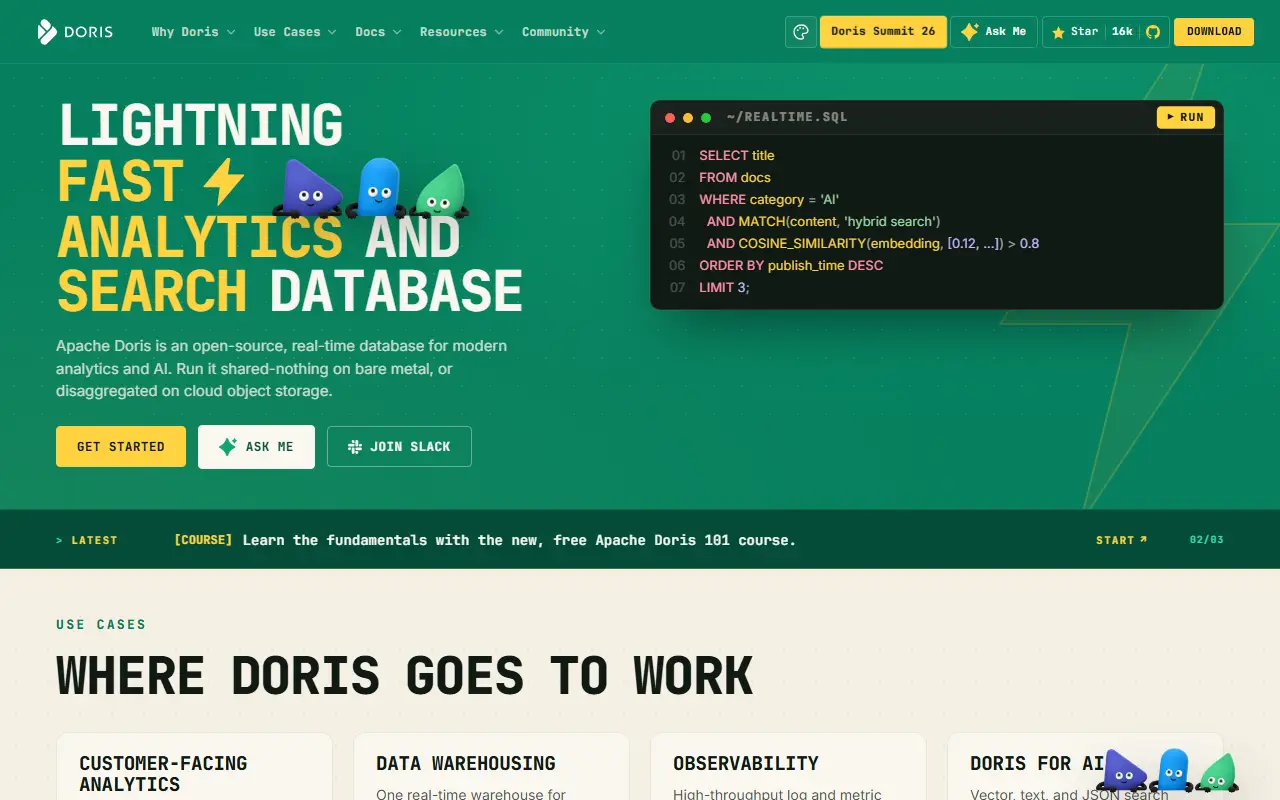
Apache Doris is an open-source analytics database built on a massively parallel processing architecture. It offers fast SQL analytics, acceleration of queries over lakehouse data, and hybrid search spanning structured, text and vector data, and it presents itself as a real-time analytics and search engine suitable for AI agents. It is written in Java.
The README lists use cases that include customer-facing analytics with sub-second interactive queries for external users, data warehousing across business domains, observability for high-throughput logs, events and metrics analyzed with SQL, and AI use where vector, text, JSON and structured search run in one SQL engine. Topics mention lakehouse formats Hudi, Iceberg and Delta Lake and comparisons with warehouses such as BigQuery, Redshift and Snowflake.
Doris is a project of the Apache Software Foundation and Apache-2.0 licensed. You can deploy it on your own clusters, and the website provides release notes, use cases and user stories, with documentation in a large number of languages. It suits data engineering teams that want an open-source, high-concurrency analytical database.
Key features
- MPP architecture for fast SQL analytics
- Lakehouse query acceleration
- Hybrid search across structured, text and vector data
- Real-time ingestion and analysis
- Support for Iceberg, Hudi and Delta Lake
- Apache Software Foundation project
Pricing: Free and open source under the Apache-2.0 license.
#6
A high-throughput C++ NoSQL database on the Seastar framework that speaks the Apache Cassandra and Amazon DynamoDB APIs.
- GitHub stars
- 16k
- Last commit
- today
- Self-hosted
- Yes
- Hosted version
- Available
scylladb.com
ScyllaDB is a NoSQL database that implements the Apache Cassandra and Amazon DynamoDB APIs, so existing applications and drivers for those systems can talk to it. It is written in C++ on the Seastar framework and is aimed at real-time big data workloads that need high throughput and predictable latency.
The project describes a shared-nothing approach in which each CPU core manages its own slice of data, which it says increases throughput and storage capacity per machine and cuts hardware costs. Building the database is demanding: it needs a very recent C++23 compiler and many up-to-date libraries, so the project offers a frozen toolchain as a pre-configured Docker image that includes everything required. You then only need Docker or Podman to compile it.
The repository's license is listed as 'Other' on GitHub, so confirm the current terms before using it commercially. You can run ScyllaDB on your own servers or consume it as a managed cloud service from the company. It suits teams that have outgrown Cassandra's resource footprint or want a DynamoDB-compatible database they can run themselves.
Key features
- Compatible with the Cassandra API
- Compatible with the DynamoDB API
- Shared-nothing architecture on Seastar
- C++ implementation for high throughput
- Frozen Docker toolchain for building
- Self-hosted or managed cloud
Pricing: ScyllaDB Cloud comes in Standard, Professional and Premium tiers with no list prices on the page; Standard is costed with an online calculator and the other two by quote. A self-managed edition is also listed.
#7
A Linux Foundation project: an analytical SQL engine for real-time and ad-hoc queries, running on its own storage or directly over data lakehouse tables.
- GitHub stars
- 12k
- Last commit
- today
- Latest release
- 4.1.7
- Licence
- Apache-2.0
- Self-hosted
- Yes
starrocks.io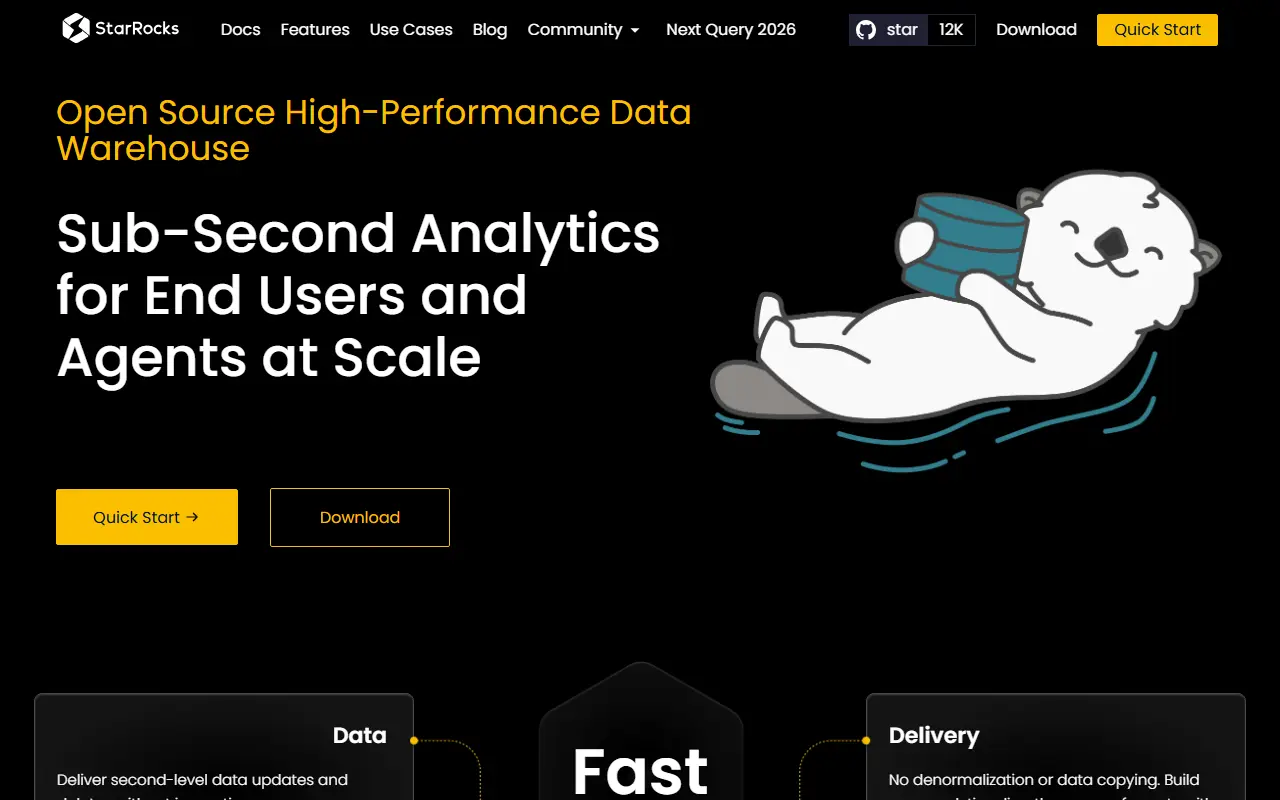
StarRocks is a query engine for analytics that returns answers quickly to multi-dimensional, real-time and ad-hoc queries. It is a Linux Foundation project written in Java, and can be used both on its own tables and over data that sits in a data lake or lakehouse without first moving it.
It uses a vectorized SQL engine that takes advantage of CPU parallelism, supports standard ANSI SQL and the MySQL protocol so existing clients and BI tools can connect, and applies a cost-based optimizer to complex queries. Primary-key tables support upserts and deletes with efficient querying during concurrent updates, and materialized views refresh during data import and are chosen automatically at query time.
Data in Hive, Iceberg, Delta Lake and Hudi tables can be queried in place, and its topics point to star-schema, MPP and distributed-database designs. The software is licensed under Apache-2.0 and can be downloaded and run yourself, with documentation, benchmarks and a demo linked from the README. It suits data teams that want fast dashboards and lakehouse analytics without heavy denormalization.
Key features
- Vectorized SQL engine for fast analytics
- ANSI SQL with MySQL protocol compatibility
- Cost-based query optimizer
- Real-time upserts and deletes by primary key
- Automatically maintained materialized views
- Direct queries over Hive, Iceberg, Delta Lake and Hudi
Pricing: Free and open source under the Apache-2.0 licence.
#8
Apache Cassandra is an open-source distributed NoSQL database built for linear scalability and fault tolerance on commodity hardware or cloud infrastructure.
- GitHub stars
- 10k
- Last commit
- yesterday
- Licence
- Apache-2.0
- Self-hosted
- Yes
cassandra.apache.org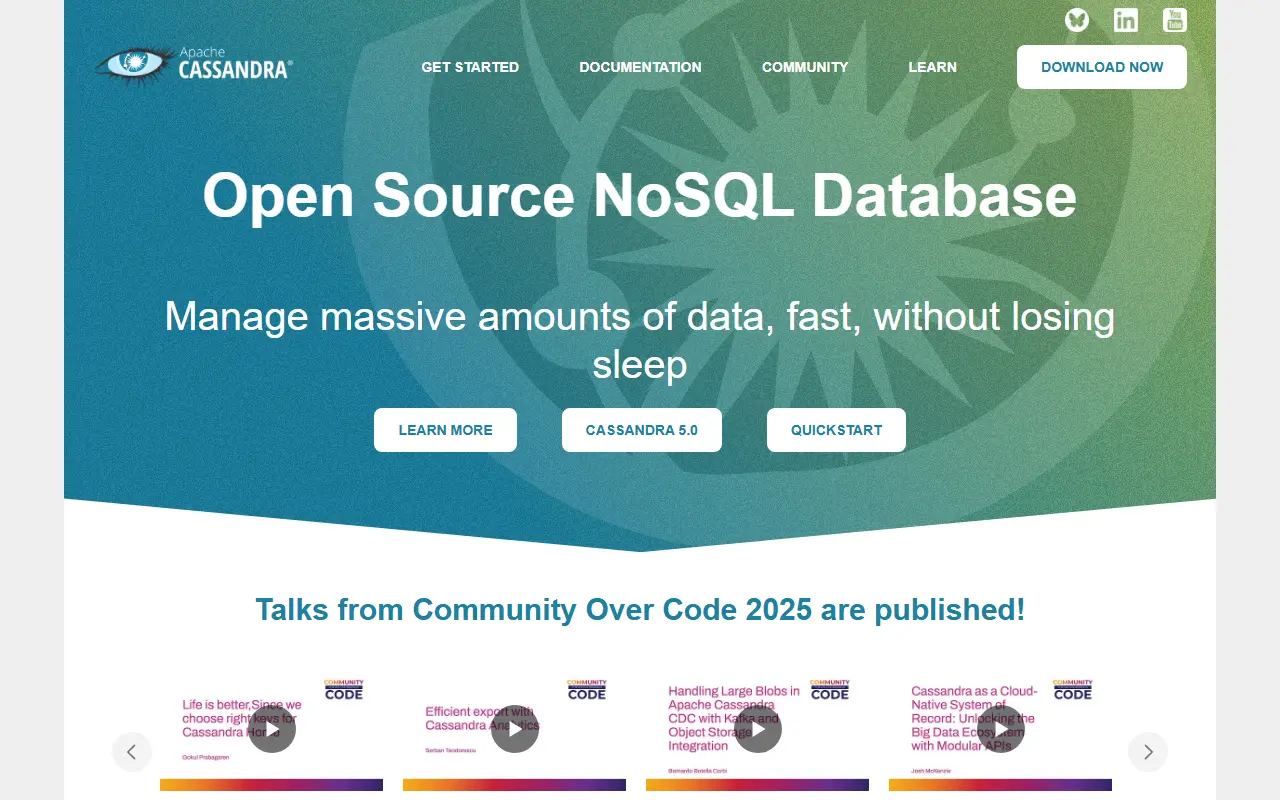
Apache Cassandra is an open-source, transactional, distributed NoSQL database. It is built to manage very large amounts of data across many machines, aiming for linear scalability and proven fault tolerance whether it runs on commodity servers or in the cloud, with no loss of performance. It is written in Java and developed under the Apache Software Foundation.
The project site presents Cassandra 5.0 along with documentation, a quickstart and community resources, and recent talks from the community cover topics such as Storage Attached Indexes, the Accord transaction protocol, mutation tracking, backups with Medusa, a sidecar process and analytics integrations. Cassandra is queried through CQL and can be run in clusters spanning racks, data centers or cloud regions.
Cassandra is licensed under Apache-2.0 and you run it yourself, either on your own servers or on cloud virtual machines or Kubernetes. It is typically chosen for write-heavy, always-on applications such as time-series data, messaging, IoT and large user-facing systems that must stay available when individual nodes fail.
Key features
- Distributed NoSQL storage
- Linear scalability across nodes
- Fault tolerance on commodity hardware
- CQL query language
- Storage Attached Indexes in 5.0
- Multi data center deployments
Pricing: Free and open source under the Apache-2.0 licence.
#9
An open-source cloud data warehouse written in Rust that unifies analytics, vector search and full-text search on object storage, with sandboxed UDFs for AI agents.
- GitHub stars
- 9.5k
- Last commit
- today
- Latest release
- v1.2.881
- Self-hosted
- Yes
- Hosted version
- Available
docs.databend.com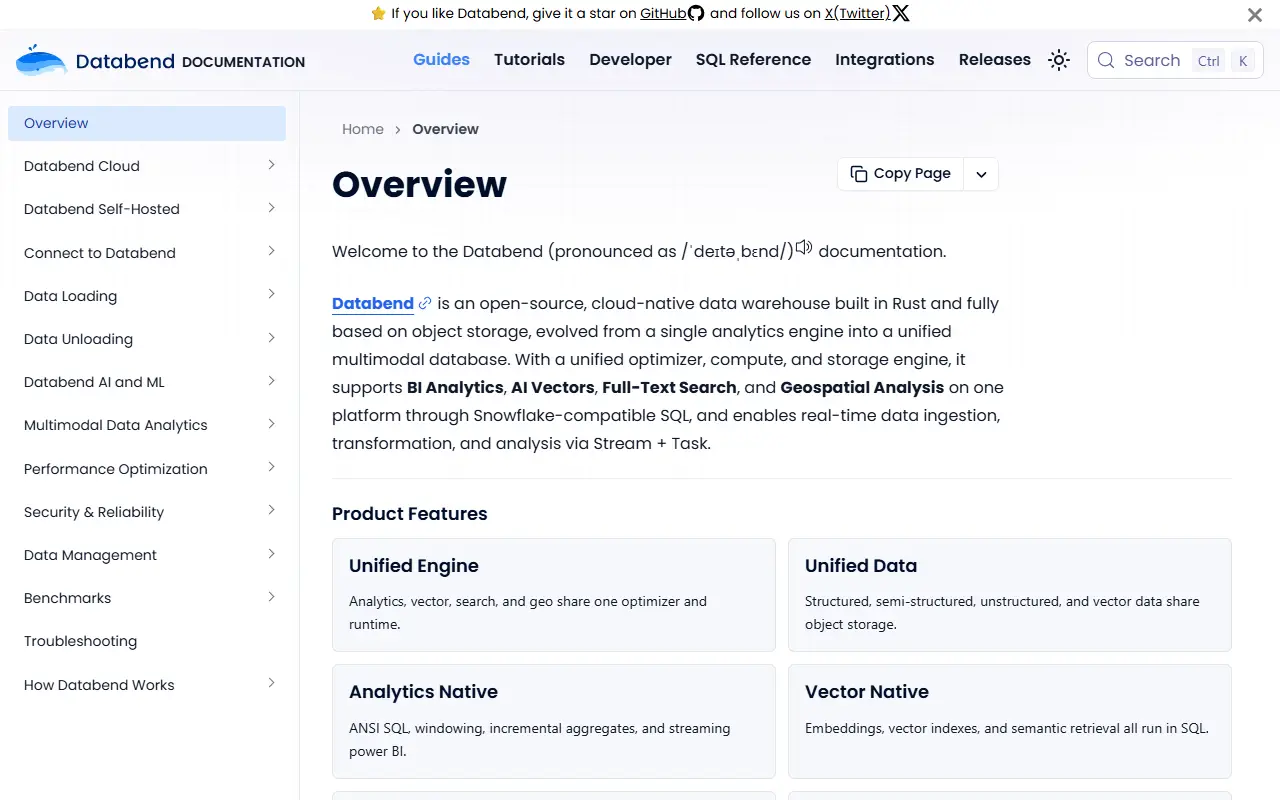
Databend is an enterprise-grade, open-source data warehouse written in Rust. It combines large-scale analytics, vector search, full-text search and automatic schema evolution in one engine, and keeps data in object storage such as S3, Azure Blob Storage or Google Cloud Storage with elastic, cloud-native compute.
The project now positions itself as a warehouse that is ready for AI agents. Sandboxed Python user-defined functions run agent logic, SQL handles orchestration, transactions provide reliability, and Git-like branching lets agents experiment safely on production snapshots. A three-layer architecture separates the control plane, the execution plane and the sandbox workers. Typical use cases listed include AI agents, analytics and BI, and search and RAG.
You can use the managed Databend Cloud, run it locally from Python for development and testing, or start the full warehouse in Docker. The repository lists the licence as Other, so review the licence file before commercial use. Topics reference Snowflake and Elasticsearch as comparable products.
Key features
- Large-scale SQL analytics
- Vector and full-text search
- Automatic schema evolution
- Sandboxed Python UDFs for agents
- Git-like data branching
- Object storage on S3, Azure or GCS
- Cloud, Docker and local Python options
Pricing: Databend Cloud offers a free start; the repository lists the license as Other.
#10
Delta Lake is an open-source storage layer that adds ACID transactions to data lakes and supports lakehouse architectures with Spark, Flink, Trino and other engines.
- GitHub stars
- 9.1k
- Last commit
- today
- Latest release
- v4.4.1
- Licence
- Apache-2.0
delta.io
Delta Lake is an open-source storage framework for building a lakehouse architecture on top of data lake storage. It works with compute engines including Apache Spark, PrestoDB, Flink, Trino and Hive, and offers APIs for Scala, Java, Rust, Ruby and Python. Its topics reference ACID transactions, big data and analytics.
The repository documents a transaction protocol, requirements for the underlying storage systems and concurrency control, and ships a quick start for Scala, Java and Python. A set of integrations connects the format to other tools: Spark can read and write Delta tables, Flink can write to them, PrestoDB and Hive can read them, Trino can read and write, Delta Standalone serves JVM projects and the Delta Rust API gives low-level access to tables with Python and Ruby bindings.
This repository is one of several in the Delta Lake organization, alongside delta-rs, delta-sharing and kafka-delta-ingest. The code is written in Scala and licensed under Apache-2.0. It is used by data engineering teams that want reliable tables on object storage, and it is a library and format rather than a hosted product.
Key features
- ACID transactions on data lake storage
- Works with Spark, Flink, Trino and Hive
- APIs for Scala, Java, Rust, Ruby and Python
- Open transaction protocol specification
- Delta Standalone for JVM projects
- Delta Rust API with Python bindings
Pricing: Free and open source under the Apache-2.0 licence.
7 more Snowflake alternatives
Snowflake alternatives: questions
- What is the best open-source alternative to Snowflake?
- ClickHouse is the top-ranked open-source alternative to Snowflake on Enlisted: An open-source column-oriented database management system built for real-time analytical reports, available to self-host or as the managed ClickHouse Cloud service. Other strong options are Apache Spark, MariaDB, Trino and Apache Doris.
- What are the best commercial alternatives to Snowflake?
- Google BigQuery, MotherDuck, Databricks, Tinybird and SingleStore are among the hosted, closed-source alternatives to Snowflake listed on Enlisted, which lists 28 in total. Compare their pricing and features on each tool page.
- Are these Snowflake alternatives free?
- All 17 are open source, so the code is free to use under its licence, and all of them can be self-hosted on your own server or computer. 4 also offer a paid or managed cloud version if you'd rather not host it yourself.
- How is this list of Snowflake alternatives ranked?
- By a score built from GitHub stars, star growth over the last 30 days and how recently the code changed. 13 of these projects shipped code in the last 30 days. Data is refreshed daily, and nobody can pay to move up.
 TrackMedia
 TrackRev