7,363 open-source and SaaS tools, with GitHub stats refreshed every day.

6 alternatives ranked by real activity

Open-source KX kdb+ alternatives

A curated, ranked list of the 6 best open-source alternatives to KX kdb+.

The best open-source alternative to KX kdb+ is ClickHouse. If that doesn't suit you, other good options are InfluxDB, TDengine, TimescaleDB and QuestDB.

KX kdb+ alternatives are mainly databases. 6 of them shipped code in the last 30 days, 6 can be self-hosted, and 4 use a permissive licence.

Last updated October 3, 2026 · ranked by GitHub stars, growth and recent commits

ClickHouse

An open-source column-oriented database management system built for real-time analytical reports, available to self-host or as the managed ClickHouse Cloud service.

GitHub stars
50k
Last commit
today
Latest release
v26.9.8.3-stable
Licence
Apache-2.0
Self-hosted
Yes
Hosted version
Available
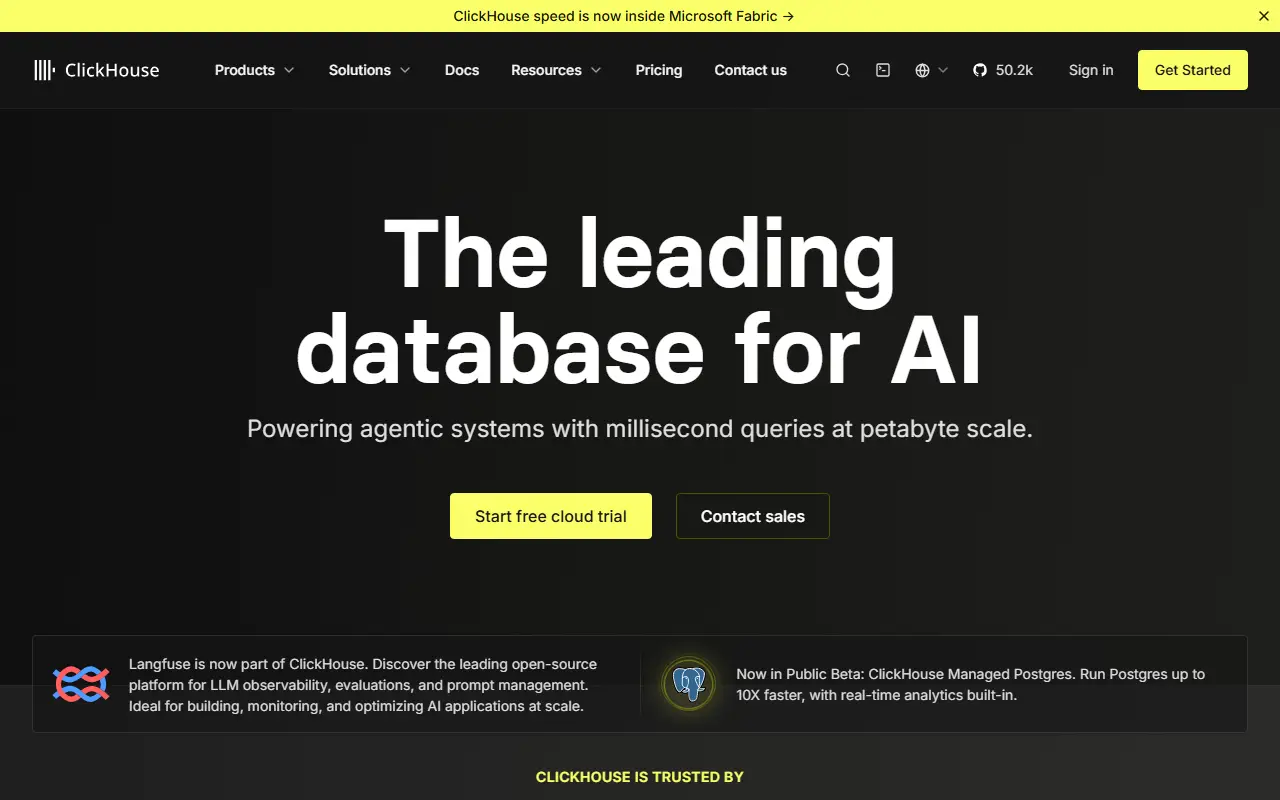
clickhouse.comClickHouse homepage screenshot

ClickHouse is an open-source database management system built to generate analytical reports in real time. Its column-oriented storage makes scans and aggregations over very large tables efficient, which is why it is widely used for event data, logs, metrics and product analytics. It is written in C++ and queried with SQL.

The project's topics describe it as an OLAP, massively parallel and distributed system, and it is used for big data workloads where query latency matters. You can install it on Linux, macOS or FreeBSD, follow a tutorial that sets up a small cluster, or skip installation by trying ClickHouse Cloud, a managed service built by its creators. Releases arrive monthly, with a community call for each one, and there are Slack and Telegram channels for help.

ClickHouse is Apache-2.0 licensed. It is a good fit for analytics engineers and platform teams who need fast aggregations over billions of rows and are comfortable operating a database, or who prefer to hand that operation to the vendor's cloud.

Key features

  • Column-oriented storage for analytics
  • SQL queries over large datasets
  • Distributed, massively parallel processing
  • Real-time analytical reporting
  • Install on Linux, macOS or FreeBSD
  • Managed ClickHouse Cloud option

Pricing: The open-source distribution is free. ClickHouse Cloud is usage-based, with plans from $53 (Basic), $437 (Scale) and $571 (Enterprise) per month and a 30-day trial with $300 in credits.

InfluxDB

InfluxDB 3 Core is an open-source time series database for ingesting and querying events and metrics in near real time, built on Apache Arrow, DataFusion and Parquet.

GitHub stars
32k
Last commit
yesterday
Latest release
v3.11.4
Licence
Apache-2.0
Self-hosted
Yes
Hosted version
Available
influxdata.comInfluxDB homepage screenshot

InfluxDB is an open-source time series database for collecting, processing, transforming and storing event and metrics data. The current Core edition of InfluxDB 3 is written in Rust and builds on Apache Arrow, DataFusion and Parquet, and it targets workloads where data must be ingested continuously and queried quickly enough to drive dashboards, interactive interfaces and automation.

The README lists typical uses such as sensor monitoring, server and network monitoring, application performance monitoring, financial market analytics and behavioral analytics. Feature highlights include a diskless architecture that can store data in object storage or on local disk with no extra dependencies, an embedded Python virtual machine for plugins and triggers, and persistence in Parquet files. The project quotes very low query latency for last-value lookups, though real numbers depend on your hardware and data.

InfluxDB is Apache-2.0 licensed and can be run on your own servers. InfluxData, the company behind it, also sells hosted and commercial editions. The topics list monitoring, metrics and time series, and it commonly sits behind visualization tools such as Grafana in observability stacks.

Key features

  • Time series storage for events and metrics
  • Diskless architecture with object storage support
  • Embedded Python VM for plugins and triggers
  • Parquet file persistence
  • Built on Apache Arrow and DataFusion
  • Fast queries for dashboards and monitoring

Pricing: InfluxDB 3 Core is free. Cloud Serverless is metered on data written, queries, storage and data out, with a free tier and $250 credit; Enterprise and Cloud Dedicated are quoted by sales.

TDengine

An open-source, cloud-native time-series database for IoT, connected vehicles and industrial data, with built-in caching, stream processing and data subscription.

GitHub stars
25k
Last commit
4 days ago
Latest release
ver-3.4.1.6
Licence
AGPL-3.0
Self-hosted
Yes
Hosted version
Available
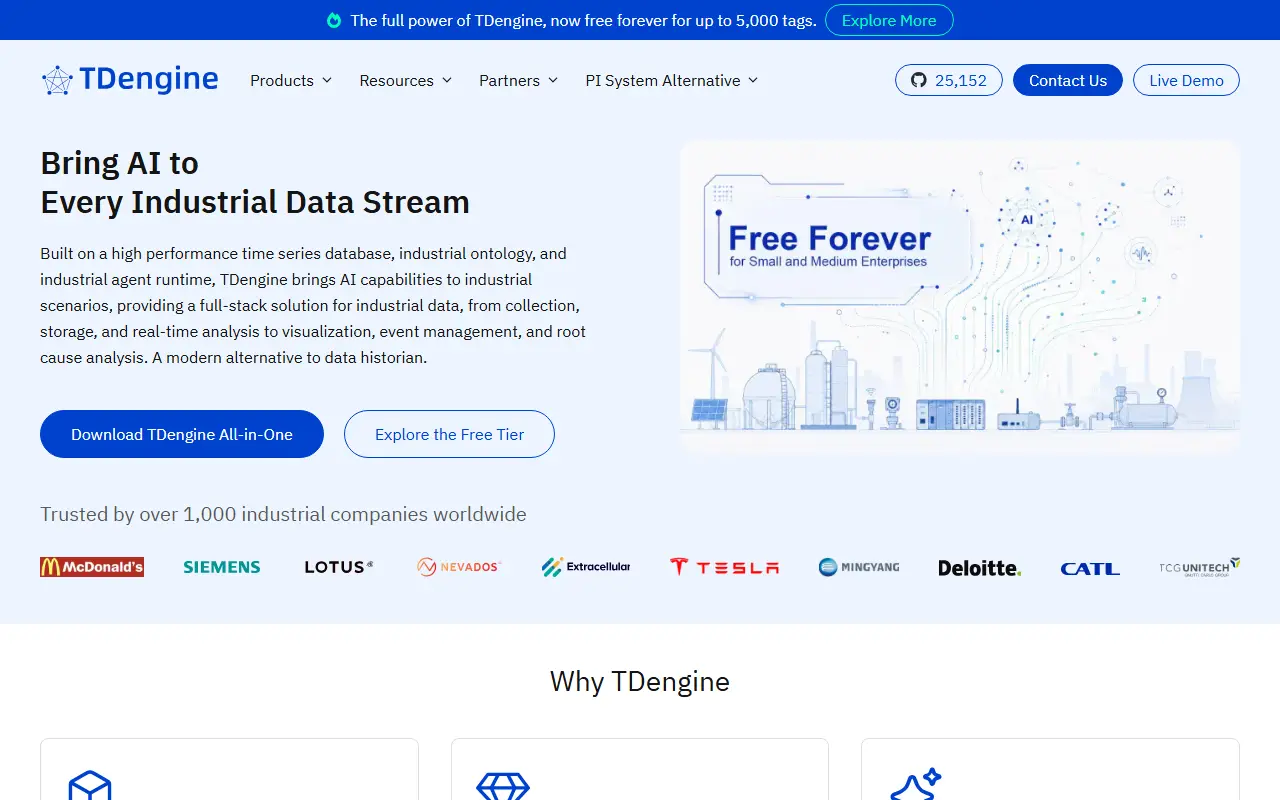
tdengine.comTDengine homepage screenshot

TDengine is an open-source time-series database designed for Internet of Things, connected car and Industrial IoT scenarios. It is built for efficient, real-time ingestion, processing and analysis of very large volumes of sensor data, and the maintainers describe it as cloud native and AI powered.

Rather than assembling a time-series store, a cache, a message queue and a stream processor separately, TDengine includes caching, stream processing, data subscription and AI agent capabilities in a single system, which aims to reduce design complexity and operating cost. It uses a natively distributed design with sharding and partitioning, is queried with SQL, and targets workloads where billions of data collection points report continuously.

TDengine is written in C and licensed under AGPL-3.0, and it can be self-hosted or used through TDengine Cloud, the managed service. Documentation is available in English, Chinese and Japanese. It fits manufacturers, energy and vehicle platforms and monitoring teams that collect high-frequency telemetry and need compact storage and fast queries.

Key features

  • Time-series storage for IoT data
  • Built-in caching and stream processing
  • Data subscription feature
  • SQL query interface
  • Distributed sharding and partitioning
  • TDengine Cloud managed option

Pricing: Self-hosted use is free up to 5,000 tags; beyond that an annual license starts at $12,500 or a perpetual license at $31,250. Managed cloud packages start at $970 per month for 5,000 tags.

TimescaleDB

A PostgreSQL extension that adds time-series storage, hypertables and a columnstore for fast, real-time analytics on event data.

GitHub stars
24k
Last commit
today
Latest release
2.30.2
Self-hosted
Yes
Hosted version
Available
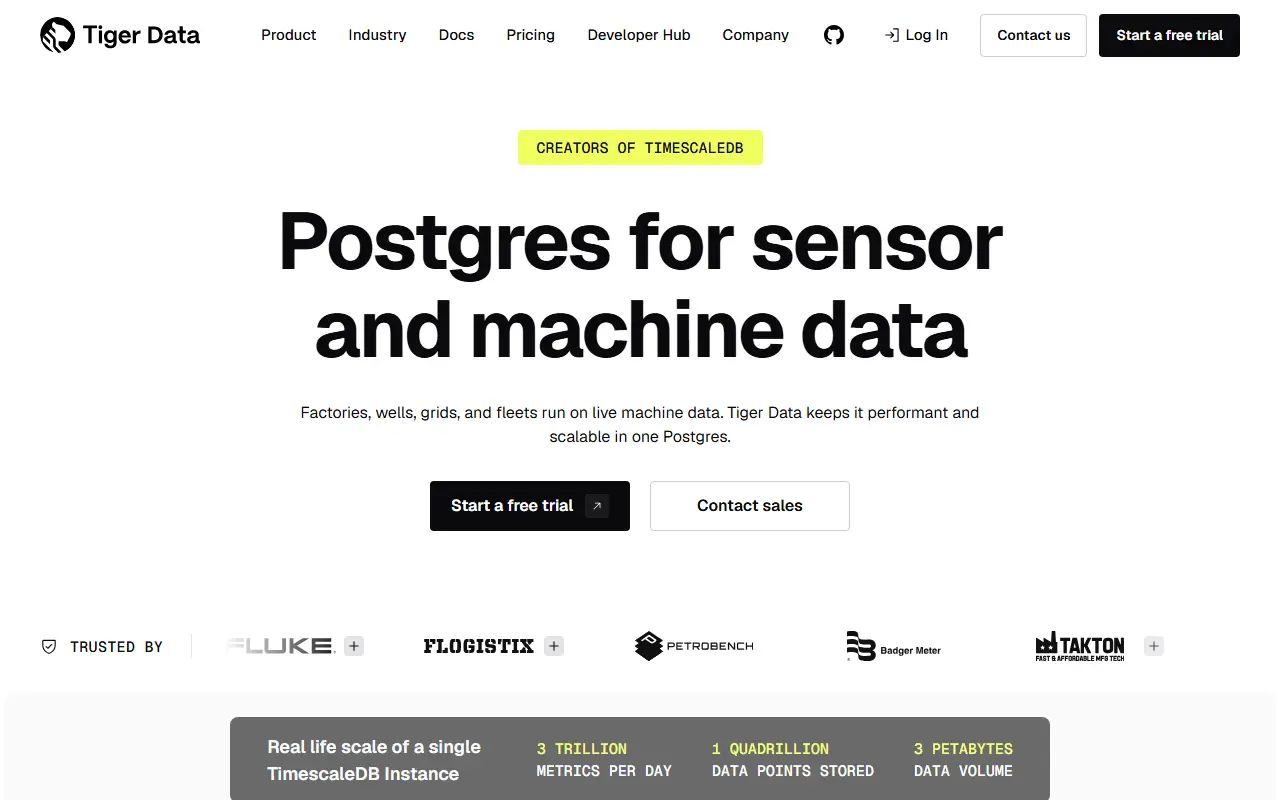
tigerdata.comTimescaleDB homepage screenshot

TimescaleDB is a PostgreSQL extension that turns Postgres into a database for time-series and event data, aimed at real-time analytics. Because it lives inside PostgreSQL, you keep SQL, existing tools and the broader Postgres ecosystem while gaining storage and query features designed for data that arrives continuously with timestamps.

The quick start walks through running it locally with a one-line install script or Docker, creating a hypertable with the columnstore enabled, inserting data directly into the columnstore and running analytical queries. It suggests Docker, around 8 GB of RAM and a psql or other PostgreSQL client, and warns that the install script is meant for local development and testing, not production. Topics list uses such as IoT, financial analysis and historian data.

The code is written in C, and its license is listed as 'Other' on GitHub because some features sit under Timescale's own license rather than a standard open-source one, so check which apply to you. The company, now branded TigerData, also runs a hosted cloud service. It suits teams who want time-series features without leaving PostgreSQL.

Key features

  • PostgreSQL extension for time-series data
  • Hypertables with columnstore
  • Fast analytical queries on event data
  • Full SQL and Postgres tooling compatibility
  • Docker and one-line local install
  • Managed cloud service from the vendor

Pricing: The open-source TimescaleDB is free to self-host. Tiger Cloud compute starts at $30 per month on Performance and $36 on Scale, plus storage, billed hourly with a 30-day free trial; Enterprise is by contact.

QuestDB

An open-source, low-latency time-series database with a single SQL engine for ingestion, stream processing and tiered storage on open formats like Parquet.

GitHub stars
17k
Last commit
today
Latest release
10.0.1
Licence
Apache-2.0
Self-hosted
Yes
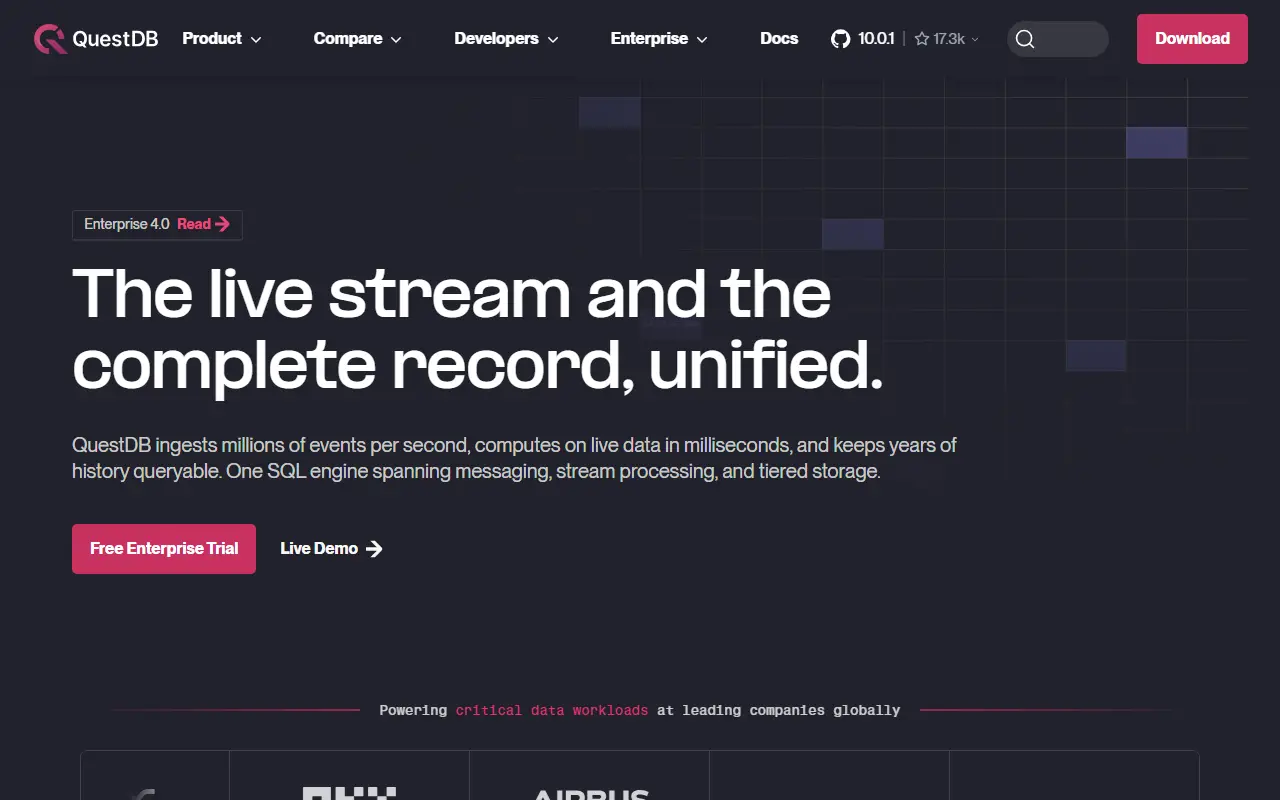
questdb.comQuestDB homepage screenshot

QuestDB is an open-source time-series database aimed at high-speed ingestion and fast analytical queries, with a focus on use cases such as capital markets, tick data and real-time analytics. One SQL engine covers ingestion, stream processing and long-term storage, so teams query live data and years of history the same way.

The engine is written in Java that avoids garbage collection, with C++ and Rust used on performance-critical paths. Data is held in memory-mapped, time-partitioned columns, and queries run across all CPU cores using SIMD and JIT-compiled filters. No third-party libraries sit on the data path. Data moves through three storage tiers: Apache Parquet files, native columnar partitions, and a write-ahead log that is written in parallel. In the open-source edition you convert partitions to Parquet manually, while the Enterprise edition automates tiering to object storage. Because the data stays in open formats (Parquet, Iceberg and Arrow), other tools can read it, and the README publishes benchmark figures for ingestion and query streaming.

QuestDB is Apache-2.0 licensed and runs on your own servers, with documentation also available in Chinese. It suits teams building financial, industrial or telemetry platforms who need very fast time-series ingestion.

Key features

  • Single SQL engine for time-series data
  • Very high-speed event ingestion
  • SIMD and JIT-accelerated queries
  • Tiered storage with Parquet
  • Open formats: Parquet, Iceberg and Arrow
  • Memory-mapped time-partitioned columns

Pricing: The open-source edition is free under the Apache-2.0 license; an Enterprise edition adds features such as automatic tiering.

Apache IoTDB

Apache IoTDB is a time series database built for IoT data, covering collection, storage and analysis with integration into Hadoop and Spark.

GitHub stars
6.4k
Last commit
today
Latest release
v2.0.11
Licence
Apache-2.0
Self-hosted
Yes
iotdb.apache.orgApache IoTDB homepage screenshot

Apache IoTDB manages time series data produced by Internet of Things devices. It provides services for collecting, storing and analyzing measurements, and is designed for the industrial IoT field, where datasets are very large and data arrives at high throughput.

The project highlights a lightweight structure, high performance and usable features, along with integration with the Hadoop and Spark ecosystems for complex analysis. It relies on TsFile, a columnar storage file format created for time series data, which is developed as a related project. The system is written in Java and is categorized as a NoSQL time series database.

IoTDB is an Apache Software Foundation project under the Apache-2.0 license and can be deployed on your own servers. The README is available in English and Chinese, and it suits teams that need to store and analyze large volumes of sensor readings.

Key features

  • Time series data collection and storage
  • Columnar TsFile storage format
  • Hadoop and Spark integration
  • High-throughput data ingestion
  • Lightweight, high-performance architecture
  • Analysis of large IoT datasets

Pricing: Free and open source under the Apache-2.0 license.

KX kdb+ alternatives: questions

What is the best open-source alternative to KX kdb+?
ClickHouse is the top-ranked open-source alternative to KX kdb+ on Enlisted: An open-source column-oriented database management system built for real-time analytical reports, available to self-host or as the managed ClickHouse Cloud service. Other strong options are InfluxDB, TDengine, TimescaleDB and QuestDB.
Are these KX kdb+ alternatives free?
All 6 are open source, so the code is free to use under its licence, and all of them can be self-hosted on your own server or computer. 4 also offer a paid or managed cloud version if you'd rather not host it yourself.
How is this list of KX kdb+ alternatives ranked?
By a score built from GitHub stars, star growth over the last 30 days and how recently the code changed. 6 of these projects shipped code in the last 30 days. Data is refreshed daily, and nobody can pay to move up.

People also look for alternatives to…

View all