7,363 open-source and SaaS tools, with GitHub stats refreshed every day.

6 alternatives ranked by real activity

Open-source SingleStore alternatives

A curated, ranked list of the 6 best open-source alternatives to SingleStore.

The best open-source alternative to SingleStore is ClickHouse. If that doesn't suit you, other good options are TiDB, Apache Doris, StarRocks and OceanBase.

SingleStore alternatives are mainly databases. 6 of them shipped code in the last 30 days, 6 can be self-hosted, and 6 use a permissive licence.

Last updated October 2, 2026 · ranked by GitHub stars, growth and recent commits

ClickHouse

An open-source column-oriented database management system built for real-time analytical reports, available to self-host or as the managed ClickHouse Cloud service.

GitHub stars
50k
Last commit
today
Latest release
v26.9.8.3-stable
Licence
Apache-2.0
Self-hosted
Yes
Hosted version
Available
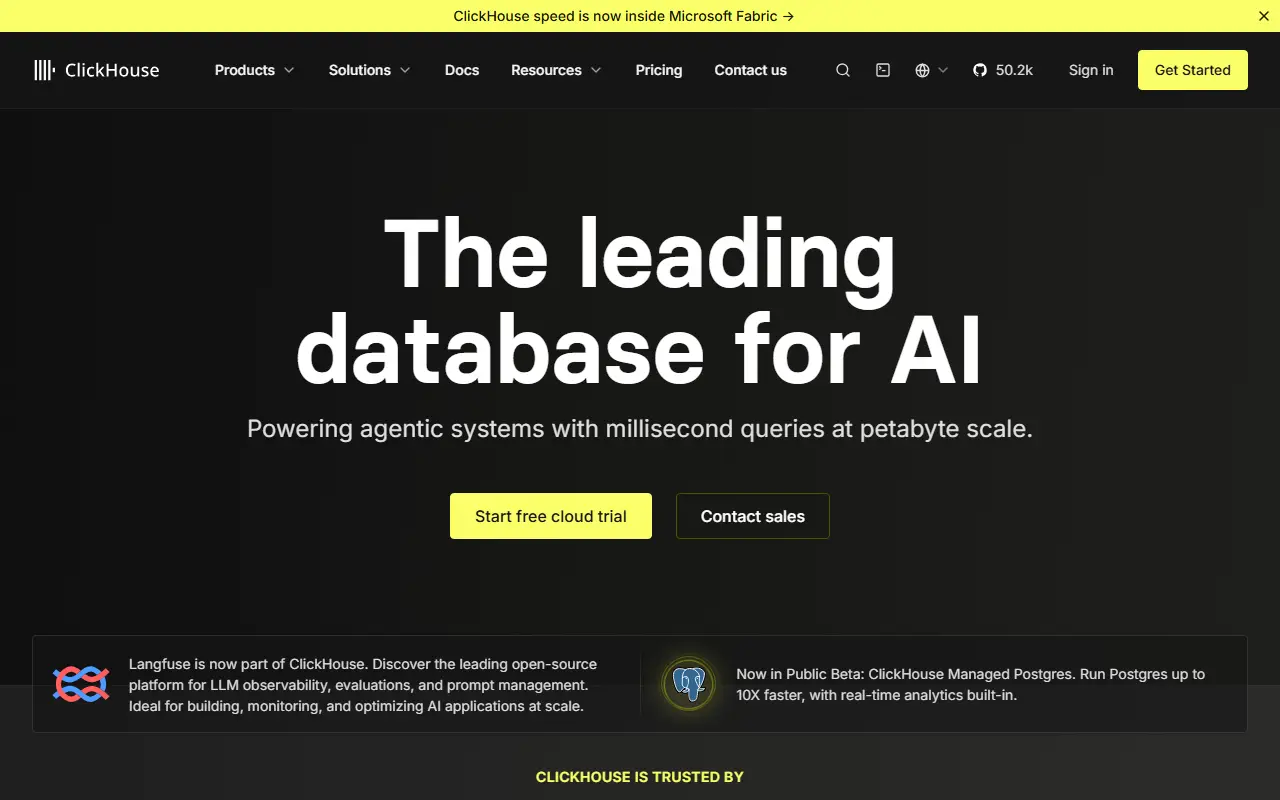
clickhouse.comClickHouse homepage screenshot

ClickHouse is an open-source database management system built to generate analytical reports in real time. Its column-oriented storage makes scans and aggregations over very large tables efficient, which is why it is widely used for event data, logs, metrics and product analytics. It is written in C++ and queried with SQL.

The project's topics describe it as an OLAP, massively parallel and distributed system, and it is used for big data workloads where query latency matters. You can install it on Linux, macOS or FreeBSD, follow a tutorial that sets up a small cluster, or skip installation by trying ClickHouse Cloud, a managed service built by its creators. Releases arrive monthly, with a community call for each one, and there are Slack and Telegram channels for help.

ClickHouse is Apache-2.0 licensed. It is a good fit for analytics engineers and platform teams who need fast aggregations over billions of rows and are comfortable operating a database, or who prefer to hand that operation to the vendor's cloud.

Key features

  • Column-oriented storage for analytics
  • SQL queries over large datasets
  • Distributed, massively parallel processing
  • Real-time analytical reporting
  • Install on Linux, macOS or FreeBSD
  • Managed ClickHouse Cloud option

Pricing: The open-source distribution is free. ClickHouse Cloud is usage-based, with plans from $53 (Basic), $437 (Scale) and $571 (Enterprise) per month and a 30-day trial with $300 in credits.

TiDB

An open-source, MySQL-compatible distributed SQL database with horizontal scaling, ACID transactions, Raft-based high availability and support for analytics and vector search.

GitHub stars
41k
Last commit
today
Latest release
v7.5.8
Licence
Apache-2.0
Self-hosted
Yes
Hosted version
Available
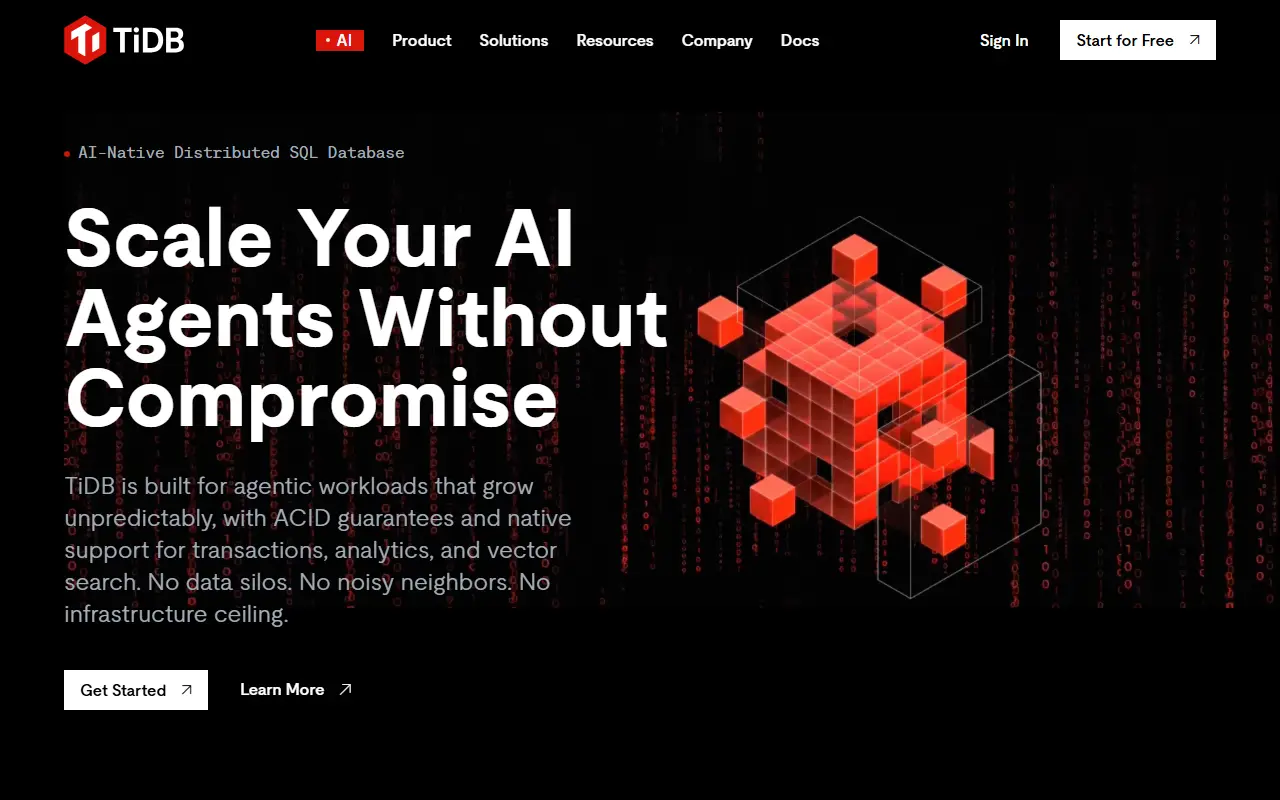
tidb.ioTiDB homepage screenshot

TiDB is a cloud-native, open-source distributed SQL database from PingCAP. The name's Ti stands for titanium, and it is built for high availability, strong consistency and the ability to scale out as data and traffic grow, while staying compatible with MySQL so existing applications and tools can connect with little change.

Distributed transactions use a two-phase commit protocol to keep ACID guarantees even across nodes, through network partitions or node failures. It scales horizontally by adding nodes or vertically by adding resources, without downtime, and its architecture separates compute from storage so each can be adjusted independently. Built-in Raft consensus keeps multiple replicas in sync and handles automated failover. Topics also mention HTAP workloads, analytics and native vector search.

TiDB is written in Go under the Apache-2.0 license. It can be deployed on your own infrastructure or consumed as a managed cloud service, and it suits teams that have outgrown a single MySQL server and want horizontal scale without sharding by hand.

Key features

  • MySQL-compatible distributed SQL
  • Distributed ACID transactions
  • Horizontal and vertical scaling without downtime
  • Separated compute and storage layers
  • Raft-based replication and automated failover
  • Analytics and vector search support

Pricing: TiDB Community is free and Cloud Starter has a monthly free quota. Cloud Premium starts from $1800 per month and Dedicated from $0.22 per hour; Self-Managed is priced on request.

Read more about TiDBWebsite GitHub

Apache Doris

Apache Doris is an open-source, MPP real-time analytics and hybrid search database for fast SQL, lakehouse query acceleration and vector and text search.

GitHub stars
16k
Last commit
today
Latest release
4.1.4.1
Licence
Apache-2.0
Self-hosted
Yes
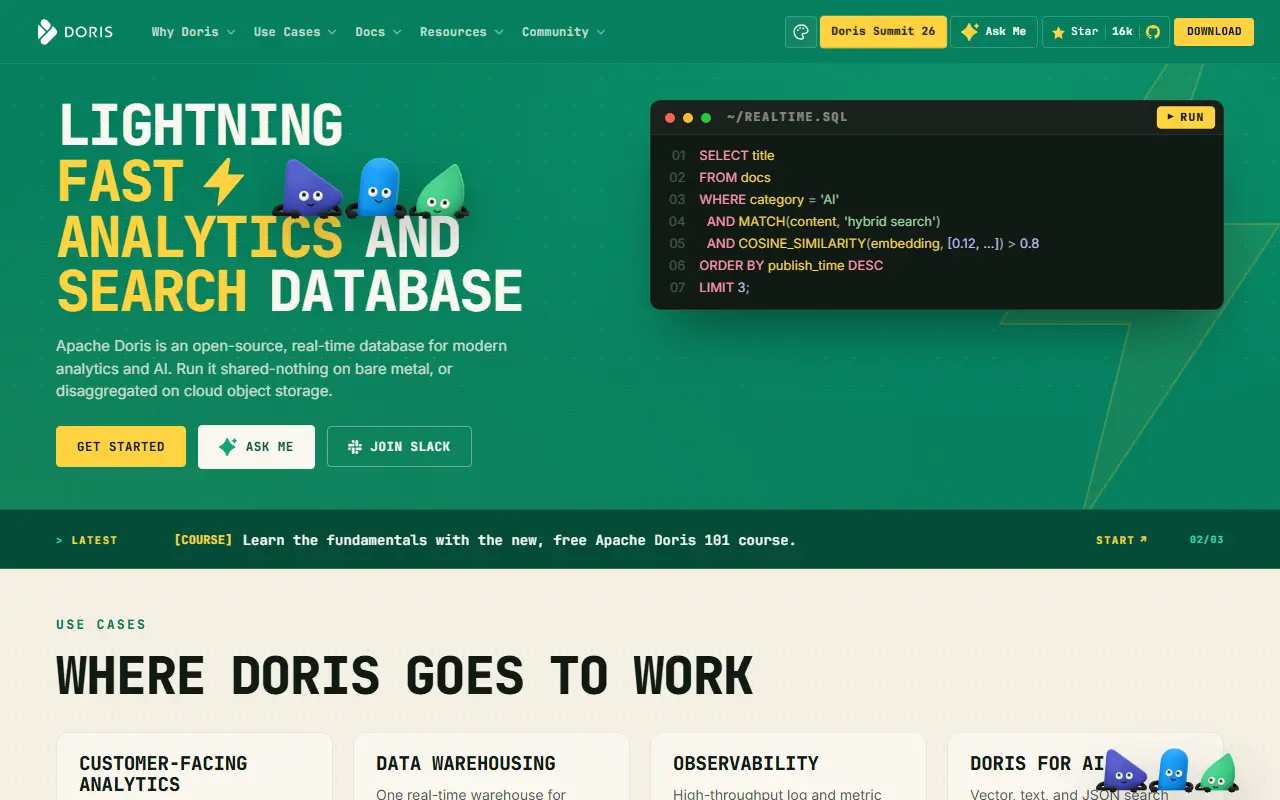
doris.apache.orgApache Doris homepage screenshot

Apache Doris is an open-source analytics database built on a massively parallel processing architecture. It offers fast SQL analytics, acceleration of queries over lakehouse data, and hybrid search spanning structured, text and vector data, and it presents itself as a real-time analytics and search engine suitable for AI agents. It is written in Java.

The README lists use cases that include customer-facing analytics with sub-second interactive queries for external users, data warehousing across business domains, observability for high-throughput logs, events and metrics analyzed with SQL, and AI use where vector, text, JSON and structured search run in one SQL engine. Topics mention lakehouse formats Hudi, Iceberg and Delta Lake and comparisons with warehouses such as BigQuery, Redshift and Snowflake.

Doris is a project of the Apache Software Foundation and Apache-2.0 licensed. You can deploy it on your own clusters, and the website provides release notes, use cases and user stories, with documentation in a large number of languages. It suits data engineering teams that want an open-source, high-concurrency analytical database.

Key features

  • MPP architecture for fast SQL analytics
  • Lakehouse query acceleration
  • Hybrid search across structured, text and vector data
  • Real-time ingestion and analysis
  • Support for Iceberg, Hudi and Delta Lake
  • Apache Software Foundation project

Pricing: Free and open source under the Apache-2.0 license.

StarRocks

A Linux Foundation project: an analytical SQL engine for real-time and ad-hoc queries, running on its own storage or directly over data lakehouse tables.

GitHub stars
12k
Last commit
today
Latest release
4.1.3
Licence
Apache-2.0
Self-hosted
Yes
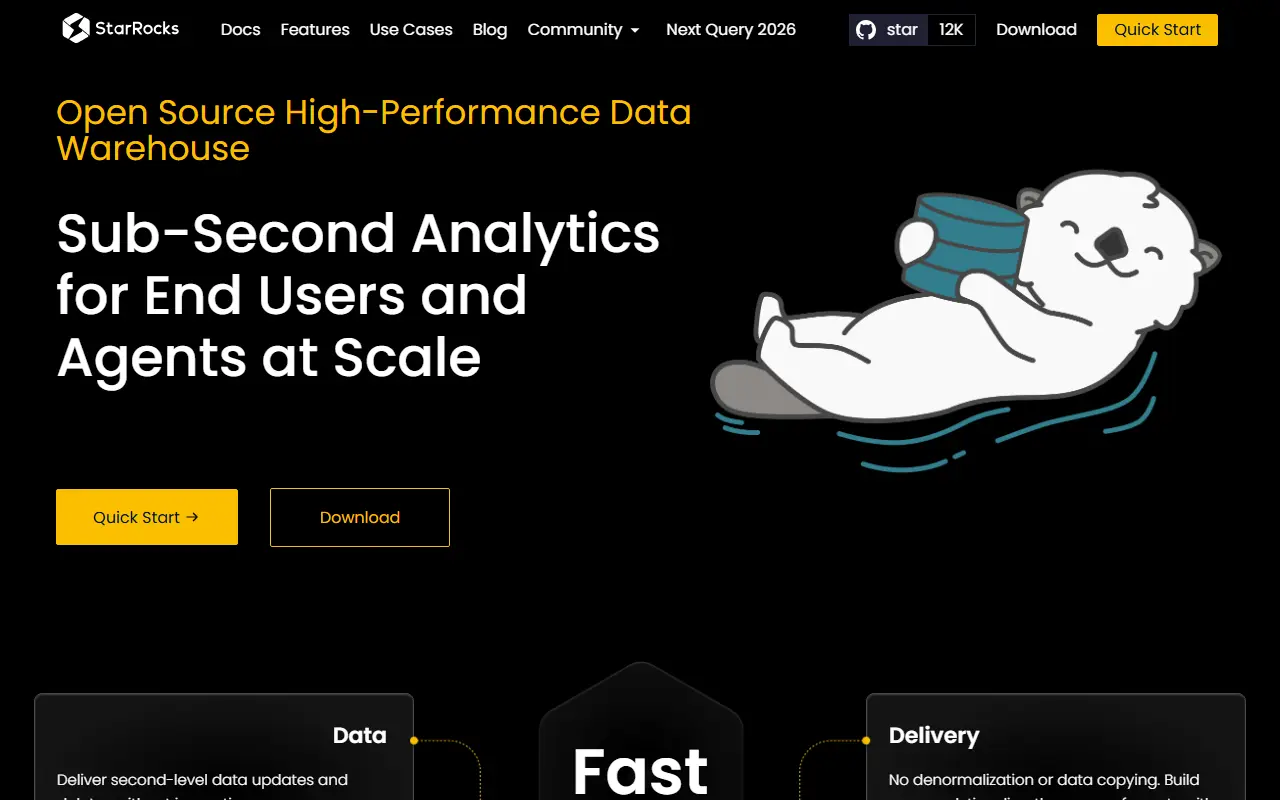
starrocks.ioStarRocks homepage screenshot

StarRocks is a query engine for analytics that returns answers quickly to multi-dimensional, real-time and ad-hoc queries. It is a Linux Foundation project written in Java, and can be used both on its own tables and over data that sits in a data lake or lakehouse without first moving it.

It uses a vectorized SQL engine that takes advantage of CPU parallelism, supports standard ANSI SQL and the MySQL protocol so existing clients and BI tools can connect, and applies a cost-based optimizer to complex queries. Primary-key tables support upserts and deletes with efficient querying during concurrent updates, and materialized views refresh during data import and are chosen automatically at query time.

Data in Hive, Iceberg, Delta Lake and Hudi tables can be queried in place, and its topics point to star-schema, MPP and distributed-database designs. The software is licensed under Apache-2.0 and can be downloaded and run yourself, with documentation, benchmarks and a demo linked from the README. It suits data teams that want fast dashboards and lakehouse analytics without heavy denormalization.

Key features

  • Vectorized SQL engine for fast analytics
  • ANSI SQL with MySQL protocol compatibility
  • Cost-based query optimizer
  • Real-time upserts and deletes by primary key
  • Automatically maintained materialized views
  • Direct queries over Hive, Iceberg, Delta Lake and Hudi

Pricing: Free and open source under the Apache-2.0 licence.

OceanBase

A distributed relational database developed by Ant Group, MySQL-compatible and built on Paxos, supporting transactional, analytical and vector workloads.

GitHub stars
10k
Last commit
2 days ago
Latest release
v4.4.2_CE_BP3
Licence
Apache-2.0
Self-hosted
Yes
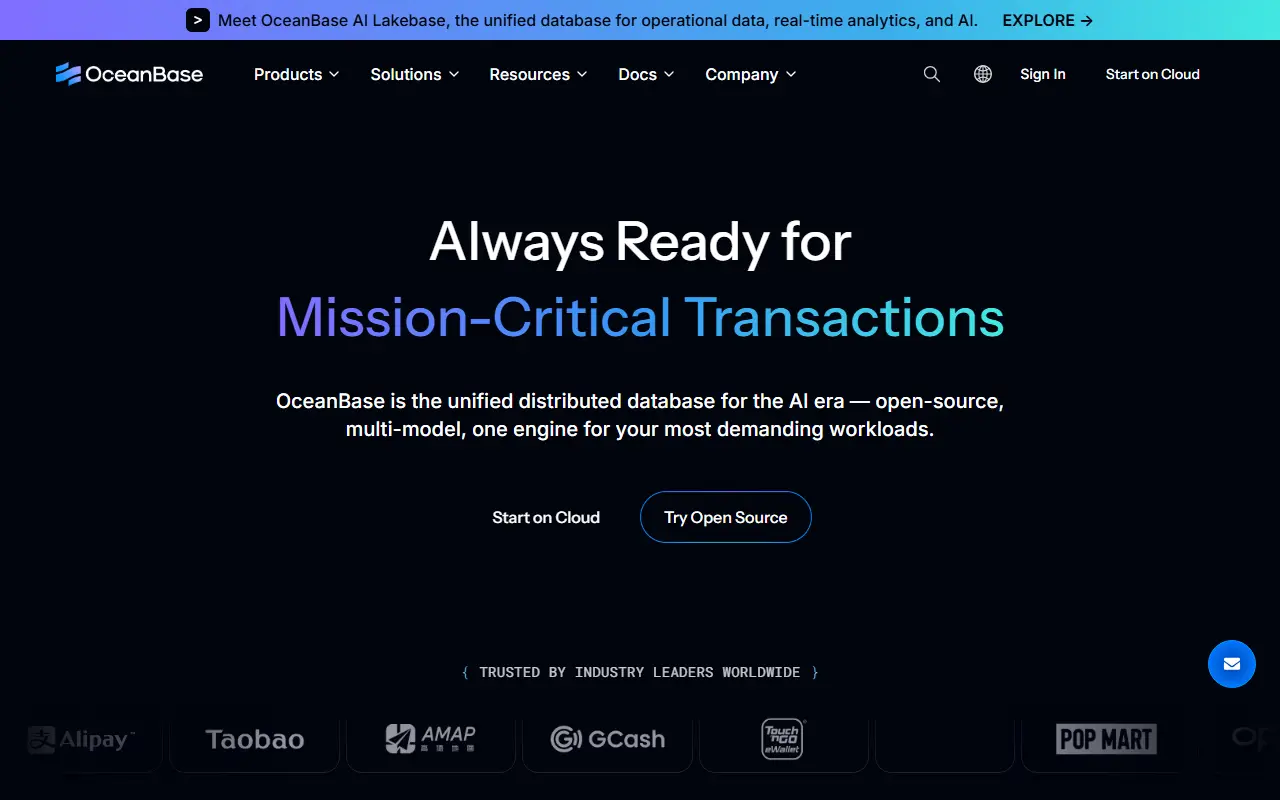
en.oceanbase.comOceanBase homepage screenshot

OceanBase is a distributed relational database developed by Ant Group. It runs on a cluster of commodity servers and uses the Paxos protocol and a distributed architecture to provide high availability and scalability, without depending on a specific hardware architecture.

It is compatible with MySQL, which eases migration from MySQL databases, and supports hybrid transactional and analytical processing, so one engine can serve both OLTP and OLAP workloads. The project now describes itself as a unified, multi-model database for the AI era, with topics that include vector search and full-text search. Cloud-native operation is supported through a Kubernetes operator.

You can try it by deploying a stand-alone instance with an all-in-one package on Linux, starting a Docker container from images on Docker Hub, quay.io or ghcr.io, or running it on Kubernetes with ob-operator. OceanBase is written in C++ and licensed under Apache-2.0, with a developer guide for compiling the observer yourself.

Key features

  • Distributed architecture on Paxos
  • Compatible with MySQL applications
  • Hybrid transactional and analytical processing
  • Vector and full-text search
  • Docker and Kubernetes deployment
  • All-in-one stand-alone installer

Pricing: Free and open source under the Apache-2.0 licence.

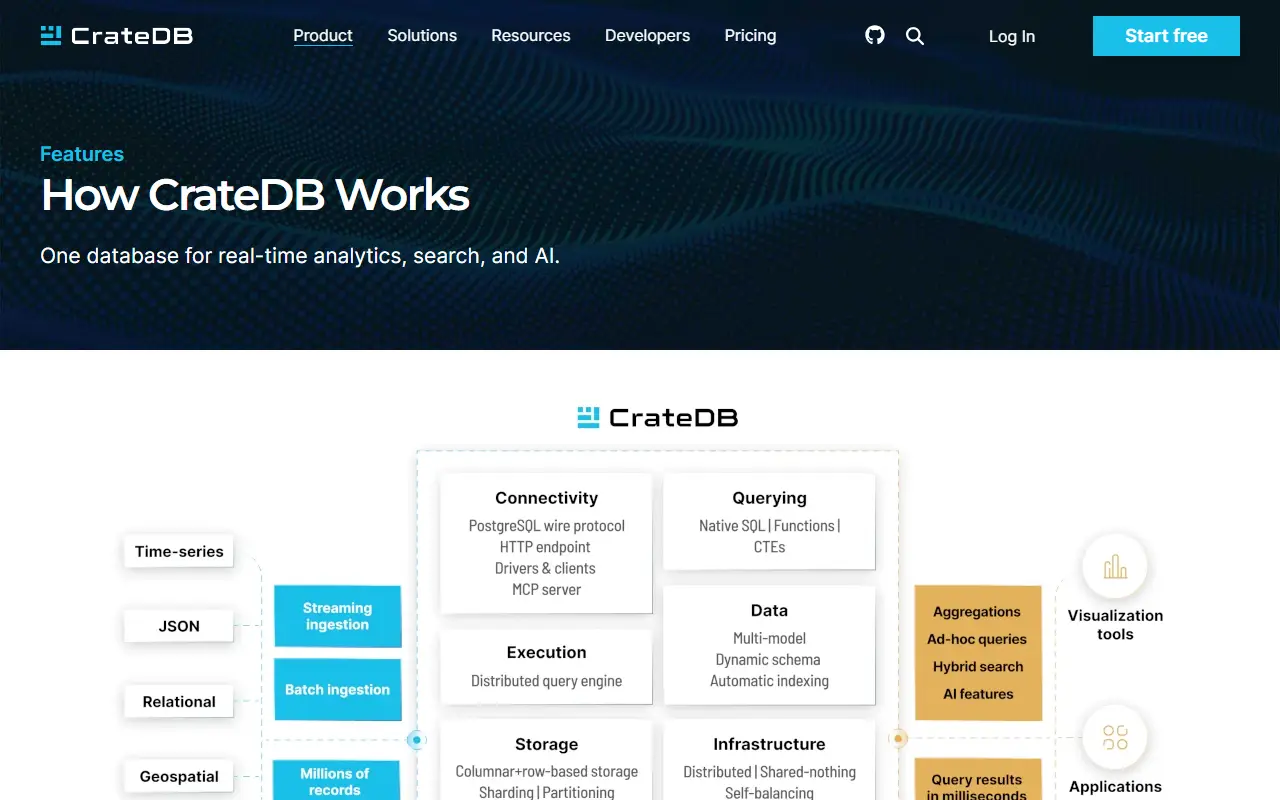
CrateDB

CrateDB is a distributed, PostgreSQL-compatible SQL database built on Lucene for real-time analytics over large volumes of time-series, JSON and vector data.

GitHub stars
4.4k
Last commit
today
Latest release
6.4.5
Licence
Apache-2.0
Self-hosted
Yes
Hosted version
Available
cratedb.comCrateDB homepage screenshot

CrateDB is a scalable, distributed SQL database for storing and analyzing very large volumes of data in near real time, including complex queries. It is compatible with PostgreSQL and based on Lucene, and the vendor describes answers in under a second across datasets of millions to billions of rows and many data types, without pre-aggregation.

The product handles many data models in one engine, including time series, document and JSON, vector, full-text, spatial and relational data. Its repository topics mention IoT, industrial IoT, OLAP, analytics and vector databases. The code is written in Java, and the vendor lists solutions for real-time industrial analytics, AI operations and application analytics across industries such as manufacturing and energy.

CrateDB is licensed under Apache-2.0 in its open-source edition. It is available as the OSS build you run yourself, as an enterprise edition and as the managed CrateDB Cloud, with pricing published on the vendor's site. It suits teams building analytics on high-volume machine and event data.

Key features

  • Distributed SQL engine
  • PostgreSQL wire compatibility
  • Time-series, JSON, vector and full-text data
  • Spatial and relational data models
  • Real-time analytics on large datasets
  • OSS, enterprise and cloud editions

Pricing: CrateDB Cloud has a free plan with 2 vCPUs. Shared clusters start at $0.073 per hour and dedicated clusters at $0.246 per hour including basic support; custom plans are quoted.

Read more about CrateDBWebsite GitHub

SingleStore alternatives: questions

What is the best open-source alternative to SingleStore?
ClickHouse is the top-ranked open-source alternative to SingleStore on Enlisted: An open-source column-oriented database management system built for real-time analytical reports, available to self-host or as the managed ClickHouse Cloud service. Other strong options are TiDB, Apache Doris, StarRocks and OceanBase.
Are these SingleStore alternatives free?
All 6 are open source, so the code is free to use under its licence, and all of them can be self-hosted on your own server or computer. 3 also offer a paid or managed cloud version if you'd rather not host it yourself.
How is this list of SingleStore alternatives ranked?
By a score built from GitHub stars, star growth over the last 30 days and how recently the code changed. 6 of these projects shipped code in the last 30 days. Data is refreshed daily, and nobody can pay to move up.

People also look for alternatives to…

View all